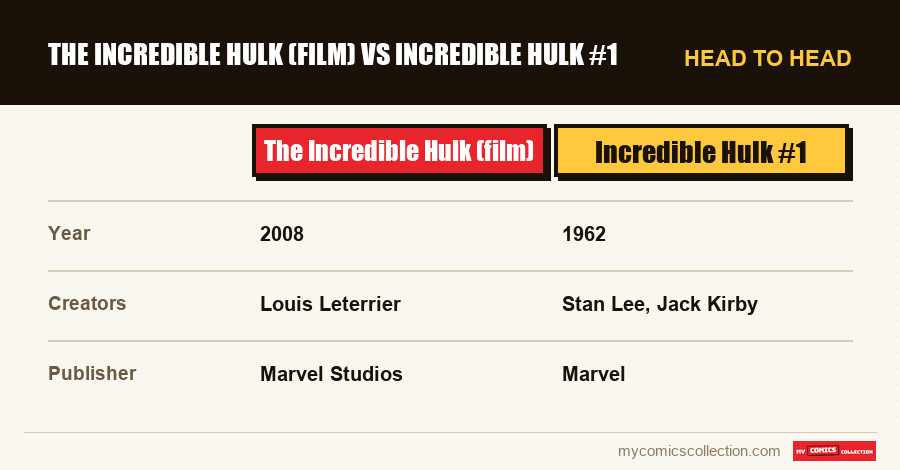
The Incredible Hulk (2008), directed by Louis Leterrier with Edward Norton, relies on the gamma origin posed in Incredible Hulk #1 (1962) by Stan Lee and Jack Kirby, while borrowing heavily from the television series of the 1970s and 80s. Its two antagonists come from the comics: the Abomination is born in Tales to Astonish #90 (1967) and the Leader in Tales to Astonish #62 (1964). The film retains the Banner/Betty Ross/General Ross trio, but rewrites the original accident and the exact nature of Blonsky. Here is the detailed comparison, film versus comics.
The second film in the Marvel universe, The Incredible Hulk is a case of dual-source adaptation: it draws from the founding comics of the 1960s, but also, and perhaps above all, from the television series which made the character popular with the general public. This mixture explains many choices, from the tone of the wandering fugitive to the winks scattered throughout the story.
As with each article in this series, the factual data (director, cast, dates, comic issues and creators) are verified, and only the comparative analysis is our editorial work. No dialogue is reproduced, no copyrighted images are used.
Title : The Incredible Hulk (2008)
Director: Louis Leterrier
Actors: Edward Norton (Bruce Banner), Liv Tyler (Betty Ross), Tim Roth (Emil Blonsky / Abomination), William Hurt (General Ross), Tim Blake Nelson (Samuel Sterns)
Exit : June 13, 2008 (United States)
Studio: Marvel Studios: second film in the Marvel Cinematic Universe
Incredible Hulk #1 (1962): origin of the Hulk (Stan Lee & Jack Kirby)
Tales to Astonish #90 (1967): 1st appearance of the Abomination (Lee & Gil Kane)
Tales to Astonish #62 (1964): 1st appearance of the Leader (Lee & Steve Ditko)
TV series “The Incredible Hulk”(1977-1982): major influence on tone
- L'gamma origin: a scientist exposed to gamma rays transforms into a colossus when anger overwhelms him.
- The founding trio: Bruce Banner , Betty Ross and the General “Thunderbolt” Ross, who tirelessly hunts down the Hulk.
- L'Abomination, a more powerful and uncontrollable gamma monster, a dark mirror of the Hulk.
- Le Leader (Samuel Sterns), whose film prepares the brain mutation at the end of the story.
- The theme of fugitive hunted, torn between man and monster.
- The original accident: the comic ties the exposition to the rescue of Rick Jones during a gamma bomb test; the film links it to a super-soldier program, absent from the 1962 story.
- Rick Jones, present at the birth of the Hulk in the comics, disappears from the film.
- Emil Blonsky: Soviet spy voluntarily exposing himself to gamma in the comic, here he becomes a soldier doped with a super-soldier serum combined with gamma.
- The tone borrows largely from the TV series (wandering hero, solitude, melancholy music) rather than from the fury of the comics.
- The Hulk is entirely in computer-generated images, an aesthetic choice far removed from Kirby's line.
A film straddling the line between the comic and the TV series
To understand The Incredible Hulk, you must keep in mind that the character has had two popular lives: that of the comics by Stan Lee and Jack Kirby, and that of the television series broadcast at the end of the 1970s, worn by Bill Bixby and Lou Ferrigno. The 2008 film assumes this dual heritage. We find there the solitude of the fugitive who travels the world, the melancholy and the idea of the internal burden, all elements which owe more to television than to the original pages. Several discreet nods seal this debt, from the presence of figures linked to the series to nostalgic musical motifs.
This positioning clearly distinguishes the Iron Man film released a few weeks earlier: where Iron Man assumed a solar and technological tone, Hulk aims for intimate drama and stalking. The contrast clearly shows that Marvel Studios, from the beginning, adapted each character according to their own tone rather than sticking to a single formula.
Incredible Hulk #1 (1962): The Gamma Matrix
Everything starts from Incredible Hulk #1 (May 1962), signed Stan Lee and Jack Kirby. This issue introduces in the same gesture Bruce Banner, the monster who inhabits him, Betty Ross and her father General Thaddeus Ross. The founding principle, a scientist exposed to gamma rays who transforms under the influence of strong emotions, is taken up in full by the film. Note, as for many characters of the time, an amusing graphic evolution: in its very first pages, the Hulk of the comic is gray before becoming green, a detail that the adaptations naturally left aside.
Where the film deviates from the source is in the circumstances of the accident. The 1962 comic makes Banner the victim of a gamma bomb explosion while trying to save a teenager, Rick Jones. The film evacuates this character and connects the exposition to a military super-soldier program, which modernizes the origin and connects it thematically to the rest of the emerging saga.
Tales to Astonish #90 (1967): the birth of the Abomination
The film's great adversary, the Abomination, first appears in Tales to Astonish #90 (April 1967), with a script by Stan Lee and drawings by Gil Kane. Emil Blonsky is a gamma colossus even more massive and brutal than the Hulk, but deprived of the part of humanity that remains in Banner. The film retains this main idea (a distorting mirror of the hero, power without doubt) but reinvents the trajectory of the character: instead of the Soviet spy from the comic who voluntarily exposes himself to a gamma dose, the film makes him a career soldier whose obsession with power pushes him to accept increasingly dangerous experiments.
Collecting this series?
Track what you own, what you are missing and what your collection is worth. 7 day trial.
Start my trial →Tales to Astonish #62 (1964): the Leader in ambush
The film also sows a seed for the future with Samuel Sterns, played on screen by Tim Blake Nelson. In the comics, Sterns becomes the Leader, one of the Hulk's most devious enemies, appearing as early as Tales to Astonish #62 (December 1964) under the pen of Stan Lee and the pencil of Steve Ditko. A genius with a deformed skull after gamma exposure, he embodies intelligence in the face of brute force. The film only prepares for his transformation, but it clearly lays the groundwork for the character for future stories.
The characters, from paper to screen
- Bruce Banner: The man/monster double is faithfully preserved, but the film emphasizes the quest for a cure and self-control, themes inherited from the TV series.
- Betty Ross: Banner's long-time love interest in the comics, she keeps this central role, the emotional anchor of the story.
- General “Thunderbolt” Ross: The soldier obsessed with capturing the Hulk is reproduced almost identically, including his ambivalence as a father.
- Emil Blonsky / Abomination: Same function (the anti-Hulk), origin rewritten to fit the logic of the film.
- Samuel Sterns: Simple introduction to the future Leader, a typical example of how the saga plants its tracks in advance.
The TV series, the hidden DNA of the film
It's impossible to understand the tone of the film without returning to the series broadcast on CBS between 1977 and 1982, with Bill Bixby in the role of the doctor (renamed David Banner for television) and bodybuilder Lou Ferrigno as the Hulk. Each episode followed an immutable outline: Banner, a fugitive hunted by a tenacious journalist, arrived in a new city, became attached to strangers there, then set off alone on the roads, his complaint on the piano, the famous theme “The Lonely Man” by Joe Harnell, accompanying his wandering. It is precisely this melancholy of the wanderer that the 2008 film appropriates, much more than the cosmic fury of the comics. The feature film also multiplies discreet homages to this cult series, notably through the presence of Lou Ferrigno himself, associated with the character for decades.
This choice makes strategic sense: in 2008, a large part of the general public knew Hulk through television rather than through comics. Relying on this collective memory allowed the film to speak to everyone, even if it meant moving away from the original material. It's a rare case of an adaptation that draws as much from another adaptation as it does from the comic itself.
A digital Hulk and a quest for a cure
On a visual level, the film assumes a Hulk entirely in computer graphics, more agile and less massive than Kirby's colossus, captured by performance techniques. This approach follows the 2003 Hulk directed by Ang Lee, whose contemplative tone was divisive: the 2008 film aims to be more nervous, closer to an action and monster film. The narrative also foregrounds the quest for a cure-the idea that Banner is seeking to rid himself of his curse rather than embrace it. This narrative thread, once again, owes more to the tragic logic of the TV series than to the mythology of the comics, where the Hulk is a character in his own right, with his own arcs, and not just an affliction to be cured.
Chronology of comics to know
- 1962: Incredible Hulk #1: origin of Banner, Betty and General Ross.
- 1964: Tales to Astonish #62: first appearance of the Leader (Samuel Sterns).
- 1967: Tales to Astonish #90: first appearance of the Abomination (Emil Blonsky).
- 1977-1982: television series, the basis of the melancholy tone of the film.
Where to start reading
To extend the film into comics, a simple path emerges. We can start with the origin in Incredible Hulk #1 (1962), to measure the gap between the matrix and its adaptation. Then comes the discovery of the great enemies via their first appearances, Tales to Astonish #62 (the Leader) and #90 (the Abomination), which shed light on the issues of the film. Finally, modern runs of the character, notably those that explored Banner's psychology and his multiple personalities, offer a richer read than the original story, and show why the Hulk remains one of Marvel's most complex characters. A little curiosity to finish: Edward Norton, who played Banner in 2008, then handed over the role to Mark Ruffalo from Avengers, which makes this film a slightly different milestone in the continuity of the saga.
Collection side: what numbers to aim for after the film
The Hulk fields some of the most coveted key numbers of the Silver Age. Incredible Hulk #1 is a peak of the Silver Age, rare and expensive in the high ranks: it is the absolute holy grail of the character. More affordable but highly sought after, Tales to Astonish #90 (first Abomination) and Tales to Astonish #62 (First Leader) offer an excellent thematic entry point for anyone who wants to own the first appearances of the film's villains. As always, condition, edition, and grading mark make grades vary greatly; it is better to rely on real recent sales before positioning yourself.
The verdict: a double-reading adaptation
- Loyalty: strong on the Banner / Betty / Ross trio and on the function of the Abomination.
- Freedoms: the original accident rewritten, the disappearance of Rick Jones and a tone inherited from television more than comics.
- Collectible numbers: Incredible Hulk #1 (the grail), Tales to Astonish #90 and #62 for the first appearances of the villains.
By playing on two tables, the mythology of the comics and the nostalgia of the series, The Incredible Hulk offers an adaptation that is less spectacular than dramatic. She reminds us that the character has always been as much a tragedy as a monster movie, and that his most memorable enemies, the Abomination and the Leader, are already lurking in the pages of the 1960s.
Frequently asked questions
From the origin laid in Incredible Hulk #1 (1962) by Stan Lee and Jack Kirby, supplemented by the first appearances of the Abomination (Tales to Astonish #90, 1967) and the Leader (Tales to Astonish #62, 1964). The television series from the 1970s and 80s strongly influenced the tone.
Emil Blonsky, appeared in Tales to Astonish #90 (1967). It is a gamma colossus more powerful than the Hulk but devoid of its humanity. In the comic, he's a Soviet spy; the film makes him a soldier doped with a super-soldier serum.
The origin: the comic links the gamma exposure to the rescue of Rick Jones during a bomb test, while the film links it to a super-soldier program and removes Rick Jones.
He is the future Leader, historical enemy of the Hulk who appeared in Tales to Astonish #62 (1964). The film prepares for his brain mutation without showing it fully.
Incredible Hulk #1 (1962) is the grail, but highly rated. Tales to Astonish #90 and #62 are more accessible key debuts, ideal for starting a thematic collection around the film.
Does the film make you want to collect the Hulk? Estimate the value for free of your issues (Incredible Hulk #1, Tales to Astonish…) with our tool based on current eBay listings.