Hulk (2003) Ang Lee , with Eric Bana, adapts the green giant born in The Incredible Hulk #1 (1962) by Stan Lee and Jack Kirby. The film takes up Bruce Banner, a scientist transformed into a monster by gamma rays, and his tragic duality, but adds a largely original family drama around his father. A unique authorial approach, he divides with his introspective tone. Here is the detailed comparison, film versus comics.
An authorial adaptation of Marvel's most tragic monster, Ang Lee's Hulk explores the anger and duality of Bruce Banner. It draws on the founding stories of Lee and Kirby. Source-by-source decryption.
As in each article in this series, only verified information (creators, distribution, dates, comic numbers) is stated; the comparative analysis is ours, without reproducing dialogue or protected images.
Title : Hulk (2003)
Director: Ang Lee
Actors: Eric Bana (Bruce Banner), Jennifer Connelly (Betty Ross), Nick Nolte (David Banner), Sam Elliott (General Ross)
Exit : June 2003
Studio: Universal Pictures
The Incredible Hulk #1 (1962): 1st appearance (Lee & Kirby)
Gamma rays: the origin of the transformation
Betty and General Ross: Banner's entourage
The Banner/Hulk duality: the man and the monster
- Bruce Banner, scientist transformed by gamma rays.
- La anger which triggers the transformation into Hulk.
- La tragic duality between man and monster.
- Betty Ross and his father, General Ross.
- La military tracking of the green giant.
- Le family drama around the father is largely invented.
- The origin mixes genetic manipulation and gamma rays.
- The tone is introspective and psychoanalytic.
- The antagonist (David Banner) is an original amalgam.
- The aesthetic adopts a box assembly of comics.
The Incredible Hulk #1 (1962): the birth of the green giant
Hulk appears in The Incredible Hulk #1 (1962), created by Stan Lee and Jack Kirby. Bruce Banner, a brilliant nuclear physicist, is irradiated by gamma rays from a bomb he designed while saving a careless teenager. From then on, under the influence of anger or stress, he transforms into the Hulk, a colossus of immeasurable strength, the incarnation of his repressed rage. Inspired by Frankenstein and Doctor Jekyll and Mr. Hyde, the character embodies the duality between intellect and beast, between civilized man and primitive fury. Hunted by the army, misunderstood, Hulk is one of Marvel's most tragic characters, a monster in spite of himself in search of peace.
The film takes up the essence of the character: Bruce Banner, gamma rays, the transformation triggered by anger, tragic duality, military tracking, Betty Ross and her father the general. Eric Bana plays an introverted and tormented Banner. The film draws on the mythology of the character while bringing a very personal authorial vision. The main freedom lies in the origin and the story: the film adds a largely invented family drama around Bruce's father, David Banner, and mixes genetic manipulation and gamma rays. This ambitious psychoanalytic rereading moves away from the simplicity of the original story while exploring the character's themes in depth.
Family drama, invention of film
The film's great freedom is to add a complex family drama around Bruce's father, David Banner. In the film, the latter is a scientist whose genetic experiments altered his son's DNA, predisposing Bruce to his transformation. This traumatic, repressed past explains the character's deep anger and his metamorphosis into the Hulk. This plot, largely invented, seeks to give a psychoanalytic dimension to the story, by making the Hulk the expression of a childhood trauma. David Banner becomes the film's antagonist, an amalgamation of several figures, culminating in a final confrontation between father and son.
This bias illustrates Ang Lee's authorial approach, which approaches Hulk less as a superhero film than as a family tragedy about anger, repression and legacy. This reading, deep and ambitious, moves away from the comics, where the origin of the Hulk is more direct and where the paternal drama does not occupy this central place. However, she enriches the character with a psychological dimension, by exploring the roots of his rage. For the reader, this family drama is an invention of the film; The Hulk of the comics draws his strength from the simplicity of his founding myth, a man and the monster who inhabits him, rather than from an elaborate Freudian past.
A unique author's approach
Hulk is radically distinguished from other superhero films by the vision of its director. Ang Lee, a filmmaker known for his intimate dramas, approaches the character with rare seriousness and ambition, favoring psychological introspection over pure action. The film explores anger, repression, the duality of being, in a meditative register far from classic entertainment. This approach is also reflected in the aesthetic: the film adopts a montage reminiscent of the panels of a comic book, with divided screens and transitions reminiscent of the layout of a comic book. This formal audacity demonstrates a concern for fidelity to the original medium, from an unexpected angle.
This authorial bias has deeply divided. Hailed by some for its ambition and depth, the film disappointed part of the public expecting a more conventional action blockbuster. This divisive reception illustrates the difficulty of approaching a popular character from such a personal angle. The film nevertheless remains a singular and respectable attempt to treat Hulk as a tragic and complex character, at the height of his mythological dimension. For the reader, it is an invitation to rediscover the psychological richness of the character in the comics, where the Banner/Hulk duality has nourished stories of a depth that the film, in its way, seeks to honor.
Collecting this series?
Track what you own, what you are missing and what your collection is worth. 7 day trial.
Start my trial →The characters, from paper to screen
- Bruce Banner / Hulk: Scientist transformed by gamma rays, faithful to Incredible Hulk #1, in an introspective reading.
- Betty Ross: Bruce's love interest, true to his role in the comics.
- General Ross: Betty's father, Hulk's military tracker, true to character.
- David Banner: Father of Bruce, amalgam antagonist invented for the film.
- Hulk: The rage monster, the embodiment of Banner's pent-up anger.
Anger and duality, the heart of the character
What defines Hulk, in the comics and in the film, is the duality between Bruce Banner and the monster. Banner, a rational and controlled man, suppresses his anger; Hulk is the uncontrollable explosion, the release of long-contained rage. This tension between the intellect and the beast, between repression and unleashing, has been at the heart of the character since its creation. The film explores this duality with particular depth, making Hulk's anger an expression of trauma and inner suffering. This psychological reading, if it takes liberties, captures an essential truth of the character.
This theme of anger and loss of control gives Hulk a universal resonance. Who has never felt this inner rage, this dark side that we try to contain? The character embodies this struggle, making him much more than a simple monster of destruction: a symbol of the difficulty in controlling his most violent emotions. Ang Lee's film, by treating this dimension seriously, honors the depth of the character. For the reader, Hulk is an invitation to discover the great stories of the green giant in the comics, where his duality and his quest for peace have inspired stories of unparalleled psychological richness.
The Contrasting Legacy of Ang Lee's Hulk
Ang Lee's Hulk occupies a unique place in the history of Marvel adaptations. Reevaluated over the years, it is today recognized as a bold and sincere attempt to treat the character with ambition, even if its authorial tone was disorienting upon its release. Its relative commercial failure led to a quick reboot of the character in cinema, with a more action-oriented approach. This contrast between the two visions of the green giant illustrates the difficulties of adapting such a rich character, torn between the spectacular blockbuster and the psychological drama.
This contrasting reception does not detract from the interest of the approach. By daring to explore the tragic and psychoanalytic dimension of the Hulk, the film reminded us that the character is much more than a machine to destroy: he embodies the universal struggle against anger and inner demons. For the reader, this approach is an invitation to discover the great stories of the green giant in the comics, where his duality and his quest for peace have inspired stories of remarkable depth. Ang Lee's Hulk, despite his divisive biases, will have left his mark with his ambition and his refusal to take the easy route, testifying to the richness of a character that cinema continues to reinvent.
Where to start reading
To extend the film, The Incredible Hulk #1 (1962) features the green giant's first appearance and his origin. The Hulk's major runs, notably that of Peter David in the 1980s and 1990s, explore the psyche of the character and his multiple facets. “Planet Hulk” (2006) offers an epic adventure. This journey covers the source material for a film that explores Banner's duality in depth.
Chronology of comics to know
- 1962: The Incredible Hulk #1: the first appearance of the green giant.
- 1980s-1990s: Peter David's run explores the psyche of Banner/Hulk.
- 2006: “Planet Hulk”: an epic adventure of the character.
Collection side: what numbers to aim for after the film
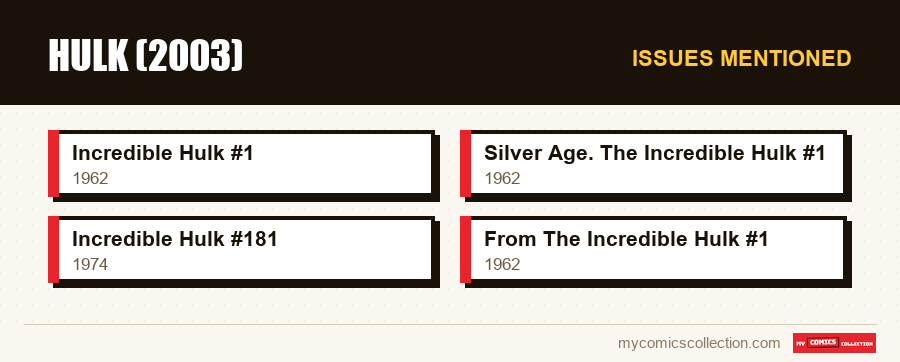
Hulk points to major keys to the Silver Age. The Incredible Hulk #1 (1962, first appearance of the green giant) is one of the most sought after and valuable keys in history, an absolute mainstay. The Incredible Hulk #181 (1974, premiere of Wolverine, which takes on the Hulk) is another major key. Big runs like Peter David's offer more accessible targets. These numbers cover a wide variety of budgets. As always, condition and gradation determine value; relying on real recent sales is strongly recommended.
Its place in the saga and for the collector
Ang Lee's Hulk brought the green giant to the screen from a unique author's perspective, exploring his tragic duality. For the collector, it revived interest in The Incredible Hulk #1, a major key to the Silver Age. It illustrates the effect of adaptations on the market. Beyond speculation, the film invites us to discover the founding stories of Lee and Kirby, where Hulk embodies the struggle between man and monster. By treating the character with ambition and depth, he recalls the psychological richness of one of Marvel's most tragic creations, well beyond the simple spectacle of destruction.
The verdict: a divisive author tragedy
- Loyalty: Bruce Banner, gamma rays, anger, the Banner/Hulk duality and the entourage (Betty, Ross) come from the comics.
- Freedoms: the invented paternal family drama, the genetic manipulation, the introspective tone, David Banner amalgamates, the boxed aesthetic.
- Collectible numbers: The Incredible Hulk #1 (Hulk), The Incredible Hulk #181 (Wolverine vs. Hulk).
Ang Lee's Hulk explores the duality and anger of Bruce Banner with rare authorial ambition, adding largely invented family drama. Faithful to the tragic essence of the character but adopting an introspective tone that divided, the film dares to take a unique approach. For both the reader and the collector, it is an invitation to discover The Incredible Hulk #1.
Frequently asked questions
From The Incredible Hulk #1 (1962), created by Stan Lee and Jack Kirby. Bruce Banner, a physicist irradiated by gamma rays, transforms into the Hulk under the influence of anger. The film faithfully reproduces this origin and the duality of the character.
Largely no: the film adds drama around Bruce's father, David Banner, whose genetic experiments allegedly predisposed his son. This psychoanalytic framework is an invention of Ang Lee, absent from the original story.
For his introspective and psychoanalytic authorial approach, far removed from the expected action blockbuster. Ang Lee treats Hulk as a family tragedy, with a comic book aesthetic. An ambition welcomed by some, disappointing for others.
Anger and stress, true to the comics: when Bruce Banner loses control of his emotions, he transforms into the Hulk, the incarnation of his repressed rage. This duality between man and monster is at the heart of the character.
The Incredible Hulk #1 (1962, first appearance of the green giant) is a very valuable Silver Age mainstay. The Incredible Hulk #181 (1974, Wolverine premiere) is another major key.
Does the film make you want to collect? Estimate the value for free of your issues (The Incredible Hulk #1…) with our tool based on current eBay listings.