
She-Hulk: lawyer (2022), created by Jessica Gao with Tatiana Maslany, adapts Jennifer Walters, the lawyer who became She-Hulk after a blood transfusion from her cousin Bruce Banner: an origin posed in Savage She-Hulk #1 (1980). The series is mainly inspired by the comic run of Dan Slott (2004) and the famous breaking the fourth wall introduced by John Byrne (1989). Here is the detailed comparison, series versus comics.
A legal comedy with a superheroic twist, She-Hulk takes on a light and meta tone rare in the Marvel universe. The series taps into the character's most inventive runs. Source-by-source decryption.
As in each article in this series, only verified information (creators, distribution, dates, comic numbers) is stated; the comparative analysis is ours, without reproducing dialogue or protected images.
Title : She-Hulk: Lawyer (2022)
Creator: Jessica Gao
Actors: Tatiana Maslany (Jennifer Walters / She-Hulk), Mark Ruffalo (Bruce Banner), Tim Roth (Abomination), Charlie Cox (Daredevil)
Broadcast: August-October 2022, Disney+ (9 episodes)
Studio: Marvel Studios
Savage She-Hulk #1 (1980): 1st appearance (Lee & Buscema)
“Sensational She-Hulk”(1989): John Byrne, The Fourth Wall
“She-Hulk”(2004): Dan Slott, the superheroic lawyer
Bruce Banner's transfusion: the gamma origin
- The gamma origin: Jennifer becomes She-Hulk after a blood transfusion from Bruce.
- The profession of lawyer, specializing in super-human law (run Slott).
- Le breaking the fourth wall, signature of Byrne's She-Hulk.
- Sa self-control: Unlike Bruce, Jen keeps her wits about her.
- Le your comical and uninhibited tone of the character.
- The plot is specific to the series (office, trial, sentimental life).
- Abomination is reinstated as Jen's client, an unprecedented connection.
- The 4th wall is pushed so far as to comment on the production of the series itself.
- Jen's control on its transformation is immediate, without a “wild” phase.
- Of the cameos (Daredevil, Wong…) weave links with the saga.
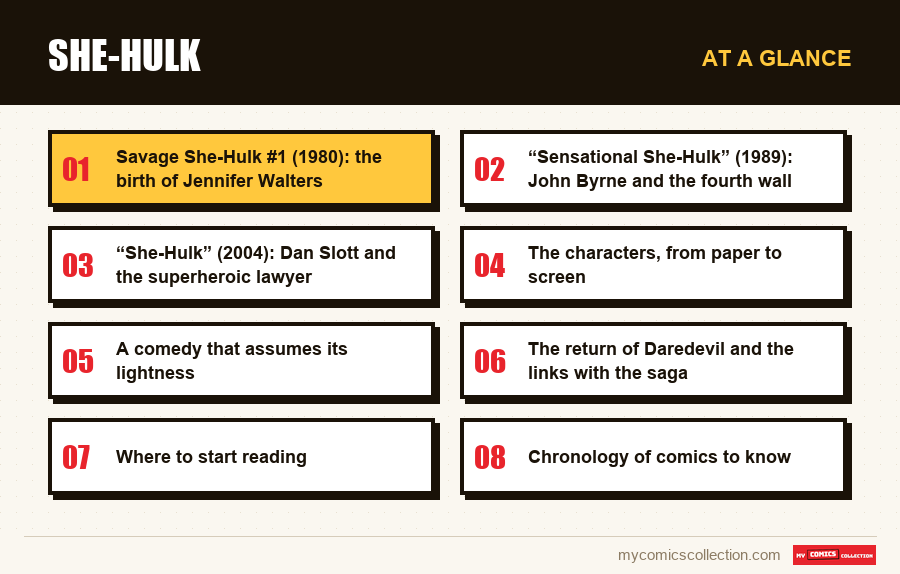
Savage She-Hulk #1 (1980): the birth of Jennifer Walters
Jennifer Walters, aka She-Hulk, appears in Savage She-Hulk #1 (1980), created by Stan Lee and John Buscema. Her origin is directly linked to that of the Hulk: a lawyer, cousin of Bruce Banner, she is seriously injured during an assassination attempt, and only a transfusion of Bruce's blood can save her. This gamma-irradiated blood transforms her into She-Hulk. The series faithfully takes up this origin (the transfusion, the family bond with Bruce, the gamma nature of the powers) while modernizing its presentation. One key difference with the Hulk is worth noting: Jennifer, unlike her cousin, generally retains her intelligence and personality in her green form. She is not torn by a destructive duality; She-Hulk is, for her, a more confident and freer version of herself. The series makes this mastery the heart of its purpose.
This contrast with the Hulk, present since 1980, is fundamental: where Bruce suffers his curse, Jen tames and sometimes savors his transformation. The series makes it a subject of comedy but also of reflection on identity and the way others see it.
“Sensational She-Hulk” (1989): John Byrne and the fourth wall
The most recognizable signature of the series, She-Hulk who speaks directly to the viewer, comes from John Byrne. In “The Sensational She-Hulk” (1989), Byrne makes Jennifer a character conscious of being in a comic book: she breaks the fourth wall, comments on the panels, addresses the reader, mocks the conventions of the genre. This satirical approach, rare and daring for the time, defined the tone of the character. The series faithfully takes up this process, adapting it to the television format: Jen comments on her own series, speaks to the camera, and goes so far as to question the very production of the episode in a daring metanarrative finale. This breaking of the fourth wall, inherited from Byrne, distinguishes She-Hulk from the other heroes of the saga and fully assumes the comic dimension of the character.
“She-Hulk” (2004): Dan Slott and the superheroic lawyer
The setting of the series (Jennifer, a lawyer specializing in the law of super-humans) comes directly from Dan Slott's run (2004), the main inspiration for the adaptation. Slott had reinvented She-Hulk as a lawyer in a firm managing the legal affairs of the world of superheroes: trials of villains, disputes over superpowers, absurd questions born from the coexistence between humans and extraordinary beings. This blend of legal comedy and superheroes, unique in comics, is the heart of the series, which takes up its tone and concept. The series faithfully adapts this idea of a heroine juggling her career as a lawyer and her powers, with the humor and lightness that characterized Slott's run.
The characters, from paper to screen
- Jennifer Walters / She-Hulk: True to Savage She-Hulk #1: transformed lawyer, master of herself.
- Bruce Banner / Hulk: Cousin of Jen, at the origin of her transformation.
- Abomination: Reinstated as Jen's client, a unique link to continuity.
- Daredevil: Cameo weaving a link with the street-level side of the saga.
- Wong: Another cameo, extending the mystical universe.
Collecting this series?
Track what you own, what you are missing and what your collection is worth. 7 day trial.
Start my trial →A comedy that assumes its lightness
She-Hulk is clearly distinguished from the rest of the saga by its resolutely comic tone and its legal sitcom format. This bias, faithful to the runs of Byrne and Slott, assumes the lightness of the character where other heroes carry dramatic issues. The series adds an explicit feminist dimension, making the view of a powerful woman (the expectations, the harassment, the double standards) a central subject. This approach, which extends themes present in the character's modern comics, gives the comedy a deeper scope than it seems. Beneath its light exterior, the series questions the place of women and the price of visibility, making Jen a heroine of assumed modernity.
This mixture of humor, meta and social purpose is faithful to the spirit of a heroine who, since Byrne, has always served to comment with irony on the superheroic genre itself. By fully assuming this singularity, the series offers a welcome variation in a universe often dominated by serious issues. She reminds us that Marvel also knows how to laugh at its own codes, a tradition of which She-Hulk has been, since the comics, the ideal spokesperson.
The return of Daredevil and the links with the saga
The series weaves several links with the rest of the universe, the most notable of which is the return of Daredevil, played by Charlie Cox. The man without fear appears in an unusually light register, far from the darkness of his own stories, during a flirtation and a collaboration with Jennifer. This offbeat tone, applied to a usually dark character, illustrates the freedom that She-Hulk grants herself: she can allow herself to make fun of the codes of the saga, including its most serious figures. This crossover between the comic universe of Jen and the street-level world of Daredevil is faithful to the spirit of the comics, where She-Hulk has often crossed paths with other heroes in unexpected registers.
These cameos and winks, from Abomination as client to Wong as witness, anchor the series in continuity while assuming its autonomy of tone. They remind us that the Marvel universe is a web of interconnected characters, where a superheroic lawyer can defend a gamma villain as well as associate with a blind vigilante. This porosity between registers (comedy, drama, action) is a wealth specific to comics, which the series exploits with mischief. By making Jennifer a heroine capable of commenting on and crossing all these worlds, She-Hulk offers a unique look at the saga, both from the inside and with the perspective of humor. It is this singular position, inherited from the runs of Byrne and Slott, which makes the character so special.
Where to start reading
Priority reading is Dan Slott's run on "She-Hulk" (2004), the direct source of the concept of the superheroic lawyer. John Byrne's "The Sensational She-Hulk" (1989) is a must-have for breaking the fourth wall. Those curious about the origins will go back to Savage She-Hulk #1 (1980). Finally, Charles Soule's run (2014), also centered on Jen lawyer, continues this vein. From 1980 to 2014, this journey covers the major periods of a heroine as funny as she is endearing, each run of which brought a new facet, from the gamma origin story to the metanarrative legal comedy.
Chronology of comics to know
- 1980: Savage She-Hulk #1: First appearance of Jennifer Walters.
- 1989: “The Sensational She-Hulk” by John Byrne: breaking the fourth wall.
- 2004: “She-Hulk” by Dan Slott: the superheroic lawyer (inspiration for the series).
Collection side: what numbers to aim for after the series
She-Hulk highlights a Bronze Age key. Savage She-Hulk #1 (1980, first appearance of Jennifer Walters) is a sought-after number, whose rating has benefited from the series. The collections of runs by Byrne (1989) and Slott (2004) offer the best entry point into reading, at a controlled budget, while being the closest to the series. These targets cover various budgets. As always, condition and gradation determine value; relying on real recent sales is strongly recommended. Savage She-Hulk #1 is an interesting target for a collector wishing to own the first appearance of a heroine who became popular on screen, a 1980 key that is still accessible but whose recognition grows as the character gains visibility in the saga.
Its place in the saga and for the collector
She-Hulk introduced a heroine with a unique tone, proving that the saga could accommodate uninhibited comedy. For the collector, the series reignited interest in Savage She-Hulk #1 and in Byrne and Slott's runs. It illustrates the effect of series on the market, including for secondary characters. Beyond speculation, the series invites you to discover particularly inventive runs, where She-Hulk serves as an ironic commentary on the superheroic genre itself. By bringing to the screen its humor, its metanarrative and its self-control, the series remains faithful to what has always made the character unique: a heroine who refuses to take herself too seriously, while taking a lucid look at the world around her.
The verdict: the assumed superheroic comedy
- Loyalty: the gamma origin, the profession of lawyer (Slott), the breaking of the fourth wall (Byrne) and self-control come from the comics.
- Freedoms: the plot specific to the series, Abomination reinstated, the meta pushed to production.
- Collectible numbers: Savage She-Hulk #1 (1980), the Byrne runs (1989) and Slott (2004).
She-Hulk adapts one of Marvel's most atypical heroines into a metanarrative legal comedy, faithful to Byrne and Slott's runs. By embracing its lightness and breaking the fourth wall, the series offers a refreshing variation in the saga. For both the reader and the collector, it is an invitation to discover a funny and lucid heroine, and the runs that made her unique. In a saga often dominated by dramatic issues, She-Hulk mischievously reminds us that Marvel also knows how to laugh at its own codes: a tradition of self-deprecation for which Jennifer Walters has been, since the comics, the ideal spokesperson.
Frequently asked questions
From the origin of Savage She-Hulk #1 (1980), the breaking of the fourth wall introduced by John Byrne ("Sensational She-Hulk", 1989) and especially the run by Dan Slott (2004), which made Jen a lawyer specializing in the law of super-humans.
By a blood transfusion from his cousin Bruce Banner (the Hulk), after a serious injury. This blood irradiated with gamma rays transforms her into She-Hulk, an origin established as early as Savage She-Hulk #1 (1980).
This has been a signature of the character since John Byrne (1989), which made Jen a heroine conscious of being in a comic book. The series takes up this process, even commenting on its own production.
Yes: Unlike Bruce, Jennifer generally retains her intelligence and personality in her green form. She-Hulk is for her a more confident version of herself, a trait faithful to the comics.
Savage She-Hulk #1 (1980, first appearance by Jennifer Walters) is the main focus. The runs by Byrne (1989) and Slott (2004) are available in collections, as close as possible to the series.
Does the series make you want to collect? Estimate the value for free of your numbers (Savage She-Hulk #1…) with our tool based on current eBay listings.