
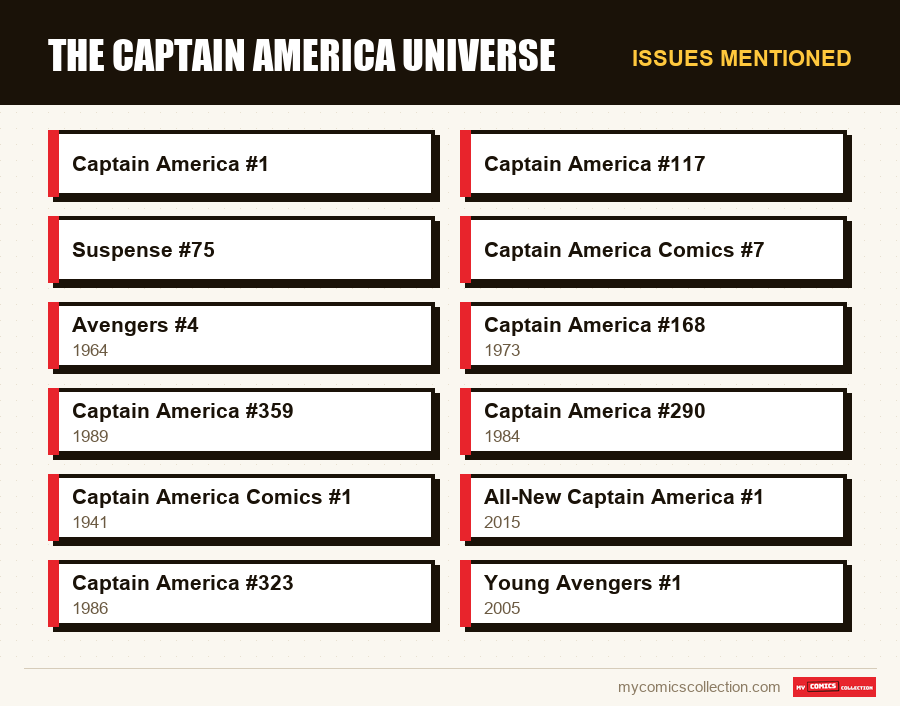
The universe of Captain America is one of Marvel's largest, focusing on the legacy of the shield. Essential early appearances include the Winter Soldier (Captain America #1 vol. 5, 2005), Falcon (Captain America #117, 1969), Sharon Carter (Tales of Suspense #75, 1966), and Red Skull (Captain America Comics #7, 1941). The series Falcon & Winter Soldier and U.S.Agent enrich this heritage.
Captain America isn't just a hero: he's a legacy. Since the 1940s, his universe has been built around the question of succession: who carries the shield, who deserves it, who betrays it. Bucky, Sam Wilson, John Walker have all taken on the mantle, creating a family tree of characters whose market value reflects narrative importance.
This guide maps key early appearances, spin-off series, and strategies for building a complete Captain America family collection. For key numbers of the main title, see our Captain America key numbers guide.
Major Villains: First Appearances
Red Skull (Johann Schmidt)
First appearance in Captain America Comics #7 (October 1941). Steve Rogers' absolute nemesis is one of the most iconic villains of the Golden Age. Copies of this Golden Age key fetch considerable prices: it is a holy grail for collectors.
Baron Zemo (Heinrich then Helmut)
Heinrich Zemo appears in Avengers #4 (March 1964, flashback) then his son Helmut in Captain America #168 (December 1973). Both versions are sought after, Helmut having gained visibility thanks to the MCU.
Crossbones and Sin
Crossbones begins in Captain America #359 (October 1989) and Sin (Red Skull's daughter) in Captain America #290 (1984). Two keys to the Gruenwald run to watch.
Supporting Cast: Key Characters
Bucky / Winter Soldier
Bucky Barnes appears in Captain America Comics #1 (March 1941). His resurrection as Winter Soldier in Captain America #1 vol. 5 (January 2005, Brubaker) is a pivotal moment. This latest issue is one of Marvel's most important modern keys.
Falcon (Sam Wilson)
First appearance in Captain America #117 (September 1969). Marvel's first African-American superhero, Sam Wilson became Captain America in All-New Captain America #1 (2015). Captain America #117 is a major Bronze Age key.
Sharon Carter (Agent 13)
First appearance in Tales of Suspense #75 (March 1966). The SHIELD agent and partner of Steve Rogers is a central character whose first appearance remains relatively accessible.
U.S. Agent (John Walker)
First appearance as Super-Patriot in Captain America #323 (November 1986). Walker becomes Captain America (#332-350) before being renamed U.S.Agent. His solo series (2001, 3 issues then 2010, 4 issues) completes his trajectory.
Patriot (Eli Bradley)
First appearance in Young Avengers #1 (April 2005). Isaiah Bradley's grandson carries the legacy of the super-soldier formula. A highly sought-after modern key.
Derivative series and spin-offs
Essential satellite titles: Captain America & Falcon (#1-14, 2004-2005), Falcon (solo series 2017, 8 issues), Winter Soldier (2012-2013, 19 issues, Brubaker), U.S.Agent (2020, 5 issues, Priest) and Captain America: Sam Wilson (#1-24, 2015-2017, Spencer).
Crossovers and key events
Major events in the Cap universe include Civil War (death of Captain America in CA #25, 2007), Fear Itself (Bucky killed/alleged), Secret Empire (2017, Steve Rogers Hydra) and Truth: Red, White & Black (#1-7, 2003: Isaiah Bradley, first black super-soldier). For the full story, see our Captain America story guide.
Collecting Strategy for the Expanded Universe
Prioritize Captain America #117 (Falcon), CA vol. 5 #1 (Winter Soldier) and Young Avengers #1 (Patriot). Truth: Red, White & Black #1 is a modern key on the rise. Supplement with Brubaker's Winter Soldier run and Spencer's Sam Wilson run for complete coverage of the Shield's legacy. The Gruenwald numbers (#323, #332, #350, #359) remain affordable and fundamental.
Manage your entire Captain America collection and its spin-offs with our management application: track each shield bearer and first appearance.
Who carried the shield: chronological markers
The Captain America universe is best understood as a succession of shield-bearers. Each generation leaves its key issues, and telling them apart avoids getting lost in the spin-offs.
Steve Rogers and Bucky (1940s). Steve Rogers is born with Captain America Comics #1 (March 1941), where Bucky Barnes also appears. Red Skull arrives in #7 (October 1941). This is the Golden Age foundation of the whole family.
Falcon's arrival (1969). Captain America #117 (September 1969) brings Sam Wilson, Marvel's first African-American superhero. He will much later become the shield-bearer in All-New Captain America #1 (2015).
The Gruenwald era (1980s). John Walker appears as Super-Patriot in Captain America #323 (November 1986), then becomes Captain America (#332-350) before taking the name U.S.Agent. This is the period of Mark Gruenwald's run, very accessible and foundational.
Bucky's return (2005). In Captain America vol. 5 #1 (January 2005), Ed Brubaker resurrects Bucky as the Winter Soldier. It is a pivotal moment, and one of Marvel's most important modern keys.
The 21st-century heirs. Truth: Red, White & Black (2003) introduces Isaiah Bradley, the first Black super-soldier, and his grandson Eli Bradley becomes Patriot in Young Avengers #1 (April 2005). Sam Wilson then takes up the mantle in Nick Spencer's series (2015-2017).
A few practical tips to move forward:
- Collect by bearer, not by title. The issues are scattered across series, and a character-based approach avoids duplicates.
- Watch out for vol. 1 to vol. 5. Several Captain America series follow one another: always specify the volume before buying.
- Tell first appearances from relaunch issues. A launch issue has first-appearance value only if the character truly appears there for the first time.
- Read the events in context. Civil War, Fear Itself or Secret Empire are better understood with the markers above in mind.
To finish, a word on method. For each shield-bearer, set yourself a small starting set of issues: his first appearance, his turning point and the series devoted to him. When that set is complete, move on to the next. This progression keeps the collection readable and avoids scattering yourself across too many series at once.
Frequently Asked Questions
Captain America Comics #7 (October 1941). Steve Rogers's absolute nemesis, he is one of the Golden Age's most emblematic villains, and copies reach considerable sums: it is a grail for collectors.
In Captain America #117 (September 1969). Marvel's first African-American superhero, Sam Wilson becomes Captain America in All-New Captain America #1 (2015). #117 is a major Bronze Age key.
Captain America vol. 5 #1 (January 2005), by Brubaker, where Bucky Barnes is resurrected. Bucky originally appears in Captain America Comics #1 (March 1941), but this 2005 issue is one of Marvel's most important modern keys.
John Walker, who appeared as Super-Patriot in Captain America #323 (November 1986). He becomes Captain America in #332-350 before being renamed U.S.Agent, and his solo series completes his trajectory.
Captain America #117 (Falcon), Captain America vol. 5 #1 (Winter Soldier) and Young Avengers #1 (Patriot), then Brubaker's Winter Soldier run and Spencer's Sam Wilson series. The Gruenwald issues (#323, #332, #350, #359) remain affordable and foundational.