
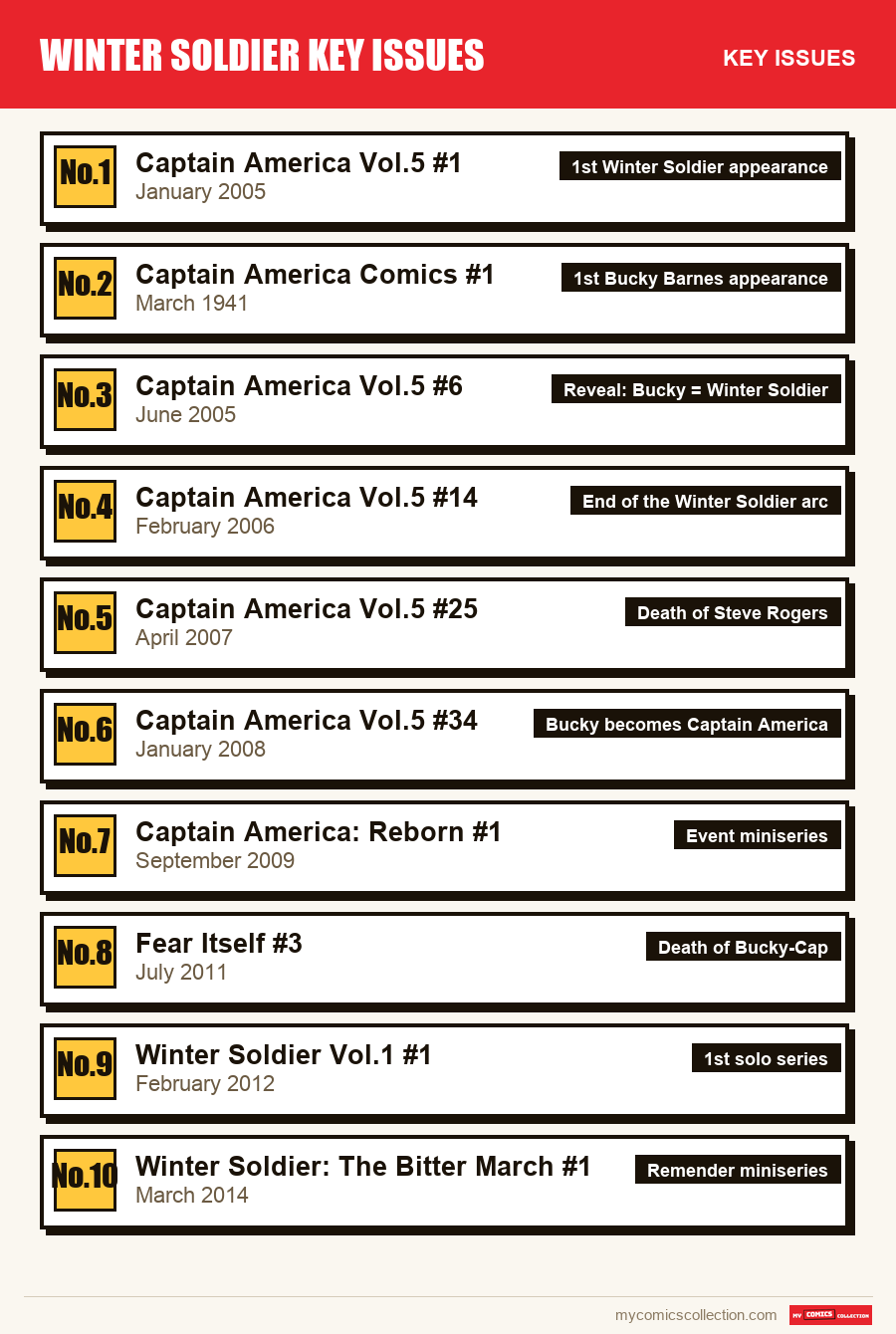
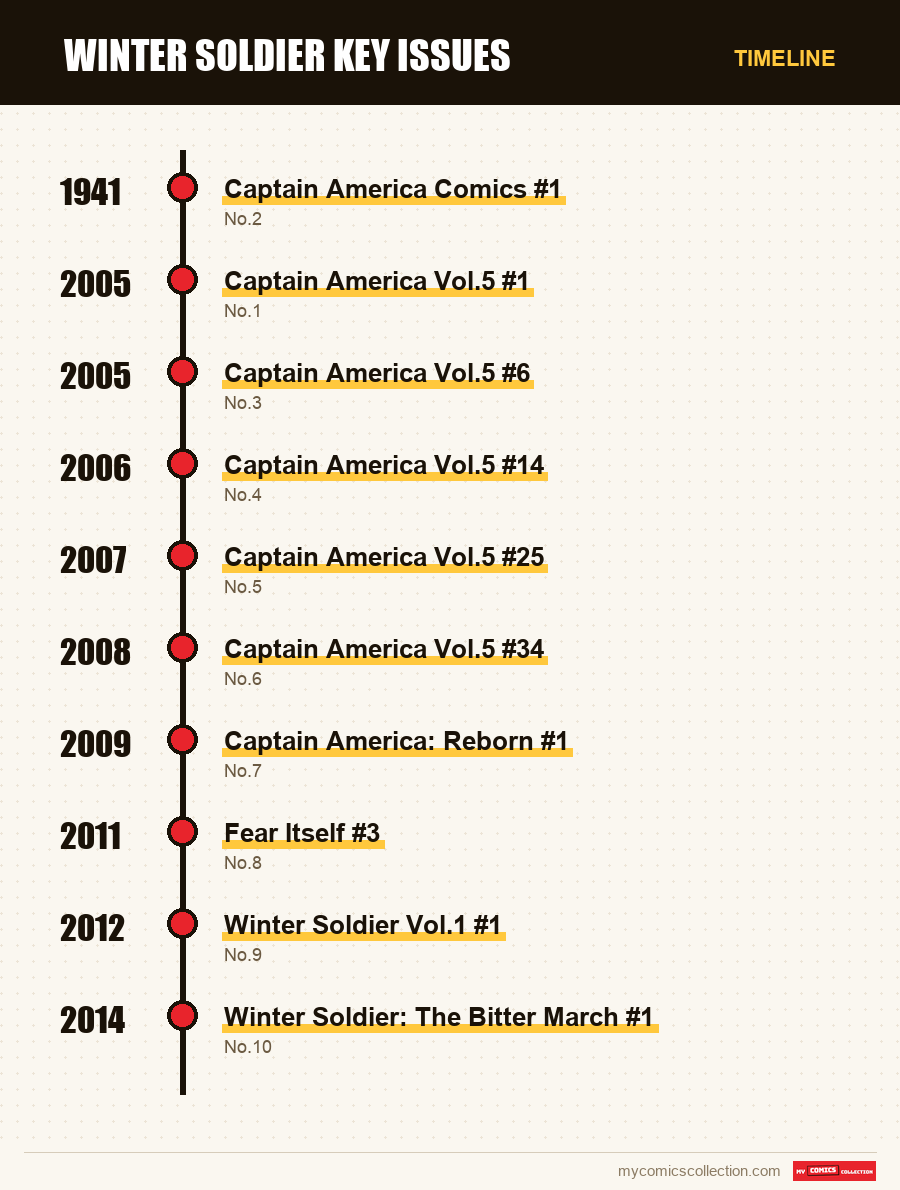
The key issue for the modern Winter Soldier is Captain America Vol.5 #1 (January 2005), the first issue of Ed Brubaker and Steve Epting's run, where his silhouette appears in the final pages. Bucky Barnes's identity is revealed in #6, while his first appearance as a sidekick dates from Captain America Comics #1 (March 1941), by Joe Simon and Jack Kirby.
The Winter Soldier is one of the few Marvel Comics supporting characters whose market value was completely reshaped in less than a decade. Reintroduced in January 2005 by Ed Brubaker and Steve Epting in Captain America Vol.5 #1, Bucky Barnes went from a patriotic sidekick killed in the war to a central antihero in the modern mythology of the shield. This guide lists the ten key issues every serious collector of the character should target first, with their editorial context, narrative significance and an indicative value range. The selection covers the first appearance as the Winter Soldier, the pivotal moments of the Brubaker run, the transition to Bucky-Cap, the symbolic death during Fear Itself and the launch of the solo series in 2012.
The Winter Soldier in comics history
The Winter Soldier belongs to the Marvel Comics catalog under a dual editorial identity. Born in March 1941 in Captain America Comics #1 as Bucky Barnes, Captain America's teenage partner created by Joe Simon and Jack Kirby, the character was officially killed off in 1945 in a sabotaged mission over the English Channel. For sixty years, that death remained one of Marvel's few sacred losses, on par with Uncle Ben's in Spider-Man. The January 2005 reinvention by Ed Brubaker and Steve Epting turned this fixed point of continuity into a major narrative lever.
From a collector's standpoint, the Brubaker run holds Marvel's fastest-appreciating issues of the 2000s. Captain America Vol.5 #1 , #6 , #14 , #25 and #34 all saw their value climb after the 2014 release of the film Captain America: The Winter Soldier. The MCU effect, extended by Civil War (2016) and then the Disney+ series The Falcon and The Winter Soldier (2021), cemented Bucky as one of the most widely recognized Marvel antiheroes among general audiences. The essential runs to know remain the Winter Soldier arc (Vol.5 #1-14), the death of Captain America (Vol.5 #25), Bucky-Cap (Vol.5 #34 onward), the Reborn miniseries (2009) and the 2012-2013 solo series Winter Soldier Vol.1. For the broader Cap/Bucky context, the Captain America key issues guide is a useful complement to this rundown.
Top 10 Winter Soldier key issues
A selection ranked by historical and collector importance, from the foundational pivot to the complementary key issue. Values remain indicative and depend on CGC grade, variant and the dynamics of the modern Marvel market.
Captain America Vol.5 #1
The first issue of the Ed Brubaker and Steve Epting run, and the canonical entry point for the modern Winter Soldier. The figure appears in the final pages, setting up the mystery that will drive the first fourteen issues. Several variants exist, but the main Epting cover remains the benchmark. A modern key issue with value rising steadily since the 2014 film announcement.
Captain America Comics #1
The foundational Timely Comics issue where Joe Simon and Jack Kirby simultaneously introduce Captain America and Bucky Barnes, the civilian identity of the future Winter Soldier. A massive print run for its era, yet extremely rare to find surviving in high grade. A museum piece of the American Golden Age. It remains the most expensive key issue tied to the character, inseparable from the Cap file.
Captain America Vol.5 #6
The issue where the Winter Soldier's identity is officially revealed to be Bucky Barnes. Part of the market considers it the "true" canonical first appearance, since #1 only shows the figure in silhouette. Its value has tracked that of #1 since 2014, with a marked appreciation in CGC 9.8.
Captain America Vol.5 #14
The conclusion of the Winter Soldier arc by Brubaker and Epting. Steve Rogers confronts Bucky and uses the Cosmic Cube to break his Soviet conditioning. A key moment in the modern mythology: this is the issue that locks in the character's definitive return to Marvel continuity and makes the entire following decade possible.
Captain America Vol.5 #25
The death of Steve Rogers at the end of Civil War, gunned down on the courthouse steps. A blockbuster issue with a very high print run, released in several variants including the limited Turner and Epting editions. Bucky isn't carrying the shield yet, but this is the spark that leads him to take up the costume nine issues later. Value rising since 2014.
Captain America Vol.5 #34
Bucky Barnes dons the Captain America costume for the first time, in a gray and midnight-blue variant designed by Steve Epting. A turning point of Marvel's 2000s and one of the most widely covered moments in American comics press that year. It remains a sought-after key issue for collectors of the character and, more broadly, of the Cap mantle lineage.
Captain America: Reborn #1
The opening issue of the Brubaker and Bryan Hitch miniseries that brings Steve Rogers back to the present and sets up the "two Caps" coexistence that defines 2010-2011. Several Hitch variants exist, including a sketch cover heavily chased by completists of the Brubaker run.
Fear Itself #3
An issue of the Fear Itself event by Matt Fraction and Stuart Immonen, in which Bucky is killed by Skadi/Sin. This editorial death clears the way to relaunch the character as the Winter Soldier in the solo series launched six months later. Speculative demand on release; current value has stabilized but stays supported by fans of the 2011-2012 transition.
Winter Soldier Vol.1 #1
The first issue of the first ongoing series titled Winter Soldier, nineteen issues in total. Ed Brubaker on script, Butch Guice on art, a dark espionage tone centered on hunting down former Soviet Sleepers. An accessible issue for beginning collectors and a central landmark in the character's solo mythology.
Winter Soldier: The Bitter March #1
The first issue of the five-part miniseries by Rick Remender and Roland Boschi, released alongside the 2014 film. A story set in the 1960s with a Bucky still under Soviet control, an essential read for anyone interested in the character's Cold War period. Modest value but steady demand supported by Remender completists.
Collecting this series?
Track what you own, what you are missing and what your collection is worth. 7 day trial.
Start my trial →The essential Winter Soldier story arcs
The character's modern story rests on a handful of easily identifiable runs. Knowing them lets you target your purchases and avoid overpaying for minor issues with little impact on the core mythology.
Winter Soldier (foundational arc)
The opening arc by Ed Brubaker and Steve Epting that reintroduces Bucky as an amnesiac assassin manipulated by the Soviets. Fourteen issues that establish all the mechanics of the modern character: conditioning, cryogenics, the metal arm, the confrontation with Steve Rogers and his release by the Cosmic Cube. Absolutely top-priority reading.
The Death of Captain America
A direct follow-up to Winter Soldier, this two-part story follows the assassination of Steve Rogers at the end of Civil War, Bucky's grief and his decision to take up the shield. A political, noir narrative, regarded as one of the high points of Marvel's 2000s. Essential for understanding Bucky-Cap's legitimacy.
Reborn and the era of two Caps
The Reborn miniseries by Brubaker and Bryan Hitch brings Steve Rogers back to the present and sets up the coexistence of the two Captain Americas. A rich period for collectors, blending Brubaker, Daniel Acuña and several crossovers. Required reading to follow Bucky between 2009 and 2011.
Winter Soldier Vol.1 (Brubaker solo)
The character's first solo series, nineteen issues published between 2012 and 2013. Ed Brubaker on script, Butch Guice then Michael Lark on art. An espionage thriller centered on the Soviet Sleepers. A spare tone, a tight plot, ideal in single issues or in trade for approaching the character outside the extended continuity.
The Bitter March
A miniseries by Rick Remender and Roland Boschi published in 2014 alongside the film's release. A Cold War story, 1960s, with a Bucky still under KGB control. A premium companion to the Brubaker run, recommended for collectors who want to explore the character's sleeper period.
How My Comics Collection manages your Winter Soldier collection
The Brubaker run is spread across Captain America Vol.5 , Reborn , Winter Soldier Vol.1, several miniseries and events like Fear Itself. Without a dedicated tool, it's easy to miss an issue or overpay for a variant. My Comics Collection centralizes the series, automatically identifies missing issues, tracks the eBay value, updated daily, and calculates the value of your run in CGC or raw.