
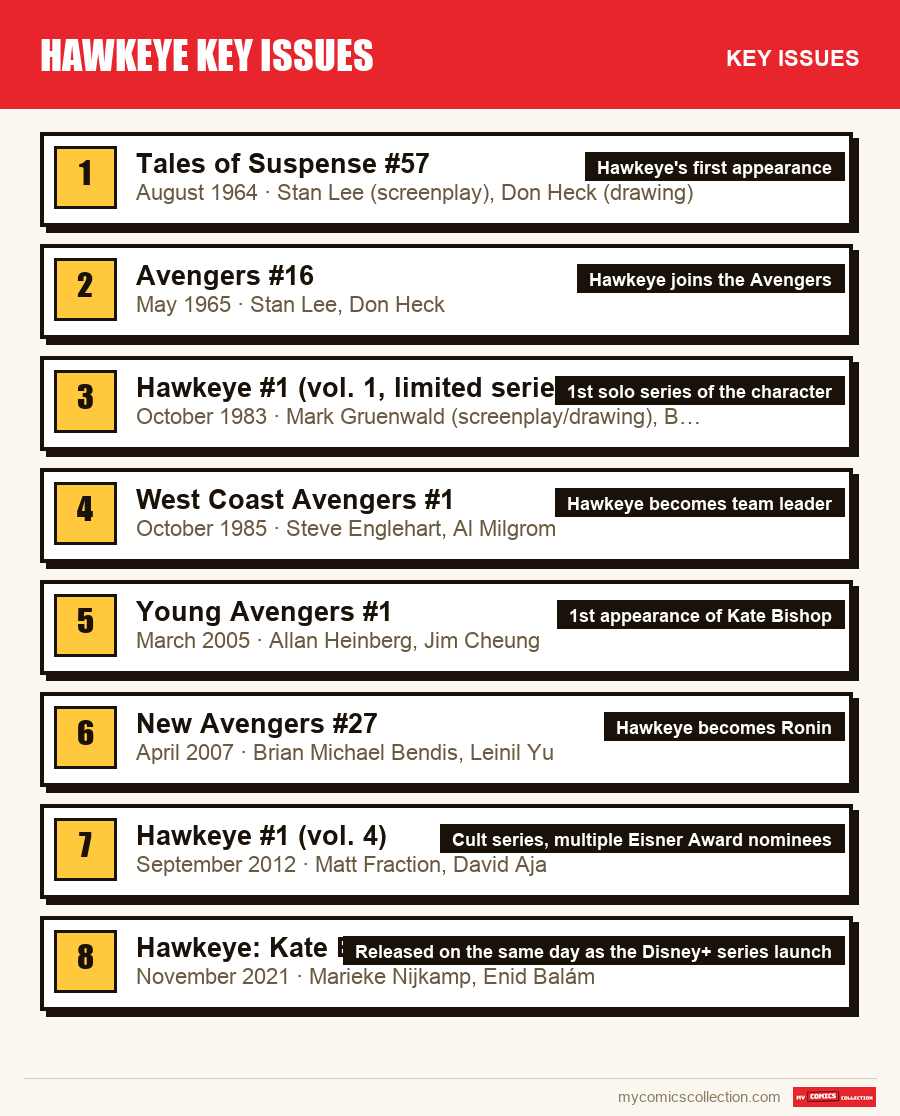
Hawkeye's absolute key number remains Tales of Suspense #57 (August 1964, Stan Lee & Don Heck), his very first appearance as the avenging archer: an NM 9.8 sold for $47,800 in February 2016. Next came Avengers #16 (1965), where he officially joins the team alongside Quicksilver and Scarlet Witch, then two modern milestones: Young Avengers #1 (2005) for the first appearance of Kate Bishop, and Hawkeye #1 (2012) from Fraction/Aja, the series that redefined the character and won several Eisner Awards.
Hawkeye occupies a special place in the Marvel pantheon: neither god, nor mutant, nor superman, just a fearsomely cold-blooded sniper who knew how, decade after decade, to reinvent himself without ever leaving the Avengers table. This rare editorial longevity, more than sixty years of continuous appearances, makes Clint Barton one of the richest characters to collect, with an editorial line that spans the Silver Age, the revival of the 1980s, the Bendis era of the 2000s and the stylistic revolution of the Fraction/Aja run in the 2010s.
Unlike heroes whose rating is based on a single peak (a first appearance and nothing else), Hawkeye offers a real collection journey: first appearances, team arrivals and departures, identity changes (Ronin), launch of solo series, and even the emergence of a second bearer of the name with Kate Bishop. This guide breaks down the numbers that really matter to a collector, with the sales data actually documented: no guesswork out of the hat.
We deliberately tightened the angle on the investments and collection milestones rather than the character's full biography. To retrace the narrative history of Hawkeye in the Marvel universe, his psychology, his relationships with the other Avengers and the evolution of his costume over the decades, head to our dedicated article: the complete story of Hawkeye in comics. Here, we talk numbers, draws, odds and buying strategy.
Hawkeye in Marvel editorial history: from Iron Man villain to Avengers mainstay
Clint Barton made his debut on August 31, 1964 in Tales of Suspense #57, at the time a shared bimonthly title that featured Iron Man as the main story. Stan Lee on the screenplay and Don Heck on the drawing initially conceived him as an antagonist: a fairground archer seduced by Natasha Romanoff (Black Widow, then a Soviet spy) and pushed to confront Tony Stark. This starting point is important for the historical reading of the character: Hawkeye is born from the dark side of the story, which partly explains why Marvel was able, decades later, to make him carry the troubled identity of Ronin without a break in tone.
Less than a year after its debut, the editorial team is carrying out one of the biggest casting renewals of the Silver Age: in Avengers #16 (May 1965), Thor, Iron Man, Wasp and Giant-Man leave the founding team, replaced by a trio of former antagonists rehabilitated under the leadership of Captain America: Hawkeye, Quicksilver and Scarlet Witch. This group will remain in the memory of readers under the nickname “Cap's Kooky Quartet”. This is the true birth certificate of the heroic Hawkeye that the general public knows today, and one of the most sought-after issues of the Avengers' Silver Age run.
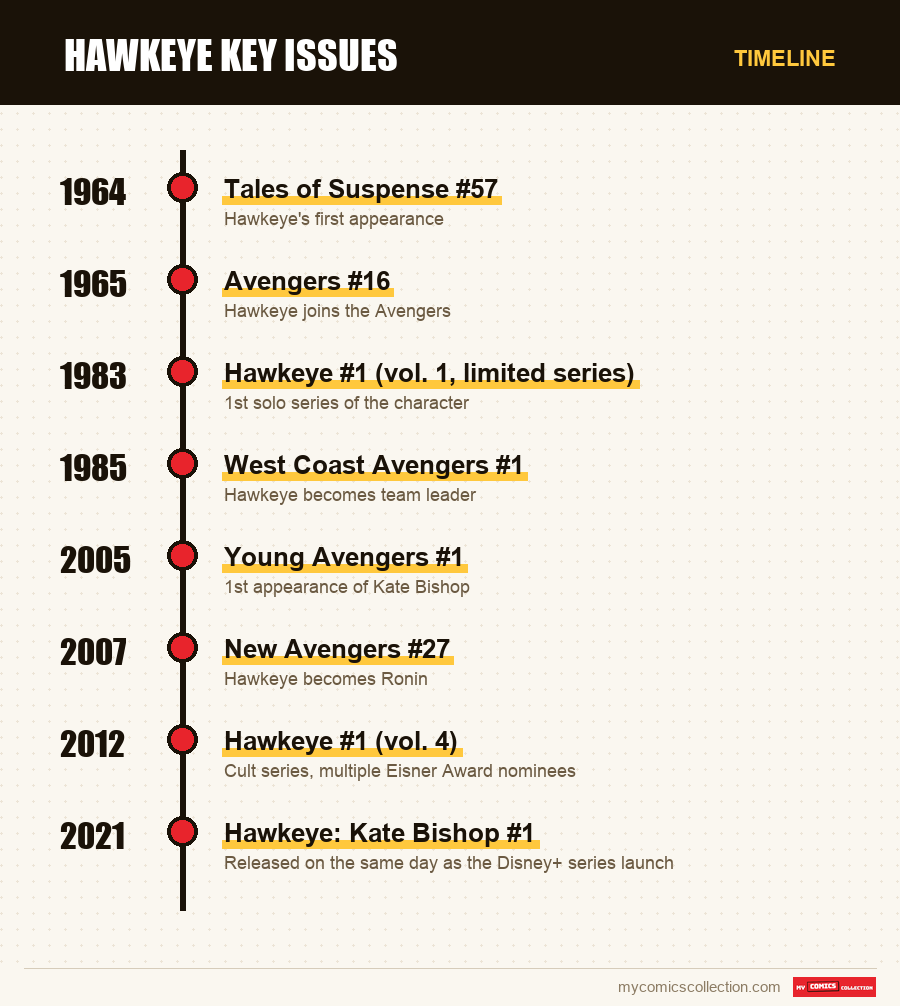
The rest of the editorial journey is built in waves. In 1983, Mark Gruenwald offered him his very first solo mini-series, Hawkeye (4 issues), which revisits his origin and introduces the mystery of Mockingbird, his future wife. Two years later, in 1985, Steve Englehart placed him at the head of a brand new team based in California in West Coast Avengers #1: the first time Clint Barton is leading superheroes rather than just accompanying them. In the 2000s, Brian Michael Bendis killed him then resurrected him as Ronin in New Avengers, a twist that marked readers of the post-Civil War. Finally, 2012 marks a major stylistic break with the launch of Hawkeye vol. 4 by Matt Fraction and David Aja, which reinvented the character as an “everyday superhero” and became one of the most celebrated series of the decade among critics.
A second narrative thread enriches this collection: that of Kate Bishop, who appeared in 2005 in Young Avengers #1 under the pen of Allan Heinberg and the pencil of Jim Cheung. Bishop will take over the Hawkeye name during Clint Barton's absence and will become, with the 2021 Disney+ series, a major entry point for new collectors.
Tales of Suspense #57
The absolute holy grail of the Hawkeye collection. Clint Barton, circus sniper, first appears there as an opponent of Iron Man, manipulated by Black Widow. This is the founding number of the entire universe of the character: without it, neither the Avengers, nor Kate Bishop, nor the Disney+ series would exist in this form. Like the majority of Silver Age Marvels with small original print runs, high grade copies are extremely rare: most copies in circulation show significant wear (yellowed paper, weakened spine), which makes NM grades almost impossible to find.
Avengers #16
The most famous casting turnover of the Silver Age: Thor, Iron Man, Wasp and Giant-Man leave the team, replaced by Hawkeye, Quicksilver and Scarlet Witch under the command of Captain America: the formation nicknamed "Cap's Kooky Quartet". This is the number that transforms Clint Barton into a permanent hero of the Marvel universe rather than just a guest star on Iron Man. For any Silver Age Avengers collector, this issue is as essential as Tales of Suspense #57 is for the pure Hawkeye collection.
Hawkeye #1 (vol. 1, limited series)
“Listen to the Mockingbird”: nineteen years after its creation, Hawkeye finally gets his own 4-issue miniseries. Gruenwald revisits the origin of the character through flashbacks featuring Barney Barton, Iron Man, Captain America, Quicksilver, Scarlet Witch and the Swordsman, while introducing the mysterious character who will become Mockingbird: Clint's future wife, whose marriage will close issue 4 of this same series. This is a structuring milestone for those who want to collect the evolution of the character beyond their status as a simple team member.
West Coast Avengers #1
First issue of the brand new Californian branch of the Avengers, with Hawkeye at its head: a major status shift for a character hitherto confined to the rank of support archer. At his side: Mockingbird, Iron Man (new red and silver Centurion armor), Wonder Man and Tigra. This is the first issue where Clint Barton officially bears the responsibility of command, a status he will maintain for much of the series that follows under the name Avengers West Coast.
Young Avengers #1
The founding number of the second Hawkeye. Kate Bishop appears alongside Patriot, Iron Lad, Asgardian (future Wiccan) and Hulkling, in a team of young heroes who take on the identities of the historical Avengers. Kate would later directly borrow Hawkeye's name and costume during Clint Barton's absence, before becoming a character in her own right with her own mythology. The popularity of the Disney+ series Hawkeye (2021), which features the Clint/Kate duo, has greatly increased demand for this issue among modern collectors.
New Avengers #27
After being given up for dead during the saga Avengers Disassembled, Clint Barton resurfaces under a new identity: Ronin, a masked saber warrior, opposed to Elektra for control of the Japanese underworld. This is the second character to bear this name in Marvel continuity, and a strong narrative turning point for Hawkeye, who temporarily abandons the bow for the sword before returning to his original identity in the following stories. An issue sought after by collectors who track the character's costume and identity changes.
Hawkeye #1 (vol. 4)
The launch that changed the perception of the character in comics culture. Fraction and Aja abandon the cosmic register of the Avengers to tell “what Hawkeye does when he's not on a mission with the team”: his building in Bed-Stuy, his money problems, his neighbors, and Lucky the Pizza Dog. The series garnered five nominations at the 2013 Eisner Awards (Best New Series, Best Ongoing Series, Best Writer, Best Cover Artist, Best Artist/Inker), with two actual wins for David Aja (Best Artist/Inker and Best Cover Artist). Today, it is one of the runs most cited as a comic book reference at Marvel.
Hawkeye: Kate Bishop #1
Marvel deliberately made the release of this solo mini-series coincide with the broadcast of the first two episodes of the Disney+ series. Hawkeye, November 24, 2021: an assumed editorial synchronization strategy to capture the new audience discovering Kate Bishop on screen. The issue ranked as the 32nd best-selling comic for the month of November 2021 according to Diamond Comic Distributors data, a solid result for a supporting character solo launch during this period.
Collecting this series?
Track what you own, what you are missing and what your collection is worth. 7 day trial.
Start my trial →The impact of adaptations on Hawkeye's rating
Hawkeye has long been considered second-best to the general public: until Jeremy Renner played him in Avengers (2012), Avengers: Age of Ultron (2015), Avengers: Infinity War (2018) and Avengers: Endgame (2019). This continuing cinematic exhibition has maintained a substantive demand on Tales of Suspense #57 and Avengers #16, without provoking the speculative outbreaks observed on other first appearances of heroes more central to the MCU.
The real recent tipping point remains the Disney+ series Hawkeye, broadcast from November 2021, which introduces Kate Bishop to the general public via Hailee Steinfeld alongside Renner. Marvel synchronized the release of Hawkeye: Kate Bishop #1 with the launch of the first two episodes, an editorial maneuver that immediately propelled the issue into the top 40 monthly Diamond sales charts. More structurally, this television exposure reactivated interest in Young Avengers #1 (2005), Kate's historic first appearance: an issue whose very high rating remains sensitive to this type of media news.
On a pure narrative level, the 2012 Fraction/Aja run also continues to influence the market, but differently: its value comes not from screen exposure but from its lasting critical reputation (Eisner recognition, reference status cited in Marvel reading guides), a factor which tends to stabilize demand over time rather than creating one-off peaks linked to a release schedule.
Buying guide
- Prioritize condition over price for Tales of Suspense #57. This is a Silver Age comic with a small original print run: the difference in value between a grade FN (6.0) and an NM (9.0+) is considerable, and high grade copies are rare on the market. If your budget is limited, a mid-grade with a solid spine and crisp corners is still a consistent purchase.
- Systematically checks the restoration on old Silver Age copies. Comics from the 1960s have often undergone retouching (spine re-gluing, color retouching) which, if undeclared, completely distorts the evaluation. A CGC rating marked “Qualified” or “Restored” should result in a significantly lower price than an unrestored example of the same grade.
- Don't discount Avengers #16 just because it's not the first appearance. For many Avengers team collectors, this issue matters as much as the solo debut, because it marks the entry into the character's collective mythology.
- On modern issues (Hawkeye 2012, New Avengers #27, Hawkeye: Kate Bishop #1), favor the 1st printing. As current print runs are larger, the difference in value between 1st and reprint can be significant: always check the print run on the back or in the credits.
- Understand the nuance between a grade 9.2 and a 9.8 before investing in a graded example. The price difference between these two ratings can represent a significant multiple of the value, for a difference in appearance that is often invisible to the naked eye. Our detailed comparison CGC grade 9 vs 9.8 explains concretely what justifies this discrepancy.
- For limited series like Hawkeye (1983) or Young Avengers, buy in full runs if possible. Issue 1 concentrates most of the collection value, but a complete run (for example the 4 issues of the Gruenwald mini-series) often sells better than a collection of isolated issues.
- Keep an eye out for variant covers of recent releases. Hawkeye #1 (2012) and Hawkeye: Kate Bishop #1 have each had alternative covers whose circulation is smaller than the standard cover: they can constitute a collection axis in their own right.
- Use a tracking tool to organize your collection as you acquire it. Whether you're aiming for the full Silver Age series or just the Kate Bishop milestones, our collection management application allows you to centralize your numbers, their grade and their estimated value.