Spider-Man: No Way Home (2021), directed by Jon Watts with Tom Holland, exploits the multiverse to bring together enemies from three franchises: the Green Goblin (born in Amazing Spider-Man #14 , 1964), Doctor Octopus ( Amazing Spider-Man #3, 1963) and others. Its conclusion, the erasure of Peter Parker's memory, reinvents the controversial arc “One More Day”(2007). The film retains the essence of these classic villains while correcting one of the most maligned narratives in comics. Detailed comparison, film versus comics.
An unprecedented event, No Way Home brings together twenty years of Spider-Man cinema thanks to the concept of the multiverse. Under the direction of Jon Watts, the film draws from comics' richest gallery of villains and one of its most discussed arcs to craft a tale that is both nostalgic and heartbreaking. Source-by-source decryption.
As in each article in the series, only verified information (distribution, dates, numbers, creators) is stated; the comparative analysis is ours, without reproducing dialogue or protected images.
Title : Spider-Man: No Way Home (2021)
Director: Jon Watts
Actors: Tom Holland (Peter Parker), Zendaya (MJ), Benedict Cumberbatch (Doctor Strange), Willem Dafoe (Green Goblin), Alfred Molina (Doctor Octopus), Jamie Foxx (Electro)
Exit : December 17, 2021 (United States)
Studio: Marvel Studios/Sony Pictures
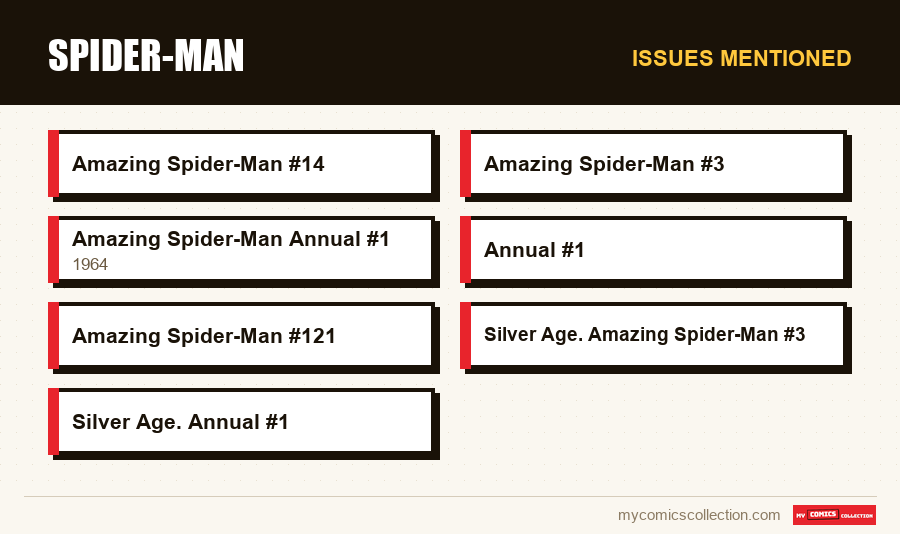
Amazing Spider-Man #14 (1964): 1st appearance of the Green Goblin
Amazing Spider-Man #3 (1963): 1st appearance of Doctor Octopus
“One More Day”(2007): identity and marriage erased
Amazing Spider-Man Annual #1 (1964): the Sinister Six
- Le Green Goblin and the Doctor Octopus, two of the weaver's greatest enemies.
- La dual personality by Norman Osborn, faithful to his comic book madness.
- The idea of a erasure of identity by Peter, the heart of “One More Day”.
- La solitude and sacrifice as the price of heroism.
- Le multiverse, a fundamental concept of Marvel cosmology.
- Villains come from other universes (the previous cinema sagas), an unprecedented gathering.
- Peter tries to heal his enemies rather than defeating them, a new moral angle.
- “One More Day” is reinvented: it's not a demonic pact but a Doctor Strange spell.
- The erased marriage of the comic becomes the erasure of all memory of Peter.
- THE other Spider-Man (previous cinema versions) appear, an event specific to the film.
Amazing Spider-Man #14 and #3: the great enemies of the weaver
The film brings together some of Spider-Man's most iconic villains, each from a seminal issue. THE Green Goblin, Norman Osborn, appears in Amazing Spider-Man #14 (1964), created by Stan Lee and Steve Ditko: industrialist whose madness makes the weaver's greatest enemy, capable of the worst atrocities. THE Doctor Octopus, Otto Octavius, is born in Amazing Spider-Man #3 (1963), a scientist with mechanical arms. The film faithfully captures the essence of these characters, notably Osborn's tortured dual personality, between the respectable businessman and the sneering monster. Willem Dafoe and Alfred Molina, reprising their roles from the Sam Raimi films, play these villains with remarkable fidelity to the comics.
The great originality of the film is to bring these enemies from other universes, the previous Spider-Man film franchises, thanks to a fault in the multiverse. This gathering, impossible in classic continuity, celebrates two decades of adaptations while confronting young Peter Parker with the most formidable nemeses of his myth.
“One More Day” (2007): the arc reinvented
The film's conclusion draws on one of the most controversial stories in Spider-Man history: "One More Day" (2007), by J. Michael Straczynski and Joe Quesada. In this comic, Peter, to save the life of his Aunt May, makes a pact with the demon Mephisto, who erases his marriage to Mary Jane and reestablishes the secret of his identity: at the cost of his happiness. This arc, reviled by many readers for its process considered arbitrary, is skillfully reinvented by the film. Here, the erasure is not a demonic pact but a Doctor Strange spell, and it is not the marriage that disappears, but every memory of Peter Parker's existence in the entire world's minds. The film thus transforms a maligned story into a heroic and heartbreaking sacrifice, repairing in its own way one of the most commented upon missteps in comics.
The Sinister Six and the gallery of villains
By bringing together five villains (Green Goblin, Doctor Octopus, Sandman, Lizard, Electro), the film evokes the famous Sinister Six, a team of Spider-Man enemies that appeared as early as Amazing Spider-Man Annual #1 (1964). The first line-up already brought together Doctor Octopus, Electro, the Vulture, Mysterio, Kraven and the Sandman. The film does not exactly reconstitute this team, but is part of the same tradition: bringing together the worst enemies of the weaver to overwhelm him. This richness of the gallery of villains, unique in comics, is the raw material of the film, which exploits it to confront Peter with an insurmountable challenge, and to explore a new idea: what if he tried to save them rather than fight them?
The characters, from paper to screen
- Peter Parker: Faithful to the spirit of the hero, he pushes compassion further by seeking to heal his enemies.
- Green Goblin (Norman Osborn): His dual personality and his cruelty are faithful to the comics.
- Doctor Octopus: Scientist with mechanical arms, taken back to his essence.
- Doctor Strange: The spell he casts replaces the demonic pact from “One More Day”.
- The other Spider-Mans: Previous cinema versions, a film-specific event.
Collecting this series?
Track what you own, what you are missing and what your collection is worth. 7 day trial.
Start my trial →Heal rather than conquer: a new moral angle
The big idea of the film, absent from the original comics, is to make Peter a hero who refuses to send the villains back to certain death in their universes. Instead of fighting them, he seeks to cure them of what corrupted them: Osborn's madness, Doc Ock's chip, Electro and the Lizard's mutations. This bias, of great generosity, redefines heroism: it is no longer a question of winning, but of saving, even if it means paying a high price. This approach extends, while deepening, the character's founding morality: responsibility as a duty towards others, including one's enemies. The film gains a rare ethical dimension, transforming a spectacular blockbuster into a meditation on redemption and forgiveness.
This choice also illuminates the tragic conclusion: it is because Peter wanted to save everyone that he finds himself, in the end, alone and forgotten by everyone. His very generosity is the source of his sacrifice, which gives the film an exemplary moral coherence, faithful to the idea that, for Spider-Man, every good deed has a cost.
Three generations of Spider-Man united
Beyond its villains, No Way Home will be remembered for a unique event: the meeting of three interpreters of the weaver, from three different franchises, thanks to the multiverse. This celebration of twenty years of Spider-Man cinema has no direct equivalent in the comics, but it extends a concept that is dear to them: the “Spider-Verse”, this idea that there are countless versions of Spider-Man across realities. Popularized in comics by the “Spider-Verse” event (2014), this principle is based on an ancient intuition: each universe has its own wearer of the mask. The film takes advantage of this to offer a moment of communion between generations, where the three heroes exchange their experiences and support each other.
This encounter has a particular emotional impact: it allows each version of the character to find a form of resolution, to heal from their own wounds. In this, the film illustrates the richness of the concept of the multiverse, which allows reunions impossible in classic continuity. For the spectator as for the reader, it is a dazzling demonstration of what the multiversal structure, born in comics, allows us to tell: not a simple accumulation of characters, but a reflection on the multiple faces of the same hero, and on what, deep down, unites them all: responsibility, sacrifice, and the desire to do well despite everything.
Where to start reading
To discover the villains of the film, we can go back to their first appearances: Amazing Spider-Man #3 (Doctor Octopus), #14 (Green Goblin), and Annual #1 (Sinister Six). To understand the reinvented arc, “One More Day” (2007) is the reference reading, provided you accept its controversial status. The great stories featuring the Green Goblin, notably “The Night Gwen Stacy Died” (Amazing Spider-Man #121-122, 1973), are among the character's most memorable. From 1963 to 2007, this journey covers the sources of a film which celebrates an entire part of Spider-Man's history.
Chronology of comics to know
- 1963: Amazing Spider-Man #3: First appearance of Doctor Octopus.
- 1964: Amazing Spider-Man #14: First appearance of the Green Goblin.
- 1964: Amazing Spider-Man Annual #1: The Sinister Six.
- 2007: “One More Day”: the erasure of identity, reinvented by the film.
Collection side: what numbers to aim for after the film
No Way Home highlights a host of keys to the Silver Age. Amazing Spider-Man #3 (first appearance of Doctor Octopus) and Amazing Spider-Man #14 (first appearance of the Green Goblin) are major, highly sought-after numbers, whose popularity has benefited from the film. Amazing Spider-Man Annual #1 (Sinister Six) is another prestigious target. These issues, among the most coveted in comics, are at the top of the market. For a more measured budget, the collections bringing together these stories offer an excellent entry point. As always, condition and gradation determine value; relying on real recent sales is strongly recommended. Each villain in the film corresponds to a first appearance to hunt, making No Way Home a real treasure map for the collector.
Its place in the saga and for the collector
No Way Home is as much a cultural event as a film: it celebrates twenty years of Spider-Man cinema and completes a trilogy while opening the era of the multiverse. For the collector, its impact was considerable: the first appearances of all the villains combined (Doctor Octopus, Green Goblin, Sandman, Lizard, Electro) saw their rating rise, each enemy referring to a founding number. This film wonderfully illustrates the richness of Spider-Man's gallery, each adaptation of which revives interest in a section of the comics. Beyond speculation, it recalls the inventiveness of Lee and Ditko, who created, from the 1960s, a gallery of villains of unequaled depth. By bringing them together, the film pays homage to this legacy while correcting one of the most maligned narratives in the character's history.
The verdict: the gallery of villains celebrated, an arch repaired
- Loyalty: the essence of the Green Goblin, Doctor Octopus and the idea of erasing identity come from comics.
- Freedoms: villains from other universes, the desire to cure them, “One More Day” reinvented as Strange's spell.
- Collectible numbers: Amazing Spider-Man #3 (Doc Ock), #14 (Green Goblin), Annual #1 (Sinister Six).
No Way Home achieves a tour de force: celebrating two decades of Spider-Man cinema while reinventing, for the better, one of the most controversial arcs in comics. By confronting Peter with his greatest enemies and making him choose compassion, the film honors the character's founding morality. For reader and collector alike, it's an invitation to explore comics' richest gallery of villains, and a host of first appearances to hunt.
Frequently asked questions
From the first appearances of his villains (Doctor Octopus in Amazing Spider-Man #3, Green Goblin in #14) and especially from the arc “One More Day” (2007), the film reinvents the conclusion on the erasure of Peter's identity.
In a way: where the comic had Peter's marriage erased by a pact with the demon Mephisto, the film transforms the idea into a Doctor Strange spell erasing all memory of Peter, a heroic sacrifice rather than a decried process.
In their essence, yes: the split personality of the Green Goblin, the mechanical arms of Doctor Octopus. The film brings them from other universes (the previous cinema franchises) and innovates by seeking to cure them rather than defeat them.
A team of Spider-Man's worst enemies, appearing in Amazing Spider-Man Annual #1 (1964). The film brings together five villains in the same spirit, without exactly reconstituting the original line-up.
Amazing Spider-Man #3 (Doctor Octopus) and #14 (Green Goblin) are major keys to the Silver Age. Annual #1 (Sinister Six) is another prestigious target.
Does the film make you want to collect Spider-Man? Estimate the value for free of your issues (Amazing Spider-Man #3, #14…) with our tool based on current eBay listings.