Spider-Man (2002) Sam Raimi , with Tobey Maguire, adapts the origins of the hero born in Amazing Fantasy #15 (1962) by Stan Lee and Steve Ditko, and confronts him with Green Goblin (Norman Osborn), appeared in Amazing Spider-Man #14 (1964). The film remains faithful to the founding myth (the bite, Uncle Ben, “with great power comes great responsibility”) while modernizing certain details, such as the organic webs. Here is the detailed comparison, film versus comics.
A cornerstone of modern superhero cinema, Sam Raimi's Spider-Man brings one of comics' most beloved myths to the screen. It draws directly from the founding stories of Stan Lee and Steve Ditko. Source-by-source decryption.
As in each article in this series, only verified information (creators, distribution, dates, comic numbers) is stated; the comparative analysis is ours, without reproducing dialogue or protected images.
Title : Spider-Man (2002)
Director: Sam Raimi
Actors: Tobey Maguire (Peter Parker), Kirsten Dunst (Mary Jane), Willem Dafoe (Norman Osborn), James Franco (Harry)
Exit : May 2002
Studio: Columbia Pictures (Sony)
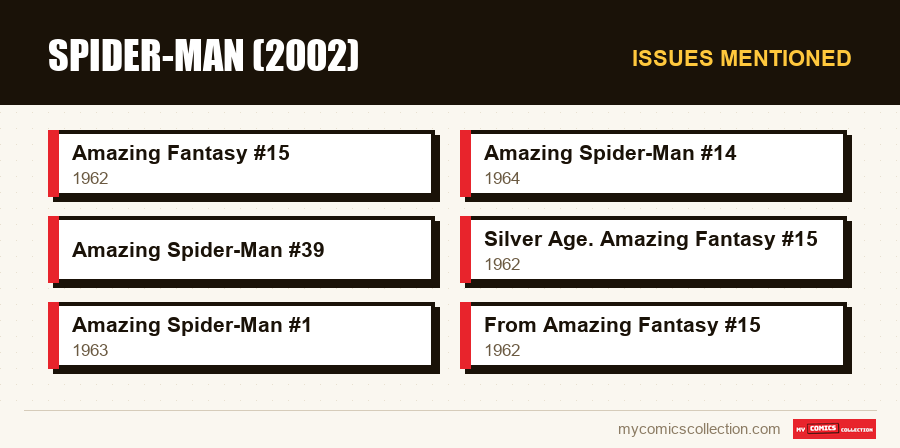
Amazing Fantasy #15 (1962): Spider-Man's first appearance (Lee & Ditko)
Amazing Spider-Man #14 (1964): 1st appearance of the Green Goblin
Amazing Spider-Man #39-40 (1966): Norman Osborn Unmasked
The Peter/MJ/Harry triangle: the human heart of the myth
- La spider bite which transforms Peter Parker.
- La death of uncle Ben and the lesson of responsibility.
- The motto “with great power comes great responsibility».
- Le Daily Bugle and J. Jonah Jameson.
- Le Green Goblin, Norman Osborn, and the drama of the Osborns.
- THE organic webs, while Peter invents mechanical web shooters in the comics.
- A genetically modified spider, and not radioactive.
- Mary Jane becomes the first high school love interest, a role similar to that of Gwen Stacy.
- Le armored suit of the Green Goblin, very different from the outfit in the comics.
- La chronology narrowed down from the origins to fit into a film.
Amazing Fantasy #15 (1962): the origins of Spider-Man
It all begins in Amazing Fantasy #15 (1962), where Stan Lee and Steve Ditko give birth to Spider-Man. Peter Parker, a gifted but marginal teenager, is bitten by an irradiated spider during a scientific demonstration and acquires prodigious powers. At first tempted to take advantage of it, he lets a burglar escape who, shortly after, kills his uncle Ben. Wracked with guilt, Peter learns the lesson that will define his entire life: “with great power comes great responsibility.” This founding story, one of the most famous in the history of comics, is the exact basis of Raimi's film, which respects both the letter and the spirit.
The great fidelity of the film lies in this moral structure. Peter is not a hero by vocation but by remorse: it is by failing in his duty that he learns responsibility. Raimi preserves each stage (the bite, the temptation, Ben's death, the awakening of conscience) with an emotion that shocked the audience. The film, however, modernizes a few details: the spider is no longer radioactive but genetically modified, an adjustment to the tastes of the early 2000s. Essentially, the myth remains intact, transmitted from a generation of readers to a generation of spectators.
Web shooters: mechanical or organic?
The most debated difference among fans concerns the canvases. In the comics, Peter Parker, a scientific genius, invents his own web shooters: mechanical devices worn on the wrists, powered by a fluid of his own design. This detail is essential in the comic, because it illustrates the character's ingenuity and introduces a recurring dramatic tension: the fear of running out of fluid in the middle of combat. Raimi's film makes the opposite choice: Peter develops organic glands and projects his webs directly from his wrists, like a real spider.
This change, motivated by a concern for verisimilitude on screen, has caused a lot of ink to flow. It simplifies the origin, no need to explain how a high school student designs cutting-edge technology, but erases a character trait dear to readers. Later films will also return to mechanical web shooters, more faithful to the comics. This back and forth illustrates the constant trade-offs of adaptation: between fidelity to the material and readability for the general public, each production draws its own line.
The Green Goblin, Norman Osborn and the Osborn drama
The film pits Spider-Man against his most iconic enemy: the Green Goblin. In the comics, the latter appears in Amazing Spider-Man #14 (1964), his identity remaining a mystery for a long time before being revealed in Amazing Spider-Man #39-40 (1966): he is Norman Osborn, industrialist and father of Harry, Peter's best friend. This revelation is one of the most significant in the saga, because it places the enemy at the very heart of the hero's intimate life. The film faithfully repeats this configuration: Norman Osborn, played by Willem Dafoe, is both a father figure for Peter and the monster who stalks him.
Raimi also retains the madness of the character, his dual personality, and the drama that tears the Osborns apart. Harry, consumed by resentment, later becomes an enemy in his turn: a trajectory faithful to the comics. The main freedom concerns appearance: the Green Goblin in the film wears closed green armor, where the comics gave him a grimacing face and a more theatrical outfit. This aesthetic choice, often criticized, does not undermine the fidelity to the character on the merits: the Jester remains the intimate enemy par excellence, the one who strikes Peter in his affections.
Collecting this series?
Track what you own, what you are missing and what your collection is worth. 7 day trial.
Start my trial →The characters, from paper to screen
- Peter Parker / Spider-Man: Gifted and marginal teenager, hero out of guilt, faithful to Amazing Fantasy #15.
- Norman Osborn / the Green Goblin: Father figure and close enemy, revealed in Amazing Spider-Man #39-40.
- Mary Jane Watson: First love of the film, in a role similar to that of Gwen Stacy in the comics.
- Harry Osborn: Best friend of Peter, son of Norman, future enemy.
- J. Jonah Jameson: The thunderous boss of the Daily Bugle, faithful incarnation of the character from the comics.
Mary Jane, Gwen Stacy and first love
A notable choice of the film concerns Peter's love interest. In the comics, at the time of high school and then the beginning of university, Peter's great love is first Gwen Stacy, before Mary Jane Watson takes this place. Raimi's film partly merges these trajectories: Mary Jane becomes the neighbor and the first high school love, occupying a narrative function that the comics reserved for Gwen. This shortcut, dictated by the constraints of a condensed story, favors the most famous character of the saga to the detriment of the exact chronology of the comics.
This choice has consequences for the entire Raimi trilogy, where Mary Jane occupies the central role of thwarted love. The famous scene of the kiss in the rain, which has become iconic, crystallizes this place. Long-time readers saw this as a departure from the comics, where the love triangle unfolds differently. But from the point of view of cinema, the simplification is understandable: concentrating the emotion on a single figure reinforces the dramatic impact. The film thus assumes a rereading of the myth, faithful to its spirit if not to its letter.
A founding film for the genre
Beyond its fidelity to the comics, Raimi's Spider-Man occupies a crucial place in the history of superhero cinema. Released in 2002, it proved that a faithful, sincere and emotionally invested adaptation could achieve immense public success. His triumph paved the way for the wave of superhero films of the following decades. By taking the Spider-Man mythos seriously, respecting its moral heart and its characters, Raimi showed that these stories deserved to be brought to the screen with ambition and respect.
For readers, this film was also a gateway to comics. Many discovered, after seeing it, the founding stories of Lee and Ditko, the origin in Amazing Fantasy #15, the first confrontations with the Green Goblin. The film thus played the role of a conduit, connecting the general public to a rich comic book heritage spanning four decades. This circulation between screen and paper, to the benefit of both, illustrates the best of what a successful adaptation can offer.
Where to start reading
To extend the film, Amazing Fantasy #15 (1962) is the absolute starting point: the origin of Spider-Man in a few unforgettable pages. The first issues of Amazing Spider-Man, from 1963, developed the hero's universe and introduced his enemies, including the Green Goblin in #14 (1964). The revelation of Norman Osborn's identity, in #39-40 (1966), is a peak in the story. This journey covers the sources of a film deeply faithful to the founding myth.
Chronology of comics to know
- 1962: Amazing Fantasy #15: The first appearance and origin of Spider-Man.
- 1964: Amazing Spider-Man #14: The Green Goblin's first appearance.
- 1966: Amazing Spider-Man #39-40: Norman Osborn unmasked.
Collection side: what numbers to aim for after the film
Spider-Man points to major keys to the Silver Age. Amazing Fantasy #15 (1962, first appearance of Spider-Man) is one of the most sought-after and valuable comics in history, an absolute holy grail. Amazing Spider-Man #14 (1964, premiere of The Green Goblin) is an important and more accessible key. Amazing Spider-Man #1 (1963) remains a must-have in any collection. These targets cover a wide variety of budgets, from the inaccessible grail to the coveted but achievable number. As always, condition and gradation determine value; relying on real recent sales is strongly recommended.
Its place in the saga and for the collector
Raimi's Spider-Man brought the founding myth of the hero to the screen with a fidelity and emotion that marked an entire generation. For the collector, it permanently revived interest in Amazing Fantasy #15 and the first Amazing Spider-Man. It illustrates the considerable effect of successful adaptations on the market. Beyond speculation, the film invites us to discover the founding stories of Lee and Ditko, these pages where one of the most beloved characters in popular culture is born. By respecting the moral heart of the myth, he ensured its transmission, from paper to screen and from screen to paper.
The verdict: a myth faithfully brought to the screen
- Loyalty: the origin, Uncle Ben, the motto, the Daily Bugle and the Green Goblin (Norman Osborn) come directly from the comics.
- Freedoms: the organic webs, the genetically modified spider, Mary Jane in a role close to Gwen, the armored costume of the Jester.
- Collectible numbers: Amazing Fantasy #15 (Spider-Man), Amazing Spider-Man #14 (Green Goblin), Amazing Spider-Man #1.
Sam Raimi's Spider-Man faithfully transposes the founding myth of the hero, from bite to responsibility, by only adjusting a few details like the organic webs. True to its characters and its moral core, the film redefined superhero cinema. For both the reader and the collector, it is an invitation to discover Amazing Fantasy #15 and the founding stories of Lee and Ditko.
Frequently asked questions
From Amazing Fantasy #15 (1962), created by Stan Lee and Steve Ditko. Peter Parker is bitten by an irradiated spider and learns, after the death of his uncle Ben, that “with great power comes great responsibility”. The film respects the essentials.
A Sam Raimi choice for verisimilitude: Peter develops organic glands. In the comics, on the contrary, he invents mechanical web shooters, a sign of his genius. Later films would revert to this version.
Norman Osborn, industrialist and father of Harry, Peter's best friend. He appears in Amazing Spider-Man #14 (1964) and is unmasked in #39-40 (1966). The film faithfully portrays this intimate enemy, played by Willem Dafoe.
The film partly merges the roles: Mary Jane becomes the first high school sweetheart, a function that the comics initially reserved for Gwen Stacy. A shortcut dictated by the constraints of a condensed story.
Amazing Fantasy #15 (1962, first appearance of Spider-Man) is the absolute grail. Other major, more accessible targets are Amazing Spider-Man #14 (Green Goblin) and Amazing Spider-Man #1 (1963).
Does the film make you want to collect? Estimate the value for free of your issues (Amazing Fantasy #15, Amazing Spider-Man #14…) with our tool based on current eBay listings.