The Amazing Spider-Man 2 (2014) Marc Webb pits the hero against Electro (Amazing Spider-Man #9, 1964) and Green Goblin (Harry Osborn), and stages the death of Gwen Stacy, a copy of the cult story Amazing Spider-Man #121 (1973). The film remains faithful to this founding drama but strongly modernizes Electro and accumulates intrigues. Here is the detailed comparison, film versus comics.
Following Marc Webb's reboot, The Amazing Spider-Man 2 brings to the screen one of the most tragic and memorable stories in the hero's history: the death of Gwen Stacy. It draws from several iconic numbers. Source-by-source decryption.
As in each article in this series, only verified information (creators, distribution, dates, comic numbers) is stated; the comparative analysis is ours, without reproducing dialogue or protected images.
Title : The Amazing Spider-Man 2 (2014)
Director: Marc Webb
Actors: Andrew Garfield, Emma Stone (Gwen), Jamie Foxx (Max Dillon), Dane DeHaan (Harry Osborn), Paul Giamatti (Rhino)
Exit : April-May 2014
Studio: Columbia Pictures (Sony)
Amazing Spider-Man #9 (1964): Electro's first appearance
Amazing Spider-Man #121 (1973). The Death of Gwen Stacy
Amazing Spider-Man #41 (1966): Rhino's first appearance
The Green Goblin: Harry Osborn, Heir to the Mask
- La death of Gwen Stacy, decal from Amazing Spider-Man #121.
- La fatal fall which Spider-Man fails to prevent.
- Electro, the electricity man, as an enemy.
- Harry Osborn became the Green Goblin.
- Le Rhino, brute with characteristic shielding.
- Electro radically modernized (invisible engineer, blue energy).
- Gwen falls from a clock tower, not from the comic book bridge.
- Harry becomes the Jester very quickly, precipitating the drama.
- Le Rhino reduced to mechanical armor at the end of the film.
- A accumulation of intrigue which dilutes the story.
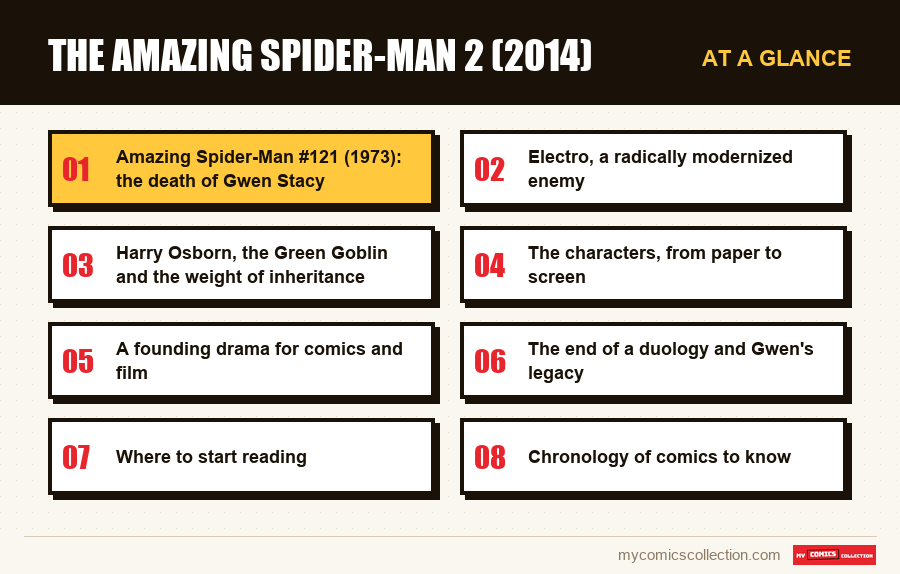
Amazing Spider-Man #121 (1973): the death of Gwen Stacy
The film's tragic climax draws from one of the most famous and heartbreaking stories in comic book history: Amazing Spider-Man #121 (1973), "The Night Gwen Stacy Died," by Gerry Conway, Gil Kane and John Romita. In this issue, the Green Goblin throws Gwen off a bridge; Spider-Man tries to catch her with his web, but the sudden stop of the fall breaks his neck. This outcome, of unprecedented brutality for the time, marked a turning point in comics: the death of a beloved character, whom the hero fails to save, shifted the medium towards a new gravity.
The film faithfully reproduces this drama, with rare emotional power. Gwen falls, Spider-Man launches his web, and the dead stop seals his fate. This scene, considered the pinnacle of Marc Webb's duology, honors the spirit and letter of the 1973 story. The main difference is the setting: Gwen falls from a clock tower and not from the George Washington Bridge in the comics. But the essential (the failure of the hero, the crushing responsibility, the irreparable loss) is transposed with a fidelity and an emotion which shocked the audience.
Electro, a radically modernized enemy
The film's main antagonist, Electro, appears in Amazing Spider-Man #9 (1964), created by Stan Lee and Steve Ditko. In the comics, Max Dillon is an electrical technician transformed by an accident into a man capable of generating and controlling electricity, sporting a distinctive green and yellow costume and a mask shaped like lightning bolts. The film profoundly modernizes the character: Max Dillon is a solitary and invisible engineer, obsessed with Spider-Man, transformed after a fall into a vat of electric eels into a creature of blue energy with a translucent body.
This rereading, visually very distant from the comics, illustrates the temptation to reinvent classic villains for the cinema. Jamie Foxx plays an Electro whose loneliness and resentment fuel the threat. If the origin (the electrical accident, the power over the current) remains faithful to the principle of the character, the appearance and psychology are largely rethought. This choice, in keeping with the times, divided fans, between those who welcomed modernization and those who regretted the abandonment of the colorful and emblematic imagery of Electro comics.
Harry Osborn, the Green Goblin and the weight of inheritance
The film also features Harry Osborn, Peter's childhood friend, who becomes the Green Goblin. In the comics, Harry inherits the madness and mask of his father Norman after a long descent, becoming the second Green Goblin. The film strongly condenses this trajectory: Harry, sick and desperate, transforms into the Jester in a few scenes, before precipitating the drama by attacking Gwen. This acceleration, dictated by the format, sacrifices the slow tragedy of the Osborns in favor of a rapid shift towards the fatal confrontation.
This shortcut illustrates the film's difficulty in balancing its many plots. By wanting to introduce Electro, develop Harry and the Jester, initiate the Rhino and continue the mystery of Peter's parents, the story becomes scattered. Like Spider-Man 3 before it, The Amazing Spider-Man 2 suffers from too much ambition. The Green Goblin, although central to Gwen's destiny, appears precipitated. Basically, Harry remains faithful to his role as friend turned enemy and cursed heir; it is his condensed treatment that weakens the impact of the character.
The characters, from paper to screen
- Peter Parker / Spider-Man: Hero crushed by responsibility and grief, true to the spirit of Amazing Spider-Man #121.
- Gwen Stacy: Love of Peter, whose death follows the cult story of 1973.
- Max Dillon / Electro: Invisible engineer turned energy creature, radically modernized.
- Harry Osborn / the Green Goblin: Friend turned enemy, whose trajectory is highly condensed.
- Aleksei / the Rhino: Brute reduced to mechanical armor at the end of the film.
Collecting this series?
Track what you own, what you are missing and what your collection is worth. 7 day trial.
Start my trial →A founding drama for comics and film
The death of Gwen Stacy is not a trivial event in the history of comics: it is often cited as the end of the Silver Age and the shift towards a darker era. By daring to kill a central character, whom the hero loves and fails to save, Amazing Spider-Man #121 broke a taboo and redefined the stakes of the genre. For Spider-Man, this mourning is a founding wound, which forever deepens the tragic dimension of the character: even with his powers, he cannot save everyone, and his responsibility has a terrible price.
By bringing this story to the screen with fidelity and gravity, The Amazing Spider-Man 2 offered the general public one of the most poignant moments of the saga. The scene of the fall, faithful to the spirit of 1973, will remain as the culmination of Marc Webb's duology, beyond the flaws of the film. For the reader, it is an invitation to discover the original story, this issue that made generations cry and changed the way superheroes are told. The film proves that a drama born in comics can retain all its strength in another medium decades later.
The end of a duology and Gwen's legacy
The Amazing Spider-Man 2 was to launch a vast extended universe around the hero; it paradoxically marked its end. The film's mixed reception led to a complete rethinking of Spider-Man's future in cinema, closing Marc Webb's duology on an unfinished note. This abrupt conclusion does not erase the power of its central scene: the death of Gwen Stacy, transposed with rare fidelity and emotion, remains one of the peaks of all adaptations of the hero. She reminds us that, even in a criticized film, a great comic moment can retain all its force.
For readers, the film's legacy lies in this transposition of a founding drama. By daring to kill Gwen on screen, faithful to the 1973 story, he introduced a huge audience to one of the most important turning points in the history of comics. Emma Stone delivers an interpretation that left its mark, honoring a central character in Peter's mythology. Beyond its flaws, The Amazing Spider-Man 2 will therefore have brought to the screen an essential page of the saga, and reminded that the greatness of Spider-Man is also measured by his mourning. It is this tragic part, born in the comics, which continues to define the hero from film to film.
Where to start reading
To extend the film, Amazing Spider-Man #121 (1973), “The Night Gwen Stacy Died,” is a must-read and one of the hero's tragic high points. Amazing Spider-Man #9 (1964) introduced Electro, and #41 (1966) introduced the Rhino. The stories from the Conway period develop Peter's grief and its aftermath. This journey covers the sources of a film faithful to its central drama despite its overflow of intrigue.
Chronology of comics to know
- 1964: Amazing Spider-Man #9: Electro's first appearance.
- 1966: Amazing Spider-Man #41: The Rhino's first appearance.
- 1973: Amazing Spider-Man #121: The Death of Gwen Stacy.
Collection side: what numbers to aim for after the film
The Amazing Spider-Man 2 points to some major keys. Amazing Spider-Man #121 (1973, death of Gwen Stacy) is a cult and highly sought-after issue, one of the hero's most memorable stories. Amazing Spider-Man #9 (1964, premiere of Electro) is a key to the Silver Age, and the #41 (1966, Rhino premiere) another popular target. These issues cover various budgets, from the Silver Age to the Bronze Age. As always, condition and gradation determine value; relying on real recent sales is strongly recommended.
Its place in the saga and for the collector
The Amazing Spider-Man 2 brought to the screen the death of Gwen Stacy, one of the hero's founding dramas, with praised fidelity and emotion, despite an overloaded narrative. For the collector, it revived interest in Amazing Spider-Man #121, a cult favorite of the Bronze Age, and in Electro. It illustrates the effect of adaptations on the market. Beyond speculation, the film invites you to discover the original story from 1973, this issue which redefined the issues of the genre. By transposing this mourning, he reminds us that the greatness of Spider-Man lies in his tragic side, born in the comics.
The verdict: a faithful drama, an overstuffed film
- Loyalty: the death of Gwen Stacy (decal from Amazing Spider-Man #121), the fatal fall, Electro and Harry as the Green Goblin come from the comics.
- Freedoms: Radically modernized electro, the fall of a clock tower, Harry's condensed trajectory, the reduced Rhino, the accumulation of intrigue.
- Collectible numbers: Amazing Spider-Man #121 (death of Gwen), Amazing Spider-Man #9 (Electro), Amazing Spider-Man #41 (Rhino).
The Amazing Spider-Man 2 transposes with fidelity and emotion the death of Gwen Stacy, the hero's tragic peak, but is weighed down by an overflow of enemies and intrigues. Faithful to its central drama, the film strongly modernizes Electro and condenses Harry's trajectory. For the reader as well as the collector, it is an invitation to discover Amazing Spider-Man #121, one of the most significant stories in the history of comics, this issue which shifted an entire medium towards more seriousness and proved that no character, no matter how beloved, was safe from drama. A founding story whose shockwave, more than fifty years after its publication, continues to resonate in comics and in cinema.
Frequently asked questions
Yes: it transfers Amazing Spider-Man #121 (1973), “The Night Gwen Stacy Died”, by Conway, Kane and Romita. The Jester throws her into the void and Spider-Man fails to save her. The film respects the essentials, changing the setting.
The film radically modernizes the character: Max Dillon, an invisible engineer obsessed with Spider-Man, becomes a creature of blue energy. In the comics (Amazing Spider-Man #9, 1964), he wears an iconic green and yellow costume.
In the film, she falls from a clock tower; in the comics, from the George Washington Bridge. But the essential point, the hero's failure to prevent the fatal fall, is faithfully transposed.
For its accumulation of intrigues: Electro, Harry as Jester, the Rhino, the mystery of the parents... The story disperses, like Spider-Man 3 before it. Gwen's death, however, remains a welcomed high point.
Amazing Spider-Man #121 (1973, death of Gwen Stacy) is a cult issue to aim for. Amazing Spider-Man #9 (Electro) and #41 (Rhino) are other keys to the Silver Age.
Does the film make you want to collect? Estimate the value for free of your issues (Amazing Spider-Man #121, #9…) with our tool based on current eBay listings.