The Amazing Spider-Man (2012) Marc Webb , with Andrew Garfield, relaunches the hero in the cinema by opposing him to Lizard (Curt Connors), appeared in Amazing Spider-Man #6 (1963). The film returns to elements faithful to the comics:Gwen Stacy (Amazing Spider-Man #31, 1965) as his first love, the mechanical web shooters, Captain Stacy: while adding an original mystery surrounding Peter's parents. Here is the detailed comparison, film versus comics.
Rebooting the saga at the cinema, The Amazing Spider-Man offers a closer rereading of certain details from the comics, starting with Gwen Stacy. He draws on the stories of Lee, Ditko and Romita. Source-by-source decryption.
As in each article in this series, only verified information (creators, distribution, dates, comic numbers) is stated; the comparative analysis is ours, without reproducing dialogue or protected images.
Title : The Amazing Spider-Man (2012)
Director: Marc Webb
Actors: Andrew Garfield (Peter Parker), Emma Stone (Gwen Stacy), Rhys Ifans (Curt Connors), Denis Leary (Captain Stacy)
Exit : July 2012
Studio: Columbia Pictures (Sony)
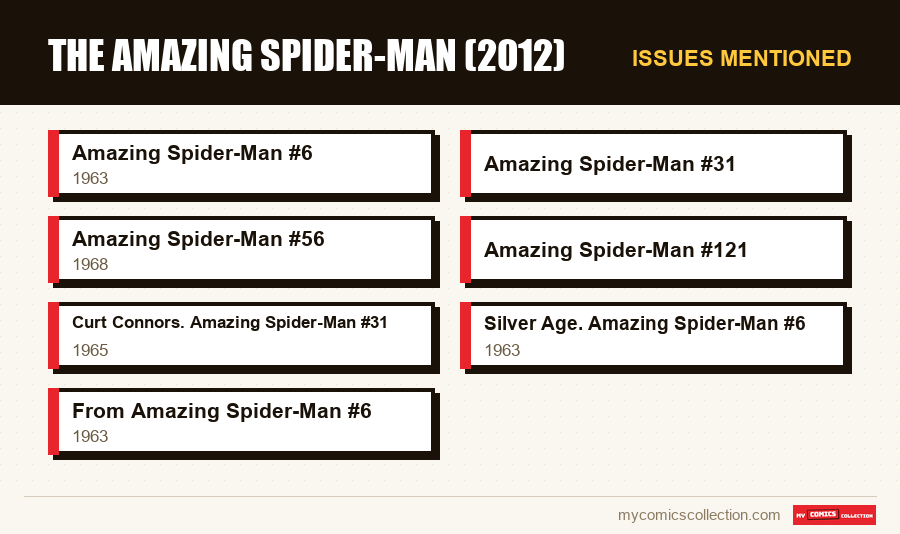
Amazing Spider-Man #6 (1963): 1st appearance of the Lizard
Amazing Spider-Man #31 (1965): Gwen Stacy's first appearance
Amazing Spider-Man #56 (1968): Captain Stacy's first appearance
Mechanical web shooters: Peter's inventive genius
- Gwen Stacy as Peter's first love, faithful to the comics.
- THE mechanical web launchers, a return to Peter's inventive genius.
- Curt Connors, a learned penguin who becomes the Lizard.
- Le Captain Stacy, father of Gwen, and his tragic end.
- Le high school student photographer, marginal and gifted.
- Le mystery of Peter's parents (Richard Parker), greatly amplified.
- Peter becomes more rebel and skater, far from the shy geek.
- Connors linked to the research of Peter's parents, an invention of the film.
- The origin Oscorp centralizes spider, lizard and relatives.
- Uncle Ben's motto, reformulated and not cited as is.
Amazing Spider-Man #6 (1963): Curt Connors and the Lizard
The film's nemesis, the Lizard, appears in Amazing Spider-Man #6 (1963), created by Stan Lee and Steve Ditko. Doctor Curt Connors is a brilliant scientist, an amputee, who seeks to regenerate his limbs by drawing inspiration from the biology of reptiles. His experimental serum transforms him into a monstrous creature, the Lizard, dominated by a reptilian instinct. The drama of the character lies in this duality: a good man, a father and a friend, prisoner of a beast that he himself awakened. The film faithfully respects this origin and this tension between the human and the monster.
Rhys Ifans plays a tortured Connors, whose quest for healing turns into a nightmare. The film, however, adds a new link: Connors is presented as the former colleague of Peter's parents, linking the Lizard to the hero's family mystery. This connection, absent from the comics, serves the new mythology of the film, centered on Oscorp and the past of Richard Parker. On the character himself, the idealistic scientist caught up in his creation, the film nevertheless remains faithful to the spirit of the Lizard from the comics.
The return of Gwen Stacy and the mechanical web shooters
Where Raimi's trilogy made Mary Jane Peter's first love, The Amazing Spider-Man returns to the comics timeline by placing Gwen Stacy at the center. Gwen appears in Amazing Spider-Man #31 (1965) and becomes, before Mary Jane, the great love of Peter's youth. The film respects this precedence: Emma Stone plays a brilliant Gwen, an intern at Oscorp, whose relationship with Peter is the emotional heart of the story. This return to the source will delight readers attached to the importance of Gwen in the mythology of the hero.
The film also corrects another deviation from the previous trilogy by reinstating the mechanical web shooters. In the comics, Peter, a scientific genius, designs these wrist-worn devices himself: an essential trait of his ingenuity. The film shows him tinkering with his web shooters, faithful to this inventive dimension. This choice, praised by fans, reaffirms that Spider-Man is not just a body with powers, but a scientific mind. Returning to Gwen and the mechanical web shooters, the film assumes a closer rereading of certain fundamentals of the comics.
The mystery of Peter's parents, an invention of the film
The main freedom of the film lies in the intrigue around Peter's parents, Richard and Mary Parker. In the comics, these characters exist but remain secondary; on the contrary, the film makes it the driving force behind a central mystery, linking the disappearance of the parents, Oscorp's research and the very origin of Peter's powers. This plot, largely invented, aims to give new depth to the character and to distinguish the reboot from Raimi's trilogy. It refocuses the universe around Oscorp, presented as the source of the spider, the Lizard and Peter's destiny.
This choice was divisive. Some saw it as a welcome enrichment, others as an unnecessary complication of an origin that its simplicity made universal. Because in the comics, Spider-Man's strength lies precisely in his ordinary nature: Peter is not the chosen one of a secret destiny, but an average teenager struck by chance and educated by grief. By adding a family mystery, the film moves away from this dimension. It nevertheless remains faithful to the heart of the character (the gifted high school student, the responsibility, the loss of Uncle Ben) even if the motto is not quoted word for word.
Collecting this series?
Track what you own, what you are missing and what your collection is worth. 7 day trial.
Start my trial →The characters, from paper to screen
- Peter Parker / Spider-Man: Gifted high school student but more rebellious, faithful to the essentials despite a revisited temperament.
- Gwen Stacy: Peter's first love, true to his place in the comics (Amazing Spider-Man #31).
- Curt Connors / the Lizard: Amputee scientist caught up in his creation, faithful to Amazing Spider-Man #6.
- Captain George Stacy: Father of Gwen, police officer, whose tragic end comes from the comics.
- Richard Parker: Father of Peter, at the heart of a mystery largely invented for the film.
Captain Stacy and the Weight of Responsibility
A key character in the film is Captain George Stacy, father of Gwen, who appeared in Amazing Spider-Man #56 (1968). An honest police officer, he embodies authority and morality, and his relationship with Peter is marked by distrust then respect. In the comics, his death, caused indirectly by a confrontation with Spider-Man, is a tragic milestone in the saga, which foreshadows other losses. The film faithfully reproduces this ending and its stake: before dying, Captain Stacy extracts from Peter the promise to keep Gwen away from danger, sowing the seeds of a heartbreaking dilemma.
This promise, faithful to the spirit of the comics, places responsibility at the heart of the story. Peter, already haunted by the death of Uncle Ben, finds himself imposed a new burden: to protect the one he loves by perhaps giving up on her. This theme, responsibility as a source of loving sacrifice, is one of the most powerful in the Spider-Man mythology, and sets up the drama that the sequel will unfold. By developing Captain Stacy and his promise, the film anchors its story in the great moral tensions of the comics.
A reboot in the shadow of Raimi's trilogy
The Amazing Spider-Man arrived in a difficult position: reviving a hero that the general public still associated with Sam Raimi's trilogy, completed only five years earlier. This context weighed on its reception. Many viewers compared the film to its predecessor, deeming a new origins story redundant. However, the reboot had its own biases: a darker and adolescent tone, a more tormented Peter, and above all a return to elements dear to readers, like Gwen Stacy and mechanical web shooters. These choices demonstrated a desire to get closer, on certain points, to the letter of the comics.
The critically acclaimed chemistry between Andrew Garfield and Emma Stone was one of the film's greatest strengths. Their relationship, at the heart of the story, honors Gwen's importance in Peter's mythology and sets up the drama that the sequel will unfold. For readers, this reboot had the merit of bringing to light characters and issues that the previous trilogy had left aside. If he was not unanimous, he recalled that there are several faithful ways of adapting a hero as rich as Spider-Man, and that each rereading can shed light on a different aspect of the myth.
Where to start reading
To extend the film, Amazing Spider-Man #6 (1963) introduced the Lizard and the drama of Curt Connors. Amazing Spider-Man #31 (1965) marks the first appearance of Gwen Stacy, and #56 (1968) that of Captain Stacy. The great stories of the Lee-Romita period develop the relationship between Peter and Gwen. This journey covers the sources of a film which returns to several fundamentals of the comics, from Gwen to mechanical web shooters.
Chronology of comics to know
- 1963: Amazing Spider-Man #6: The Lizard's first appearance.
- 1965: Amazing Spider-Man #31: Gwen Stacy's first appearance.
- 1968: Amazing Spider-Man #56: Captain Stacy's first appearance.
Collection side: what numbers to aim for after the film
The Amazing Spider-Man points to keys to the Silver Age. Amazing Spider-Man #6 (1963, first appearance of the Lizard) is a sought-after number in the hero's gallery of enemies. Amazing Spider-Man #31 (1965, first appearance of Gwen Stacy) is an important key, whose rating is driven by the central role of the character. Amazing Spider-Man #56 (1968, Captain Stacy) completes the set. These targets cover varied budgets within the Silver Age. As always, condition and gradation determine value; relying on real recent sales is strongly recommended.
Its place in the saga and for the collector
The Amazing Spider-Man relaunched the hero in the cinema by returning to several fundamentals of the comics, starting with Gwen Stacy and mechanical web shooters. For the collector, it highlighted Amazing Spider-Man #6 and #31, keys to the Silver Age. It illustrates the effect of adaptations on the market, including for characters like Gwen or the Lizard. Beyond speculation, the film invites us to discover the stories of Lee, Ditko and Romita, where the great love story of Peter's youth is written. By placing Gwen back at the center, he prepares the drama that the sequel will bring to the screen.
The verdict: a reboot close to certain fundamentals
- Loyalty: Gwen Stacy as first love, mechanical web shooters, Curt Connors / the Lizard and Captain Stacy come from the comics.
- Freedoms: the mystery of Peter's parents, a more rebellious hero, Connors linked to Richard Parker, the centrality of Oscorp.
- Collectible numbers: Amazing Spider-Man #6 (Lizard), Amazing Spider-Man #31 (Gwen Stacy), Amazing Spider-Man #56 (Captain Stacy).
The Amazing Spider-Man revives the hero by returning to fundamentals dear to readers (Gwen Stacy, mechanical web shooters, the Lizard) while adding a largely invented family mystery. Faithful to the heart of the character and his great moral tensions, the film assumes its rereading. For both the reader and the collector, it is an invitation to discover Amazing Spider-Man #6 and #31, two keys to the Silver Age.
Frequently asked questions
From Amazing Spider-Man #6 (1963), created by Stan Lee and Steve Ditko. Dr. Curt Connors, amputee scientist, transforms into a Lizard while seeking to regenerate his arm. The film faithfully respects this origin and the duality of the character.
The film returns to the chronology of the comics: Gwen Stacy (Amazing Spider-Man #31, 1965) is the first love of Peter's youth, before Mary Jane. Emma Stone plays him at the emotional heart of the story.
Yes: the film restores the mechanical web shooters from the comics, which Peter designed himself, as opposed to the organic webs of Raimi's trilogy. A return to the inventive genius of the character, praised by fans.
It is greatly amplified for the film. Richard and Mary Parker exist in the comics but remain secondary. The film makes it a central mystery linked to Oscorp, which has divided fans.
Amazing Spider-Man #6 (1963, Lizard) and Amazing Spider-Man #31 (1965, Gwen Stacy's first) are two Silver Age keys to aim for. #56 (Captain Stacy) completes the set.
Does the film make you want to collect? Estimate the value for free of your issues (Amazing Spider-Man #6, #31…) with our tool based on current eBay listings.