Morbius the Living Vampire first appears in The Amazing Spider-Man #101 (October 1971), created by screenwriter Roy Thomas and artist Gil Kane. Nobel Prize-winning biochemist Michael Morbius is transformed into a pseudo-vampire after a failed experiment intended to cure a rare blood disease. The character then carried his own series (Vampire Tales, Adventure into Fear, then a first ongoing in 1992 with the Midnight Sons) before being adapted for the cinema in 2022 with Jared Leto, a film which remains, despite its critical failure, an accelerator of interest in the original comics.
There are few characters in the Marvel catalog whose genesis owes as much to a specific regulatory change as Morbius. Without the Comics Code Authority's review in February 1971, which lifted the ban on vampires, werewolves and other creatures of the night in mainstream comics, the cursed biochemist simply would not have existed in this form in the pages of Amazing Spider-Man. This very dated editorial context largely explains why Morbius occupies a special place in the Spider-Man mythology: neither a classic supervillain, nor a supernatural monster, but a scientist victim of his own science, in line with the "laboratory accident" origins dear to Stan Lee.
This article traces the complete editorial history of the character, from its creation in 1971 to its most recent adaptations, based on the creative credits, publication dates and verifiable facts which today structure the collection around Morbius comics.
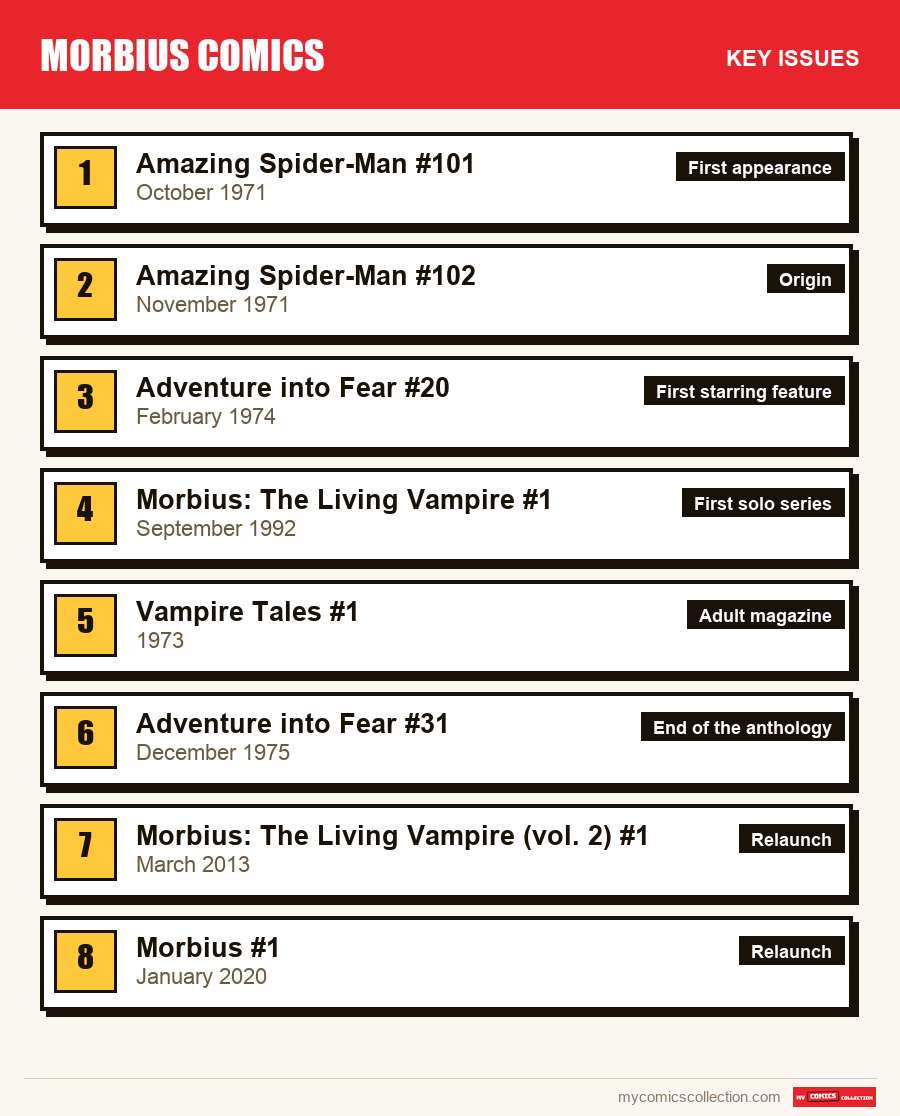
For collectors seeking to locate a specific issue in this chronology, or to value a piece found at a flea market, the following benchmarks help distinguish truly significant milestones from simple reprints or secondary appearances.
1971: the birth of a scientific vampire in Amazing Spider-Man
Morbius the Living Vampire debuts in The Amazing Spider-Man #101, dated October 1971. The outcome is part of a three-part arc, the famous "Six Arms Saga", which runs over issues #100 to #102 (September to November 1971) and whose drawing is entrusted to Gil Kane, accompanied by inking by Frank Giacoia. This saga remains best known for its improbable starting point: Peter Parker, seeking to permanently get rid of his spider powers using a chemical cocktail of his invention, wakes up with four extra arms instead of losing his abilities. It is in this context that Morbius emerges, literally at the moment when Spider-Man, a six-armed mutant, is desperately looking for a cure.
Issue #101 also marks a precise editorial break: it is the first episode of the flagship Spider-Man series which is not written by Stan Lee himself, then editor-in-chief of Marvel, mobilized on the writing of a science fiction film script which will never see the light of day. Lee entrusts the pen of the series to his close collaborator Roy Thomas, who thus becomes, with this issue, the new regular screenwriter of Amazing Spider-Man. It is therefore Thomas, in a creative partnership with Gil Kane, who designs Morbius: the two men consider it more coherent, for a series anchored in a universe where powers are explained by science rather than magic, to create an antagonist endowed with pseudo-vampiric traits of scientific origin rather than a classic supernatural vampire à la Dracula. Gil Kane draws the angular face and knife-cut features of Morbius, taking direct inspiration from the actor Jack Palance, a physical reference immediately recognizable to readers of the time.
The choice of timing is not a coincidence. In February 1971, the Comics Code Authority relaxed its historically strict rules on horror, once again allowing the depiction of vampires, werewolves and similar creatures, provided they were treated "in the literary tradition" of Mary Shelley, Bram Stoker or Edgar Allan Poe. This revision opens the way in a few months to a whole wave of horrific characters at Marvel: Morbius is one of the very first beneficiaries on the superhero side, almost at the same time as the launch of the series. Tomb of Dracula. The distinction is, however, fundamental to understanding the character: where Dracula is pure supernatural, Morbius remains a product of science, which allows him to remain credible in the logical universe of Spider-Man while exploring gothic themes new for the title.
Michael Morbius, cursed biochemist: an origin that contrasts with the codes of the classic vampire
Michael Morbius' origin story, developed in #101 then completed in subsequent issues, is based on a precise scientific postulate. Morbius is presented as an internationally renowned, Nobel Prize-winning biochemist suffering from a rare and incurable blood disease. Refusing to give up, with the help of a laboratory assistant, he develops an experimental treatment combining electroshocks and a serum derived from vampire bats, in the hope of regenerating his blood. The experiment turns into a disaster: instead of healing him, it transforms him into a creature with vampiric characteristics, endowed with superhuman strength, fangs, an irrepressible thirst for blood and an aversion to daylight, without however being mysticism.
Taken by a murderous madness during his first transformation, Morbius kills his own laboratory assistant. Consumed by guilt and refusing to harm his fiancée Martine Bancroft, he flees and throws himself into the ocean in an attempt to end his life. Picked up unconscious by the crew of a freighter, he wakes up at night and feeds on the blood of the sailors before fleeing again, horrified by his own actions. It is this tragic dimension, that of a brilliant man who becomes a monster in spite of himself and haunted by remorse, which immediately distinguishes Morbius from the classic villains of the time and which explains his lasting popularity: the reader is invited to feel empathy for a character who hates himself for what he has become.
From recurring threat to star of his own collection
After several returns in the pages of Amazing Spider-Man and of Marvel Team-Up in the early 1970s, Morbius quickly got its own stories. It first appears in Vampire Tales, a black-and-white magazine aimed at a more mature readership, published by Marvel's Curtis Magazines subsidiary between August 1973 and June 1975. Of the magazine's eleven issues, Morbius appears in nine of them; the first solo story is by Steve Gerber, with the majority of subsequent episodes being written by Don McGregor.
The character then gets his own regular color series within the anthology Adventure into Fear, from issue #20 (February 1974) to issue #31 (December 1975), the last issue of the series. This series saw the succession of several major screenwriters of the time: Mike Friedrich, Steve Gerber, Doug Moench, then Bill Mantlo, each bringing their own inflection to the character, between gothic horror and social criticism typical of 1970s comics.
1992: the first solo ongoing and the Midnight Sons era
It was not until September 1992 that Morbius finally got its first truly autonomous monthly series: Morbius, the Living Vampire, released under Marvel's horror imprint Midnight Sons, alongside titles like Ghost Rider , Darkhold or Nightstalkers. The series totaled 32 issues, until April 1995. Issue #1 was notably released in a polybag, accompanied by a mini-poster forming part of a six-part puzzle, "Rise of the Midnight Sons", assembled by combining the posters distributed in each of the crossover titles of the same month: a promotional process very characteristic of the comics market of the early 1990s.
The opening plot sees Ghost Rider and John Blaze recruit Morbius into the "Nine", while Fang, one of the Lilin, sabotages a cure that should have cured Morbius of his vampiric condition, instead transforming him into a half-Lilin hybrid. Issues #2 through #4 introduce the recurring character of Dr. Thaddeus Paine, as Morbius is hunted by Agent Simon Stroud while Spider-Man investigates his return. The series subsequently had two issues with a special all-black cover, marking Midnight Sons crossover chapters: #12, fourth chapter of "Midnight Massacre", and #16, fourth chapter of "Siege of Darkness", with a black cover enhanced with grayscale illustrations. This period marks an editorial turning point: Morbius gradually moves from the status of an ambiguous threat to that of a vigilant antihero, a figure of "cursed vigilante" who will remain associated with the character in the following decades.
Editorial attempts of the 2010s and 2020s
After the end of the first series in 1995, Morbius continued to appear occasionally in various Marvel titles before finding a series in his name in 2013, with a second volume of Morbius, the Living Vampire which totals nine numbers. A new attempt at relaunch took place in 2019, with a series of five issues which was interrupted in 2020, victim of the disruptions in the comics market linked to the COVID-19 pandemic, a period during which many Marvel titles saw their publication suspended or shortened. The character then returns occasionally in the form of a one-shot with Morbius: Bond of Blood in 2021, before cinema news sustainably revives interest in the character.
Collecting this series?
Track what you own, what you are missing and what your collection is worth. 7 day trial.
Start my trial →The impact of adaptations on the rating
Morbius had several on-screen incarnations long before his time in cinema as a headliner. The character appears notably in Spider-Man: The Animated Series in 1994, where he was voiced by Nick Jameson, then in a different version, employed by Hydra, within the series Ultimate Spider-Man from 2012. On the video game side, Morbius faces Spider-Man as a boss in Spider-Man 3 (2007), before becoming a playable character in DLC in Marvel Ultimate Alliance 3 (2019) then in Marvel's Midnight Suns (2022).
However, it is the film Morbius, released on April 1, 2022 in the United States, which had the most lasting impact on the general public's perception of the character. Directed by Daniel Espinosa for Sony within its "Spider-Man Universe" (SSU, universe of characters linked to Spider-Man but without the appearance of the hero himself), the film stars Jared Leto in the role of Michael Morbius and Matt Smith in that of Milo Morbius / Loxias Crown. Initially scheduled for July 2020, its release was postponed several times due to the pandemic. Produced for a budget estimated between $75 and $83 million, the film totaled $167.5 million in worldwide revenue: a result considered disappointing by the standards of the superheroic genre, compounded by a very negative critical reception.
The most singular episode in the film's career remains its theatrical release on June 3, 2022, decided by Sony after the unexpected virality of internet memes around the line "It's Morbin' time", which had given rise to a wave of collective irony around the film several weeks after its initial release. This second theatrical release ended in another commercial failure, with derisory daily revenues. The film also garnered five Razzie Award nominations, including Worst Picture, Jared Leto winning Worst Actor and Adria Arjona winning Worst Supporting Actress. In late 2024, it was reported that Sony was ending its Spider-Man Universe with Kraven the Hunter, effectively ruling out any prospect of a sequel for Morbius at the cinema.
For the comic collection, this episode illustrates a phenomenon well known to buyers of key issues: the release of an adaptation, even poorly received by critics, mechanically generates a peak in searches and purchases around the comic of the first appearance of the character concerned, here Amazing Spider-Man #101. The market also recorded, in 2022, a record sale for a copy of the issue rated CGC 9.8 (the highest grade awarded to date for this title), sold for $26,400 at auction. This result should not, however, be interpreted as a stable price level: the price of a first appearance comic remains very sensitive to the exact state of conservation, the CGC/CBCS grade assigned and the market situation at the time of sale, much more than just the performance of the film which revived attention to the character.
Buying guide
Building a coherent collection around Morbius requires distinguishing truly structuring milestones from the simple accumulation of secondary appearances. Here are the points to be aware of before any purchase:
- Identify the first appearance precisely : It is Amazing Spider-Man #101 (October 1971) which should be aimed for for the character's grail, and not the issues #100 or #102 which surround him in the Six Arms Saga and which do not introduce Morbius himself.
- Check the status of 1971 Bronze Age comics: at this age, common defects are yellowing of the paper, handling creases, moisture stains and wear on the spine; ask for the exact condition (raw grade or certified CGC/CBCS grade) before any distance purchase.
- Distinguish first edition and reprint: Marvel has regularly re-released classic Spider-Man stories in subsequent collections; make sure that the issue offered is an original print from 1971 and not a later reprint, which has a much lower collector's value.
- Consider Morbius, the Living Vampire #1 (1992) as an accessible entry point for the character's first solo series: check for the original polybag and the "Rise of the Midnight Sons" mini-poster for a complete copy.
- Do not neglect Vampire Tales and Adventure into Fear for collectors looking for the character's very first solo stories; these are magazines and anthologies with a different format and paper from classic comics, which influences their mode of conservation and gradation.
- Be wary of a purely speculative price increase around cinema news or a rumor of the character's return: always favor an estimate based on recent real sales rather than on prices displayed in stores.
- Cross-reference several price sources before a significant purchase or sale, particularly for high grades where the gap between two sales can be significant depending on the market context.
To follow the evolution of its collection over time, including issues related to Morbius acquired over time, the comic collection management application allows you to centralize your copies, their condition and their acquisition history in one place.
Key issues to know
Amazing Spider-Man #101
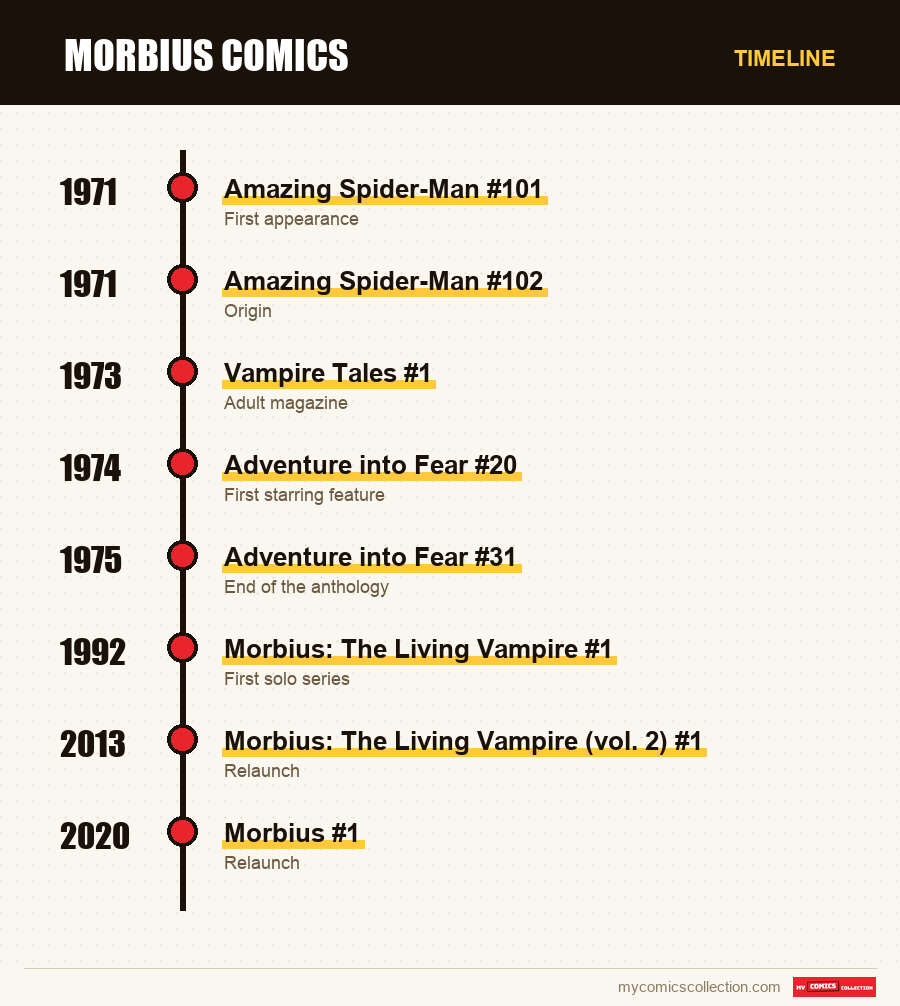
Roy Thomas, the series' first writer after Stan Lee, and Gil Kane introduce Michael Morbius in the middle of the "Six Arms Saga". The living vampire is born a few months after the Comics Code relaxed its ban on creatures of the night.
Amazing Spider-Man #102
"Vampire at Large!" concludes the saga and tells Morbius's origin: a biochemist with a rare blood disease, turned into a pseudo-vampire by his own experimental treatment.
Adventure into Fear #20
Mike Friedrich and Paul Gulacy make Morbius the star of the anthology, which stays devoted to him until its final issue. The living vampire gets his first regular color adventures.
Morbius: The Living Vampire #1
Len Kaminski and Ron Wagner launch the first monthly series under his name, under the Midnight Sons banner, as part of "Rise of the Midnight Sons". Sold polybagged, the issue opens a thirty-two-issue series.
Vampire Tales #1
This black-and-white magazine aimed at a more mature readership opens with a Morbius story by Steve Gerber and Pablo Marcos. The character finds a darker format there than in color comics.
Adventure into Fear #31
"The End of a Vampire!": Bill Mantlo and Frank Robbins deliver the last issue of the anthology devoted to Morbius. The character then goes back to being a recurring guest in other Marvel titles.
Morbius: The Living Vampire (vol. 2) #1
Joe Keatinge and Richard Elson relaunch the series under his name for a nine-issue volume following the living vampire on the run.
Morbius #1
Vita Ayala and Marcelo Ferreira devote a new series to the character, whose publication stopped in 2020 after the fifth issue.