Blade II (2002) Guillermo del Toro , with Wesley Snipes, continues the adventures of the vampire hunter born in Tomb of Dracula #10 (1973). The film pits Blade against a new threat, the Reapers, mutation of vampires, in a forced alliance with his enemies. Largely original, it deepens the character while relying on his nature as a “Daywalker”. Here is the detailed comparison, film versus comics.
Second part of the trilogy, Blade II entrusts the hunter to the visionary Guillermo del Toro, for a spectacular action horror film. He continues the character born in Marvel's horror comics. Source-by-source decryption.
As in each article in this series, only verified information (creators, distribution, dates, comic numbers) is stated; the comparative analysis is ours, without reproducing dialogue or protected images.
Title : Blade II (2002)
Director: Guillermo del Toro
Actors: Wesley Snipes (Blade), Ron Perlman, Leonor Varela, Norman Reedus, Luke Goss (Nomak)
Exit : March 2002
Studio: New Line Cinema
Tomb of Dracula #10 (1973): Blade's first appearance
The “Daywalker”: half-man, half-vampire
Whistler: the mentor and gunsmith
The horrific universe: Marvel's vampires
- Blade, the vampire-hunting “Daywalker”.
- Sa crusade ruthless against bloodsuckers.
- Whistler, his mentor and gunsmith.
- Sa dual nature, between humanity and vampirism.
- The universe horrific and nocturnal of the character.
- THE Reapers, a mutation of vampires, are invented for the film.
- L'forced alliance with vampires is original.
- Nomak and the Bloodpack are creations from the film.
- The plot is largely autonomous.
- La visual touch del Toro scores the film.
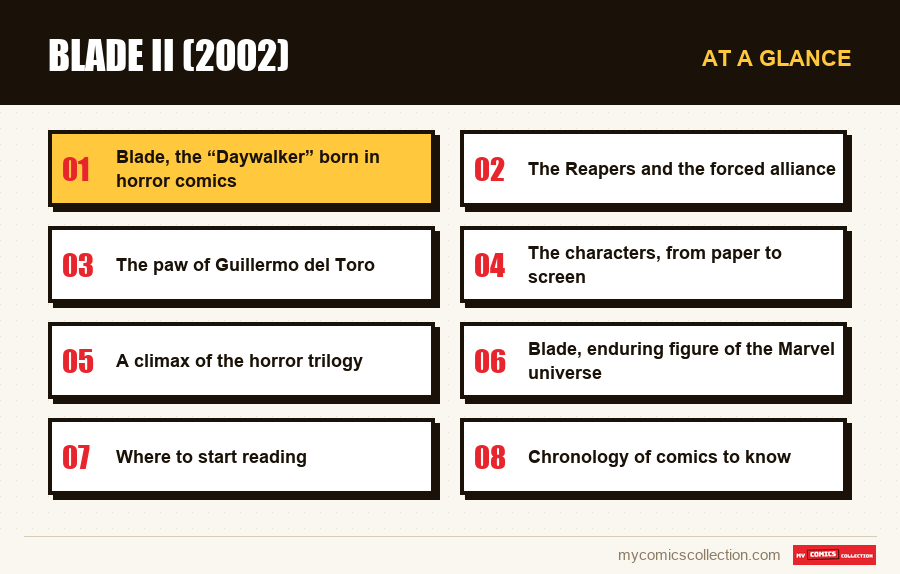
Blade, the “Daywalker” born in horror comics
Blade II continues the story of the vampire hunter who appeared in Tomb of Dracula #10 (1973), created by Marv Wolfman and Gene Colan. The character, born from the bite of a vampire on his pregnant mother, is a “Daywalker”: half-man, half-vampire, endowed with the powers of bloodsuckers without their weaknesses. His ruthless crusade against vampires, his fight against his own bloodlust and his anchoring in the horror universe of Marvel define the character. Blade II faithfully takes up this characterization established by the first film and rooted in the comics: the solitary hunter, haunted by his dual nature, leads a merciless war against the creatures of the night.
The film retains the central elements of the character (the “Daywalker”, his crusade, his mentor Whistler, his ambivalence) while developing a largely original plot. Under the direction of Guillermo del Toro, a filmmaker passionate about horror and creatures, Blade II deepens the character's universe by adding his distinctive visual touch, made of organic monsters and modern gothic aesthetics. This collaboration between a horrific Marvel character and a visionary director of the genre resulted in one of the most beloved parts of the trilogy. The film remains faithful to the spirit of Blade while pushing its horrific dimension and moral ambiguity further.
The Reapers and the forced alliance
The plot of Blade II is largely invented for the film. A new threat appears: the Reapers, a faster, more ferocious and almost invulnerable mutation of vampires, which prey on both humans and vampires. Faced with this common danger, Blade is forced to ally himself with his sworn enemies: the vampires, who form an elite team, the Bloodpack, to hunt down the Reapers. This forced alliance between the hunter and his prey, rich in tensions and betrayals, is the central driving force of the story. These elements (the Reapers, the Bloodpack, their leader Nomak) are creations of the film, with no direct equivalent in the comics.
This originality illustrates the freedom with which the Blade trilogy developed its universe. Rather than adapting specific stories from the comics, the films reinvented the character and his world, relying on his essence, the vampire hunter, to build their own plots. Blade II, in particular, exploits del Toro's imagination to create visually striking creatures and a world. This approach, if it moves away from the letter of the comics, respects their horrific spirit. For the reader, the film is an invitation to discover the universe of Marvel vampires in the comics, where Blade evolves in a classic gothic register, very different from the monstrous techno-thriller of the film trilogy.
The paw of Guillermo del Toro
Blade II stands out for the vision of its director, Guillermo del Toro, a filmmaker who has become one of the biggest names in fantasy cinema. Passionate about monsters and gothic horror, del Toro imprints his visual touch on the film: organic and nightmarish creatures, a dark and baroque aesthetic, inventiveness in the design of the Reapers. This signature elevates Blade II above a simple action film, making it a stylized and ambitious work of horror. The meeting between a horror character from Marvel and a master of the genre produced one of the most memorable parts of the trilogy, often cited as the best.
This collaboration illustrates the interest in entrusting comic book characters to authors with a strong vision. By letting del Toro express his passion for horror and creatures, the film gained identity and ambition. This approach, which favors the vision of a filmmaker with strict fidelity, gave Blade II a unique flavor. For the reader, it reminds us that the best adaptations are sometimes born from the encounter between a universe and a singular perspective. Del Toro, by taking on Blade, extended the horror tradition from which the character comes, while reinventing it through his visionary imagination. The film thus honors the horror roots of Blade.
Collecting this series?
Track what you own, what you are missing and what your collection is worth. 7 day trial.
Start my trial →The characters, from paper to screen
- Blade (Eric Brooks): The “Daywalker” vampire hunter, faithful to the spirit of the character.
- Whistler: Blade's mentor and armorer, returning in the film.
- Nomak: Leader of the Reapers, antagonist created for the film.
- The Bloodpack: Elite vampire team, creation of the film.
- The Reapers: Mutation of vampires, threat invented for the story.
A climax of the horror trilogy
Blade II is often considered the best part of the trilogy, for its ambitious production and its balance between action and horror. By entrusting the character to Guillermo del Toro, the film gained in visual identity and depth, while retaining the energy and charisma that made the first one successful. It illustrates the potential of the character of Blade, capable of carrying stylized and spectacular horror stories. This success confirmed Blade's place in the landscape of Marvel adaptations, and demonstrated that a horrific character could support a quality trilogy, carried by talented filmmakers.
This achievement is part of Blade's legacy as a pioneer of Marvel adaptations. By extending and deepening the universe of the hunter, Blade II consolidated a franchise born from a secondary character in horror comics. For the reader, it is an invitation to explore this little-known part of Marvel, where Blade rubs shoulders with Dracula, Morbius and figures of the supernatural. The film reminds us that the Marvel universe is not limited to superheroes, but is also home to a rich horror tradition, born in the 1970s. Blade II, through its quality and ambition, honors this heritage while bringing it to a modern audience, hungry for horror and action films.
Blade, enduring figure of the Marvel universe
Over the course of his trilogy, Blade has established himself as a lasting figure in the Marvel universe in cinema, well beyond his initial status as a secondary character in horror comics. His longevity and popularity testify to the richness of a hero at the crossroads of action and fantasy, capable of telling dark and adult stories. Blade II, by entrusting the character to a filmmaker of the caliber of Guillermo del Toro, showed the full potential of this universe, combining spectacle and artistic ambition. The vampire hunter thus became a sure value, whose appeal has never waned among the public who love horror and action.
This enduring position illustrates the depth of Marvel's catalog, which is not limited to its most famous superheroes. Blade, born in the fringes of “Tomb of Dracula,” proved that a niche character could compete with major franchises. For the reader, it is a gateway to the supernatural side of Marvel, rich in figures like Ghost Rider, Morbius or the Midnight Sons. Blade II, through its quality, consolidated this heritage and reminded us that horror is an integral part of Marvel's DNA. The hunter remains, from paper to screen, one of the most charismatic ambassadors of this little-known and fascinating part of the universe.
Where to start reading
To extend the film, Tomb of Dracula #10 (1973) features the first appearance of Blade. The “Tomb of Dracula” series, by Wolfman and Colan, develops the horrific universe of the character and Dracula. Blade's modern solo series continue his crusade. This journey covers the sources of a film that is largely original but faithful to the spirit of the hunter.
Chronology of comics to know
- 1973: Tomb of Dracula #10: Blade's first appearance.
- 1970s: “Tomb of Dracula” expands Marvel’s horror universe.
- 1990s-2000s: Blade's modern single-player series.
Collection side: what numbers to aim for after the film
Blade II points to the character's major key. Tomb of Dracula #10 (1973, first appearance of Blade) is a highly sought-after issue of Bronze Age horror, whose popularity soared with the success of the trilogy. The other issues of “Tomb of Dracula” are targets for delving deeper into the universe of Dracula and Marvel’s vampires. Blade's solo series offer more accessible tracks. These targets cover various budgets. As always, condition and gradation determine value; relying on real recent sales is strongly recommended.
Its place in the saga and for the collector
Blade II confirmed the success of the trilogy by entrusting the hunter to Guillermo del Toro, for a peak of horror and action. For the collector, it has maintained interest in Tomb of Dracula #10, key to the Bronze Age. It illustrates the effect of adaptations on the market. Beyond speculation, the film invites you to discover the horrific universe of Marvel, where Blade was born alongside Dracula. By delving deeper into the character through the vision of a master of fantasy, he extended Marvel's horror tradition and consolidated Blade's place among its cult figures.
The verdict: a hunter at the top of his game
- Loyalty: Blade the “Daywalker”, his crusade, Whistler and his ambivalence come from the comics and the first film.
- Freedoms: the Reapers, the forced alliance with the vampires, Nomak and the Bloodpack invented, the self-contained plot.
- Collectible numbers: Tomb of Dracula #10 (Blade), the “Tomb of Dracula” series.
Blade II delves deeper into the vampire hunter through the horrific vision of Guillermo del Toro, in a largely original story pitting Blade against the Reapers. Faithful to the spirit of “Daywalker” but inventing its plot, the film is often cited as the pinnacle of the trilogy. For the reader as well as the collector, it is an invitation to discover Tomb of Dracula #10 and the horrific universe of Marvel.
Frequently asked questions
No: the plot, with the Reapers and the forced alliance with the vampires, is largely invented for the film. It draws on the essence of the character: the vampire-hunting “Daywalker” born in Tomb of Dracula #10 (1973).
A mutation of vampires, faster, fiercer and almost invulnerable, which also feeds on vampires. These are creations from the film, with no direct equivalent in the comics, designed by Guillermo del Toro and his imagination of monsters.
The director imprints his visual touch on the film: organic creatures, modern gothic aesthetic, inventiveness in the design of the Reapers. This signature elevates Blade II to the rank of a work of stylized horror, often cited as the pinnacle of the trilogy.
Yes: born in Tomb of Dracula #10 (1973), within Marvel's horror wave of the 1970s, alongside Dracula. The film continues this tradition through the vision of del Toro, master of the fantastic.
Tomb of Dracula #10 (1973, Blade's first appearance) is the most sought-after key, whose popularity soared with the success of the trilogy. Other issues of “Tomb of Dracula” are other targets.
Does the film make you want to collect? Estimate the value for free of your issues (Tomb of Dracula #10…) with our tool based on current eBay listings.