Blade (1998) Stephen Norrington , with Wesley Snipes, adapts the vampire hunter born in Tomb of Dracula #10 (1973) by Marv Wolfman and Gene Colan. The film takes up the “Daywalker”, half-man, half-vampire, his thirst for revenge and his enemy DeaconFrost, while profoundly modernizing the character and his universe. A discreet pioneer of Marvel adaptations, he launched a cult trilogy. Here is the detailed comparison, film versus comics.
Often forgotten, Blade was nevertheless one of the first successes of a Marvel adaptation to the cinema. It draws on a character born in horror comics from the 1970s. Decryption source by source.
As in each article in this series, only verified information (creators, distribution, dates, comic numbers) is stated; the comparative analysis is ours, without reproducing dialogue or protected images.
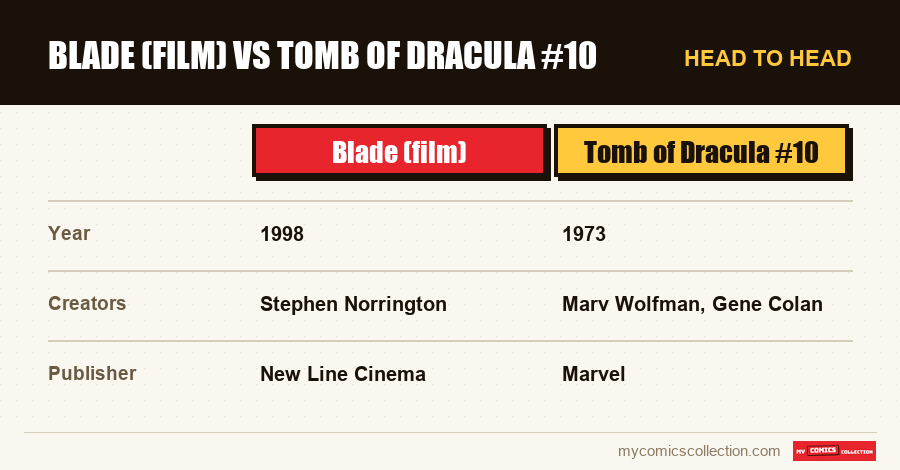
Title : Blade (1998)
Director: Stephen Norrington
Actors: Wesley Snipes (Blade), Stephen Dorff (Deacon Frost), Kris Kristofferson (Whistler), N'Bushe Wright
Exit : August 1998
Studio: New Line Cinema
Tomb of Dracula #10 (1973): Blade's first appearance (Wolfman & Colan)
DeaconFrost: the vampire responsible for his birth
The “Daywalker”: half-man, half-vampire
Horror comics of the 1970s: the original universe
- Blade, half-man, half-vampire vampire hunter.
- Sa birth linked to a bite on his pregnant mother.
- DeaconFrost, the vampire at the origin of his destiny.
- Sa thirst for revenge against the vampires.
- The universe horrific and nocturnal character.
- Blade becomes a Daywalker» with vampire powers.
- The universe is modernized (techno-thriller, nightclubs).
- No Dracula nor the context of Tomb of Dracula.
- Whistler, his mentor, is a creation of the film.
- The plot is largely original.
Tomb of Dracula #10 (1973): the birth of Blade
Blade appears in Tomb of Dracula #10 (1973), created by Marv Wolfman and Gene Colan. The character was born in the horror wave of Marvel comics of the 1970s, within a series devoted to Dracula himself. Eric Brooks, whose mother was bitten by a vampire while she was pregnant, was born with an immunity to bites and a fierce hatred of vampires. A merciless hunter armed with stakes and blades, he hunts bloodsuckers across the world. Initially a secondary character in “Tomb of Dracula”, Blade gradually established himself as a striking figure in the horror universe of Marvel, the incarnation of the solitary hunter dedicated to his crusade.
The film takes up the essence of the character: the vampire hunter, his birth linked to the bite of his pregnant mother, his thirst for revenge, his enemy Deacon Frost. Wesley Snipes plays a charismatic and ruthless Blade, whose interpretation has become iconic. The film, however, profoundly modernizes the character's universe. Where the comics anchored it in the gothic of “Tomb of Dracula”, the film opts for a nocturnal techno-thriller, between nightclubs and secret vampire societies. It also makes Blade a “Daywalker”, endowed with the powers of vampires without their weaknesses, an amplified element compared to the comics of the time. This rereading redefined the character.
The “Daywalker” and the modernization of the myth
The film establishes Blade as a "Daywalker": a being who possesses the strength, speed, and healing factor of vampires, but none of their weaknesses, notably an aversion to daylight. This characterization, which makes Blade an ideal hunter, half-man, half-vampire, marked the character to the point of becoming his best-known definition. The film also develops Blade's struggle against his own bloodlust, which he contains thanks to a serum, adding a tragic dimension to his crusade. This tension between his nature as a vampire and his fight against them is at the heart of the cinematic character.
This modernization illustrates how the film reinvented Blade for the late 1990s. By taking it out of the gothic “Tomb of Dracula” and anchoring it in a contemporary and stylized universe, the film created a new aesthetic, mixing action, horror and urban culture. Vampires are modern creatures, organized into secret societies infiltrating power. This rereading, very far from the original context, nevertheless preserved the essence of Blade: the implacable hunter, haunted by his dual nature. For the reader, it is an invitation to discover the origins of the character in the horror comics of the 1970s, where Blade rubs shoulders with Dracula in a more classic register.
Deacon Frost and Whistler
The film pits Blade against Deacon Frost, an ambitious vampire from the comics: it was he who, in "Tomb of Dracula", bit Blade's mother, causing his birth as a "Daywalker". The film takes this character and this founding bond, but reinvents him as a young upstart vampire, played by Stephen Dorff, seeking to overthrow the ancient order of vampires and invoke a blood deity. This rereading, which modernizes Frost and gives him grandiose ambitions, moves away from the character in the comics while retaining his role as the original antagonist, at the origin of Blade's destiny.
The film also introduces Whistler, Blade's mentor and armorer, a creation specific to the film (the character will later be integrated into the comics). A gruff old hunter making Blade's anti-vampire weapons, he brings a human and paternal dimension to the story. This successful invention enriches the universe of the film and will become inseparable from the character on screen. For the reader, it illustrates how an adaptation can create lasting elements, to the point of in turn influencing the comics. Whistler, born in the cinema, will join the mythology of Blade, proof of the porosity between the media and the influence of the film on the character.
Collecting this series?
Track what you own, what you are missing and what your collection is worth. 7 day trial.
Start my trial →The characters, from paper to screen
- Blade (Eric Brooks): Half-man, half-vampire vampire hunter, faithful to Tomb of Dracula #10, modernized into “Daywalker”.
- DeaconFrost: Vampire responsible for the birth of Blade, reinvented as an ambitious careerist.
- Whistler: Mentor and gunsmith, creation of the film then integrated into the comics.
- Karen: Hematologist allied to Blade, character in the film.
- The vampires: Modern creatures organized into secret societies.
A discreet pioneer of Marvel adaptations
Blade occupies an often overlooked but crucial place in the history of Marvel adaptations. Released in 1998, two years before X-Men and four years before Spider-Man, it was one of the first commercial successes of a film based on a Marvel character, at a time when the genre was far from dominating cinema. By proving that a Marvel adaptation could resonate with audiences, Blade quietly paved the way for the wave that would follow. Its success, driven by the charisma of Wesley Snipes and his innovative aesthetic, demonstrated the commercial viability of these stories, helping to revive studio interest in comics.
This pioneering role is all the more notable as Blade was not a leading character, but a horror figure relatively unknown to the general public. Its success showed that a secondary character, well adapted, could carry a franchise. Blade thus launched a cult trilogy and proved that the Marvel universe concealed treasures beyond its most famous heroes. For the reader, the film is an invitation to discover the horror comics of the 1970s, this little-known part of Marvel where Blade, Morbius and so many other figures of the supernatural were born. It recalls the unsuspected richness of a universe that is not limited to superheroes in tights.
Blade's lasting legacy
Blade's influence goes far beyond its trilogy. By imposing a new aesthetic (stylized action, urban horror, a charismatic African-American hero) the film left a lasting mark on popular culture and genre cinema. Wesley Snipes created an iconic incarnation of the character, associating the face of Blade for a generation with his crusade against vampires. This achievement proved that a black hero could carry a fantasy action blockbuster, paving the way for greater diversity in the genre. The imprint of Blade can be felt in many subsequent productions, both in its style and in its ambition.
This legacy explains the enduring attachment to the character and the persistent interest in its future adaptations. Blade demonstrated the richness of Marvel's horror side and the viability of a monster hunter as a cinema hero. For the reader, this legacy is an invitation to explore not only the Blade comics, but the entire Marvel supernatural universe of the 1970s, where so many notable figures were born. The film reminds us that a secondary character, driven by a strong vision and a charismatic actor, can become an icon and launch a franchise, while revealing to the general public a little-known and fascinating part of the Marvel universe.
Where to start reading
To extend the film, Tomb of Dracula #10 (1973) features the first appearance of Blade. The “Tomb of Dracula” series, by Wolfman and Colan, develops the character’s horrific universe. Blade's modern solo series continue his crusade. This journey covers the sources of a film which profoundly modernizes the vampire hunter.
Chronology of comics to know
- 1973: Tomb of Dracula #10: Blade's first appearance.
- 1970s: “Tomb of Dracula” develops the character’s horrific universe.
- 1990s-2000s: Blade's modern single-player series.
Collection side: what numbers to aim for after the film
Blade points to a major key to the horrific Bronze Age. Tomb of Dracula #10 (1973, first appearance of Blade) is a highly sought-after number, whose popularity has risen sharply with the popularity of the character in the cinema. The other issues of “Tomb of Dracula” are targets for delving deeper into the universe. Blade's modern solo series offer more accessible tracks. These targets cover various budgets. As always, condition and gradation determine value; relying on real recent sales is strongly recommended.
Its place in the saga and for the collector
Blade quietly paved the way for modern Marvel adaptations, while bringing a little-known horror character to the screen. For the collector, it increased interest in Tomb of Dracula #10, key to the Bronze Age. It illustrates the considerable effect of adaptations on the market, even for niche characters. Beyond speculation, the film invites us to discover the horrific side of Marvel, where Blade was born alongside Dracula. By proving that a secondary character could carry a successful franchise, he marked a turning point in the history of comic book adaptations.
The verdict: a modernized and pioneering fighter
- Loyalty: Blade, his birth linked to his mother's bite, Deacon Frost and his thirst for revenge come from the comics.
- Freedoms: Blade as a “Daywalker” with vampire powers, the modernized universe, the absence of Dracula, Whistler invented.
- Collectible numbers: Tomb of Dracula #10 (Blade), the “Tomb of Dracula” series.
Blade profoundly modernizes the vampire hunter from horror comics, making him a stylized “Daywalker” in a contemporary universe. Faithful to the essence of the character (his birth, his revenge, Deacon Frost) but reinventing its setting, the film was a discreet pioneer of Marvel adaptations. For both the reader and the collector, it is an invitation to discover Tomb of Dracula #10.
Frequently asked questions
From Tomb of Dracula #10 (1973), created by Marv Wolfman and Gene Colan, in the series dedicated to Dracula. Eric Brooks, whose mother was bitten while pregnant, becomes a vampire hunter. The film takes up this origin by modernizing it.
A being who possesses the powers of vampires-strength, speed, healing-without their weaknesses, notably aversion to daylight. This characterization of Blade, amplified by the film, has become his best-known definition.
He's a creation from the film: Blade's mentor and armorer. The character was so successful that he was later integrated into the comics, illustrating the influence of the adaptation on its source material.
Released in 1998, before X-Men and Spider-Man, it was one of the first successes of a Marvel adaptation, proving their commercial viability. This discreet pioneer paved the way for the wave of superhero films and launched a cult trilogy.
Tomb of Dracula #10 (1973, Blade's first appearance) is the most sought-after key, whose rating rose with the character's popularity. Other issues of “Tomb of Dracula” are other targets.
Does the film make you want to collect? Estimate the value for free of your issues (Tomb of Dracula #10…) with our tool based on current eBay listings.