
The best vampire comics are, at the top, American Vampire by Scott Snyder and Rafael Albuquerque, 30 Days of Night by Steve Niles, The Tomb of Dracula by Marv Wolfman and Gene Colan, and Blade. This tier list ranks vampire stories in comics according to their quality and influence, from horror classics to niche series. Facts (authors, publishers, dates) checked, no invented ratings.
The vampire spans the entire history of comics, from classic gothic to modern horror. This tier list brings together the series that reinvent the myth with the most force: atmosphere, characters, renewal of folklore. Criterion: the success of the vampire story, not popularity alone.
Editorial Ranks, Facts verified. Each entry refers to a site file when it exists.
Collecting this series?
Track what you own, what you are missing and what your collection is worth. 7 day trial.
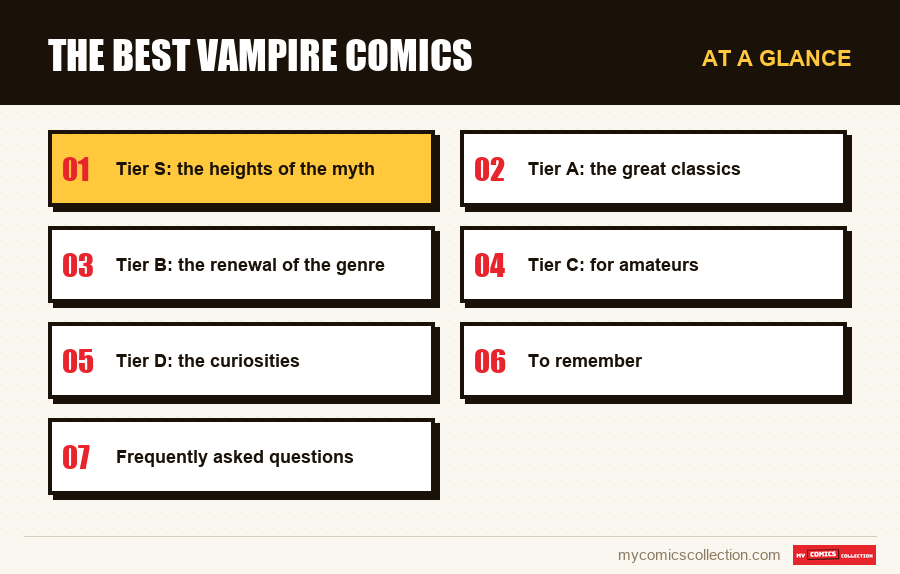
Start my trial →Tier S: the heights of the myth
American Vampire (2010) by Scott Snyder reinvents the vampire as a typically American predator, through the ages: the great modern vampire series. 30 Days of Night (2002) encloses a town in Alaska in an endless polar night, an ideal hunting ground. The Tomb of Dracula (1972) by Wolfman and Colan remains the absolute classic, which also introduced Blade, the vampire hunter who became a Marvel icon.
Tier A: the great classics
Vampirella (1969) is a cult figure in magazine horror. Morbius, Spider-Man's living vampire, and I, Vampire (DC) explore the superheroic vampire. Criminal Macabre by Steve Niles brings a supernatural thriller touch.
Tier B: the renewal of the genre
Baltimore by Mike Mignola places the vampire in a gothic war universe. Life Sucks actually a teenage comedy, Cock Club (Vertigo) a mafia thriller, and The Strain (Guillermo del Toro) a viral epidemic.
Tier C: for amateurs
Vampire Knight Requiem (Ledroit) is a European visual summit. Curse of Dracula , American Vampire: Second Cycle and Nocturnals by Dan Brereton complete this tier for fans of the genre.
Tier D: the curiosities
The adaptations of Vampire: The Masquerade , the mini Bloodline (Marvel) and various independent productions close this selection: niche readings, real but more difficult to find.
To remember
- The Tomb of Dracula is the founding stone, cradle of Blade.
- American Vampire is the best modern front door.
- The vampire lends itself to all tones: horror, thriller, comedy, gothic.
- The Tomb of Dracula #10 (Blade's first appearance) is a sought-after key issue.
Reading Vampire Comics by Era and by Tone
The vampire fits every register, and the tier list benefits from a simple extra marker: when the series was born, and what kind of story it offers. It helps you choose a first read without getting lost in a selection that runs from 1969 to 2014.
A chronology in three stages
The first stage is the Bronze Age classics: Vampirella (1969, Warren), Morbius (1971, Marvel), The Tomb of Dracula (1972, Wolfman and Colan), Blade (1973) and I, Vampire at DC (1981). The second covers the 1990s, with Nocturnals (1995), Curse of Dracula (1998) and Requiem Vampire Knight (2000). The third is the modern wave: 30 Days of Night (2002), Criminal Macabre (2003), Bite Club (2004), Bloodline (2005), Baltimore (2007), Life Sucks (2008), American Vampire (2010), The Strain (2011) and then American Vampire: Second Cycle (2014).
Choosing by tone
Pure horror is found in 30 Days of Night, which locks an Alaskan town in an endless polar night. The supernatural noir comes through Criminal Macabre and the mob thriller Bite Club. The superhero vampire reads in Morbius, I, Vampire and Blade. Baltimore brings wartime gothic, Life Sucks teen comedy and The Strain the viral epidemic. Finally, American Vampire crosses the eras with a typically American predator.
Points of caution for the collector
For a key issue, look first at The Tomb of Dracula #10 (1973), the first appearance of Blade, sought after since the success of the films. American Vampire and 30 Days of Night exist in collected editions, easier to find than single issues. The Vampire: The Masquerade adaptations and the Bloodline miniseries are niche reads, real but harder to track down. Finally, American Vampire exists in several cycles: check which cycle a volume belongs to before buying it so you leave no gap.
If you hesitate, two entries are enough to start: American Vampire, the best modern entry point, and The Tomb of Dracula, the founding stone and cradle of Blade. Add 30 Days of Night if you want effective, self-contained horror. These three titles cover the essentials of the genre before you move on to the curiosities at the bottom of the tier list.
Frequently asked questions
American Vampire (Snyder & Albuquerque) is the modern reference, while The Tomb of Dracula remains the historical classic of the genre.
Blade first appears in The Tomb of Dracula #10 (1973), a key issue highly sought after by collectors, especially since the success of the films.
By American Vampire (modern and accessible) or 30 Days of Night (effective and autonomous horror). Both exist in collections.
Do you own Tomb of Dracula #10 or another key vampire issue? Estimate its value for free with our tool based on current eBay listings.