The best horror comics are, at the top, Hellboy by Mike Mignola, Swamp Thing by Alan Moore, Locke & Key by Joe Hill and Something is Killing the Children by James Tynion IV. This tier list classifies comic book horror stories according to their control of anxiety and their quality of writing. Facts (authors, dates) verified, no invented odds.
Horror is an ideal playground for comics: the still image lets the imagination complete the worst. This tier list brings together the series that best exploit this tension: from fantasy folklore to slasher, from gothic to intimate anguish. Criterion: the effectiveness of the fear coupled with the quality of the story.
Editorial Ranks, Facts verified. It is a reading guide.
Collecting this series?
Track what you own, what you are missing and what your collection is worth. 7 day trial.
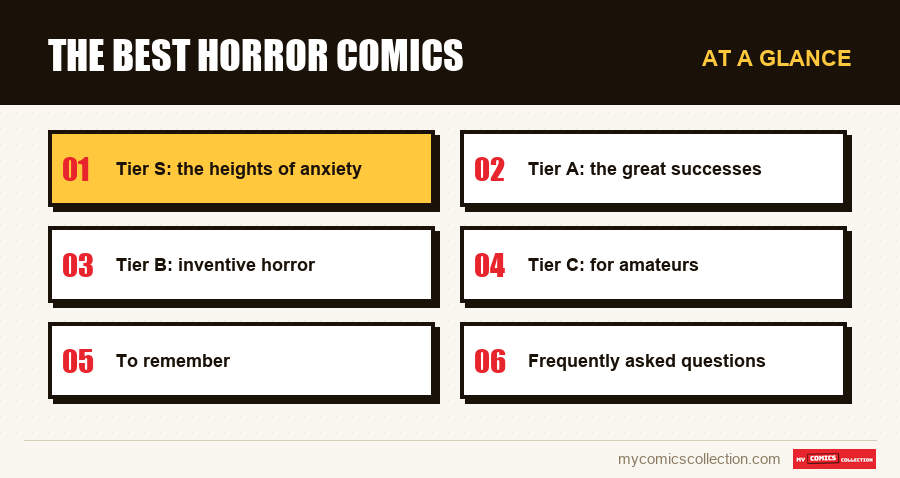
Start my trial →Tier S: the heights of anxiety
Hellboy (1993) mixes occult folklore and melancholy in an inimitable graphic style: one of the great horror universes of the medium. THE Swamp Thing by Alan Moore (1984) transformed a B-movie monster into a terrifying ecological meditation. Locke & Key distills a family horror of rare inventiveness. And Something is Killing the Children (2019) is the great modern horror success.
Tier A: the great successes
The Walking Dead redefined the zombie narrative over nearly 200 issues. Wyches by Scott Snyder plays on intimate fear, Gideon Falls by Jeff Lemire on cosmic anxiety, and 30 Days of Night reinvented the vampire in an endless polar night.
Tier B: inventive horror
Harrow County immersed in a captivating rural fantasy. Ice Cream Man is a surreal horror anthology. Nailbiter investigates a town with serial killers, and Outcast (Kirkman) explores demonic possession.
Tier C: for amateurs
B.P.R.D. extends the Hellboy universe. Hack/Slash returns the slasher codes, and Colder explores madness with disturbing imagery. Solid horror reads, a notch below the genre's peaks.
To remember
- Horror is a strong indie genre: Image and Dark Horse dominate there, not Marvel/DC.
- Alan Moore led the way with Swamp Thing from the 80s.
- The genre is very active: Something is Killing the Children is recent proof of this.
- Each entry refers to a key file or number on the site.
Choosing your first read by the kind of fear you want
A tier list ranks; it does not tell you where to start. Yet horror comics split into very different families, and the best starting point depends less on the rank than on the kind of chill you are after. Here is a reading grid built from the series on the list.
Folklore and the occult
If you like legends and melancholy, start with Hellboy (Mike Mignola, 1993), which blends occult folklore with an inimitable graphic style. If the universe appeals to you, B.P.R.D. (Mignola and others, 2003) extends it. Harrow County (Cullen Bunn and Tyler Crook, 2015) offers a rural fantasy that is gentler in mood but just as spellbinding.
Intimate and family fear
Locke & Key (Joe Hill and Gabriel Rodríguez, 2008) distills family horror of rare inventiveness, and it reads in collected editions as a complete story. Wytches (Scott Snyder and Jock, 2014) plays on intimate fear. For a more disorienting approach, Ice Cream Man (W. Maxwell Prince and Martín Morazzo, 2018) is a surreal horror anthology: each issue can be read almost on its own.
Cosmic and psychological dread
Gideon Falls (Jeff Lemire and Andrea Sorrentino, 2018) plays on cosmic dread, and Colder (Paul Tobin and Juan Ferreyra, 2012) explores madness with disturbing imagery. Swamp Thing, in Alan Moore's version (1984), remains the best example of a B-movie monster turned into an ecological and terrifying meditation.
Blood and violence
For slashers, Hack/Slash (Tim Seeley, 2004) turns the genre's conventions upside down. 30 Days of Night (Steve Niles and Ben Templesmith, 2002) reinvents the vampire in an endless polar night, and Nailbiter (Joshua Williamson and Mike Henderson, 2014) investigates a town of serial killers. Outcast (Robert Kirkman and Paul Azaceta, 2014) explores demonic possession.
Horror for the long haul
Something is Killing the Children (James Tynion IV, 2019) is the great modern horror success on the list. The Walking Dead (Robert Kirkman, 2003) redefined the zombie story across nearly 200 issues: it is the pick if you want a long series rather than a compact story.
Tips for collecting horror
The genre is dominated by Image, Dark Horse and IDW, not by Marvel or DC: the first issues of these series are therefore the natural landmarks of a collection, such as Walking Dead #1 or the beginnings of Hellboy. When a series exists in collected editions, read the collection first: it saves you from buying separate issues for a story that may not speak to you. Check off each series in your tracker by tier, from S to C, and you will get a collection that moves from the most consensual to the most personal.
Frequently asked questions
Hellboy and the Swamp Thing by Alan Moore refer. For a recent series, Something is Killing the Children is the great modern horror success.
No, rather among independent publishers: Dark Horse (Hellboy), Image (Walking Dead, Ice Cream Man) and IDW dominate the genre. DC contributes mainly via its mature label (Swamp Thing).
By Hellboy (accessible folklore) or Locke & Key (complete and gripping story). Both can be read in collections, without prerequisites.
Do you have a sought-after first horror issue (Walking Dead #1, Hellboy, etc.)? Estimate its value for free with our tool based on current eBay listings.