The best supernatural and occult comics are, at the top, Hellboy , Hellblazer (John Constantine), The Sandman and Swamp Thing by Alan Moore. This tier list ranks stories of esotericism, demons and black magic according to their quality and atmosphere. Facts (authors, publishers, dates) verified, no invented ratings; each entry refers to a record when it exists.
The occult is fertile ground for comics: demonic pacts, forbidden magic, ancient entities. This tier list brings together the series that best delve into the supernatural: atmosphere, personal mythology, fear. Criterion: the success of the esoteric story.
Editorial Ranks, Facts verified. Each entry refers to a site file when it exists.
Collecting this series?
Track what you own, what you are missing and what your collection is worth. 7 day trial.
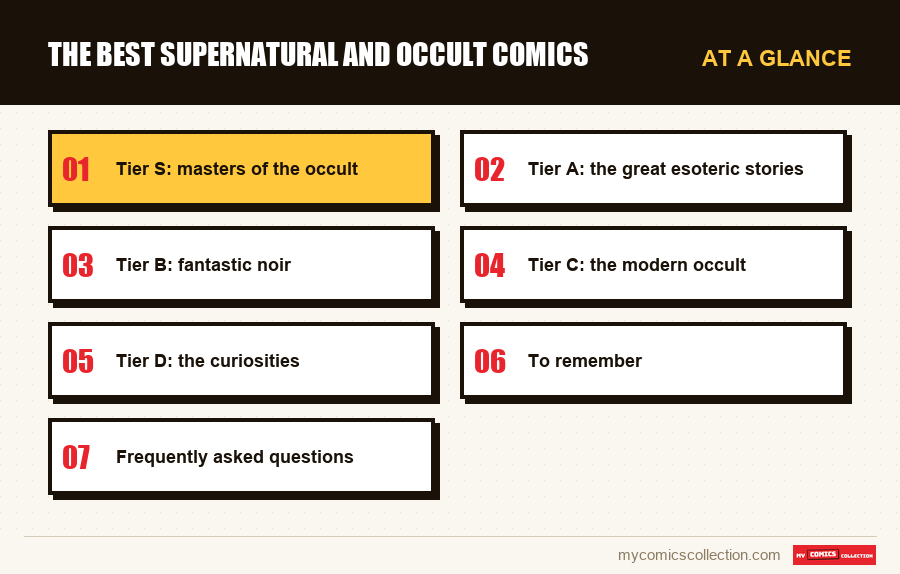
Start my trial →Tier S: masters of the occult
Hellboy by Mike Mignola is the benchmark for occult fantasy. Hellblazer follows John Constantine, the medium's most cynical trickster-magician. The Sandman mixes all the mythologies, and the Swamp Thing by Alan Moore reinvented ecological and mystical horror.
Tier A: the great esoteric stories
Locke & Key (a terrifying family magic), Ghost Rider (the demonic pact), Doctor Strange (the Sorcerer Supreme) and The Books of Magic by Gaiman explore the occult from all its angles.
Tier B: fantastic noir
Spawn, B.P.R.D. , The Sixth Gun (occult western) and Harrow County (rural fantasy) dive into the supernatural with force.
Tier C: the modern occult
Fatal (Lovecraftian thriller), Baltimore, Zatanna et Wyches complete the selection.
Tier D: the curiosities
Dr. Occult (one of the very first DC characters, 1935), The Dreaming and Colder close this tier list: more confidential but real occult stories.
To remember
- Hellboy and Hellblazer are the two references of the modern occult.
- The Vertigo label produced some of the greatest esoteric stories.
- The occult meets horror but is distinguished by its mythology and magic.
- Each entry refers to a site file when it exists.
Frequently asked questions
Hellboy by Mike Mignola and Hellblazer (Constantine) are the references of the genre, alongside the Swamp Thing by Alan Moore.
Horror seeks fear; the occult features magic, demons and esotericism, often with its own mythology. The two intersect, like in Hellboy.
By Hellboy (fantastic accessible) or the Swamp Thing by Alan Moore. Both exist in bound collections.
Do you own a sought-after Hellboy: Seed of Destruction or Swamp Thing? Estimate its value for free with our tool based on current eBay listings.
Reading paths: four families of occult comics
Not every series in this tier list offers an easy way in. Grouping them by universe helps you choose where to start.
Mike Mignola's universe. Hellboy (1993) is the entry point, with Seed of Destruction. B.P.R.D. (2003) extends its universe, and Baltimore (2007), co-written with Christopher Golden, shares the same fantasy vein. These stories complement each other and are collected in sets.
The Vertigo lineage. Alan Moore's Swamp Thing (1984) saw the birth of John Constantine, who first appears in Swamp Thing #37 (1985) before getting his own series, Hellblazer (1988). Neil Gaiman's The Sandman (1989) follows, then The Books of Magic (1990) and The Dreaming (1996), which extends the Sandman universe. Reading in this order shows how the occult was built at DC.
Classics from the two big publishers. Doctor Strange (Marvel, 1963) and Ghost Rider (Marvel, 1972) represent the superhero take on the occult. Zatanna (DC, 1964) is its magical counterpart, and Dr. Occult (DC, 1935) is a reminder that the genre has existed since the dawn of comics.
Standalone creator-driven stories. Locke & Key (2008), Wytches (2014), Fatale (2012), The Sixth Gun (2010) and Harrow County (2015) each tell a complete story, with no past to know. They are the best choices for a reader who wants a finished tale rather than a long continuity.
For the collector, two practical markers. First, Hellboy: Seed of Destruction is the sought-after issue of the Mignola universe, but its follow-ups (B.P.R.D., Baltimore) stay accessible and are easy to complete. Second, the founding issues of the 1980s (Moore's Swamp Thing, Hellblazer, Sandman) can also be read in collected editions: you can read first, then decide which period issues deserve a place in the collection.
A method tip: pick one family, read it, then move on to the next. Occult comics are rich in personal mythologies, and mixing them from the start blurs your bearings.