The horror comic is one of the oldest and most fertile genres in the American industry. Even before Spider-Man or Batman existed, horror comics terrified millions of readers in the '40s and '50s.
The horror comic is one of the oldest and most fertile genres in the American industry. Even before Spider-Man or Batman existed, horror comics terrified millions of readers in the '40s and '50s. Censored in 1954 by the Comics Code Authority, they resurfaced in the '70s and '80s with even bolder works, carried by authors like Alan Moore, Neil Gaiman, and Jamie Delano. Today, in 2026, the horror comics market is experiencing a renaissance carried by series like Something is Killing the Children and Nailbiter that reach prices never seen for modern indie publications.
This guide covers horror comic essentials to collect: from pre-Code EC Comics classics to contemporary indie publications, through major DC/Vertigo series that redefined the genre. Whether you're a seasoned collector looking to complete a run or a beginner discovering the genre, this overview will give you keys to build a cohesive, passionate horror comics collection.
Pre-Code EC Comics classics (1950-1955)
EC Comics (Educational Comics, then Entertaining Comics) is the publisher that defined the American horror comic. Founded by William Gaines, it published between 1950 and 1954 a revolutionary line of titles blending horror, sci-fi, and crime in short twist-ending stories: a format that would influence all popular culture for decades, from The Twilight Zone to HBO's Tales from the Crypt.
Tales from the Crypt
Tales from the Crypt (1950-1955, 46 issues) is EC Comics' flagship title. Narrated by the Cryptkeeper, this collection of graphic horror short stories shocked and fascinated 1950s America. This series' issues are museum pieces for any serious horror comic collector. Their preservation condition is crucial, seventy years of existence leave marks, and copies in good condition (CGC 6.0 and up) reach high prices.
Vault of Horror and Haunt of Fear
Vault of Horror (1950-1955, 40 issues) and Haunt of Fear (1950-1954, 28 issues) are the other pillars of the EC horror line. Weird Fantasy and Weird Science represent EC's sci-fi branch, with adaptations of Ray Bradbury stories among the pages. These publications ultimately fell victim to their own success: the 1954 Kefauver Senate Commission identified them as presumed causes of juvenile delinquency, forcing EC to abandon its boldest titles. It's the birth of the Comics Code Authority, and the end of an era.
Note for collectors: EC Comics reprints by Fantagraphics (EC Archives) offer an excellent way to read these classics in beautifully reproduced hardcovers, without investing in fragile 1950s originals. For collectors wanting originals, the best path is Heritage Auctions or ComicLink, specialized in CGC-certified pre-Code comics.
Horror's return in the '70s: '80s: House of Mystery and House of Secrets
After the Comics Code censorship, DC Comics continued publishing watered-down horror anthologies throughout the '60s:House of Mystery and House of Secrets: which, though less graphic than EC Comics, kept the genre alive. These titles also incubated some of DC horror's most important characters: Swamp Thing first appears in House of Secrets #92 (1971), one of the most valuable Bronze Age DC issues.
Marvel's horror magazines from the same period, Tomb of Dracula (1972-1979, 70 issues) and Werewolf by Night (1972-1977, 43 issues), are emblematic Bronze Age horror series. Tomb of Dracula #10 (1973) contains the first appearance of Blade, who has since become a major MCU character: its key issue is among the most sought-after Bronze Age Marvel books.
Alan Moore and Swamp Thing: the narrative revolution of horror comics
Saga of the Swamp Thing #21 (1984), the first issue of Alan Moore's run, is one of the most important single issues in comic history. Moore radically reinterprets the character: Swamp Thing isn't a man transformed into a plant, but a plant creature that simply believes it was once a man: a philosophical distinction that deeply transforms the series. The arc is called "The Anatomy Lesson" and is unanimously cited among the best single issues ever published.
Moore's complete Swamp Thing run (#21 to #64, 1984-1987 ) also introduced John Constantine: the character who would get his own series in Hellblazer (1988). Moore explores cosmic horror, spirituality, and environmental politics with narrative sophistication unprecedented in mainstream comics of the era.
Hellblazer: the longest Vertigo run in history
Hellblazer (DC/Vertigo, 1988-2013, 300 issues) is the longest series published under DC's Vertigo label. John Constantine, the cunning and selfish magician from Liverpool navigating between the world of the living and that of demons, is one of contemporary horror comics' most durable creations. The series counted among its authors some of the genre's biggest names: Jamie Delano (#1-40), Garth Ennis (#41-83), Warren Ellis, and Brian Azzarello.
The most sought-after Hellblazer issues are the early Jamie Delano ones:Hellblazer #1 (1988) is a modest but emblematic key issue, and certain specials like Hellblazer Special: Bad Blood. The series concluded with issue #300 (2013), and the complete collection is a long-term objective for genre fans.
Catalog your horror comics with the app
My Comics Collection supports all horror publishers: DC Vertigo, Image, IDW, BOOM! Studios. Catalog your EC Comics, Hellblazer, and SITC issue by issue.
Start my horror catalogLocke & Key (IDW): the modern horror comic masterpiece
Locke & Key (Joe Hill and Gabriel Rodriguez, IDW Publishing, 2008-2013) is one of the most acclaimed horror comic series of its time. Joe Hill, Stephen King's son and an author in his own right, tells the story of the Locke family who move into the ancestral Keyhouse after the father's murder, only to discover the estate hides magic keys with extraordinary and dangerous powers. The series comprises six mini-series and several spin-offs.
Locke & Key #1 (IDW, 2008) is the founding issue, whose first printings have become hard to find. The Netflix adaptation (2020-2022) considerably boosted the series' visibility and demand for originals. Rodriguez delivers some of contemporary horror comics' most beautiful art, with architectural precision that makes every nook of Keyhouse fascinating.
Financial disclaimer: The price estimates mentioned in this article for horror key issues (EC Comics, Locke & Key, Something is Killing the Children) are indications based on market data available as of 2026 and subject to change. Any comic purchase for collection or investment purposes carries risk. Modern indie comic prices are particularly volatile. Check specialized platforms (Heritage Auctions, eBay sold listings) before any significant purchase. This article does not constitute investment advice.
Nailbiter (Image Comics): serial-killer horror
Nailbiter (Joshua Williamson and Mike Henderson, Image Comics, 2014-2017, 30 issues) is a horror-noir series exploring why a small Oregon town produced sixteen of America's greatest serial killers. The series combines psychological tension, gore horror, and police mystery in remarkable balance. Nailbiter #1 (2014) remains accessible second-hand and makes an excellent entry point into 2010s indie horror comics.
Collecting this series?
Track what you own, what you are missing and what your collection is worth. 7 day trial.
Start my trial →Something is Killing the Children: the contemporary horror comic phenomenon
Something is Killing the Children (James Tynion IV and Werther Dell'Edera, BOOM! Studios, since 2019) is arguably the most discussed horror comic series in the market since 2020. It follows Erica Slaughter, a brutal-methods monster hunter, in a small town where children are disappearing. The series combines atmospheric horror, mystery, and complex characters in storytelling that owes much to the best '80s horror films.
Something is Killing the Children #1 (BOOM! Studios, 2019) became a very sought-after issue shortly after publication, with its first printing becoming hard to find. Spin-offs like House of Slaughter (2021) have expanded the universe. Tynion IV has since confirmed the series is planned over several years, making it a continuously expanding collecting universe.
2026 horror comics market trends
In 2026, the horror comics market presents several distinct trends every collector should know:
The rise of BOOM! Studios and Image in horror
BOOM! Studios and Image Comics dominate indie horror comics in 2026. Beyond SITC, series like Spread, Nomen Omen, and The Nice House on the Lake (DC Black Label) have attracted new audiences. Early issues of these series are often undervalued at release and significantly appreciate if the series succeeds critically.
The rebound of pre-Code EC Comics in average condition
The EC Comics market has structured in recent years around mid-grade copies (CGC 3.0 to 5.5), more accessible than pristine copies but with more steadily growing value. Modest collectors can find Tales from the Crypt issues in readable condition for $165 to $440.
Growing interest in '90s Vertigo
First editions of '90s Vertigo series: Preacher, Transmetropolitan, Y: The Last Man: are experiencing renewed interest, especially for their early issues. These issues, often produced in large quantities, aren't rare but find more and more fans, notably among collectors who grew up with TV adaptations of these series.
Classic Marvel Bronze Age horror on the rise
Tomb of Dracula #10 (first Blade) remains one of the most in-demand Bronze Age horror issues. Other issues in the series and related series (Werewolf by Night, Man-Thing) benefit from renewed interest linked to Marvel Studios announcements about Blade. The Bronze Age Marvel horror market remains more accessible than Silver Age while offering significant collectible pieces.
Horror key issues to document in your collection
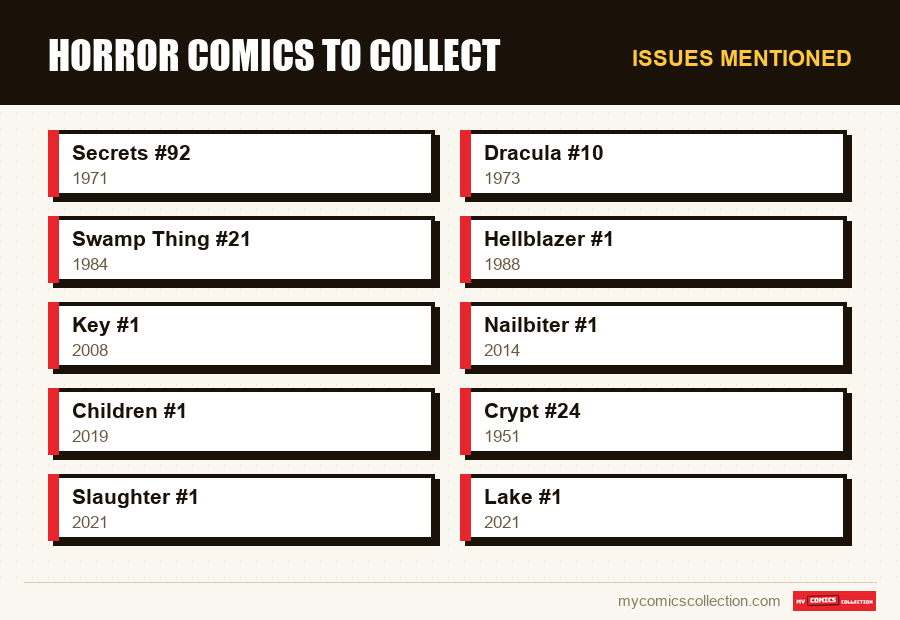
Here's our selection of the most important horror key issues to document, classified by period:
- Tales from the Crypt #24 (EC Comics, 1951): first issue under this title, EC museum piece.
- House of Secrets #92 (DC, 1971): first Swamp Thing appearance. Major Bronze Age DC.
- Tomb of Dracula #10 (Marvel, 1973): first appearance of Blade the vampire hunter.
- Saga of the Swamp Thing #21 (DC, 1984): start of Alan Moore's revolutionary run.
- Hellblazer #1 (DC/Vertigo, 1988): first John Constantine solo series.
- Locke & Key #1 (IDW, 2008): first printing, high demand post-Netflix.
- Nailbiter #1 (Image, 2014): accessible and representative of 2014 indie horror.
- Something is Killing the Children #1 (BOOM!, 2019): the 2020s horror phenomenon.
- House of Slaughter #1 (BOOM!, 2021): SITC spin-off, affordable modern issue.
- The Nice House on the Lake #1 (DC Black Label, 2021): James Tynion IV, acclaimed psychological horror.
Important reminder on horror comic prices: The issues cited in this list have values that vary significantly by edition (first printing, reprint), condition (ungraded, CGC graded), and market fluctuations. A Something is Killing the Children #1 first-printing CGC 9.8 can be worth five to ten times a good-condition ungraded copy. Systematically check recent eBay and Heritage Auctions sold listings before any purchase. This info is documentary only and does not constitute investment advice.
FAQ: Horror comics to collect
Manage your horror collection issue by issue
My Comics Collection handles all horror publishers: EC Comics, DC Vertigo, Image, IDW, BOOM! Studios. Catalog your collection and identify gaps at a glance.
Manage my horror collection