The best comics of the 70s are, at the top, Giant-Size X-Men and the Claremont run, Conan the Barbarian , The Tomb of Dracula and Green Lantern / Green Arrow by O'Neil and Adams. This tier list classifies the major series of the Bronze Age according to their quality and audacity. Facts (authors, publishers, dates) checked, no invented ratings.
The 70s are the Bronze Age: comics darken, tackle drugs, racism, horror, and see the birth of more adult characters. This tier list ranks the defining series of the decade according to their importance and quality: a pivotal period full of key numbers.
Editorial Ranks, Facts verified. Each entry refers to a site file when it exists.
Collecting this series?
Track what you own, what you are missing and what your collection is worth. 7 day trial.
Start my trial →Tier S: the peaks of the Bronze Age
Giant-Size X-Men (1975) revived the mutant team and launched Chris Claremont's legendary run. Conan takes heroic fantasy to the top. The Tomb of Dracula is the great horror classic (birthplace of Blade), and Green Lantern / Green Arrow by O'Neil and Adams introduces the social and engaged comic.
Tier A: narrative audacity
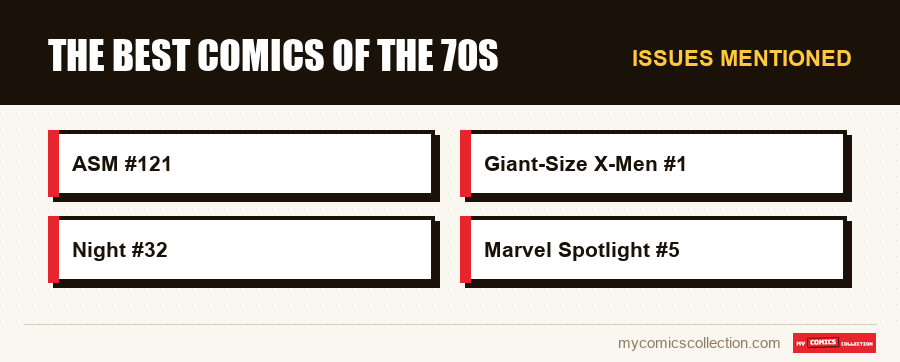
L'Amazing Spider-Man by Gerry Conway dares the death of Gwen Stacy (ASM #121), a turning point in the medium. Swamp Thing , Master of Kung Fu and Howard the Duck show the diversity of the decade.
Tier B: the rise of horror and fantasy
Ghost Rider, Werewolf by Night (birthplace of Moon Knight), The Eternals by Kirby and The Defenders benefit from the relaxation of the Comics Code.
Tier C: the heroes of the time
Jonah Hex , Warlord , Killraven and Kamandi embody the western, fantasy and post-apo sci-fi of the 70s.
Tier D: the curiosities
Omega the Unknown , Nova and Devil Dinosaur close this tier list: more confidential creations but representative of the inventiveness of the decade.
To remember
- Bronze Age darkens the comic and broadens its themes.
- Giant-Size X-Men #1 and Werewolf by Night #32 (1st from Moon Knight) are major key numbers.
- Horror explodes thanks to the relaxation of the Comics Code.
- Each entry refers to a site file when it exists.
A timeline of the Bronze Age
The ranking says what matters, the timeline says when and why. Here are the dates that structure the decade, useful both for reading and for spotting the issues worth knowing.
1970 to 1972: the first breaks
Conan the Barbarian launches at Marvel in 1970 and puts heroic fantasy in the catalogue. The same year, Green Lantern / Green Arrow, by Denny O'Neil and Neal Adams, begins in Green Lantern #76 and brings the socially engaged comic to the forefront. In 1971 the Comics Code is relaxed: horror can return, which explains the 1972 wave with The Tomb of Dracula, Swamp Thing, Werewolf by Night, Ghost Rider (first appearance in Marvel Spotlight #5) and The Defenders. Jonah Hex and Kamandi were also born that year.
1973 and 1974: the turning point of the medium
In Amazing Spider-Man #121 (1973), Gerry Conway kills Gwen Stacy, a shock the medium had never known. Blade appears in The Tomb of Dracula #10, and Shang-Chi in Special Marvel Edition #15, before Master of Kung Fu takes over. In 1974, Wolverine makes his first appearance in The Incredible Hulk #180 and #181, long before joining the X-Men.
1975 and 1976: renewal and daring
Giant-Size X-Men #1 (1975) launches Chris Claremont's new team, who then continue in Uncanny X-Men #94. Werewolf by Night #32 (1975) introduces Moon Knight. In 1976, Steve Gerber's Howard the Duck gets his own series, although the character had appeared in 1973 in Adventure into Fear #19, while Jack Kirby launches The Eternals. Nova and Omega the Unknown arrive the same year.
What this timeline teaches the collector
- The first appearance is not always in the famous series. Wolverine is in Hulk, Moon Knight in Werewolf by Night, Blade in The Tomb of Dracula, Ghost Rider in Marvel Spotlight. Look for the issue, not the series.
- The Giant-Size format is a special case. Giant-Size X-Men #1 is an oversized issue that precedes the relaunch of the main title: do not mistake it for a reprint or a facsimile.
- The keys have been heavily republished. Collected editions and facsimiles reprint most of these stories: always check the edition notice and the cover price before buying an original.
- Read for the story, collect for the impact. The decade's collected editions are enough to read everything without hunting for the original issues.
This timeline complements the tier list: it shows how the decade moved from stories softened by the Comics Code to more adult, social and fantastical series.
Frequently asked questions
Giant-Size X-Men and the Claremont run that followed dominated the decade. The Tomb of Dracula and Green Lantern/Green Arrow also feature at the height of the Bronze Age.
This is the period of the 70s (around 1970-1985), marked by darker and adult stories, the rise of horror and social themes, between the Silver Age and the Modern Age.
Some key issues (Giant-Size X-Men #1, Werewolf by Night #32, Marvel Spotlight #5) are highly sought after, especially at high grades. Always check condition before purchasing.
Do you own a key issue from the 70s (Giant-Size X-Men #1…)? Estimate its value for free with our tool based on current eBay listings.