MCU and DCU movie announcements can spike comic book values by 200-1,000% overnight, but most of these gains are temporary. The comics that retain their post-movie value are those featuring characters who become genuine cultural icons: not one-off appearances. Understanding the hype cycle is essential for both buying and selling at the right time.
No single force has shaped the comic book market more profoundly over the past fifteen years than the Marvel Cinematic Universe. When Marvel Studios announces a new project, the source comics see immediate and often dramatic price increases. DC's cinematic efforts have had similar effects, though with more variability. For collectors, the key question is always the same: is this a lasting shift in value, or a temporary spike that will evaporate?
The anatomy of a movie-driven price spike
Every MCU or DCU announcement triggers a predictable cycle in the comic market. Understanding this cycle is the single most important skill for any collector navigating the modern market.
Phase 1: Rumor and early speculation
Before official announcements, industry insiders and dedicated fans begin circulating rumors. At this stage, informed buyers are already accumulating. Prices begin to creep upward, but most collectors have not yet noticed. This is the highest-profit, highest-risk buying window: you are betting on unconfirmed information.
Phase 2: Official announcement
When Marvel or DC officially confirms a project, prices spike sharply: often doubling or tripling within 48 hours. eBay listings multiply as speculators rush to acquire copies. This is when most casual collectors first become aware of the opportunity, but the biggest gains have already been captured by early movers.
Phase 3: Casting and trailer hype
Casting announcements and trailer releases create secondary spikes. A beloved actor being cast as a character can push prices even higher. The first trailer, with its visual confirmation of beloved characters, often marks the absolute peak of speculative pricing.
Phase 4: Release and reality check
After the movie or show is released, one of three things happens: if it is a massive hit (like Guardians of the Galaxy), prices stabilize at elevated levels. If it is mediocre (like Eternals), prices retreat significantly. If it flops, prices can crash below pre-announcement levels as disappointed speculators dump their holdings.
Case studies: before and after the MCU effect
The data tells the story better than any theory. Here are specific comics with documented price movements tied to MCU announcements.
Guardians of the Galaxy: the gold standard
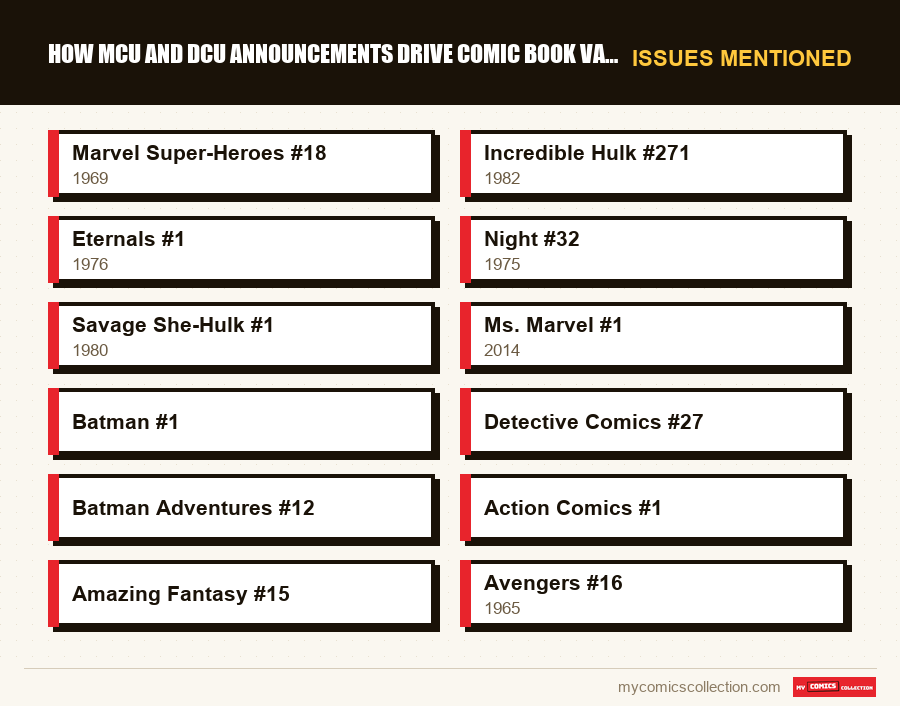
Marvel Super-Heroes #18 (first Guardians of the Galaxy, 1969): Before the 2014 movie announcement, a CGC 8.0 copy sold for approximately $500-700. After the movie became a surprise mega-hit, the same grade commanded $5,000-8,000. Even years later, the comic has retained most of its gains because the characters became genuine cultural icons with multiple sequels and crossover appearances.
Incredible Hulk #271 (first Rocket Raccoon, 1982): Pre-movie price in CGC 9.4 was roughly $100. Post-Guardians success, the same grade traded at $800-1,200. It has since settled to $300-500: still a massive premium over pre-movie levels, reflecting Rocket's enduring popularity.
Eternals: the cautionary tale
Eternals #1 (1976, Jack Kirby): Pre-announcement price for a CGC 9.4 was around $150. During peak movie hype, the same grade hit $600-800. After the film's underwhelming reception, prices retreated to $200-300. Collectors who bought at the peak lost 50-60% of their investment.
Moon Knight: the sustained riser
Werewolf by Night #32 (first Moon Knight, 1975): This comic has seen one of the most dramatic MCU-driven appreciations. Pre-Disney+ series announcement, a CGC 8.0 was approximately $1,500. During series hype, it spiked to $6,000-8,000. Post-series, it has settled around $3,000-4,000:still a 100-150% premium over pre-announcement levels, as Moon Knight established himself as a viable franchise character.
She-Hulk and Ms. Marvel: mixed results
Savage She-Hulk #1 (1980): Jumped from $200 (CGC 9.4) to $600+ on Disney+ announcement, then retreated to $250-350 after the series received polarized reception.
Ms. Marvel #1 (Kamala Khan, 2014): Rose from $40 (CGC 9.8) to $400+ during Disney+ hype. Settled to $80-120 after the series, though the character's inclusion in The Marvels provided a secondary bump.
DC cinematic impact: a different pattern
DC's film adaptations have had a more uneven impact on comic values, partly because DC's cinematic output has been less consistent than Marvel's.
- Batman-related keys remain relatively insulated from movie performance because Batman's cultural cachet transcends any single film. Batman #1 and Detective Comics #27 appreciate steadily regardless of cinematic quality.
- Suicide Squad characters saw dramatic spikes: Batman Adventures #12 (first Harley Quinn) jumped from $100 to $800+ and has largely held those gains as Harley became a standalone cultural icon.
- Justice League Dark characters like Swamp Thing and Constantine have seen modest but sustained increases with each new adaptation announcement.
- James Gunn's DCU reboot is creating fresh speculation cycles around characters like Booster Gold, Authority members, and Swamp Thing.
How to profit from movie announcements
The pre-announcement strategy
The biggest profits go to collectors who anticipate announcements before they happen. Study the studios' announced slates, pay attention to which characters are trending in current comics, and watch for trademark filings that often precede media announcements.
The post-announcement discipline
If you already own comics that spike on an announcement, the time to sell is during the hype, not after the release. Set a target price and list when it hits. Greed, waiting for one more spike, is the most common way collectors leave money on the table.
The post-release opportunity
After a successful movie or show, there is often a buying opportunity in the dip that follows the initial hype. If a character has proven to be culturally resonant, buying after the post-release correction can yield excellent long-term returns.
The video game factor: an emerging driver
Video games are becoming an increasingly important catalyst for comic values, particularly as game budgets and cultural impact rival Hollywood productions.
- Marvel's Spider-Man (Insomniac, 2018-2024): The Insomniac Spider-Man games introduced millions of players to characters like Miles Morales and Venom, supporting sustained demand for their comic first appearances.
- Batman: Arkham series: These games maintained Batman's cultural presence between film releases, providing a price floor for Bat-family comics.
- Marvel's Wolverine (upcoming): Major upcoming games tied to specific characters can create speculation cycles similar to (though typically smaller than) movie announcements.
As gaming audiences grow and overlap with comic collector demographics, expect video game announcements to become a meaningful secondary catalyst alongside film and TV.
Comics that hold value regardless of movies
The safest investments are comics whose value does not depend on any single movie's performance:
- Action Comics #1, Detective Comics #27, Amazing Fantasy #15: These are the cornerstones of the hobby. Their value is driven by historical significance, not media adaptations.
- First appearances of A-list characters: Spider-Man, Batman, Superman, X-Men, and Wolverine will always command premium prices regardless of cinematic quality.
- Iconic covers and runs: Todd McFarlane's Spider-Man, Jim Lee's X-Men, and Frank Miller's Dark Knight Returns have standalone artistic value that transcends media tie-ins.
- Culturally significant independent keys: Maus, Persepolis, and Watchmen derive value from literary merit, not cinematic adaptation potential.
The media-proof portfolio: The smartest strategy is to build a core portfolio of comics whose value is independent of any single media project, then layer on selective media-driven speculation around that core. If every comic in your collection depends on a movie announcement to appreciate, your portfolio is dangerously concentrated in a single risk factor.
The streaming factor: Disney+, HBO Max, and beyond
Theatrical films are not the only media driver. Streaming series have become a significant secondary force in comic valuations, though their impact follows a different pattern.
How streaming differs from theatrical impact
- Smaller initial spikes: Streaming announcements create price jumps of 50-200% versus 200-500% for theatrical films. The cultural impact of a streaming premiere is simply smaller than a global theatrical release.
- Faster corrections: Streaming shows generate intense but brief attention cycles. Prices often peak within the first 1-2 weeks after premiere and correct quickly.
- Binge vs. weekly release impact: Shows released weekly (like WandaVision) sustain interest and prices longer than shows dropped all at once (like She-Hulk).
- Breakout potential: A streaming hit that captures social media attention (Loki, WandaVision) can rival theatrical impact in terms of lasting price changes.
Notable streaming price impacts
- WandaVision (2021): Avengers #16 (first Quicksilver and Scarlet Witch, 1965) saw sustained 40-60% price increases that largely held after the series ended, as both characters were established as major MCU figures.
- Loki (2021): Journey into Mystery #85 (first Loki, 1962) appreciated 30-50% and held, supported by the character's centrality to the MCU multiverse storyline.
- Hawkeye (2021): Young Avengers #1 (2005) doubled on the Kate Bishop introduction, settling at a 50% premium over pre-show levels.
- Peacemaker (2022): Fightin' 5 #40 (first Peacemaker, 1966) went from essentially unsaleable to $200-500 in any grade, demonstrating that even obscure Charlton Comics can benefit from a hit streaming show.
The lesson for investors: streaming series are most impactful when they turn an unknown or B-list character into a fan favorite, creating new demand where none previously existed.
International markets and global adaptation effects
The MCU and DCU are global phenomena, and international collector demand is increasingly influencing American comic prices.
- Chinese market growth: Marvel's expansion into China has created a new pool of high-spending collectors competing for key issues at auction.
- European collector interest: Strong comic traditions in France, Germany, and the UK mean that MCU adaptations pull European buyers into the American comic market.
- Anime/manga crossover collectors: As anime and superhero fandoms overlap, collectors from Japan, South Korea, and Southeast Asia are entering the American comic market.
This global demand expansion means that the pool of potential buyers for key issues is larger than ever, providing structural support for prices even during domestic market corrections.
Frequently Asked Questions
Prices typically begin moving within hours of an official announcement and can double or triple within 48 hours. eBay sold listings show the most dramatic price jumps occurring in the first week. By the time casual collectors hear the news, prices have usually already spiked significantly.
Disney+ and other streaming series have proven to impact values significantly, though typically less than blockbuster theatrical releases. Shows like WandaVision, Loki, and Moon Knight created substantial price movements. The key factor is cultural penetration: a hit show that generates social media buzz can rival a theatrical release in its market impact.
It depends on the comic. If you own a speculative comic whose entire value proposition rests on the movie, selling during peak hype (usually between casting confirmation and movie release) maximizes your return. If you own a genuine blue-chip key whose value would be strong regardless of the movie, holding through the cycle is often the better choice.
As of 2026, keep an eye on announced projects featuring characters whose first appearances are still affordable: Secret Wars tie-in keys, Doom-related first appearances, and any characters confirmed for James Gunn's DCU slate. The earlier you position before official casting announcements, the better your potential returns.
Animated films and series have a measurable but smaller impact compared to live-action projects. Spider-Verse boosted Miles Morales keys significantly, and animated Batman films have supported Bat-family comic values. The effect is strongest when the animated project introduces a character to a new, younger audience.