The best comics of the 60s are, at the top, Amazing Spider-Man by Lee and Ditko, Fantastic Four by Lee and Kirby, The X-Men (1963) and Doctor Strange. This tier list classifies the major series of the Silver Age according to their quality and their influence on the medium. Facts (authors, publishers, dates) checked, no invented ratings.
The 60s are the Silver Age: Marvel invents the modern, fallible and human superhero, while DC modernizes its icons. This tier list ranks the founding series of the decade according to their historical importance and quality. Many of them concentrate the key issues most sought after by collectors.
Editorial Ranks, Facts verified. Each entry refers to a site file when it exists.
Collecting this series?
Track what you own, what you are missing and what your collection is worth. 7 day trial.
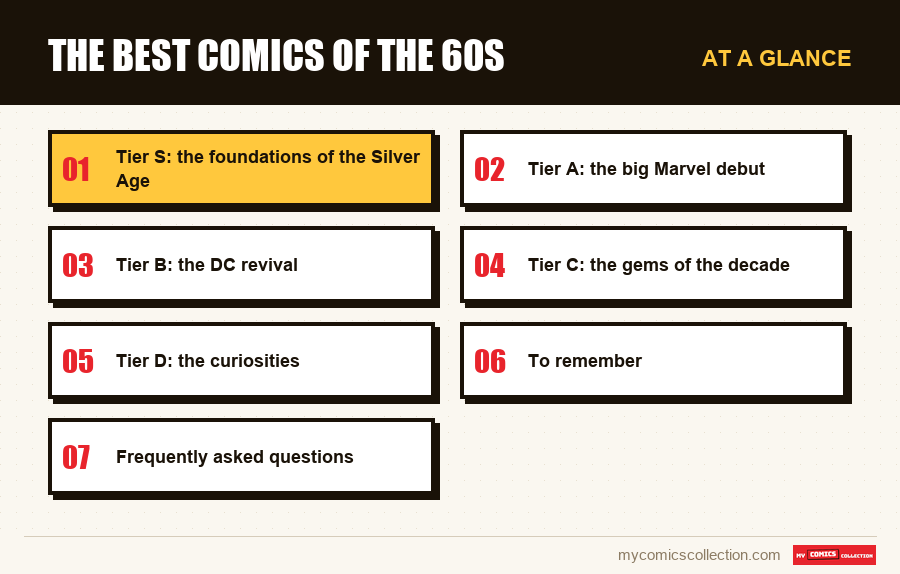
Start my trial →Tier S: the foundations of the Silver Age
Amazing Spider-Man (born in Amazing Fantasy #15) invents the adolescent superhero, fallible and endearing. Fantastic Four launches the modern Marvel Universe. The X-Men poses the allegory of difference, and Doctor Strange opens the psychedelic dimension of the medium thanks to Steve Ditko.
Tier A: the big Marvel debut
Daredevil, The Avengers, Thor and the Nick Fury by Steranko install the Marvel pantheon and revolutionize the layout.
Tier B: the DC revival
La Justice League of America, Green Lantern, The Flash et Metamorpho embody the modernization of DC during the decade.
Tier C: the gems of the decade
Doom Patrol , Metal Men , Sgt. Rock and the magazine Creepy (Warren) complete the landscape of the 60s.
Tier D: the curiosities
Herbie , Magnus, Robot Fighter and the T.H.U.N.D.E.R. Agents close this tier list: more confidential series but representative of the diversity of the time.
To remember
- Marvel dominates the decade with Lee, Kirby and Ditko.
- The 60s concentrate the key numbers the most expensive (Amazing Fantasy #15, X-Men #1, FF #1).
- It's the Silver Age, founder of the modern superhero.
- Each entry refers to a site file when it exists.
Frequently asked questions
L'Amazing Spider-Man of Lee and Ditko and the Fantastic Four by Lee and Kirby dominate the decade, both in terms of their quality and their historical influence.
Because they contain the first appearances of major heroes (Spider-Man, X-Men, Hulk), they are old and rare in good condition. Amazing Fantasy #15 is one of the most expensive comics in the world.
By the Marvel Masterworks or Epic Collection collections, which bring together these founding series at a reasonable price, without chasing the overpriced original issues.
Do you own a key issue from the 60s (Amazing Fantasy #15, X-Men #1, etc.)? Estimate its value for free with our tool based on current eBay listings.
Reading and collecting the 1960s: landmarks and watch-outs
To place the series in this tier list in time, remember a few launch dates: Fantastic Four #1 in November 1961, Amazing Fantasy #15 in August 1962 (first appearance of Spider-Man), Strange Tales #110 in July 1963 (Doctor Strange), then X-Men #1 and Avengers #1 in September 1963, and Daredevil #1 in April 1964. Marvel thus installs most of its pantheon in three years, with a recurring creative trio: Stan Lee, Jack Kirby and Steve Ditko.
First watch-out: many first appearances are not under the title you would expect. Spider-Man is born in Amazing Fantasy, Thor in Journey into Mystery #83 (August 1962), Doctor Strange in Strange Tales. When hunting a character's key, go back to the original anthology series rather than the series that bears their name today. On the DC side, Barry Allen appears in Showcase #4 (October 1956) and Hal Jordan in Showcase #22 (October 1959): these try-out titles launched the revival summed up by tier B.
Second point: reading order. A tier list ranks quality, not the entry door. To discover these series, start from the first issue of each title and move forward in short arcs: 1960s stories are often built as self-contained episodes, which makes them easier to read than many modern series. Collected editions remain the simplest way to read without chasing originals.
Third point: reprints and counterfeits. The landmark issues have been reissued many times, for example as the Golden Record Reprint (1966), the Marvel Milestone Edition (1993) or the Facsimile Edition (2019). A period original carries a 12-cent cover price, yellowed paper with a rough texture and period ads inside; paper that is too white or shiny staples should raise suspicion.
Last piece of advice for building a coherent collection: pick a specific series and period rather than chasing a single issue, and check the completeness of each copy. Ad pages torn out by former readers are common on Silver Age comics, and a missing page weighs on condition. For important pieces, favor a certified copy, which limits the risk of concealed restoration.