
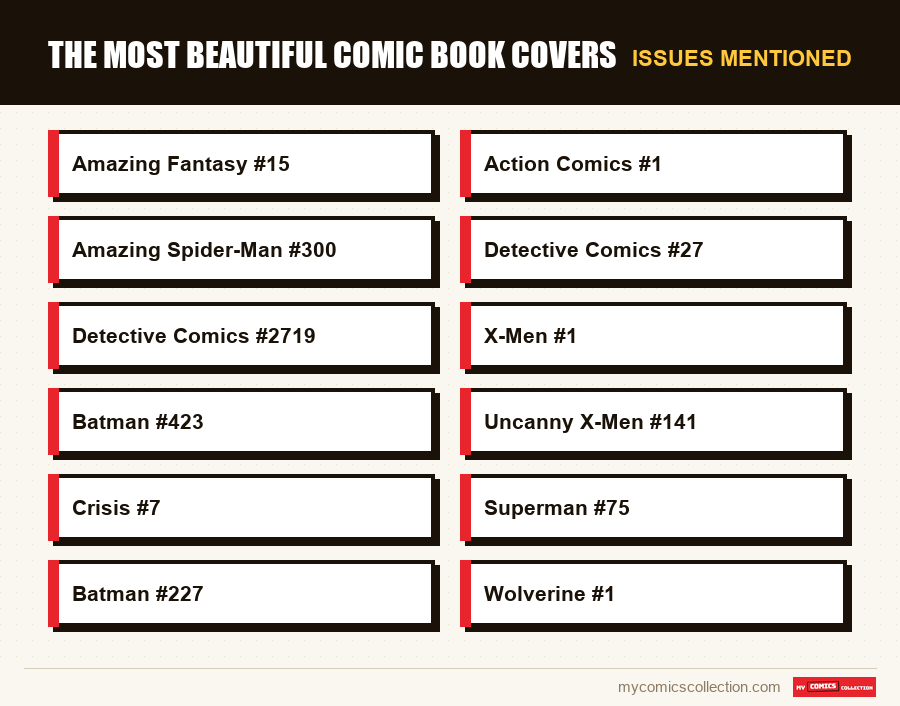
The most beautiful comic book covers of all time are, at the top, those of Amazing Fantasy #15 (first appearance of Spider-Man), Action Comics #1 (premiere of Superman), Amazing Spider-Man #300 (Venom, by McFarlane) and Detective Comics #27 (Batman premiere). This tier list classifies covers according to their iconicity and their visual impact. Each entry refers to the corresponding key number record.
A great cover can be recognized in a fraction of a second and etched into the collective memory. This tier list does not classify the numbers by their rating but by the graphic strength of their cover: composition, audacity, iconic status. Many are also historic numbers: this is no coincidence: a strong image often accompanies a strong moment.
Editorial Ranks, Facts verified. Each cover points to its key number on the site.
Collecting this series?
Track what you own, what you are missing and what your collection is worth. 7 day trial.
Start my trial →Tier S: the four images engraved in history
The cover of Amazing Fantasy #15 (1962), where Spider-Man rushes carrying a criminal, is one of the most reproduced in the world. Action Comics #1 (1938), Superman lifting a car, opens the golden age. Amazing Spider-Man #300 (1988) imposes Venom on full page thanks to Todd McFarlane. And Detective Comics #27 (1939) presents Batman for the first time: four images which, alone, summarize the history of the comic.
Tier A: the cult covers
X-Men #1 (1991) by Jim Lee, whose giant poster remains legendary, accompanies the best-selling comic of all time. Batman #423 by McFarlane is one of the most sought-after modern covers. Uncanny X-Men #141 (1981) and his research notice “Days of Future Past” is a model of composition, just like Crisis #7 (1985), Superman carrying Supergirl.
Tier B: the major compositions
Superman #75 (1992), with his torn cape against a backdrop of mourning, left his mark. Batman #227 by Neal Adams is a gothic homage that has become a reference. Wolverine #1 (1982) by Frank Miller launches the character solo, and Giant-Size X-Men #1 (1975) breaks up the new team through the old one.
Tier C: modern icons
Spawn #1 (1992) inaugurates the Image era with panache. The Walking Dead #1 (2003) establishes an immediately identifiable black and white atmosphere. And Fantastic Four #1 (1961) opens the Marvel Silver Age. Three major covers, a notch below the absolute icons.
To remember
- A great cover is often a great number: strong image and historical moment go hand in hand.
- The designer counts: McFarlane, Jim Lee and Neal Adams dominate this ranking.
- An iconic cover raises the price and requesting a number.
- Each cover refers to its key number sheet.
Frequently asked questions
Amazing Fantasy #15 (Spider-Man, 1962) and Action Comics #1 (Superman, 1938) are the two most recognizable and reproduced covers in the history of the medium.
Yes. An iconic cover (McFarlane on ASM #300, Jim Lee on X-Men #1) increases desirability and therefore popularity, especially at high grades where the aesthetics of the cover are perfectly preserved.
This is an alternative cover of the same issue, printed in limited quantities. Certain variants, often signed by great artists, become more sought after than the standard cover.
Choosing, protecting and displaying a beautiful cover
The cover is the first thing you look at and the first thing to wear. If you collect images as much as stories, a few simple habits will spare you nasty surprises and protect what gives an issue its value.
Cover and interior do not always go together
The name of the cover artist is not always the interior artist's. Jack Kirby, for instance, kept drawing the Avengers covers up to #17 even though he had already left the interior pages. Before buying for a specific artist, check the issue's credits: you will know whether you are paying for the cover, the interior or both.
Virgin variants and alternate covers
A virgin version, with no logo or text, reveals the full composition of the illustration, which appeals to art lovers. Versions of this kind, such as certain Gabriele Dell'Otto variants, are often sought after for that reason. Keep in mind, though, that a heavily printed alternate cover loses its edge: only scarcity adds to the beauty of the image.
Protecting a cover
- Slide each comic into a Mylar bag, or failing that polypropylene, with an acid-free backing board.
- Store issues upright in acid-free boxes, away from direct light and humidity, ideally between 18 and 22 °C and at 40 to 50 percent relative humidity.
- Matte finishes and special inks mark easily: handle them with cotton gloves and plan for bags suited to thicker cardstock covers.
- An iconic cover is mostly valued in high grade, where the image is perfectly preserved: a worn copy loses precisely the visual impact people seek.
Displaying without damaging
Displaying the original of a legendary cover exposes it to light, the worst enemy of colors. To hang an unreachable icon, serious alternatives exist: reprints such as the Famous First Edition or the Millennium editions, or modern facsimiles. Keep the original copy in protected storage and regularly rotate what you show.
Building a collection by cover
An original idea is to gather covers by artist or by theme rather than by series. Between the covers of McFarlane, Jim Lee, Neal Adams or Steve Epting, you compose a visual journey to your taste. Note in your catalog the cover artist's name, the printing and the condition for each cover: it makes the collection readable and easy to complete.
Do you own one of these issues with the legendary cover? Estimate its value for free with our tool based on current eBay listings.