
The best comic book artists in history are, at the top, Jack Kirby , Alex Ross , Jim Lee and Frank Miller. This tier list classifies artists according to their influence, their style and their imprint on the medium: visual invention, posterity, significant works. The facts (works, periods) are verified; each artist refers to one of their emblematic boards on the site.
The drawing makes the comic as much as the scenario. This tier list distinguishes artists who have changed the way of drawing comics: creators of visual language, stylists recognizable among thousands, masters of graphic narration. The criterion is not “who draws most cleanly” but the extent of the influence left.
Editorial Ranks, Facts verified. Each name points to a signature work.
Collecting this series?
Track what you own, what you are missing and what your collection is worth. 7 day trial.
Start my trial →Tier S: the four founding artists
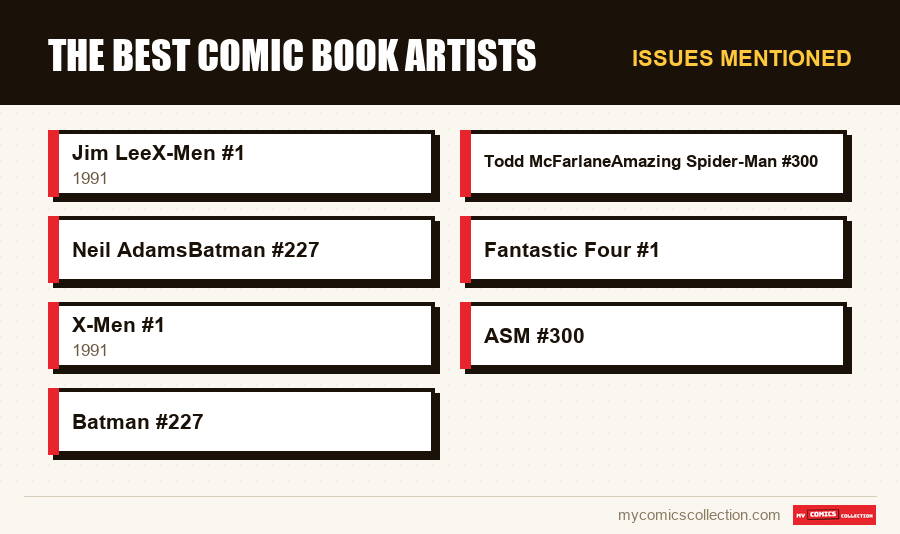
Jack Kirby is the “King”: co-creator of an immense part of the Marvel universe, he invented a graphic energy, the “Kirby Krackle”, which still irrigates the medium, visible from Fantastic Four #1. Alex Ross imposed photorealism painted with Marvels and Kingdom Come . Jim Lee defined the aesthetic of the 90s and created the best-selling comic of all time, X-Men #1 (1991). Frank Miller, finally, reinvented the black and angular layout with The Dark Knight Returns.
Tier A: the major stylists
Todd McFarlane revolutionized the drawing of Spider-Man before founding Image: see ASM #300. Neil Adams brought back dynamic realism to DC, as on Batman #227. David Mazzucchelli signed the refined boards of Batman: Year One and of Born Again . And John Romita Sr. shaped the classic Spider-Man of the 60s-70s.
Tier B: the great contemporaries
Fiona Staples gives to Saga its warm visual identity. George Perez remains the master of frescoes with a hundred characters, like Crisis on Infinite Earths. Frank Quitely (All-Star Superman) and Bryan Hitch (The Ultimates) have each imposed an immediately recognizable elegance.
Tier C: the singular virtuosos
Jim Steranko introduced psychedelia and cinema into the box in the 1960s. Williams III composes double-page spreads of crazy inventiveness on Batwoman and Promethea . Esad Ribic brings a pictorial dimension to the Thor by Jason Aaron. Three exceptional artists, a step behind the most influential figures.
To remember
- The criterion is influence, not just the technique.
- The S tier brings together artists who have created a visual language that has been imitated for decades.
- A great designer sells: numbers signed Lee, McFarlane or Ross are highly sought after.
- Each name refers to an emblematic board of the site.
Frequently asked questions
Jack Kirby unanimously recognized as the most influential figure, nicknamed “The King”. Alex Ross, Jim Lee and Frank Miller complete this summit according to styles.
Yes, strongly. An issue drawn by a cult artist (McFarlane on ASM #300, Jim Lee on X-Men #1) is generally more sought after and higher rated than a comparable, less iconic issue.
Absolutely. Many collectors follow a specific artist (Kirby, Adams, McFarlane) and collect their runs. This is a very common themed entryway.
Do you have an issue signed by one of these artists? Estimate its value for free with our tool based on current eBay listings.
Collecting by artist: one signature work at a time
This tier list gives each artist a signature work, and that is a good starting point for collecting: first spot the issue or series that defines an artist, then widen out only if their style grabs you. It keeps you from scattering across an immense bibliography.
Follow a character through several hands. Spider-Man can be read through John Romita Sr, who shaped the character, then Todd McFarlane, whose signature work is Amazing Spider-Man #300. For Batman, three landmarks answer one another: Neal Adams with Batman #227, David Mazzucchelli with Batman: Year One, and Frank Miller with The Dark Knight Returns. Comparing these approaches shows how much the same hero changes with the line.
Epic canvases and events. George Pérez is the master of hundred-character panoramas, and Crisis on Infinite Earths is the proof. Bryan Hitch gives The Ultimates an immediately recognizable elegance, while Alex Ross imposed painted photorealism in Marvels and Kingdom Come. These three names attract those who love grand compositions.
Auteur works. Fiona Staples gives Saga its warm visual identity, Frank Quitely draws All-Star Superman, J.H. Williams III composes highly inventive double-page spreads on Batwoman and Promethea, and Esad Ribić brings a painterly dimension to Thor: God of Thunder. These are tighter collections, often easier to finish than a multi-year run.
The founders. Jack Kirby is the artist to go back to first: his graphic energy, the "Kirby Krackle", is visible from Fantastic Four #1. Jim Steranko brought psychedelia and cinema into the panel with Nick Fury, and Jim Lee marked the early 1990s with X-Men #1 (1991). These artists are the most imitated, and their issues are also the ones the market seeks most.
Things to watch. Do not confuse artist and writer: an issue can be drawn by a great artist without the story being theirs, and vice versa. Always check the creative team and, when aiming for a specific work, the exact issue number and volume. For short, closed stories like Marvels or Kingdom Come, a collected edition may be enough if you are mainly after the art.
Organize your collection by artist. If you follow an artist, note the artist's name in your inventory alongside the series and issue number. You will then see at a glance which signature works you own and which are missing from your selection.