
The best comic book colorists are, at the top, Dave Stewart , Steve Oliff , Laura Martin and Lynn Varley. This tier list ranks artists of color, too often forgotten, according to their talent and influence. Facts (major works) verified, no rating invented; each entry refers to a signature work when it exists.
Color creates the atmosphere of a comic as much as the drawing: it creates light, emotion, atmosphere. This tier list highlights colorists, essential but little-known artists, classified according to their talent and their mark on the medium.
Editorial Ranks, Facts verified. Each colorist refers to a signature work when it exists.
Collecting this series?
Track what you own, what you are missing and what your collection is worth. 7 day trial.
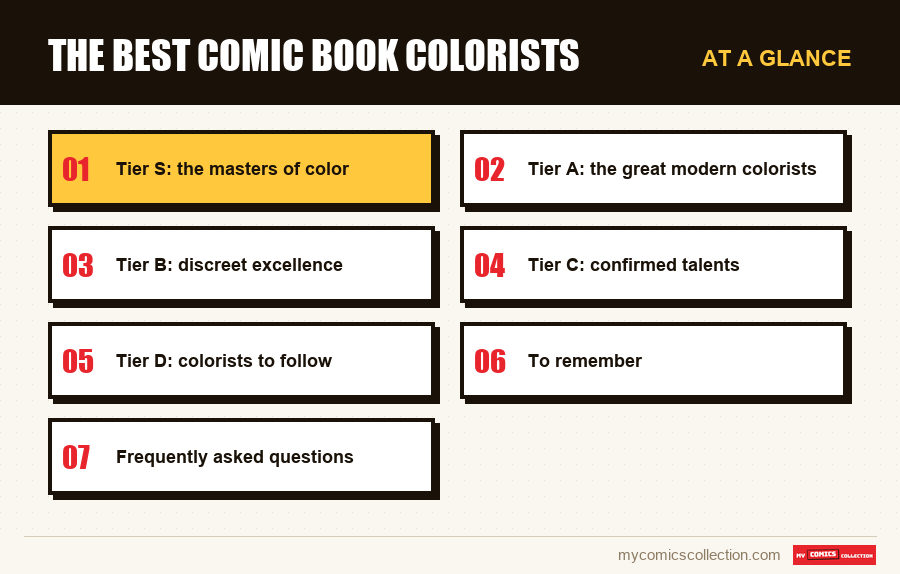
Start my trial →Tier S: the masters of color
Dave Stewart is the most awarded colorist, inseparable from the Hellboy universe. Steve Oliff was a pioneer of digital color (Spawn, Akira). Laura Martin illuminates the great superheroic series, and Lynn Varley signed the revolutionary colors of The Dark Knight Returns and 300.
Tier A: the great modern colorists
Matt Hollingsworth (the very particular look of Hawkeye), Jordie Bellaire , Dave McCaig and Nathan Fairbairn are among the most sought-after of their generation.
Tier B: discreet excellence
Jamie Grant (All-Star Superman), Marte Gracia (the modern X-Men), Dean White and Frank Martin bring recognizable palettes.
Tier C: confirmed talents
Alex Sinclair (Batman loyalist), Jose Villarrubia , Elizabeth Breitweiser (Brubaker's thrillers) and Christian Lichtner complete the selection.
Tier D: colorists to follow
Peter Steigerwald , Tamra Bonvillain and Chris Chuckry close this tier list: talented colorists, a notch below the most influential figures.
To remember
- Dave Stewart is the most awarded colorist of his generation.
- Color sets the mood as much as drawing: an art in its own right.
- The transition to digital color (Steve Oliff) transformed the medium.
- Each colorist refers to a signature work when it exists.
Frequently asked questions
Dave Stewart is unanimously acclaimed, particularly for his work on Hellboy. Laura Martin and Matt Hollingsworth are also among the most admired.
Yes, essential: color defines the atmosphere, light and emotion of a page. The same drawing can be completely transformed by the work of the colorist.
Historically, their name was little highlighted. But the profession is now recognized, with its own Eisner Awards, and stars like Dave Stewart and Jordie Bellaire.
Do you have a number with striking coloring? Estimate its value for free with our tool based on current eBay listings.
How to collect by following a colorist
This tier list also works as a map for collecting differently: instead of following a character, you follow a palette. The colorist's name appears in the credits box of every issue, alongside the writer and the artist. It is the first habit to pick up when flipping through a comic in a shop or at a convention.
Lasting partnerships are the best guiding thread. Laura Martin colored Astonishing X-Men and Planetary, two series drawn by John Cassaday: you can read the same duo in two very different universes. Lynn Varley colored The Dark Knight Returns and 300, two works by Frank Miller. Dave Stewart remains inseparable from Hellboy and B.P.R.D., where his palette ended up defining the atmosphere of the whole series.
Some colorists also tell the technical story of the medium. Steve Oliff was a pioneer of digital color, from Spawn to Akira: his issues are landmarks for understanding the shift from traditional coloring to the computer. Matt Hollingsworth gave Hawkeye its distinctive look, a striking example of a series whose visual identity rests largely on color.
A few useful habits for the collector. Always compare a reprint with the first printing: a new coloring, a different paper or a different printing process can change the mood of the very same page. Also protect your copies from direct light, since inks and paper yellow and fade over time, which damages precisely what the colorist built.
To get started, here is a simple approach: pick a colorist from tier S or A, note two or three signature works mentioned in the tier list, then read them in sequence. Within a few issues, you will see how color changes the light, the emotion and the rhythm of a page. That is often how a reader learns to look at a comic differently, and how a collection gains coherence.