The best comic book writers are, at the top, Alan Moore , Neil Gaiman , Grant Morrison and Frank Miller. This tier list ranks comic book authors according to their influence, their ambition and the quality of their work. Facts (major works, period) verified, no rating invented; each screenwriter refers to one of his works on the site.
The screenwriter is the architect of the comic: plot, dialogue, themes, inspiration. This tier list ranks the great authors according to their influence on the medium and the consistency of their work. The criterion is not productivity but the footprint left.
Editorial Ranks, Facts verified. Each screenwriter points to a signature work of the site.
Collecting this series?
Track what you own, what you are missing and what your collection is worth. 7 day trial.
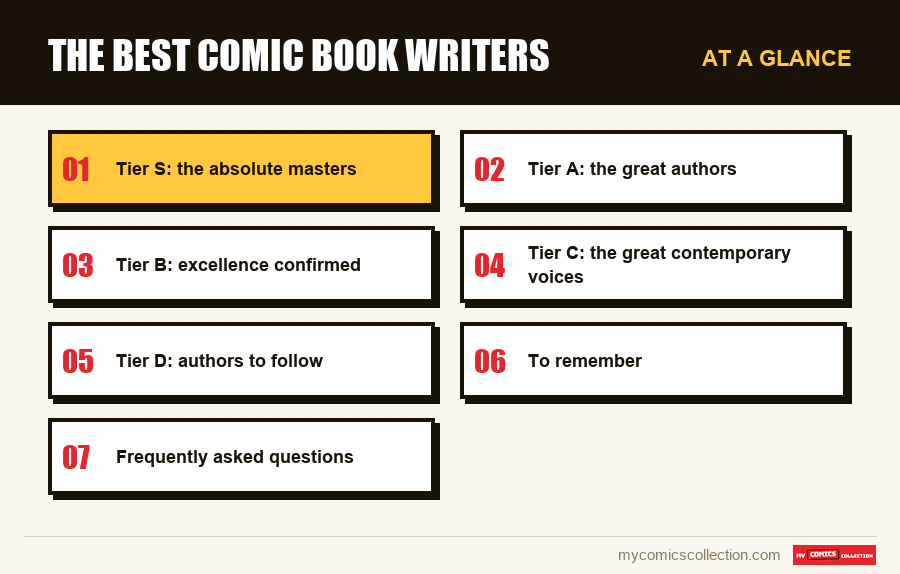
Start my trial →Tier S: the absolute masters
Alan Moore redefined what a comic could be (Watchmen, V for Vendetta). Neil Gaiman brought a literary dimension to the medium with Sandman. Grant Morrison pushed conceptual ambition to its extreme, and Frank Miller reinvented the dark, adult superhero.
Tier A: the great authors
Chris Claremont wrote the longest and most influential X-Men run. Brian K. Vaughan dominates modern indie, while Warren Ellis et Garth Ennis have marked the mature comic.
Tier B: excellence confirmed
Ed Brubaker (king of thriller), Jonathan Hickman (universe architect), Brian Bendis et Mark Waid are among the most prolific and respected screenwriters.
Tier C: the great contemporary voices
Tom King, Geoff Johns, Jason Aaron et Kurt Busiek have each signed notable runs in the recent period.
Tier D: authors to follow
Jeff Lemire , Kieron Gillen et Robert Kirkman close this tier list: major screenwriters of the current generation.
To remember
- Alan Moore is the most influential screenwriter in the history of the medium.
- A great screenwriter sells: his runs become collector's items.
- The author's comic owes a lot to this British generation (Moore, Gaiman, Morrison, Ellis).
- Each screenwriter refers to a signature work of the site.
Frequently asked questions
Alan Moore is unanimously considered the most influential screenwriter, followed by Neil Gaiman and Grant Morrison. The choice depends on the style you are looking for.
Absolutely. Many collectors follow a specific author (Moore, Claremont, Vaughan) and collect his runs. This is a very common themed entryway.
By their flagship works: Watchmen (Moore), Sandman (Gaiman), Saga (Vaughan). All exist in accessible bound collections.
Do you own an original edition signed by a great screenwriter? Estimate its value for free with our tool based on current eBay listings.
Collecting by writer: method and markers
Following an author rather than a character is one of the most common entry points, and the tier list works here as a map. But "collecting Alan Moore" does not mean the same thing as "collecting Chris Claremont", and a few markers avoid many mistakes.
Choose your form of collection. Two logics coexist. The first is reading: a bound collection of Watchmen, The Sandman or Saga is more than enough, and it is the cheapest way to discover an author. The second is collecting original issues, for those who want the booklets as published at the time, with their paper, ads and covers.
A few facts to help you get your bearings:
- Moore and Miller are 1986 works. Watchmen (Alan Moore) and The Dark Knight Returns (Frank Miller) came out the same year: this is the heart of the turn toward "adult" comics.
- Gaiman means a 1989 series. The Sandman begins in 1989: there is no issue of that series in the Silver or Bronze Ages, which contrasts with other authors on the list.
- Claremont is a question of length. He wrote the longest and most influential X-Men run. His work is collected by arcs rather than as a single block.
- Vaughan and Kirkman are 21st century. Saga (2012) and The Walking Dead (2003) are independent series: their first printings matter far more than the sequels.
Pitfalls to avoid. A writer is not always the only author of an issue: the work is shared with an artist, and an issue's value often depends as much on one as on the other. For signed editions, demand proof of authenticity (certificate, witnessed signing): a signature without traceability is worth almost nothing.
Finally, an author can rank high on influence and low on price: the two are unrelated. Moore tops the tier list, but his best-known collections remain very accessible. Take the list for what it is: a reading map before it is a shopping map.
A method tip to finish: choose one author at a time. Read first his signature work, then a second, more recent title, before deciding to gather all his runs. This progression avoids committing to an author whose style does not suit you and turns the collection into a reading path rather than a mere accumulation.