The best mentors in comics are, at the top, Professor , Alfred Pennyworth , Uncle Ben and The Ancient One. This tier list classifies the figures of transmission which form the heroes according to their importance and their narrative richness. Facts (publisher, creation) checked, no invented ratings.
The mentor is the emotional heart of many comics: he trains the hero, embodies wisdom and, often, dies to launch his trajectory. This tier list ranks these figures according to their narrative importance and lasting impact. Criterion: the weight of the mentor in the hero's story.
Editorial Ranks, Facts verified. Each entry refers to a site file when it exists.
Collecting this series?
Track what you own, what you are missing and what your collection is worth. 7 day trial.
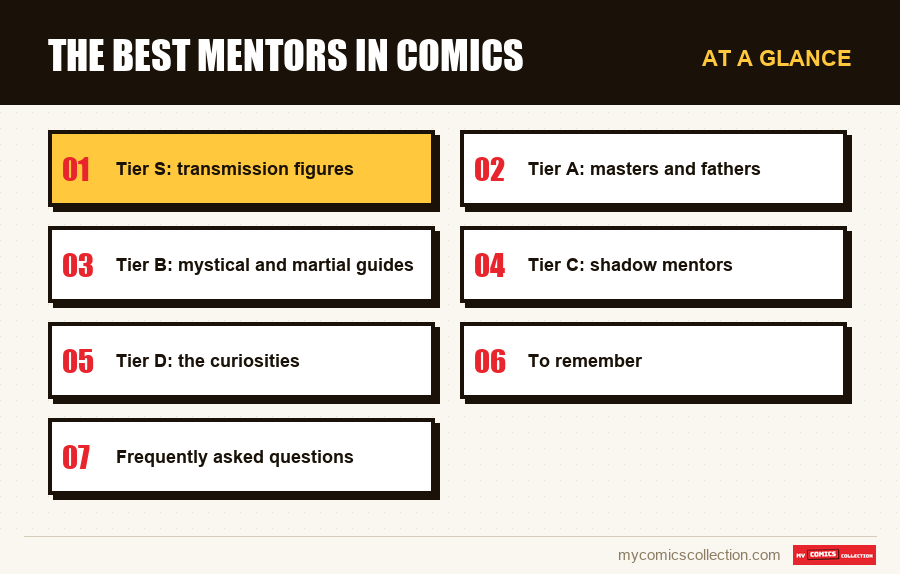
Start my trial →Tier S: transmission figures
Le Professor forms the X-Men and embodies an ideal of coexistence. Alfred is much more than a butler: Batman's moral conscience. Uncle Ben leaves Peter Parker with his founding lesson (“with great power comes great responsibility”), and The Ancient One introduces Doctor Strange to the mystical arts.
Tier A: masters and fathers
Jonathan Kent transmits his values to Clark, Odin reigns and educates Thor, Stick trains Matt Murdock in combat, and Nick Fury guides many spies.
Tier B: mystical and martial guides
Wong, Agatha Harkness (Scarlet Witch's mentor), Zatara et Wildcat (who trained many DC heroes) complete the gallery.
Tier C: shadow mentors
Swordsman , Highfather , Wizard Shazam and Sensei embody other, more discreet figures of transmission.
Tier D: the curiosities
The Chief (Doom Patrol), Master Izo (Daredevil) and Turtle (speed mentor) closes this tier list: more obscure but very real mentors.
To remember
- The mentor often dies to launch the trajectory of the hero (Uncle Ben).
- Professor X and Alfred are the most emblematic mentors.
- The mentor carries the moral burden and emotional aspect of the story.
- Each entry refers to a site file when it exists.
Where to read and find each mentor's first appearance
Knowing that a mentor matters is one thing, knowing where they were born is another. Here are the pointers that let you trace each one back to the source, whether to read or to complete a collection.
Mentors born alongside their hero
Some mentors appear in the very issue that launches the hero. Uncle Ben debuts in Amazing Fantasy #15 (1962), the issue where Spider-Man first appears, and his death takes place in that same issue. The Ancient One and Wong appear in Strange Tales #110 (1963), at the same time as Doctor Strange. Professor X debuts in X-Men #1 (1963), with the team he trains. For these mentors, the hero's key is also theirs: a single issue to look for.
Mentors who arrive after their student
Others are introduced later, and their issue is separate. Alfred Pennyworth enters in Batman #16 (1943). Agatha Harkness appears in Fantastic Four #94 (1970), long before becoming Scarlet Witch's mentor. Stick debuts in Daredevil #176 (1981), more than fifteen years after Matt Murdock himself. These issues are often less conspicuous than the heroes' ones, which makes them interesting leads for a collector who likes to leave the beaten path.
Mentors passed down between generations
Zatara (DC, 1938) is a case apart: mentor and father of Zatanna, he illustrates the family transmission of magical knowledge. Wildcat (DC, 1942) trained many DC heroes. Odin (Marvel, 1962) rules and raises Thor, and Nick Fury (Marvel, 1963) guides many spies. Each has their own logic of transmission: parental, martial, magical or institutional.
Four mentor profiles
- The moral mentor: Alfred, Jonathan Kent, Uncle Ben. They pass on values more than techniques.
- The martial mentor: Stick, Wildcat, Swordsman. They train in combat, sometimes harshly.
- The mystical mentor: The Ancient One, Wong, Agatha Harkness, Zatara, the Wizard Shazam. They open access to hidden knowledge.
- The institutional mentor: Professor X, Nick Fury, The Chief. They structure a team rather than a single student.
Reading tips
To understand a mentor's importance, first read the issue of their first appearance, then an arc where they are central. Collected editions are enough for reading. For the collection, check that you are aiming at the original issue (edition notice, cover price) and not a reprint: founding stories like Uncle Ben's have been republished many times.
Frequently asked questions
Le Professor (X-Men) and Alfred Pennyworth (Batman) are the most iconic mentors, each deeply defining their hero.
Because the death of the mentor is a powerful narrative spring: it marks the hero's passage to adulthood. Uncle Ben is the most famous example.
Yes, it's a common occurrence: certain mentors (like Stick with Daredevil) maintain ambiguous, even conflicting, relationships with their students.
Do you have a key number linked to these mentors (Amazing Fantasy #15…)? Estimate its value for free with our tool based on current eBay listings.