
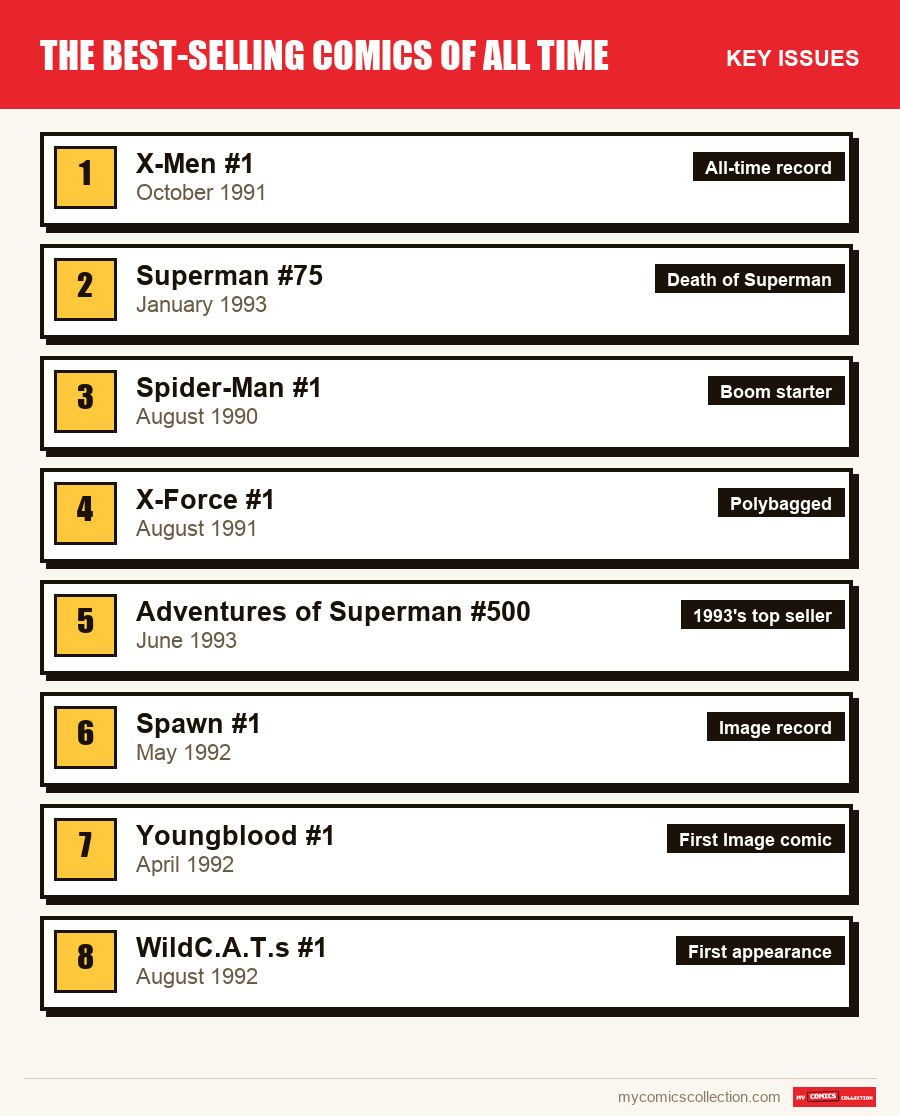
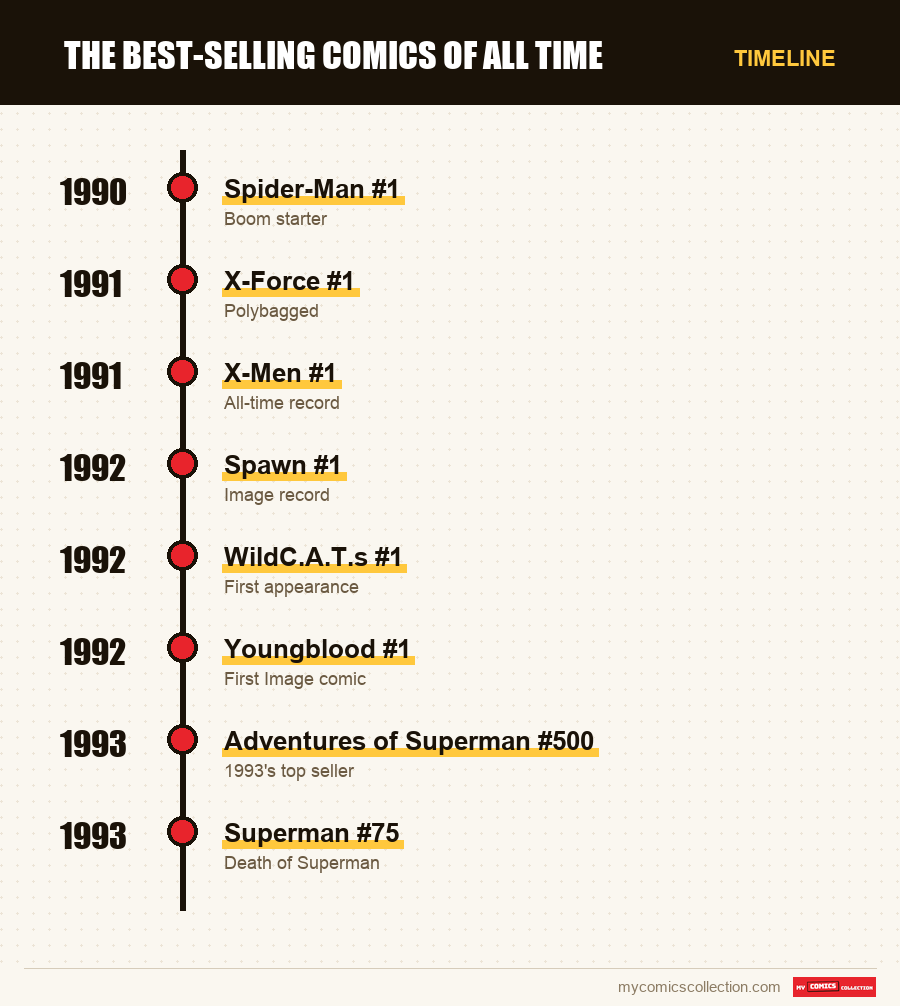
The best-selling comics of all time are, at the top, X-Men #1 (1991), X-Force #1 (1991), Spider-Man #1 (1990) and Superman #75 (cover-dated January 1993, “The Death of Superman”). X-Men #1 holds the documented record for best-selling comic, with approximately 8 million copies sold. This tier list ranks the biggest print runs in history; the major figures are verified, the rest is given conservatively.
“The most sold” is not “the most expensive”: the big print runs of the 90s boom sold millions of copies, which makes them today abundant and little rated. This tier list ranks sales records: especially single issues, then some collections. Exact figures are rare and sometimes estimated: here we favor caution over false precision.
Ranks and numbers checked as much as possible; when a print is not documented with certainty, we say so.
Tier S: sales records
X-Men #1 (1991), by Chris Claremont and Jim Lee, holds the record for the best-selling comic in history: around 8 million copies, inflated by its five different covers. X-Force #1 (1991), sold in a blister pack with a collectible card, sold several millions. Spider-Man #1 by Todd McFarlane (1990) launched the boom, and Superman #75 (released November 1992, cover-dated January 1993) took advantage of the hype surrounding the hero's death.
Collecting this series?
Track what you own, what you are missing and what your collection is worth. 7 day trial.
Start my trial →Tier A: the hits of the 90s boom
Spawn #1 (1992) remains one of the biggest launches in Image's history. Youngblood #1 and WildC.A.T.s #1 accompanied the founding of Image in a speculative frenzy. Adventures of Superman #500 surfed on the return of the hero. All were overproduced: hence their current low rating despite colossal sales.
Tier B: collections that are still selling
On the book side, Watchmen et Maus have been continuously reprinted for decades. The compendiums of The Walking Dead et The Dark Knight Returns are among the best-selling collections in the medium: a substantive success, not speculation.
Tier C: the sure values of the catalog
The Killing Joke, Saga vol. 1 and the collections of The Sandman sell year after year: regular bestsellers driven by their quality rather than by a fashion peak.
To remember
- Most sold ≠ most expensive: 90s records are abundant, therefore little rated.
- X-Men #1 (1991) is the all-time record of the single issue, with ~8 million copies.
- The real lasting bestsellers are collections (Watchmen, Maus, Walking Dead).
- Always check the actual rating before purchasing a “best seller” from the boom.
Key issues to know
X-Men #1
Written by Chris Claremont and drawn by Jim Lee, this first issue of the second X-Men series is recognized by Guinness as the best-selling comic book of all time, with more than 8.1 million copies pre-ordered. Its five covers came out a week apart between August 13 and September 10, 1991, and the first four combine into the gatefold image of the fifth.
Superman #75
Dan Jurgens wrote and pencilled (with inks by Brett Breeding) the final fight against Doomsday that costs Superman his life. Retailers had ordered five million copies in advance, and the issue went on to sell over six million, the top-selling comic of 1992: it was on shelves by late 1992 even though its cover is dated January 1993. The polybagged edition came with a black armband, a Daily Planet obituary, stamps and a poster.
Spider-Man #1
To keep Todd McFarlane happy, Marvel gave him a new Spider-Man series to write and draw on his own, opening with the Torment arc against the Lizard. The issue sold 2.5 million copies, a record at the time, and set the tone for the giant first issues of the early 1990s.
X-Force #1
Rob Liefeld (art and plot) and Fabian Nicieza (script) launched the series of Cable's team, born in the last pages of New Mutants. The issue came polybagged with one of five trading cards (Deadpool, Cable and Shatterstar among them), a gimmick that pushed buyers to pick up several copies. Its exact sales are not reliably documented, so we do not quote a figure.
Adventures of Superman #500
Written by Jerry Ordway and drawn by Tom Grummett, this issue begins Superman's return and introduces, in four short stories, the heroes who will claim to be his successor. It also marks Hank Henshaw's first appearance as the Cyborg Superman. It ended up as the best-selling comic of 1993.
Spawn #1
Todd McFarlane wrote, pencilled and inked this first issue alone, the second title released by the brand-new Image Comics. It sold 1.7 million copies, an extraordinary figure for a comic whose creator kept ownership of his character.
Youngblood #1
The first comic published by Image, written and drawn by Rob Liefeld with Hank Kanalz, it introduces the Youngblood team, including Shaft, Diehard, Vogue and Chapel. Pre-orders reached 930,000 copies, a record at the time for an independent comic and for a creator-owned book.
WildC.A.T.s #1
Jim Lee's first project at Image, co-written with Brandon Choi and inked by Scott Williams, this issue introduces the WildC.A.T.s, including Grifter, Spartan and Zealot, and lays the foundations of the Wildstorm universe. The series' early issues topped one million copies ordered by comic shops.
Frequently asked questions
X-Men #1 (1991), with approximately 8 million copies sold, holds the documented record for best-selling issue single: a figure inflated by its multiple covers.
Rarely. The large prints of the 90s have been overproduced: they remain very common and therefore little rated, except in very high certified grade. Rarity determines value, not volume sold.
Because of the speculative bubble: multiple covers, blister packs, collectible cards encouraged people to buy several copies. The bubble burst in the mid-1990s, leaving huge inventory unsold.
Do you have a “bestseller” from the 90s and want its real rating? Estimate it for free with our tool based on current eBay listings.