The major comic book publishers ranked at the top are Marvel , DC , Picture and Dark Horse. This tier list classifies American publishing houses according to their catalog, their influence and their importance for a collector. Facts (foundation, flagship titles) verified, no invented odds. Each publisher refers to one of its emblematic titles.
Knowing the publishers means understanding the comic landscape: each one has its history, its catalog and its type of collectors. This tier list classifies houses according to their historical weight, the richness of their catalog and their interest in the collection: from the two giants to the independents who are shaping the medium.
Editorial Ranks, Facts verified. Each editor points to a flagship title of the site.
Collecting this series?
Track what you own, what you are missing and what your collection is worth. 7 day trial.
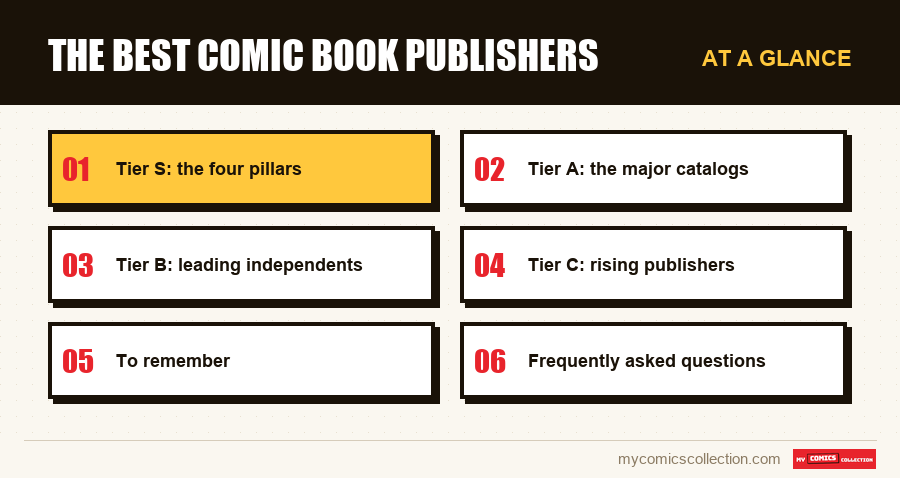
Start my trial →Tier S: the four pillars
Marvel et DC have dominated the medium since the golden age: these are the two deepest and most sought-after catalogs of collectors. Picture (1992), founded by star cartoonists, established the “creator-owned” comic and today publishes most of the major indie series (Saga, The Walking Dead). Dark Horse (1986) reigns over author fantasy (Hellboy) and licenses.
Tier A: the major catalogs
Vertigo, DC's former adult label, has published some of the medium's greatest stories (Sandman, Preacher). Boom! Studios has established itself on the modern series side (Something is Killing the Children). IDW and Mirage carry the Ninja Turtles and many licenses. Dynamite exploits a large catalog of pulp characters.
Tier B: leading independents
Valiant has built a coherent universe very popular with speculators. Oni Press (Scott Pilgrim) and Fantagraphics (the spearhead of author and heritage comics) maintain demanding lines. AfterShock focuses on established creators.
Tier C: rising publishers
Vault , Mad Cave and Ahoy represent the new generation of independent publishers: more recent catalogs, but titles to watch for those looking for the gems of tomorrow.
To remember
- Marvel and DC concentrate most of the value for collectors (golden and silver ages).
- Image is the king of modern indie and creator-owned.
- Small publishers are the hunting ground for underpriced gems.
- Each editor refers to a flagship title of the site.
Collecting by publisher: what the logo changes
Choosing a publisher means choosing a type of collection. The rules of the game differ between the two giants, creator-owned independents, and imprints that have closed. Here is what that changes in practice for a collector.
The giants: Marvel and DC
Marvel (1939) and DC (1934) own their characters. The direct consequence: their catalogs are reissued constantly, as collected editions, reprints and facsimile editions. True Believers and facsimile editions exist precisely to offer old covers at low cost, but they must not be confused with originals. Always check the indicia and the cover price. These two publishers hold the Golden and Silver Age first appearances, hence the highest values.
Image and Dark Horse: creator-owned
Image (1992) was founded by star artists and champions comics whose creators keep the rights. The result: complete author-driven series, such as Saga or The Walking Dead, which collect from first issue to last. One point of attention specific to these titles: the print run. Saga #1 sold out before release and went through five reprints, whereas Spawn #1 was printed at 1.7 million copies. In both cases, value comes not from the issue number but from printing and grade. Dark Horse (1986) blends auteur fantasy, with Hellboy, and licenses.
Closed imprints: a frozen catalog
Vertigo, DC's adult imprint, published from 1993 to 2020. A closed catalog is simpler to complete: you know what exists, and nothing gets added. Sandman and Preacher are the two most cited entry points. This finished-catalog logic also holds for the author-driven maxiseries of other publishers.
Independents: choose by universe or by creator
Valiant builds a coherent universe, IDW and Mirage carry the Ninja Turtles, Boom! Studios shines in modern series, Oni Press with Scott Pilgrim, and Fantagraphics with auteur comics. With these publishers, one rarely collects "the house": one follows a universe or a creator.
Newcomers: watch without getting carried away
Vault, Mad Cave and Ahoy form the young generation. Their catalogs are recent, so there is little market history. For a collector, the sound approach is to buy what you enjoy reading and keep track of your issues, rather than betting on a price that does not yet exist.
Frequently asked questions
Marvel and DC dominate by the depth of their catalog and their importance for the collection. Picture is the undisputed leader of modern independent comics.
Marvel and DC own their characters; At independent publishers like Image, it is the creators who keep the rights (“creator-owned”), which encourages more personal stories.
At the house of Marvel and DC, whose early appearances from the Golden and Silver Ages achieve the highest ratings. Recent publishers mainly concentrate speculation on new products.
Do you have issues from different publishers and want to estimate them? Estimate them for free with our tool based on current eBay listings.