Beyond Marvel and DC, a world of boundless creativity exists in independent comics. Image Comics, Dark Horse, IDW Publishing, Boom! Studios, Fantagraphics, Drawn & Quarterly... These publishers produce some of the most innovative and collectible works on the market.
Beyond Marvel and DC, a world of boundless creativity exists in independent comics. Image Comics, Dark Horse, IDW Publishing, Boom! Studios, Fantagraphics, Drawn & Quarterly... These publishers produce some of the most innovative and collectible works on the market. Unlike the superheroes of the Big Two, independent comics are often creator-owned : the authors own their characters, which creates very different market dynamics.
Whether you're passionate about Walking Dead, Saga, Invincible, or Hellboy, this guide explains how to organize, track, and grow the value of your independent comics collection in 2026.
The major independent publishers and their flagship series
Image Comics (founded in 1992)
Image Comics was born from a revolution: in 1992, seven star artists left Marvel to found their own publishing house. Todd McFarlane, Jim Lee, Rob Liefeld, Marc Silvestri, Erik Larsen, Jim Valentino, and Whilce Portacio created a label entirely dedicated to creators, where each author retains the rights to their characters. This creator-owned model transformed the industry and produced some of the most collected series in modern history.
- Walking Dead (Robert Kirkman, Tony Moore/Charlie Adlard), 193 issues, series completed
- Saga (Brian K. Vaughan & Fiona Staples), ongoing
- Invincible (Robert Kirkman), 144 issues, series completed
- Spawn (Todd McFarlane), ongoing since 1992, over 330 issues
Key issue to watch: Walking Dead #1 (2003) is one of the most valuable independent key issues of the 21st century. In Near Mint, it's worth between 500 and 2,000 euros today depending on the CGC grade. A copy in average condition remains accessible, but copies close to NM are becoming scarce rapidly.
Dark Horse Comics
Founded in 1986 in Oregon, Dark Horse established itself as the third-largest American publisher through a catalog combining original creations and prestigious licenses. The publisher is particularly known for its genre series, horror, sci-fi, fantasy, and for publishing Star Wars comics for over twenty years before Disney reclaimed the license.
- Hellboy (Mike Mignola), expanded BPRD universe and numerous spin-offs
- Sin City (Frank Miller), iconic noir anthology
- Star Wars : license held until 2014, then transferred to Marvel
- The Mask, The Goon : cult titles from the catalog
IDW Publishing
IDW Publishing has specialized in licensing established intellectual properties while developing remarkable original creations. The Locke & Key series, written by Joe Hill (son of Stephen King), is one of the most acclaimed titles of the decade and represents a solid investment for collectors.
- Teenage Mutant Ninja Turtles : official continuation of the franchise, recognized canon
- Locke & Key (Joe Hill & Gabriel Rodriguez), complete series, highly collected
- Transformers, G.I. Joe : Hasbro licenses, numerous cover variants
Boom! Studios
Boom! Studios is the most dynamic independent publisher of recent years, with original creations that appeal to both readers and Hollywood adapters. Two series stand out particularly for their collecting potential:
- Once & Future (Kieron Gillen & Dan Mora), contemporary Arthurian fantasy
- Something is Killing the Children (James Tynion IV & Werther Dell'Edera), horror, a series experiencing an explosion in popularity
Why independent comics are different to collect
Collecting independent comics follows different rules than the Big Two. Understanding these specificities will help you better target your acquisitions and avoid the classic beginner mistakes.
The creator-owned model is the first factor to consider: if a series ends, because the author decides to wrap it up, passes away, or for any other reason, it ends permanently. No relaunch, no new issue #1 by another writer, no mandatory crossover with other series. This finality is precisely what makes independents valuable.
Print runs are often more limited, particularly for early issues before a series finds its readership. A Walking Dead #1 was not printed in the millions like an Amazing Spider-Man #1 from the 1960s. This relative scarcity mechanically increases the value of issues in good condition.
Finally, film and television adaptations have a considerable impact on prices. The AMC Walking Dead series multiplied the value of early issues by ten. Invincible on Amazon Prime triggered a similar surge. Following adaptation announcements has become an essential skill for the modern collector.
Hard to find
Older issues are often out of print from publishers and absent from bookstore stock. The hunt goes through conventions and specialized dealers.
Fewer reprints
Collected editions and TPBs exist for most series, but they don't replace the prestige, or the value, of original numbered issues.
Difficult tracking
There is no centralized catalog equivalent to the Marvel or DC Universe for independents. Each publisher has its own numbering system.
Rising variants
Image Comics in particular has been multiplying cover variants in recent years, making tracking more complex for completist collectors.
Essential independent key issues
Here are the issues that every independent comics collector should know. These key issues represent first appearances, first issues of foundational series, or works whose value continues to grow.
Independent key issues, the essentials
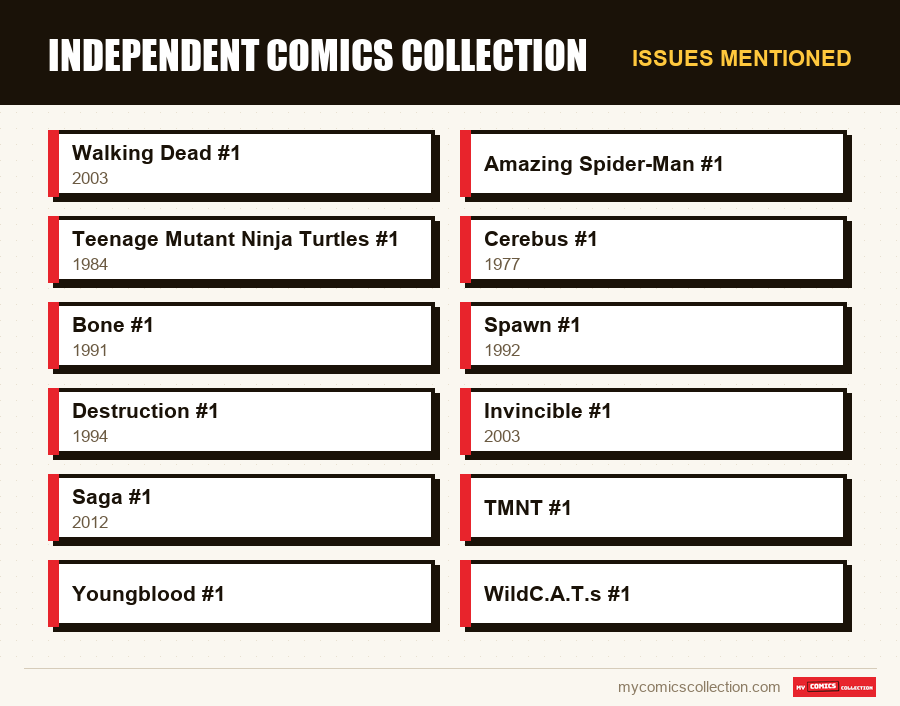
- Teenage Mutant Ninja Turtles #1 (1984) : Mirage Studios. Value in NM: > 10,000 euros. The holy grail of independents.
- Cerebus #1 (1977) : Aardvark-Vanaheim. Value in NM: > 1,000 euros. Pioneer of independent comics.
- Bone #1 (1991) : Jeff Smith / Cartoon Books. First self-published edition, highly sought after.
- Spawn #1 (1992) : Image Comics. First Image publication, massive print run but NM copies are rare.
- Hellboy: Seed of Destruction #1 (1994) : Dark Horse. First solo appearance of Hellboy.
- Walking Dead #1 (2003) : Image Comics. Most iconic modern key issue. In NM: 500-2,000 euros.
- Invincible #1 (2003) : Image Comics. Value sharply rising since the Amazon series.
- Saga #1 (2012) : Image Comics. Stable value in NM: 100-300 euros.
Collecting this series?
Track what you own, what you are missing and what your collection is worth. 7 day trial.
Start my trial →How to organize your independent comics collection
Managing an independent comics collection presents specific challenges compared to Marvel or DC collections. The lack of unified numbering, the multitude of publishers, and the diversity of formats (one-shots, mini-series, ongoing series) require a rigorous method.
Catalog by publisher then by series
Organize your collection by publisher (Image, Dark Horse, IDW...) then by series within each publisher. This hierarchy simplifies both physical searching and digital management.
Import your series into My Comics Collection
The worldwide comics catalog integrated into My Comics Collection covers the major independent series. Import your series in just a few clicks and mark owned issues one by one.
Distinguish one-shots, mini-series, and ongoing
A one-shot is a single issue. A mini-series has a set number of episodes (often 4 to 6). An ongoing series is currently being published. This distinction is essential for correctly identifying missing issues.
Identify and flag first issues and cameos
Pay particular attention to #1 issues and first character appearances. In creator-owned independents, there is often only one "true" first appearance, no retro-continuity like at Marvel.
Monitor adaptation announcements
A confirmed adaptation can double or triple an issue's value within weeks. Set up alerts for TV series and film announcements to anticipate price increases before they happen.
The impact of adaptations on independent comics values
No factor influences the value of an independent comic more than a TV series or film adaptation. Here is an overview of the most significant cases and the lessons to draw for your collecting strategy.
Walking Dead #1 is the most striking example: the issue's value multiplied by ten after the launch of the AMC series in 2010. Copies that were trading for a few dozen euros before the announcement now reach several hundred, even several thousand euros in Near Mint or CGC-graded condition.
Invincible #1 has seen a significant increase since the launch of the animated series on Amazon Prime. The valuation is still adjusting, copies in good condition are becoming scarce on the secondary market, a sign that collectors are holding onto them carefully.
Saga is an interesting case: the series is one of the most acclaimed on the market, but the absence of a confirmed adaptation keeps the value at a stable level without the speculative surge seen with Walking Dead. When (if) the adaptation materializes, the impact will likely be massive.
TMNT #1 illustrates the case of a multi-decade franchise: the value has been structurally high for years, driven not by a single adaptation but by the cultural longevity of the license across generations of fans.
Strategic advice: Follow development production announcements on specialized sites (Deadline, Variety, Hollywood Reporter). Adaptation rumors create anticipated price increases, sometimes unjustified if the project doesn't come through, but real in the short term. Acting before official confirmation allows you to seize the best opportunities.
FAQ, Independent comics
Manage your independent comics collection
Track your Image, Dark Horse, and IDW series issue by issue. Identify the key issues in your collection and never miss another important first issue.
Free 7-day trial, No commitment