
Modern Age sleeper comics are undervalued keys hiding in plain sight: books whose significance has not yet been reflected in market prices. These 15 picks range from $10 to $200 in current value and each has a clear catalyst (media adaptation, character growth, or census rarity) that could drive substantial appreciation in the coming years.
Every collector dreams of finding the next Amazing Fantasy #15: a comic that nobody values today but that becomes a blue-chip key tomorrow. In reality, most undervalued comics stay undervalued, but a select few Modern Age sleepers have the fundamentals to break out. This list focuses on 15 comics from the 1990s through the 2020s that are currently under the radar, with specific reasons why each could multiply in value. These are not guaranteed winners. They are calculated bets backed by data, print run information, and market trends.
What makes a modern sleeper worth buying
Not every cheap comic is a sleeper. A genuine sleeper has specific characteristics that separate it from the millions of worthless modern books sitting in dollar bins.
- A meaningful first appearance: The comic introduces a character who has grown in significance since publication.
- Lower-than-expected print run: Books published during market downturns (1996-2001, 2017-2019) tend to have significantly lower print runs.
- Upcoming media catalyst: An announced or strongly rumored movie, TV show, or game adaptation.
- Critical/fan acclaim: Books from runs that are widely respected but whose key issues have not yet been priced accordingly.
- CGC census scarcity in high grade: A comic that seems common but has surprisingly few 9.8 copies in the CGC census.
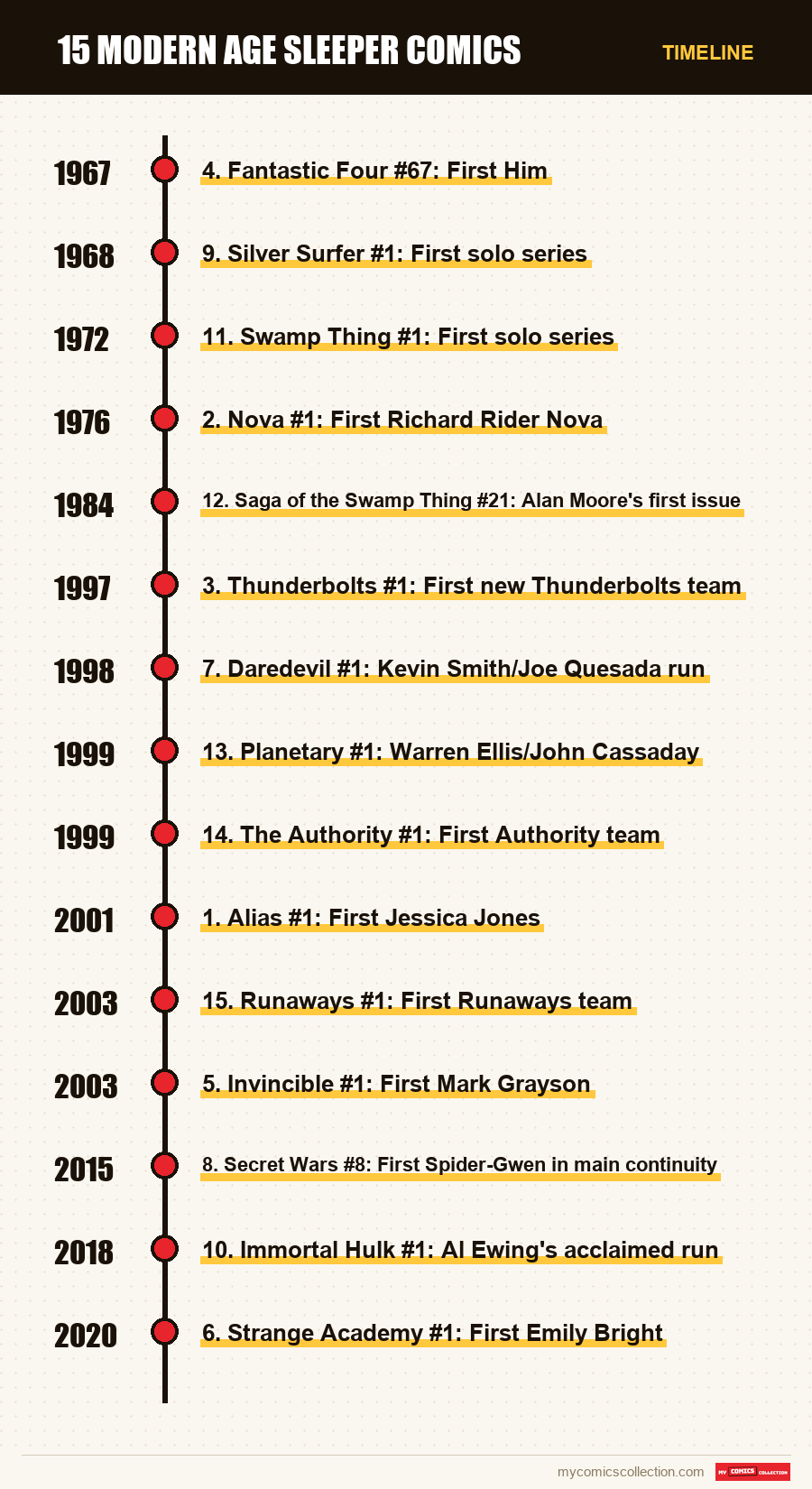
The 15 sleeper picks
1. Alias #1 (2001): First Jessica Jones (MAX imprint)
Current price: $40-80 (CGC 9.8). Why it is undervalued: Published under Marvel's mature MAX imprint with limited distribution, this is the definitive first appearance of Jessica Jones. The Netflix series boosted prices temporarily, but they have since settled well below their peak. If Jessica Jones returns in any MCU capacity, this book could easily double or triple.
2. Nova #1 (1976): First Richard Rider Nova
Current price: $80-150 (CGC 8.0). Why it is undervalued: A Nova project has been in development at Marvel Studios for years. When it is officially announced with casting, this Bronze/Modern crossover key will spike hard. Current prices are reasonable for a classic first appearance with confirmed MCU interest.
3. Thunderbolts #1 (1997): First new Thunderbolts team
Current price: $20-50 (CGC 9.8). Why it is undervalued: With the MCU Thunderbolts project confirmed and released, this comic remains surprisingly affordable in high grade. The low 1997 print run (during the industry's worst depression) means fewer copies exist than most collectors assume.
4. Fantastic Four #67 (1967): First Him (Adam Warlock)
Current price: $100-200 (CGC 7.0). Why it is undervalued: Adam Warlock's story is deeply intertwined with the Infinity Stones and the cosmic MCU. Despite his brief appearance in Guardians Vol. 3, Warlock's full potential has not been explored on screen. This Silver Age key is significantly cheaper than comparable first appearances.
5. Invincible #1 (2003): First Mark Grayson
Current price: $150-250 (CGC 9.8). Why it is undervalued: The Amazon animated series has been a massive hit, and a live-action adaptation is in development. First printings had a modest print run. If Invincible achieves the cultural status of The Boys, this book could reach $500-1,000 in CGC 9.8.
6. Strange Academy #1 (2020): First Emily Bright
Current price: $15-30 (CGC 9.8). Why it is undervalued: Published during the pandemic, this series introduced fresh characters in the magical corner of the Marvel Universe. Emily Bright has strong potential as a media adaptation candidate. At current prices, the downside is minimal and the upside is significant.
7. Daredevil #1 (1998, Marvel Knights): Kevin Smith/Joe Quesada run
Current price: $30-60 (CGC 9.8). Why it is undervalued: This run relaunched Daredevil and led directly to the creative renaissance (Bendis, Brubaker, Waid) that defined the character for two decades. With Daredevil now firmly in the MCU, this book's importance as a turning point will be increasingly recognized.
8. Secret Wars #8 (2015): First Spider-Gwen in main continuity
Current price: $20-40 (CGC 9.8). Why it is undervalued: Spider-Gwen exploded in popularity after Spider-Verse. Her Edge of Spider-Verse #2 first appearance is already expensive, but her transition into the main Marvel continuity in Secret Wars #8 remains cheap. If Spider-Gwen gets a live-action role, adjacent keys will rise.
9. Silver Surfer #1 (1968): First solo series
Current price: $150-300 (CGC 6.0-7.0). Why it is undervalued: The Silver Surfer is one of the most iconic Marvel characters yet to receive a definitive MCU portrayal. With the Fantastic Four franchise entering the MCU, a Silver Surfer solo project feels inevitable. This Silver Age key is remarkably affordable compared to other major first solo titles.
10. Immortal Hulk #1 (2018): Al Ewing's acclaimed run
Current price: $30-60 (CGC 9.8). Why it is undervalued: Widely regarded as one of the best Hulk runs ever written, this horror-tinged reimagining of the character introduced concepts that would translate brilliantly to screen. A low-risk pick with the potential for significant upside if adapted.
11. Swamp Thing #1 (1972): First solo series
Current price: $100-200 (CGC 6.0-7.0). Why it is undervalued: With Swamp Thing confirmed for James Gunn's DCU, this Bronze Age classic is positioned for a significant bump. Current prices are moderate relative to the character's upcoming media exposure.
12. Saga of the Swamp Thing #21 (1984): Alan Moore's first issue
Current price: $40-80 (CGC 9.4). Why it is undervalued: The issue that launched one of the most acclaimed runs in comic history. Alan Moore keys from other titles (Watchmen, V for Vendetta) command far higher prices. If the DCU Swamp Thing leans into Moore's vision, this book is the direct beneficiary.
13. Planetary #1 (1999): Warren Ellis/John Cassaday
Current price: $30-60 (CGC 9.8). Why it is undervalued: One of the most acclaimed series of the late 1990s, published during the industry's darkest era (meaning low print runs). If any major studio adapts Planetary, which is both visually stunning and thematically rich, this book will surge.
14. The Authority #1 (1999): First Authority team (Ellis/Hitch)
Current price: $20-40 (CGC 9.8). Why it is undervalued: The Authority is confirmed for James Gunn's DCU slate. A team book featuring Apollo and Midnighter, characters with growing cultural relevance, published during a print-run valley. This is one of the most obvious pre-announcement plays in the market.
15. Runaways #1 (2003): First Runaways team
Current price: $30-60 (CGC 9.8). Why it is undervalued: The Hulu series came and went without fully capitalizing on these characters. A potential MCU reboot with a higher budget and better integration could transform this book. The modest 2003 print run ensures genuine scarcity.
How to build a sleeper portfolio
Position sizing
Never put more than 5% of your total comic budget into any single sleeper pick. These are speculative plays, and many will not pan out. Spread your bets across 5-10 picks and accept that some will fail while hoping that one or two deliver outsized returns.
Grade matters
For Modern Age sleepers, CGC 9.8 is the target grade. Unlike Silver or Bronze Age keys where mid-grade copies hold value, modern books derive most of their premium from the 9.8 designation. A 9.6 copy might sell for 50% less than a 9.8 of the same book.
Timing your exit
- Sell 50% on the announcement spike: When news breaks, sell half your position to lock in profits.
- Hold 50% through the hype cycle: Keep the rest in case the project becomes a genuine cultural phenomenon.
- Never hold through a flop: If the adaptation is poorly received, sell your remaining copies immediately.
Where to find sleepers at fair prices
- Dollar bins at conventions: Many modern keys still end up in dollar bins at smaller conventions. Check every box methodically.
- eBay auction-format listings: Avoid Buy It Now prices, which tend to be inflated. Auction-format listings often close at true market value.
- Local comic shops: Many LCS owners price books based on cover price, not market value. Build relationships and check their back-issue bins regularly.
- Estate sales and garage sales: Collections from the 2000s are increasingly hitting the secondary market as original owners downsize.
How to research sleeper picks yourself
The 15 books above are a starting point, but the most profitable sleeper picks are the ones you discover before anyone else. Here is a systematic research process for identifying undervalued modern comics.
Step 1: Monitor studio announcements
Track confirmed and rumored projects from Marvel Studios, DC Studios, Amazon, Netflix, and other major content producers. Look for characters whose first comic appearances have not yet spiked in price. Studio trademark filings often precede public announcements by months: the United States Patent and Trademark Office website is a free resource.
Step 2: Study print run data
Comichron (comichron.com) publishes monthly sales data for direct-market comic book sales. Look for key issues published during low-sales periods (1996-2000, 2017-2019) where total orders fell below 30,000 copies. These books have built-in scarcity that current prices may not reflect.
Step 3: Cross-reference the CGC census
Check the CGC census for your target books. Focus on the 9.8 population. If a book from 2005 has fewer than 100 copies in CGC 9.8, that is a genuine scarcity signal. Compare this to the print run data: a book printed in 30,000 copies with only 50 graded in 9.8 has significant room for premium expansion.
Step 4: Evaluate character trajectory
Look beyond the initial first appearance. Ask: is this character gaining cultural relevance? Check whether the character is appearing in more comics, being featured in crossover events, or generating fan art and cosplay interest. Characters with growing organic audiences are the strongest sleeper candidates.
Step 5: Assess the investment thesis in writing
Before buying any sleeper, write down your thesis in three sentences: why is this book undervalued, what catalyst could change that, and what is your target return? If you cannot articulate a clear thesis, do not make the purchase.
Common mistakes when buying sleepers
- Confusing "cheap" with "undervalued": A comic in the dollar bin is not automatically a sleeper. It is only undervalued if there is a specific, articulable reason why it should be worth more.
- Buying too many copies of one pick: Owning 20 copies of a sleeper ties up capital and creates a selling problem if the book does spike: dumping 20 copies into a thin market depresses the very price you are trying to profit from.
- Ignoring print run reality: A modern book printed in 200,000 copies with 5,000 copies in CGC 9.8 is not scarce, regardless of what the character's media future holds. True scarcity requires both low print runs and low census numbers.
- Following social media "hot picks" blindly: By the time a sleeper is promoted on YouTube or TikTok, the presenter has already bought their copies. You are their exit liquidity.
The sleeper hunter's advantage: The modern comic market is large and fragmented enough that no single source of information captures everything. By combining print run data, CGC census analysis, and media industry tracking, an individual collector can consistently identify undervalued books before the broader market catches on.
Frequently Asked Questions
A sleeper is a comic whose current market price does not reflect its potential value. This could be because the character has not yet appeared in media, the print run was lower than recognized, or collector awareness has not caught up to the book's significance. Sleepers are speculative by nature: not all will appreciate.
Limit sleeper speculation to 10-15% of your total comic budget. Each individual pick should be 1-5% of your budget. This ensures that even if most sleepers fail to appreciate, your overall portfolio remains healthy. Think of sleeper buying as venture capital: most bets fail, but the winners can be transformative.
For maximum returns, yes. The modern comic market heavily rewards the highest grades because high print runs mean there is minimal scarcity at lower grades. A CGC 9.6 of a modern book might sell for 50-70% less than the 9.8. The exception is books with genuinely low print runs where any graded copy carries a premium.
Give a sleeper pick 2-5 years. If no catalyst has materialized (media announcement, character revival, critical reappraisal), consider selling and redeploying the capital. The opportunity cost of holding a flat investment indefinitely is the biggest hidden expense in comic collecting.