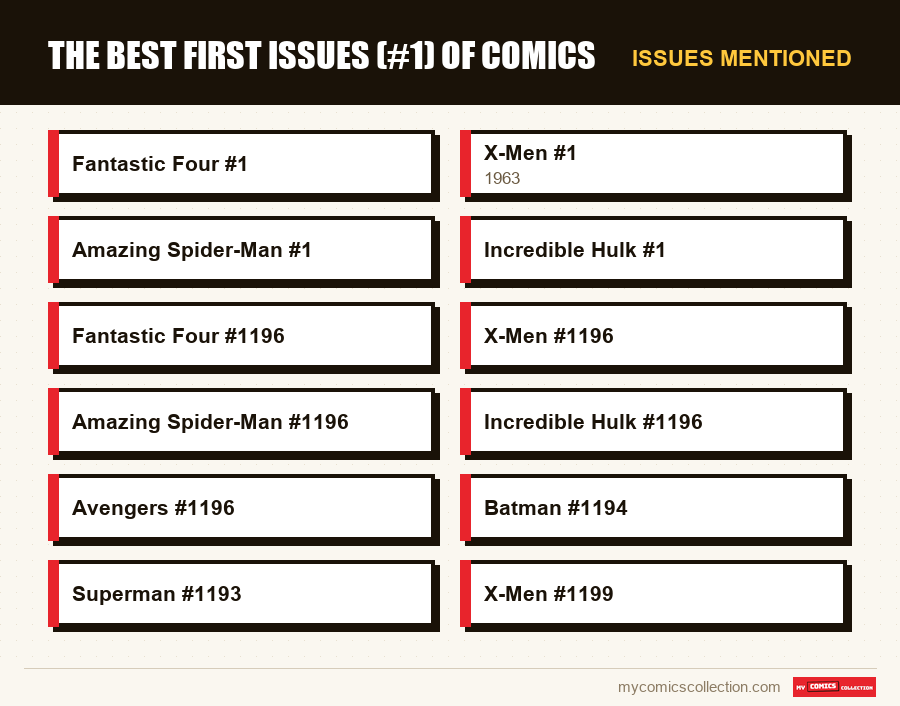
The best first issues (#1) of comics are, at the top, Fantastic Four #1 , X-Men #1 (1963), Amazing Spider-Man #1 and Incredible Hulk #1. This tier list ranks launch issues according to their historical importance and collectible value. Facts (publisher, date) verified, no invented ratings; each entry refers to its file.
The first issue of a series is doubly valuable: historically, because it launches a character or team; and for the collector, because it often concentrates the most sought-after first appearances. This tier list ranks the #1s according to their importance and their potential rating.
Editorial Ranks, Facts verified. Each entry refers to its file on the site.
Collecting this series?
Track what you own, what you are missing and what your collection is worth. 7 day trial.
Start my trial →Tier S: the #1 founders of Marvel
Fantastic Four #1 (1961) launched the modern Marvel Universe. X-Men #1 (1963) introduced the original mutants, Amazing Spider-Man #1 launches the hero's solo series, and Incredible Hulk #1 (1962) presents the green giant. Four of the most expensive key numbers on the market.
Tier A: the big launches
Avengers #1, Batman #1 (1940), Superman #1 (1939) and the X-Men #1 from 1991 (the best-selling comic of all time) are at the top.
Tier B: the notable #1s
Daredevil #1, Spawn #1, Watchmen #1 et The Walking Dead #1 are major launches, from classic to modern.
Tier C: the modern #1s sought after
Saga #1, Invincible #1, New Teen Titans #1 et Preacher #1 are among the most popular debut issues of recent decades.
Tier D: the #1 authors
Y: The Last Man #1, East of West #1 et The Sandman #1 close this tier list: excellent first issues, often more affordable.
To remember
- The #1s of the Silver Age (FF #1, ASM #1) are among the most expensive on the market.
- A #1 often concentrates the most sought after first appearance.
- Beware of overproduced modern #1s: rarity is not guaranteed.
- Each entry refers to its file on the site.
Frequently asked questions
Fantastic Four #1 (1961) is often cited as the most important, as it launched the modern Marvel Universe. Amazing Spider-Man #1 and X-Men #1 (1963) followed closely.
Not necessarily: old and rare #1s increase in value, but many modern #1s are overproduced and remain undervalued. Always check the actual rating before purchasing.
Often yes, because it carries the launch and sometimes the first appearance. But a later issue containing a major first appearance may be worth more than #1.
First issue versus first appearance: do not mix them up
A #1 is not always where a character is born. To collect without aiming at the wrong target, you need to tell a series launch from the first appearance of its hero, then check that the copy in your hands really is the first printing.
When #1 is not the origin
- Superman #1 (1939) launches his solo series, but the character was born in Action Comics #1 (1938).
- Batman #1 (1940) introduces the Joker and Catwoman, while Batman himself debuts in Detective Comics #27 (1939).
- Amazing Spider-Man #1 (1963) opens the hero's series, but he had already appeared in Amazing Fantasy #15 (1962).
Conversely, Fantastic Four #1 (1961) and Avengers #1 (1963) launch a team: here, the first issue is indeed the birth certificate. Before buying, ask yourself what the #1 really contains that is new.
Recognizing a true first printing
Many modern #1s have been reprinted, sometimes several times, and the cover is often identical from one printing to the next. The clues are elsewhere.
- Saga #1: the first printing carries no printing note on the back, whereas reprints say "2nd printing", "3rd printing" and so on.
- The Walking Dead #1: look for the indicia, the legal notice printed inside, which should read "First Printing, October 2003" or mention no printing at all.
- In every case, ask for a clear photo of the back or the indicia before buying remotely, and compare the printed cover price and the paper with an authenticated printing.
Scarcity is not popularity
Sales figures do not tell the whole story. X-Men #1 (1991) is the best-selling comic of all time precisely because it was produced in enormous quantities: its common copies are therefore not rare. At the other end, Saga #1 was printed at about 37,641 copies, a notable under-print for an Image series, which explains the interest in its first printing.
What to remember
- An old, scarce #1 gains value; an overproduced modern #1 does not necessarily do so.
- A later issue containing a major first appearance can be worth more than its series' #1.
- A particular variant or printing can change everything: check it before comparing prices.
Catalog every #1 with its printing and variant: it is the only way to know what you really own, and to spot what you are missing.
Do you have a wanted #1 (Fantastic Four #1, Amazing Spider-Man #1, etc.)? Estimate its value for free with our tool based on current eBay listings.