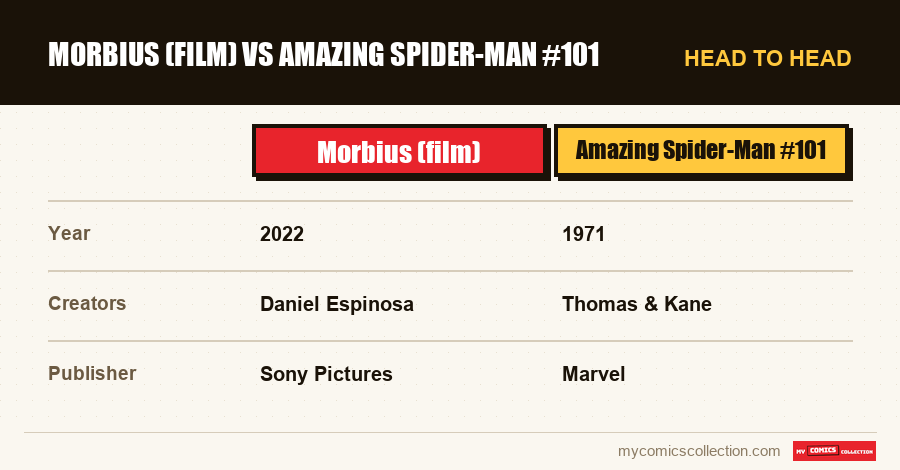
Morbius (2022) Daniel Espinosa , with Jared Leto , adapts Michael Morbius, the living vampire , appeared in Amazing Spider-Man #101 (1971) by Roy Thomas and Gil Kane. The film retains the “pseudo-scientific” origin, a scientist suffering from a blood disease who becomes a vampire while seeking treatment, but cuts all ties with Spider-Man and invents his antagonist, Milo. Here is the detailed comparison, film versus comics.
Adaptation of a gothic antihero from the Spider-Man universe, Morbius brings to the screen a tragic figure born in the horror wave of the 1970s. He draws on a character on the border of science and the supernatural. Source-by-source decryption.
As in each article in this series, only verified information (creators, distribution, dates, comic numbers) is stated; the comparative analysis is ours, without reproducing dialogue or protected images.
Title : Morbius (2022)
Director: Daniel Espinosa
Actors: Jared Leto (Michael Morbius), Matt Smith (Milo), Adria Arjona, Jared Harris
Exit : April 2022
Studio: Sony Pictures (Columbia)
Amazing Spider-Man #101 (1971): 1st appearance of Morbius (Thomas & Kane)
The “living vampire”: a pseudo-scientific origin
“Rise of the Midnight Sons”(1992): the supernatural side of Marvel
Martine Bancroft: Morbius' companion
- Michael Morbius, scientist suffering from a rare blood disease.
- The origin pseudo-scientific via bat-based therapy.
- Le “living” vampire, non-supernatural, bloodthirsty.
- La guilt of the character, torn between thirst and morality.
- Martine Bancroft, his companion, from the comics.
- No connection to Spider-Man, of whom Morbius is originally an enemy.
- Milo, the antagonist, is invented for the film.
- The medical origin is amplified and modernized.
- Le supernatural side comics is ruled out.
- The story is intended to be a history of origins autonomous.
Amazing Spider-Man #101 (1971): The Birth of Morbius
Morbius appears in Amazing Spider-Man #101 (1971), created by Roy Thomas and Gil Kane. Its birth coincides with a relaxation of the comics censorship code, which once again allows classic horror figures like vampires. Michael Morbius is a genius biochemist, Nobel Prize winner, suffering from a rare and fatal blood disease. Desperately seeking a cure, he experiments with therapy using bat blood and electroshocks, which transforms him into a creature with vampiric traits: pale skin, canines, thirst for blood. Notably, this vampirism is “alive” and pseudo-scientific, born from an experience and not from a supernatural curse. Morbius first becomes an enemy of Spider-Man, before evolving into a tragic antihero.
The film faithfully respects this origin: Michael Morbius, a brilliant scientist consumed by illness, transforms into a living vampire while seeking to cure himself. Jared Leto plays a tortured character, torn between his thirst for blood and his morals as a doctor. The main freedom, as with Venom, is the absence of Spider-Man. In the comics, Morbius is born as an enemy of the hero; on the contrary, the film presents him as an autonomous figure, unrelated to the universe of Peter Parker. This rewriting, imposed by the rights, nevertheless preserves the essence of the character: a scientist who, in wanting to save himself, becomes a monster in spite of himself.
The living vampire, between science and horror
The singularity of Morbius lies in its hybrid nature, on the border between science and the supernatural. Unlike classic vampires, he is not a magical creature but the product of a failed biochemical experiment. This “pseudo-scientific” origin places him in a literary tradition, that of the scientist whose ambition turns against him, in the manner of Doctor Frankenstein or Jekyll and Hyde. The film retains this dimension, emphasizing the medical side of the transformation: the illness, the search for a cure, the experiment that goes wrong. This approach, faithful to the comics, anchors Morbius in a more realistic register than supernatural figures.
The film, however, rejects the more frankly supernatural side that Morbius explored in the comics, notably when he joined the “Midnight Sons”, a team of occult heroes from Marvel brought together in the 1990s. In these stories, Morbius rubs shoulders with Ghost Rider, Blade and other figures of horror, in a universe where magic and the demonic play a large part. The film, more sober, prefers the medical anchor and the original story. This choice, consistent with the tone of the Sony universe, however deprives the character of part of his richness. For the reader, it is an invitation to discover the Morbius of comics in all its complexity, between science and the supernatural.
Milo, an antagonist invented for the film
To structure its story, the film creates an antagonist absent from the comics: Milo, Morbius' childhood friend, suffering from the same blood disease. When Milo in turn injects himself with the serum, he fully embraces his predatory nature, becoming the evil mirror of Morbius. This opposition (two men transformed by the same remedy, one fighting against his thirst, the other giving in to it) provides the film with its central conflict. Matt Smith plays a jubilant Milo, counterpoint to the torment of Morbius. This schema, classic in the superhero story (the hero and his dark reflection sharing the same origin), is an invention specific to the film.
This choice illustrates a frequent practice of adaptations: creating a tailor-made antagonist when the character's gallery of enemies depends on an unavailable universe. Deprived of Spider-Man and his connections, Morbius lacked an obvious adversary; Milo fills this void. If the process works dramatically, it moves the film away from the origin stories, where Morbius first faces Spider-Man then evolves in the occult universe of Marvel. For the reader, Milo does not exist: he is a creation intended to give the film its antagonist, in a cinematographic universe forced to reinvent the balance of power.
Collecting this series?
Track what you own, what you are missing and what your collection is worth. 7 day trial.
Start my trial →The characters, from paper to screen
- Michael Morbius: Savant suffering from a blood disease, turned living vampire, faithful to Amazing Spider-Man #101.
- Milo: Antagonist invented for the film, evil mirror of Morbius.
- Martine Bancroft: Companion of Morbius, character from the comics.
- The living vampire: Pseudo-scientific creature, faithful to the hybrid nature of the character.
- Spider-Man: Original enemy of Morbius in the comics, absent from the film.
A gothic antihero from the Spider-Man universe
Morbius belongs to a particular category of characters: the gothic antiheroes born in the horror wave of the 1970s. At that time, Marvel built a whole section of its universe around the supernatural (Dracula, the Werewolf, Ghost Rider, the Son of Satan) and Morbius is one of the striking figures. Created as an enemy of Spider-Man, he gradually gained the status of tragic antihero, torn between his predatory nature and his desire to do good. This ambivalence, at the heart of the character, is what the film seeks to capture, with a Morbius consumed by guilt.
For the reader, Morbius is a gateway to this horrific and little-known side of Marvel, where science rubs shoulders with fantasy. The character has had his own series, joined occult teams, and embodied the publisher's fascination with friendly monsters. The film, by bringing it to the screen, reminds us that the universe of Spider-Man is not limited to superheroes in tights: it is also home to troubled figures, on the edge of good and evil. This richness, born in the comics of the 1970s, deserves to be rediscovered beyond an adaptation which only offers a glimpse.
A difficult welcome, a character to rediscover
Morbius experienced one of the most difficult receptions in the Sony universe, both from critics and the public. The film struggled to convince, suffering in particular from the absence of Spider-Man, without whom the character loses part of its meaning, and from an antagonist invented from scratch. This relative failure has fueled numerous discussions about the limits of a cinematographic universe built around secondary characters, deprived of their original context. Morbius, a fascinating figure in the comics, did not find the framework on screen that would have done him justice.
This welcome should not, however, overshadow the interest of the character on paper. Michael Morbius is one of the richest antiheroes in the Spider-Man universe, at the crossroads of science and horror, torn between his thirst for blood and his doctor's morality. His adventures in the comics, from his confrontation with Spider-Man to his integration into the “Midnight Sons”, reveal a depth that the film only touched on. For the reader, the disappointment caused by the adaptation is one more reason to turn to the comics, where Morbius displays all its tragic complexity. It is there, in Marvel's horror stories, that the living vampire reveals his true face.
Where to start reading
To extend the film, Amazing Spider-Man #101 (1971) features the first appearance of Morbius and his origin. His dedicated series, notably “Morbius: The Living Vampire” (1992), develop the antihero in the wake of “Midnight Sons”. Marvel's horror stories from the 1970s shed light on the context of its creation. This journey covers the sources of a film faithful to the pseudo-scientific origin of the character.
Chronology of comics to know
- 1971: Amazing Spider-Man #101: Morbius' first appearance.
- 1970s: The horrific golden age of Marvel, context of its creation.
- 1992: “Morbius: The Living Vampire” and “Midnight Sons”.
Collection side: what numbers to aim for after the film
Morbius points to a Bronze Age key. Amazing Spider-Man #101 (1971, first appearance of Morbius) is a sought-after issue, important for fans of the character and Marvel horror. The series “Morbius: The Living Vampire” (1992) offers more accessible targets to delve deeper into the antihero. Marvel's other horror titles from the 1970s complete this field of exploration. These targets cover various budgets. As always, condition and gradation determine value; relying on real recent sales is strongly recommended.
Its place in the saga and for the collector
Morbius brought to the screen a gothic antihero from the Spider-Man universe, despite the absence of the hero and a difficult reception. For the collector, it brought attention to Amazing Spider-Man #101, key to the Bronze Age. It illustrates the effect of adaptations on the market, even for niche characters. Beyond speculation, the film invites us to discover the horrific side of Marvel and the figure of the living vampire, on the border of science and the supernatural. By adapting Morbius, he recalls the richness of the Spider-Man universe, populated by troubled figures born in the 1970s.
The verdict: a living vampire true to his origin
- Loyalty: Michael Morbius, the pseudo-scientific origin, the living vampire, his guilt and Martine Bancroft come from the comics.
- Freedoms: the absence of Spider-Man, Milo invented, the medical origin amplified, the supernatural aspect removed.
- Collectible numbers: Amazing Spider-Man #101 (Morbius), “Morbius: The Living Vampire” (1992).
Morbius faithfully adapts the pseudo-scientific origin of the living vampire, but cuts the character of Spider-Man and invents an antagonist, Milo. Faithful to the hybrid nature and guilt of Morbius, the film dismisses its supernatural side. For both the reader and the collector, it is an invitation to discover Amazing Spider-Man #101 and the horrific universe of Marvel.
Frequently asked questions
From Amazing Spider-Man #101 (1971), created by Roy Thomas and Gil Kane. Michael Morbius, a biochemist suffering from a blood disease, becomes a “living” vampire while seeking treatment. The film faithfully respects this origin.
No: he is a “living” vampire, of pseudo-scientific origin, born from a failed biochemical experiment and not from a supernatural curse. This hybrid nature, on the border of science and horror, is faithfully taken up by the film.
An antagonist invented for the film: childhood friend of Morbius, suffering from the same illness, he fully embraces his predatory nature. It does not exist in the comics, where Morbius first faces Spider-Man.
For rights reasons, as in other films in the Sony universe. Morbius, although born as an enemy of Spider-Man, is presented as an autonomous figure, without link to the universe of Peter Parker.
Amazing Spider-Man #101 (1971, first appearance of Morbius) is the most sought after key. The series “Morbius: The Living Vampire” (1992) offers more accessible targets.
Does the film make you want to collect? Estimate the value for free of your issues (Amazing Spider-Man #101…) with our tool based on current eBay listings.