Kraven the Hunter (2024) J.C. Chandor , with Aaron Taylor-Johnson , adapts Sergei Kravinoff , the hunter born in Amazing Spider-Man #15 (1964) by Stan Lee and Steve Ditko. The film retains the elite hunter, his half-brotherhood with the Chameleon and Calypso, but makes him an antihero protagonist, invents a supernatural origin for him and cuts all ties with Spider-Man. Here is the detailed comparison, film versus comics.
A film dedicated to one of Spider-Man's greatest enemies, Kraven the Hunter brings to the screen an obsessive hunter who becomes, here, the protagonist. It draws on a rich character and his most famous saga. Source-by-source decryption.
As in each article in this series, only verified information (creators, distribution, dates, comic numbers) is stated; the comparative analysis is ours, without reproducing dialogue or protected images.
Title : Kraven the Hunter (2024)
Director: J.C. Chandor
Actors: Aaron Taylor-Johnson (Sergei Kravinoff), Russell Crowe, Ariana DeBose (Calypso), Alessandro Nivola
Exit : December 2024
Studio: Sony Pictures (Columbia)
Amazing Spider-Man #15 (1964): Kraven's first appearance
“Kraven’s Last Hunt”(1987): DeMatteis & Zeck
Amazing Spider-Man #209 (1980): Calypso's first appearance
The Chameleon: Dmitri, Kraven's half-brother (Amazing Spider-Man #1, 1963)
- Sergei Kravinoff, elite hunter of Russian origin.
- Her obsession with stalking and its code of honor.
- Calypso, priestess linked to Kraven.
- Le Chameleon, his half-brother Dmitri.
- His superhuman physical abilities and its connection to nature.
- Kraven becomes an antihero protagonist, not a villain.
- A supernatural origin (potion, lion's blood) replaces training.
- No Spider-Man, although they are inseparable.
- Un family drama (the father, the brother) at the center of the story.
- «Kraven's Last Hunt» is not suitable.
Amazing Spider-Man #15 (1964): Spider-Man Hunter
Kraven the Hunter appears in Amazing Spider-Man #15 (1964), created by Stan Lee and Steve Ditko. Sergei Kravinoff is a big game hunter of Russian origin, a fallen aristocrat, who hunted down the most dangerous prey in the world. Tired of ordinary game, he sets out in search of the ultimate prey: Spider-Man. Endowed with superhuman strength and reflexes thanks to herbal potions, master of the arts of hunting, Kraven becomes one of the hero's most emblematic enemies and a recurring member of the Sinister Six. His hunter's code of honor, his obsession and his tragic nobility make him a special adversary, driven by a personal quest more than by simple malevolence.
The film retains the heart of the character (the elite hunter, the obsession with stalking, the link to nature) but radically modifies its function. Where the comics make Kraven an enemy of Spider-Man, the film makes him an antihero protagonist, whose rise we follow. This inversion, imposed by the absence of Spider-Man, deprives the character of his original reason for being: tracking down the Spider-Man. Aaron Taylor-Johnson plays a physical and determined Kraven, but cut off from the relationship that, in the comics, defines him entirely. The film thus reinvents the hunter as the hero of his own story.
A supernatural origin, far from the training of the comics
The most notable freedom concerns Kraven's powers. In the comics, his superhuman abilities come from potions and extreme training: Kraven is above all an exceptional hunter, at the limit of human possibility, with no real supernatural power. The film, on the contrary, chooses a more fantastic origin: after a lion attack and the intervention of a mystical potion, Sergei acquires quasi-animal abilities, a supernatural connection to the wild kingdom. This reinvention gives the character a more spectacular dimension, but moves away from the rigorous training which, in the comics, made Kraven a being shaped by his will alone.
This choice illustrates a tendency of adaptations to magnify origins, to transform the exceptional into the supernatural. Kraven, a deadly hunter in the comics, becomes on screen a creature endowed with almost mystical gifts. This more flamboyant rereading, however, deprives the character of part of what made him fascinating: the idea that a simple man, through his discipline and his obsession, could compete with a superhero. For the reader, it is an invitation to discover the Kraven of the comics, whose strength lies as much in his psychology as in his abilities, and whose code of honor provides all the tragic richness.
“Kraven’s Last Hunt”, the absent saga
It's impossible to talk about Kraven without mentioning "Kraven's Last Hunt" (1987), by J. M. DeMatteis and Mike Zeck, considered one of the greatest Spider-Man stories. Published across several series, it features an aging Kraven who, to prove his superiority, takes down Spider-Man, buries him, then dons his costume to demonstrate that he can be a better hero than him. This dark and psychological story, culminating in Kraven's suicide once his quest was accomplished, redefined the character and marked the history of the medium. This is where Kraven reaches his full tragic dimension.
The film cannot adapt this saga, entirely built around Spider-Man. Deprived of the hero, he can resume neither the ultimate hunt, nor the usurpation of the costume, nor the heartbreaking conclusion. It therefore falls back on a story of origins and a family drama, far from the narrative summit that “Last Hunt” represents. This absence deprives the film of the richest character material. For the reader, this is one more reason to immerse themselves in “Kraven's Last Hunt”, a masterpiece where the hunter reveals all his complexity, his madness and his nobility, in a face-to-face with Spider-Man that the cinema has not been able to bring to the screen.
Collecting this series?
Track what you own, what you are missing and what your collection is worth. 7 day trial.
Start my trial →The characters, from paper to screen
- Sergei Kravinoff / Kraven: Elite hunter, transformed into an antihero protagonist with supernatural origins.
- Calypso: Priestess bound to Kraven, from Amazing Spider-Man #209 (1980).
- The Chameleon (Dmitri): Half-brother of Kraven, master of disguise, present in the film.
- Kraven's father: Central figure in the family drama, developed for the film.
- Spider-Man: Target and adversary always in the comics, absent from the film.
Calypso, the Chameleon and Kraven's entourage
The film draws on Kraven's entourage to compose its story. Calypso, a voodoo priestess who appeared in Amazing Spider-Man #209 (1980), is in the comics an ally and lover of Kraven, linked to magic and rituals. The film takes her back, played by Ariana DeBose, by linking her to the mystical dimension of the hunter's origin. The Chameleon, aka Dmitri Smerdyakov, is Kraven's half-brother and Spider-Man's very first enemy, appearing as early as Amazing Spider-Man #1 (1963). A master of disguise, he plays a devious counterpoint to Sergei's brute strength, and his inclusion enriches the film's family drama.
By developing these characters, the film creates a mythology around Kraven, independent of Spider-Man. The family drama (a harsh father, two half-brothers who are completely opposed) becomes the heart of the story, where the comics anchored Kraven in his hunt for the hero. This refocusing on the Kravinoff family, while it gives the film its coherence, moves away from the source. For the reader, Calypso and the Chameleon are invitations to explore the universe of Spider-Man, where they revolve around the hero. The film makes them parts of a family saga, reinventing the relationships that the comics had woven around the Spider-Man.
A cult villain transformed into a hero
The central gamble of the film, making Kraven a protagonist rather than a villain, illustrates a trend in adaptations: giving the leading role to popular antagonists. Like Venom or Morbius, Kraven goes from enemy to hero of his own story. This approach, attractive on paper, runs into a difficulty: Kraven is defined, in the comics, by his opposition to Spider-Man. Depriving it of this relationship amounts to emptying it of part of its substance. The film must therefore reinvent the character, at the risk of making him unrecognizable for long-time readers.
This transformation raises a fundamental question about the Sony universe: can we bring to the screen characters entirely built around an absent hero? Kraven, like Madame Web or Morbius before him, reveals its limits. The hunter loses his reason for being, his prey, his quest. For the reader, the film is an invitation to rediscover the real Kraven in the comics, where he embodies one of Spider-Man's most noble and tragic enemies. It is in his hunt for the hero, and not in an isolated family saga, that the hunter reveals all his greatness.
Where to start reading
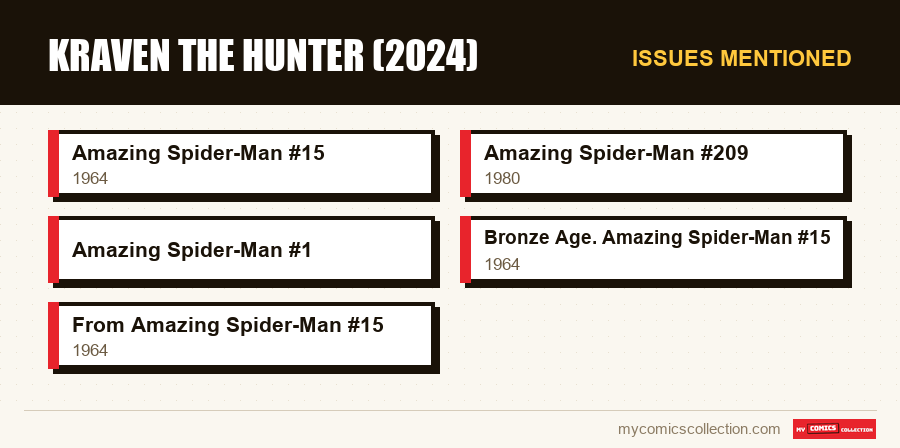
To extend the film, Amazing Spider-Man #15 (1964) features the first appearance of Kraven. “Kraven's Last Hunt” (1987), by DeMatteis and Zeck, is the absolute pinnacle of the character, a must-read. Amazing Spider-Man #209 (1980) introduced Calypso, and #1 (1963) the Chameleon. This course covers the sources of a film which reinvents the hunter as an antihero, far from his hunt for Spider-Man.
Chronology of comics to know
- 1963: Amazing Spider-Man #1: the first appearance of Chameleon, Kraven's half-brother.
- 1964: Amazing Spider-Man #15: the first appearance of Kraven the Hunter.
- 1980: Amazing Spider-Man #209: Calypso's first appearance.
- 1987: “Kraven's Last Hunt”: the tragic peak of the character.
Collection side: what numbers to aim for after the film
Kraven the Hunter points to keys from the Silver Age and Bronze Age. Amazing Spider-Man #15 (1964, first appearance of Kraven) is a sought-after number, important for the hero's gallery of enemies. Amazing Spider-Man #1 (1963, Chameleon) is a must-see. The issues of “Kraven's Last Hunt” (1987) will interest fans of the cult saga. Amazing Spider-Man #209 (1980, Calypso) completes the set. These targets cover various budgets. As always, condition and gradation determine value; relying on real recent sales is strongly recommended.
Its place in the saga and for the collector
Kraven the Hunter brought one of Spider-Man's great enemies to the screen by transforming him into an antihero, despite the hero's absence and a difficult reception. For the collector, it attracted attention to Amazing Spider-Man #15 and "Kraven's Last Hunt." It illustrates the effect of adaptations on the market. Beyond speculation, the film invites us to discover the real Kraven in the comics, a noble and tragic hunter whose quest for Spider-Man inspired one of the hero's greatest stories. By reinventing him as a protagonist, he recalls how the hunter is inseparable from his prey.
The verdict: a hunter deprived of his prey
- Loyalty: Sergei Kravinoff, the obsession with stalking, Calypso and the Chameleon (Dmitri) come from the comics.
- Freedoms: Kraven as antihero protagonist, supernatural origin, absence of Spider-Man, central family drama, “Last Hunt” not adapted.
- Collectible numbers: Amazing Spider-Man #15 (Kraven), “Kraven's Last Hunt” (1987), Amazing Spider-Man #1 (Chameleon), #209 (Calypso).
Kraven the Hunter transforms one of Spider-Man's greatest enemies into an antihero protagonist, inventing a supernatural origin for him and cutting him off from his long-time prey. Faithful to the hunter, Calypso and the Chameleon, the film nevertheless moves away from the essence of the character. For both the reader and the collector, it is an invitation to discover Amazing Spider-Man #15 and “Kraven's Last Hunt”.
Frequently asked questions
From Amazing Spider-Man #15 (1964), created by Stan Lee and Steve Ditko. Sergei Kravinoff is an elite hunter who hunts down Spider-Man as his ultimate prey. The film takes him but makes him an antihero protagonist, without the hero.
No: his superhuman abilities come from potions and extreme training. He is above all an exceptional hunter, with no real supernatural power. The film invents a more fantastic origin for him, linked to a mystical potion.
A cult saga from 1987, by DeMatteis and Zeck, considered one of the greatest Spider-Man stories. Kraven kills the hero there, dons his costume, then commits suicide, his quest accomplished. The film cannot adapt it due to lack of Spider-Man.
A voodoo priestess appeared in Amazing Spider-Man #209 (1980), ally and lover of Kraven in the comics. The film takes her back, played by Ariana DeBose, by linking her to the mystical dimension of the hunter's origin.
Amazing Spider-Man #15 (1964, Kraven's first) is the most sought after key. “Kraven's Last Hunt” (1987) and Amazing Spider-Man #1 (Chameleon) are other major targets.
Does the film make you want to collect? Estimate the value for free of your issues (Amazing Spider-Man #15, #1…) with our tool based on current eBay listings.