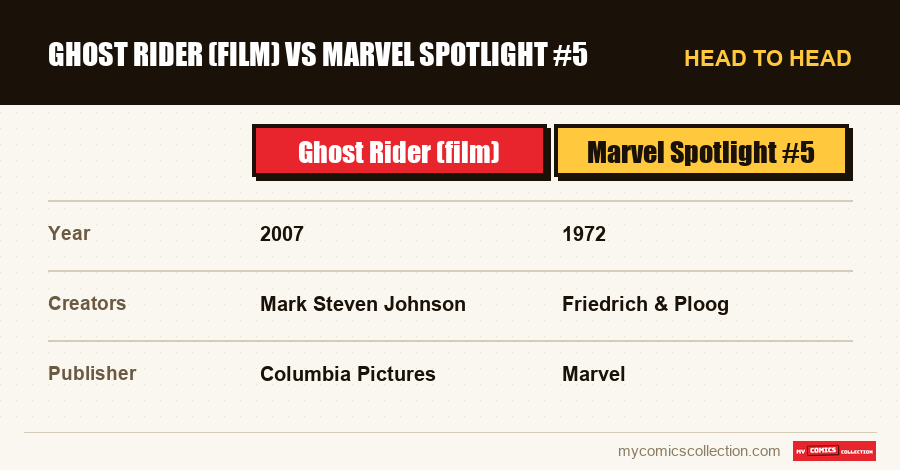
Ghost Rider (2007) Mark Steven Johnson , with Nicolas Cage, adapts the demonic biker born in Marvel Spotlight #5 (1972) by Gary Friedrich and Mike Ploog. The film resumes Johnny Blaze, stuntman who sold his soul to Mephisto, who became the Spirit of Vengeance with a flaming skull. He opposes it to Blackheart (Daredevil #270, 1989). Faithful to the origin, he simplifies the horrific mythology. Here is the detailed comparison, film versus comics.
Adaptation of a key figure in Marvel horror from the 1970s, Ghost Rider brings the vigilante with the flaming skull to the screen. It draws on a character at the crossroads of fantasy and western. Source-by-source decryption.
As in each article in this series, only verified information (creators, distribution, dates, comic numbers) is stated; the comparative analysis is ours, without reproducing dialogue or protected images.
Title : Ghost Rider (2007)
Director: Mark Steven Johnson
Actors: Nicolas Cage (Johnny Blaze), Eva Mendes, Wes Bentley (Blackheart), Peter Fonda (Mephisto)
Exit : February 2007
Studio: Columbia Pictures (Sony)
Marvel Spotlight #5 (1972): 1st appearance of Ghost Rider (Friedrich & Ploog)
Johnny Blaze: stuntman linked to Mephisto
Daredevil #270 (1989): Blackheart's first appearance
The Spirit of Vengeance: the inflamed skull
- Johnny Blaze, motorcycle stuntman.
- Le pact with Mephisto to save a loved one.
- L'Spirit of Vengeance with an inflamed skull.
- Le Gaze of Penance who punishes the guilty.
- Blackheart, the demon son of Mephisto.
- The plot combines several rearranged elements comics.
- The tone oscillates between horror and lightness.
- Blackheart and his acolytes are reinvented.
- La mythology of Ghost Riders is simplified.
- Some western elements are added.
Marvel Spotlight #5 (1972): the birth of Ghost Rider
Ghost Rider appears in Marvel Spotlight #5 (1972), created by Gary Friedrich and Mike Ploog. Johnny Blaze, a motorcycle stuntman, sells his soul to the demon Mephisto to save his adoptive father from a fatal illness. The deal goes wrong, and Johnny finds himself linked to a demonic spirit: at nightfall, or in the presence of evil, he transforms into Ghost Rider, a biker with a flaming skull, the Spirit of Vengeance. Endowed with supernatural powers (his fiery motorcycle, his chains, and the fearsome "Look of Penance" which makes the guilty relive all the suffering they have caused) he punishes the bad guys. This character, born in Marvel's horror wave of the 1970s, combines fantasy, motorcycles and redemption.
The film faithfully reproduces the origin of the character: Johnny Blaze, stuntman, the pact with Mephisto to save a loved one, the transformation into the Spirit of Vengeance with a flaming skull. Nicolas Cage plays an inhabited Johnny Blaze, faithful to the tortured dimension of the character. The film retains the iconic powers (the fire bike, the chains, the Penitent Gaze) and the flamboyant aesthetic of the flaming skull. The main freedom lies in the simplification of the complex mythology of the Ghost Riders and a hesitant tone, oscillating between horror and lightness. On the essentials (the pact, the curse, the revenge) the film remains faithful to the spirit of the character.
The pact with Mephisto and the curse
At the heart of the character is the Faustian pact with Mephisto, one of the great demons of the Marvel Universe. In the comics, Johnny Blaze sells his soul to save a loved one, and finds himself cursed, linked to a spirit of vengeance that he cannot control. This curse makes him a tragic figure, torn between his humanity and the demon who inhabits him, condemned to a damned existence. The film faithfully reproduces this tragic deal and its consequences: Johnny, having saved his father, pays the price of his pact by becoming the slave of the demon, transformed against his will into Ghost Rider. Peter Fonda plays a manipulative Mephisto, true to his nature as a tempter.
This Faustian dimension, specific to comics, gives the character its tragic depth. Ghost Rider is not a happy hero but a damned one, condemned to bear the curse of his pact. The film explores this tension between man and demon, between Johnny's guilt and the vengeful power of the Spirit. This fidelity to the tragic spirit of the character is one of the strong points of the film, even if its hesitant tone sometimes attenuates its impact. For the reader, the pact with Mephisto is an invitation to discover the origin stories of Ghost Rider, where the curse and Johnny Blaze's quest for redemption reach an intensity that the film only touches on.
Blackheart and the Demon Universe
The film pits Ghost Rider against Blackheart, a demon from the comics who appeared in Daredevil #270 (1989), created by Ann Nocenti and John Romita Jr. Son of Mephisto, Blackheart is an evil entity who seeks to emancipate himself from his father and conquer the world. The film reinvents him as the main antagonist, seeking to seize a contract of souls to supplant Mephisto. Accompanied by demonic acolytes embodying the elements, he embodies the supernatural threat that Ghost Rider must face. Wes Bentley plays a dark Blackheart, reinvented for the film but faithful to his status as the demonic offspring of Mephisto.
This gallery of demonic antagonists anchors the film in Marvel's horrific and supernatural universe, that of pacts, demons and hell. The film, however, simplifies this rich mythology, reducing the cosmic and infernal issues of the comics to a more classic confrontation. Blackheart, a complex character in the comics, becomes a relatively generic villain. For the reader, these figures are invitations to explore the demonic side of Marvel, where Mephisto, Blackheart and Ghost Rider evolve in a universe of damnation and redemption. The film gives an overview, faithful in broad terms but simplified, of this fascinating horrific mythology.
Collecting this series?
Track what you own, what you are missing and what your collection is worth. 7 day trial.
Start my trial →The characters, from paper to screen
- Johnny Blaze / Ghost Rider: Cursed stuntman turned Spirit of Vengeance, faithful to Marvel Spotlight #5.
- Mephisto: The tempting demon of the pact, faithful to his role.
- Blackheart: Son of Mephisto, reinvented as the main antagonist.
- Roxanne: The love of Johnny, a character in his entourage.
- The Caretaker: Former Ghost Rider, keeper of secrets, linked to mythology.
1970s Marvel Horror
Ghost Rider belongs to Marvel's rich horror tradition of the 1970s, born from the relaxation of the censorship code for comics. At that time, the publisher created a whole section of its universe around the supernatural: Dracula, Blade, the Werewolf, the Son of Satan, Man-Thing: of which Ghost Rider is one of the most emblematic figures. His mix of motorcycles, fire and damnation has made him a cult character, at the crossroads of modern western and gothic fantasy. This unique aesthetic, between the motorized rebel and the vengeful demon, left its mark on readers and made Ghost Rider a special figure in the Marvel universe.
The film seeks to capture this flamboyant aesthetic, particularly through the spectacular image of the flaming skull riding his fiery motorcycle. This visual success is one of its assets. For the reader, Ghost Rider is a gateway to this horrific and little-known side of Marvel, where so many figures of the supernatural were born. The film reminds us that the Marvel universe is not limited to classic superheroes, but is also home to a tradition of horror and fantasy, rich in the damned and demons. Ghost Rider, a biker from hell in search of redemption, is one of the most spectacular ambassadors, from paper to screen.
A long-awaited adaptation
The arrival of Ghost Rider at the cinema responded to a long-standing expectation of fans of the character. A cult figure in Marvel horror, the biker with the flaming skull seemed cut out for the big screen, with his spectacular imagery and visual potential. The film fulfilled this expectation, finally bringing to the screen one of the publisher's most flamboyant creations. Nicolas Cage, a claimed fan of comics and the character, brought a personal investment to the role, playing a Johnny Blaze inhabited by his curse. This adaptation, despite its flaws, satisfied the desire to see Ghost Rider come to life.
This appearance on screen illustrates the enduring appeal of Marvel's horror figures to audiences. Ghost Rider, with its unique blend of motorcycles, fire and damnation, embodies an aesthetic that spans the decades without going out of style. For the reader, the film is an invitation to discover the character in the comics, where his much richer mythology explores damnation, redemption and the fight against infernal forces. The flaming skull riding his fiery motorcycle will remain as one of the most memorable images brought to the screen, testifying to the visual power of a creation born in the horror pages of Marvel in the 1970s.
Where to start reading
To extend the film, Marvel Spotlight #5 (1972) features the first appearance of Ghost Rider and Johnny Blaze's pact. The solo series “Ghost Rider”, launched in the 1970s, developed the character’s universe. Daredevil #270 (1989) introduced Blackheart. This journey covers the sources of a film faithful to the origin of the demonic biker.
Chronology of comics to know
- 1972: Marvel Spotlight #5: the first appearance of Ghost Rider (Johnny Blaze).
- 1970s: The solo series “Ghost Rider” develops the character’s universe.
- 1989: Daredevil #270: Blackheart's first appearance.
Collection side: what numbers to aim for after the film
Ghost Rider points to keys to the horrific Bronze Age. Marvel Spotlight #5 (1972, first appearance of Ghost Rider) is a highly sought-after issue, important to Marvel's Supernatural Universe. The first issue of the solo series “Ghost Rider” is another target. Daredevil #270 (1989, premiere of Blackheart) will interest fans of the demon. These targets cover various budgets. As always, condition and gradation determine value; relying on real recent sales is strongly recommended.
Its place in the saga and for the collector
Ghost Rider brought a cult figure of Marvel horror to the screen, despite a hesitant tone. For the collector, it has revived interest in Marvel Spotlight #5, key to the Bronze Age. It illustrates the effect of adaptations on the market. Beyond speculation, the film invites us to discover the horrific side of Marvel and the tragic figure of Johnny Blaze, damned in search of redemption. By bringing the flaming skull and the Faustian pact to the screen, it recalls the richness of a supernatural universe born in the 1970s, where the fantastic rubs shoulders with superheroes.
The verdict: a demonic biker true to his origin
- Loyalty: Johnny Blaze, the Pact with Mephisto, the Spirit of Vengeance, the Gaze of Penance and Blackheart come from the comics.
- Freedoms: the plot rearranged, the tone hesitant, Blackheart reinvented, the mythology simplified.
- Collectible numbers: Marvel Spotlight #5 (Ghost Rider), Daredevil #270 (Blackheart).
Ghost Rider faithfully adapts the demon biker's origin (the pact with Mephisto, the Spirit of Vengeance) but suffers from a hesitant tone and simplified mythology. Faithful to the tragic dimension of Johnny Blaze and his flamboyant aesthetic, the film brings to the screen the Marvel horror of the 1970s. For the reader and the collector, it is an invitation to discover Marvel Spotlight #5.
Frequently asked questions
From Marvel Spotlight #5 (1972), created by Gary Friedrich and Mike Ploog. Johnny Blaze, a stuntman, sells his soul to Mephisto and becomes the Spirit of Vengeance with a flaming skull. The film faithfully reproduces this origin.
Ghost Rider's signature power: it makes perpetrators relive all the pain they caused their victims. This gift, emblematic of the character in the comics, is faithfully taken up by the film.
A demon, son of Mephisto, appeared in Daredevil #270 (1989), created by Ann Nocenti and John Romita Jr. The film reinvents him as the main antagonist seeking to supplant his father, while retaining his nature as a demonic offspring.
Yes: in the comics, Johnny Blaze sells his soul to Mephisto to save a loved one, and finds himself cursed, linked to the Spirit of Vengeance. The film faithfully reproduces this Faustian bargain and its tragic dimension.
Marvel Spotlight #5 (1972, first appearance of Ghost Rider) is the most sought after key. Daredevil #270 (1989, Blackheart premiere) is another target for enthusiasts.
Does the film make you want to collect? Estimate the value for free of your issues (Marvel Spotlight #5…) with our tool based on current eBay listings.