Ghost Rider: Spirit of Vengeance (2011) Mark Neveldine and Brian Taylor , with Nicolas Cage, continues the adventure of the Spirit of Vengeance born in Marvel Spotlight #5 (1972). The film resumes Johnny Blaze, his curse and his fight against demonic forces, in a more outrageous tone. Largely original, it deepens the tormented nature of the character. Here is the detailed comparison, film versus comics.
Following the radically different tone, Spirit of Vengeance entrusts the demonic biker to a duo of directors adept at excess. He continues the character born in Marvel horror from the 1970s. Decryption source by source.
As in each article in this series, only verified information (creators, distribution, dates, comic numbers) is stated; the comparative analysis is ours, without reproducing dialogue or protected images.
Title : Ghost Rider: Spirit of Vengeance (2011)
Directors: Mark Neveldine and Brian Taylor
Actors: Nicolas Cage (Johnny Blaze), Idris Elba, Ciarán Hinds (Roarke / Mephisto)
Exit : February 2012 (2011 production)
Studio: Columbia Pictures (Sony)
Marvel Spotlight #5 (1972): Ghost Rider's first appearance
Johnny Blaze: the cursed bearer of the Spirit
Mephisto: the demon of the pact
The Spirit of Vengeance: the curse and its nature
- Johnny Blaze and the Spirit of Vengeance.
- La curse and the fight against the inner demon.
- Mephisto and the demonic pact.
- THE powers and the aesthetic of the flaming skull.
- La quest for redemption of the character.
- The plot (saving a child) is original.
- The tone is more outrageous and hallucinatory.
- The European decor replaces the America comics.
- The Ghost Rider is more monstrous and unstable.
- La mythology remains simplified.
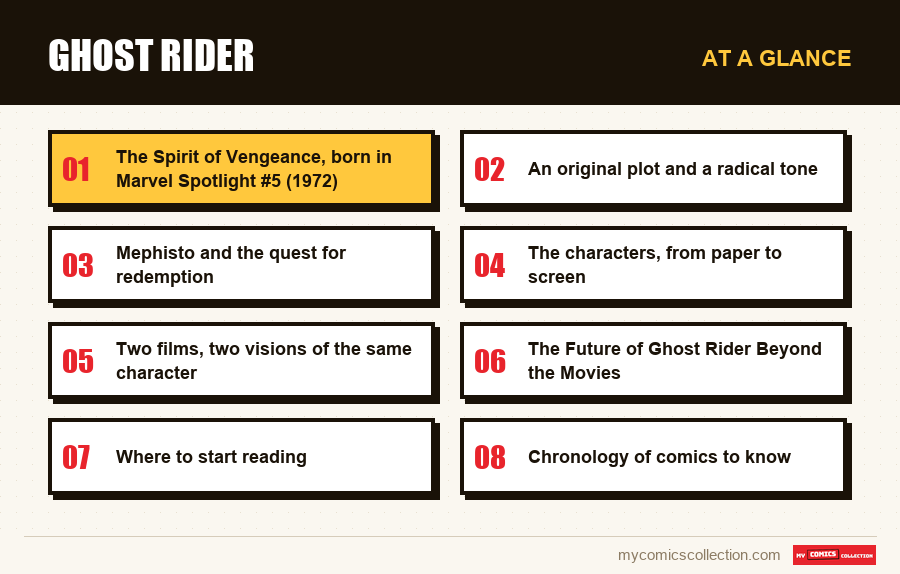
The Spirit of Vengeance, born in Marvel Spotlight #5 (1972)
Spirit of Vengeance continues the story of the character that appeared in Marvel Spotlight #5 (1972), created by Gary Friedrich and Mike Ploog. Johnny Blaze, a stuntman who sold his soul to Mephisto, is cursed: he transforms into Ghost Rider, the Spirit of Vengeance, a biker with a flaming skull who punishes the guilty. This curse, at the heart of the character, makes him a tragic figure, condemned to carry the demon that inhabits him. The film faithfully repeats this characterization established in the comics and the first film: Johnny Blaze, tormented, seeks to free himself from his curse while fighting against the demonic forces that threaten the world.
The film delves deeper into the tormented nature of the character, emphasizing his inner struggle against the demon that possesses him. Nicolas Cage delivers a more outrageous interpretation, reflecting the general tone of the film. Under the direction of Mark Neveldine and Brian Taylor, filmmakers adept at excess and visual energy, Spirit of Vengeance adopts a hallucinatory and frenetic aesthetic, very different from the first part. This more radical approach seeks to translate the madness and violence of the Spirit of Vengeance. The plot, largely original, moves away from the comics while retaining the essence of the character: the curse, the fight against the demon, the quest for redemption.
An original plot and a radical tone
The plot of Spirit of Vengeance is entirely invented for the film. A refugee in Eastern Europe, Johnny Blaze is recruited by a sect to protect a young boy coveted by the devil, who wants to be reincarnated as him. This quest, which combines chase and demonic issues, serves as the framework for a film resolutely focused on action and spectacle. The tone, hallucinatory and outrageous, contrasts with the first part: the film assumes a frenetic aesthetic, stylized violence and black humor, carried by the characteristic style of its directors. This radicality, while divisive, gives the film a more assertive identity.
This bias illustrates an attempt to reinvent the character after the first film, considered too lukewarm. By entrusting Ghost Rider to Neveldine and Taylor, the film seeks to visually convey the madness and power of the Spirit of Vengeance, more monstrous and unstable than in the first part. This approach, more faithful to the horrific and demonic dimension of the character, however moves away from American roots and comic book mythology. For the reader, the film is an invitation to discover the stories of Ghost Rider, where Johnny Blaze's curse and his fight against infernal forces are developed with a richness that neither film has fully captured.
Mephisto and the quest for redemption
The film once again features Mephisto, here in human guise, the demon of Johnny Blaze's original pact. A central figure in the Ghost Rider mythology, Mephisto embodies temptation and damnation, the one to whom Johnny sold his soul and from whom he seeks to free himself. The film takes up this role and the issue of redemption: Johnny hopes to break his curse and regain his humanity, while having to face the demon's schemes. This quest for liberation, at the heart of the character in the comics, structures the story and gives it its tragic dimension. Ciarán Hinds plays a manipulative Mephisto, true to his nature as a tempter.
This dimension of redemption is one of the most faithful aspects of the film. Ghost Rider, in the comics, is fundamentally a damned person in search of redemption, torn between the demon who possesses him and his aspiration for freedom and goodness. The film explores this tension, showing a Johnny Blaze desperate to free himself from his curse. This quest, universal and poignant, anchors the film in the mind of the character despite its invented plot. For the reader, it reminds us that Ghost Rider is not just a spectacular biker, but a tragic figure of damnation and redemption, whose moral and spiritual complexity the comics explore far beyond what the film can show.
Collecting this series?
Track what you own, what you are missing and what your collection is worth. 7 day trial.
Start my trial →The characters, from paper to screen
- Johnny Blaze / Ghost Rider: The cursed Spirit of Vengeance, more monstrous and unstable, faithful to Marvel Spotlight #5.
- Roarke / Mephisto: The demon of the pact in human appearance, faithful to his role.
- Nadya: The mother of the boy to be protected, character in the story.
- Danny: The young boy coveted by the devil, at the heart of the plot.
- Moreau: Member of the sect who recruits Johnny, character in the film.
Two films, two visions of the same character
The two Ghost Rider films offer two contrasting visions of the same character. The first, more classic and general public, sought to tell the origin of the demonic biker with a hesitant tone. The second, more radical and outrageous, assumes a frenetic aesthetic and stylized violence, at the risk of disorienting the public. Neither one nor the other fully convinced, illustrating the difficulty of adapting a character as singular as Ghost Rider, at the crossroads of horror, western and spectacle. These two attempts, in their opposing approaches, demonstrate the challenges posed by the transposition of such an excessive and flamboyant figure.
This double attempt recalls the richness and complexity of the character in the comics. Ghost Rider, a damned avenger with a flaming skull, combines registers (horror, tragedy, action, spirituality) that are difficult to balance on screen. For the reader, these films are an invitation to discover Ghost Rider in the comics, where the character has experienced numerous incarnations and stories of great depth, from 1970s horror to modern reinterpretations. Spirit of Vengeance, despite its excesses, will have had the merit of attempting a bolder approach, more faithful to the demonic dimension of the character, confirming that Ghost Rider remains one of the most fascinating figures on the horrific side of Marvel.
The Future of Ghost Rider Beyond the Movies
After the two films, Ghost Rider continued his existence in other media, proof of the character's vitality beyond his film adaptations. A recurring figure in comics, he has had numerous incarnations, from the classic Johnny Blaze to the more modern Robbie Reyes, each bringing their vision of the Spirit of Vengeance. This richness testifies to the concept's ability to reinvent itself, while retaining its essence: a cursed being, linked to an infernal power, in search of redemption. The character remains one of the pillars of the supernatural side of Marvel.
This longevity illustrates the enduring appeal of a character at the crossroads of horror, western and spectacle. Neither the limitations of the two films nor their mixed reception have diminished the fascination with the biker with the flaming skull. For the reader, this persistence is an invitation to explore the mythology of Ghost Rider in the comics, where the Spirit of Vengeance has crossed the decades and the hosts, always carrying the same themes of damnation and redemption. Spirit of Vengeance, despite its excesses, will have contributed to keeping alive this cult figure, whose potential, both visual and narrative, continues to inspire well beyond its screen adaptations.
Where to start reading
To extend the film, Marvel Spotlight #5 (1972) features the first appearance of Ghost Rider and Johnny Blaze's pact. The 1970s solo series “Ghost Rider” expands on the character's universe. Modern retellings of Ghost Rider extend its mythology. This journey covers the sources of a film faithful to the tragic spirit of the demonic biker.
Chronology of comics to know
- 1972: Marvel Spotlight #5: the first appearance of Ghost Rider (Johnny Blaze).
- 1970s: The solo series “Ghost Rider” develops the character’s universe.
- Subsequent decades: Modern rereadings of the Spirit of Vengeance.
Collection side: what numbers to aim for after the film
Spirit of Vengeance points to the major key of the character. Marvel Spotlight #5 (1972, first appearance of Ghost Rider) is a highly sought-after issue of Bronze Age horror, essential to Marvel's supernatural universe. The first issue of the solo series “Ghost Rider” is another popular target. Modern rereadings offer more accessible avenues. These targets cover various budgets. As always, condition and gradation determine value; relying on real recent sales is strongly recommended.
Its place in the saga and for the collector
Spirit of Vengeance attempted to reinvent Ghost Rider in a more radical tone, without fully convincing. For the collector, it has maintained interest in Marvel Spotlight #5, key to the Bronze Age. It illustrates the effect of adaptations on the market. Beyond speculation, the film invites us to discover the horrific side of Marvel and the tragic figure of Johnny Blaze, damned in search of redemption. By taking a more demonic and outrageous approach, he recalls the richness of a character at the crossroads of horror and spectacle, whose complexity the comics explore well beyond the screen.
The verdict: a more radical Spirit of Vengeance
- Loyalty: Johnny Blaze, the Spirit of Vengeance, the curse, Mephisto and the quest for redemption come from the comics.
- Freedoms: the original plot, the outrageous tone, the European setting, a more monstrous Ghost Rider, the simplified mythology.
- Collectible numbers: Marvel Spotlight #5 (Ghost Rider), the “Ghost Rider” solo series.
Spirit of Vengeance continues the adventure of the Spirit of Vengeance in a radical and hallucinatory tone, moving away from the first film. Faithful to Johnny Blaze's curse and quest for redemption but inventing its plot, the film assumes its excess. For the reader as well as the collector, it is an invitation to discover Marvel Spotlight #5 and the universe of Ghost Rider.
Frequently asked questions
No: the plot, where Johnny Blaze protects a child coveted by the devil, was invented for the film. It draws on the essence of the character (the curse, the Spirit of Vengeance) born in Marvel Spotlight #5 (1972).
The tone is more outrageous and hallucinatory, carried by directors Neveldine and Taylor. The Ghost Rider is more monstrous and unstable, the action more frenetic, and the setting moves to Europe. A more radical and demonic approach.
The demon of Johnny Blaze's original pact, here in human guise (Roarke). A central figure in the Ghost Rider mythology, he embodies temptation and damnation, the one from which Johnny seeks to free himself.
Yes: Ghost Rider is fundamentally a damned person in search of redemption, torn between the demon who possesses him and his desire for freedom. The film faithfully explores this tension, showing Johnny desperate to break his curse.
Marvel Spotlight #5 (1972, first appearance of Ghost Rider) is the most sought after key. The first issue of the solo series “Ghost Rider” is another popular target.
Does the film make you want to collect? Estimate the value for free of your issues (Marvel Spotlight #5…) with our tool based on current eBay listings.