
Helstrom (series, 2020) adapts Daimon Hellstrom, the “Son of Satan”, appeared in Ghost Rider #1 (1973) then launched solo in Marvel Spotlight #12 (1973). The series follows Daimon and his sister Ana, demon trackers haunted by a cursed heritage. It abandons the most explicit diabolical imagery of comics in favor of a sober horror thriller, with no visible link with the rest of the universe. Here is the detailed comparison, series versus comics.
Immersed in the horrific and occult side of Marvel, Helstrom brings to the screen a sulphurous figure born in the 1970s. She draws from a dark and little-known part of the universe, that of demons and hunters of the supernatural. Source-by-source decryption.
As in each article in this series, only verified information (creators, distribution, dates, comic numbers) is stated; the comparative analysis is ours, without reproducing dialogue or protected images.
Title : Helstrom (2020)
Showrunner: Paul Zbyszewski
Actors: Tom Austen (Daimon Helstrom), Sydney Lemmon (Ana Helstrom), Elizabeth Marvel
Broadcast: 2020, Hulu (1 season, 10 episodes)
Studio: Marvel Television
Ghost Rider #1 (1973): Daimon Hellstrom's first appearance
Marvel Spotlight #12 (1973): launch of “Son of Satan”
Satana: Daimon's demonic sister
Demonic Legacy: an evil father, cursed blood
- Daimon Helstrom and his demonic heritage.
- His sister Ana, echo of the character of Satana.
- The theme of a cursed blood inherited from an evil father.
- La demon hunting and possession.
- Anchoring in the horrific and occult side from Marvel.
- Imaging explicit satanic comics is greatly attenuated.
- The iconic costume (bare chest, cape, trident)disappears.
- The tone favors horror thriller sober to occult fantasy.
- None link shown with the rest of the Marvel Universe.
- The plot, centered on the family, is largely original.
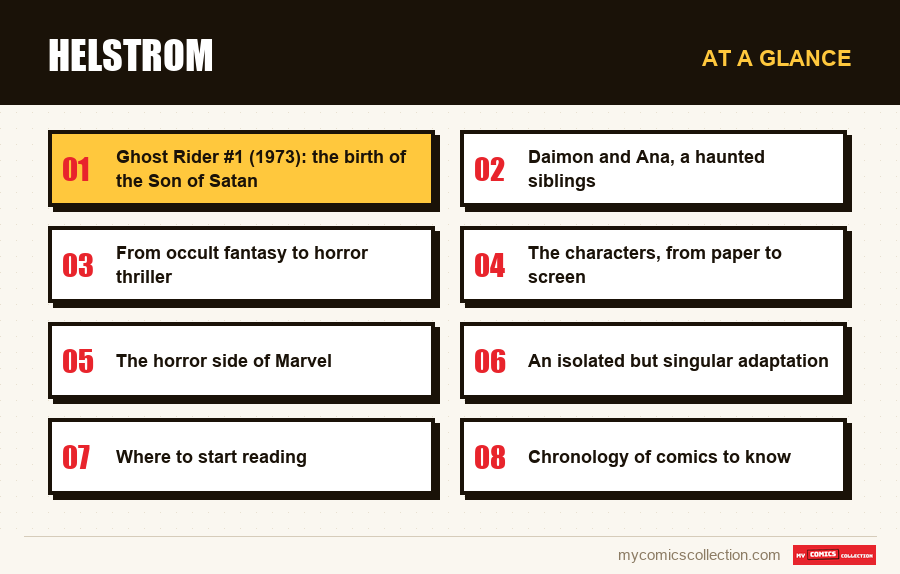
Ghost Rider #1 (1973): the birth of the Son of Satan
Daimon Hellstrom first appeared in Ghost Rider #1 (1973), before being launched into his own series, "The Son of Satan", starting in Marvel Spotlight #12 (1973). The character was born in the middle of the horror wave in comics of the 1970s, a period when Marvel, taking advantage of a relaxation of the censorship code, multiplied supernatural heroes - Ghost Rider, Dracula, Man-Thing, Werewolf by Night. Daimon is the son of a demonic being and a mortal woman: torn between his cursed blood and his aspiration for good, he becomes a demon hunter, tormented by the dark side of his heritage.
This duality, a half-demonic hero fighting against his own nature, is at the heart of the character. In the comics, Daimon wears an iconic and provocative costume: bare torso marked with a pentagram, long cape, fiery trident. He embodies the horrific audacity of his time, flirting with satanic imagery in a genre that was then booming. Her sister, Satana, continues this sulfurous vein. The series takes up the basis of the character (the cursed inheritance, the hunt for demons) but deliberately erases the most explicit imagery, in favor of a more sober and contemporary approach.
Daimon and Ana, a haunted siblings
The series chooses to center its story on siblings: Daimon and Ana Helstrom, children of a monstrous father whose shadow hangs over their existence. Daimon, played by Tom Austen, is an academic specializing in cults and the occult, endowed with powers that he is reluctant to use. Ana, played by Sydney Lemmon, is sharper, more assertive in her relationship to violence. Together, they track down the manifestations of evil while confronting the ghosts of their childhood: an interned mother, an absent and evil father, a heritage they would like to deny.
This character of Ana is a direct echo of Satana, Daimon's demonic sister in the comics. The series reinvents her as a modern, complex and ambiguous woman, far from the succubus imagery of 1970s comics. This brother-sister duo, united by the same cursed blood but divided by their choices, constitutes the emotional heart of the series. Their relationship, made of resentment, loyalty and shared wounds, anchors the supernatural in an intimate family drama, where comics favored occult adventure and horrific grandiloquence.
From occult fantasy to horror thriller
The change in tone is the most striking aspect of the adaptation. The “Son of Satan” comics fully embraced their diabolical imagery: pentagrams, demons, flaming trident, flamboyant mystical confrontations. The series opts for a muted horror, closer to psychological thriller and possession stories than occult fantasy. Exit the provocative costume; place with a Daimon as a tormented academic, with a gray and anxiety-provoking atmosphere, with suggested violence that is more than spectacular. This more consensual bias attenuates the sulphurous charge that made the character unique.
This choice is partly explained by the difficulty of adapting imagery as frontal as that of The Son of Satan to a wide audience. But he also defused what made the original comics so audacious. By smoothing out the character, the series lost part of its provocative identity, without always managing to impose such a strong alternative. Broadcast in a context of reorganization of Marvel television productions, Helstrom only had one season, remaining an isolated curiosity in the landscape of adaptations. It nevertheless remains an interesting testimony to the desire to explore the horrific side of the universe.
Collecting this series?
Track what you own, what you are missing and what your collection is worth. 7 day trial.
Start my trial →The characters, from paper to screen
- Daimon Helstrom: Son of a demon, scholar of the occult and reluctant demon hunter, haunted by his legacy.
- Ana Helstrom: Her sister, echo of the character of Satana, sharper in her relationship to violence.
- Victoria: Their mother, a figure marked by possession and trauma.
- The demonic father: The evil shadow that weighs on all the siblings.
- Occult allies and adversaries: Largely invented for the family narrative of the series.
The horror side of Marvel
Helstrom belongs to a tradition often unknown to the general public: that of Marvel horror comics. In the 1970s, the publisher built a whole section of its universe around the supernatural, with heroes like Ghost Rider, Blade, Werewolf by Night or Man-Thing. These stories, darker and daring than classic superhero adventures, explored fear, damnation and fantasy. Daimon Hellstrom, the Son of Satan, is one of the emblematic figures, embodying the fascination of the time for the occult and the demonic.
For the reader, Helstrom is a gateway to this horrific universe. The series, despite its limitations, reminds us that Marvel is not limited to the Avengers and the X-Men: the publisher also has a rich gallery of supernatural heroes, born in the margins of its catalog. This heritage, which has long remained discreet on screen, is experiencing renewed interest as productions explore darker tones. Helstrom, by bringing one of these sulphurous characters to the screen, modestly participates in the rediscovery of this horrific treasure, where the most daring fantasy rubs shoulders with the great heroic figures of the house.
An isolated but singular adaptation
Helstrom occupies a special place among Marvel adaptations: broadcast at the end of a cycle of television productions, with no apparent link with the rest of the universe, it remained an isolated work, stopped after a single season. This isolation, if it has harmed its visibility, also gives it a singularity: far from the large interconnected frescoes, the series has been able to focus on an intimate and dark story, without the obligation to serve a shared universe. This free electron status makes it a curious object, halfway between a superhero adaptation and a pure horror thriller.
For the collector and comics lover, this curiosity has one merit: that of drawing attention to a character rarely highlighted and to a whole horrific part of Marvel. Even imperfect, an adaptation helps to make its sources known and to revive interest in issues that have long been confidential. Helstrom, by drawing the Son of Satan from the shadows, invites us to explore the horror comics of the 1970s, this abundant period when Marvel dared the most daring supernatural. This is, without doubt, its main contribution: serving as a gateway to a little-known heritage.
Where to start reading
To discover Daimon Hellstrom, his first appearance in Ghost Rider #1 (1973) and the launch of “Son of Satan” from Marvel Spotlight #12 (1973) lay the foundation for the character. Marvel's horror stories from the 1970s, with Ghost Rider, Blade and Werewolf by Night, shed light on the context of this golden age of the supernatural. Daimon's subsequent appearances, notably within teams of occult heroes, extend his journey. This journey covers the sources for a series that explores the horror side of Marvel.
Chronology of comics to know
- 1973: Ghost Rider #1: First appearance of Daimon Hellstrom.
- 1973: Marvel Spotlight #12: “Son of Satan” launch.
- 1970s: Marvel's golden age of horror (Ghost Rider, Blade, Werewolf by Night).
Collection side: what numbers to aim for after the series
Helstrom points to keys to the horrific Bronze Age. Ghost Rider #1 (1973, first appearance of Daimon Hellstrom, and also linked to Ghost Rider) is a sought-after issue, doubly important. Marvel Spotlight #12 (1973, launch of “Son of Satan”) is another valuable target for fans of the character. Marvel's horror comics from the 1970s offer vast territory for exploration. These targets cover various budgets. As always, condition and gradation determine value; relying on real recent sales is strongly recommended.
Its place in the saga and for the collector
Helstrom brought to the screen a sultry and little-known Marvel figure, toning down his satanic imagery in favor of a family thriller. For the collector, it drew attention to Ghost Rider #1 and Marvel Spotlight #12, keys to the horrific Bronze Age. It illustrates the effect of adaptations on the market, even for niche characters. Beyond speculation, the series invites you to discover the horrific side of Marvel, this daring heritage of the 1970s where the publisher dared the supernatural. By drawing the Son of Satan from the shadows, she recalls the unsuspected diversity of the universe, well beyond its most famous superheroes.
The verdict: a horrifying curiosity
- Loyalty: Daimon Helstrom, his sister Ana (echo of Satana), the cursed blood and the hunt for demons come from the comics.
- Freedoms: the attenuated satanic imagery, the missing costume, the sober thriller tone, the lack of connection to the universe, an original family intrigue.
- Collectible numbers: Ghost Rider #1 (1973), Marvel Spotlight #12 (1973).
Helstrom transposes a sulfurous horror figure from the comics into a sober family thriller, even if it means erasing its iconic audacity. Faithful to the cursed legacy of Daimon and the echo of Satana, the series favors the intimate over the occult spectacular. For the reader as well as the collector, it is an invitation to discover, from Ghost Rider #1, the little-known horrific side of Marvel, the one where monsters and the damned rub shoulders with superheroes, and where the publisher has signed some of its most daring pages.
Frequently asked questions
He first appeared in Ghost Rider #1 (1973), before going solo as "Son of Satan" starting in Marvel Spotlight #12 (1973). Son of a demon, he becomes a demon hunter haunted by his heritage.
Daimon's sister, echo of the character of Satana in the comics. The series reinvents her as a modern, complex and ambiguous woman, far from the succubus imagery of 1970s comics.
It retains the demonic heritage, the siblings and the demon hunt, but greatly attenuates the satanic imagery, removes the iconic costume and adopts a tone of a sober horror thriller, with no apparent link with the Marvel universe.
Broadcast at the end of a cycle of Marvel television productions and without connection with the rest of the universe, Helstrom remained an isolated work, stopped after a single season, making it a separate curiosity.
Ghost Rider #1 (1973, first appearance of Daimon Hellstrom) is the most sought after key, doubly important. Marvel Spotlight #12 (1973, "Son of Satan" launch) is another valuable target.
Does the series make you want to collect? Estimate the value for free of your issues (Ghost Rider #1, Marvel Spotlight #12…) with our tool based on current eBay listings.