
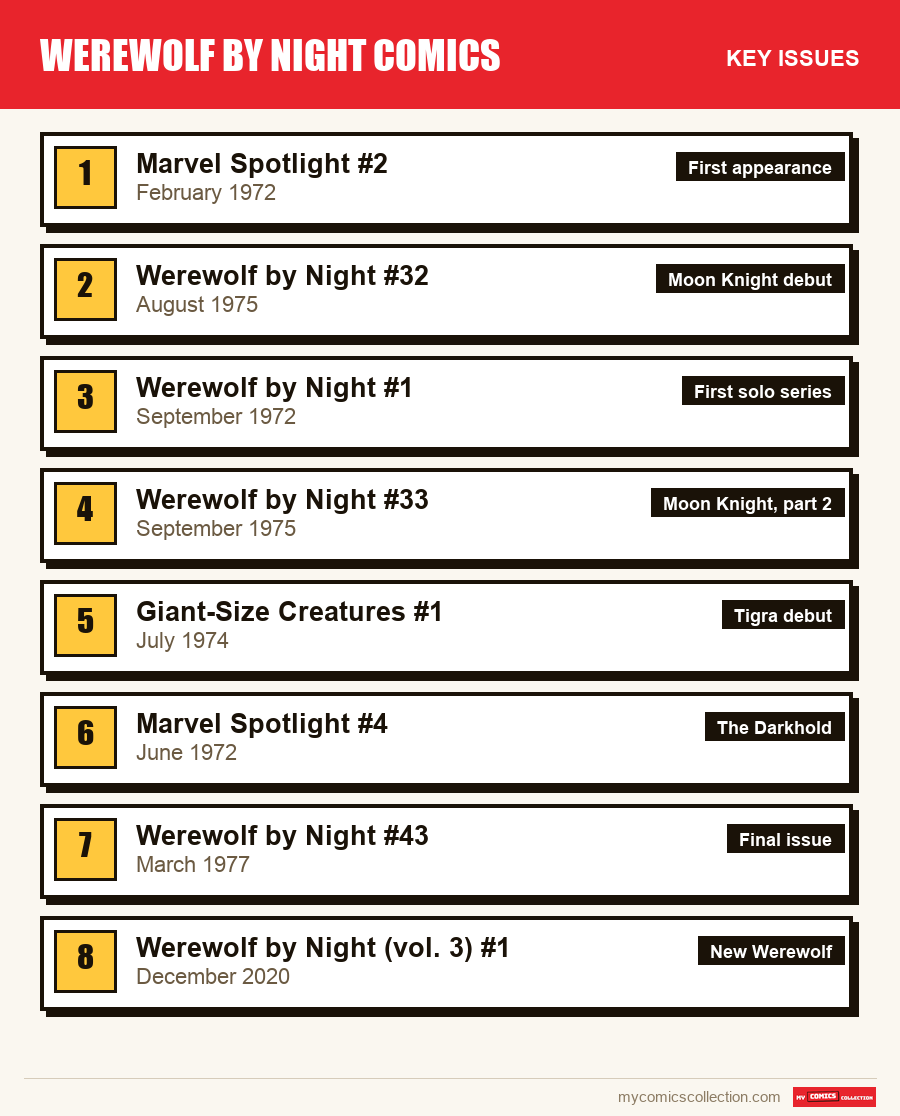
Werewolf by Night first appeared in Marvel Spotlight #2 (February 1972), before obtaining his own title, Werewolf by Night #1, in September 1972 (script Gerry Conway, drawings Mike Ploog). The series lasted 43 issues until March 1977 and notably gave birth, in issue 32 (August 1975), to the very first appearance of Moon Knight. Top copies of Marvel Spotlight #2 are trading in the five figures today, while Werewolf by Night #32 is on the Overstreet Price Guide's list of the top 25 Bronze Age comics.
Few characters in the Marvel stable owe their existence as much to a simple rule change as Jack Russell, aka Werewolf by Night. Without the relaxation of the Comics Code Authority in 1971, which finally allowed classic monsters (vampires, werewolves, undead) into Code-approved pages, the character would simply never have existed in this form. This editorial shift, as technical as it appears, explains why Werewolf by Night remains today one of the pillars of the Bronze Age most sought after by collectors of horror comics.
This article traces the complete editorial history of the character, from its creation by the trio Roy Thomas / Jean Thomas / Gerry Conway / Mike Ploog until its notable appearance on Disney+ in 2022, focusing in detail on the key issues which are now raising the stakes: Marvel Spotlight #2, Werewolf by Night #1 and Werewolf by Night #32, the latter featuring the first appearance of Moon Knight. We will also see how to seriously evaluate a copy before buying or selling it.
Whether you are looking to complete a Bronze Age collection, understand why certain issues of this modestly sold series at the time are worth considerable sums today, or simply want to check the condition of an inherited example, this guide brings together the verified facts, without extrapolation or invented prices.
The origins of Werewolf by Night: a werewolf born from a Code change
At the turn of the 1970s, the Comics Code Authority, this self-regulatory body created in 1954 to censor violence and horror in American comics, relaxed its criteria. From 1971, publishers were allowed to publish vampires, werewolves and other figures of Gothic folklore, as long as they remained within the classic literary tradition (Bram Stoker, Mary Shelley). Marvel jumped at the opportunity: it was from this regulatory window that Tomb of Dracula and Werewolf by Night were born almost simultaneously.
The character Jack Russell first appears in Marvel Spotlight #2, dated February 1972. The anthological title Marvel Spotlight then served as an editorial test bed: several characters were tested there before receiving their own series. Werewolf by Night occupies issues 2 to 4, the time to convince the readership and the editorial management that the concept deserved a title in its own right. The very name of the character, “Jack Russell”, is an obvious nod to the breed of dog of the same name, a joke that the screenwriters have never denied.
The launch of the solo series in September 1972
Building on the reception given to his three test issues, the character obtains his own title: Werewolf by Night #1 was released in September 1972. The screenplay was by Gerry Conway, the drawings by Mike Ploog, and the plot of this first issue is based on a plot developed by Roy Thomas and his wife Jean Thomas. The name of the series itself was reportedly suggested by Stan Lee, then editor-in-chief and editorial director of Marvel. Mike Ploog's style, more organic and gothic than the dominant superheroic style of the time, immediately gives the title a separate visual identity, which contrasts with the rest of the Marvel catalog of the early 1970s.
The series will have 43 regular issues, published until March 1977, before giving way to other formats. Over this five-year period, the creative team rotated a lot: after Gerry Conway and Mike Ploog, we find Len Wein on the screenplay, then Doug Moench, who will take charge of the majority of the second half of the series, supported most often by the artist Don Perlin. Marv Wolfman, often incorrectly cited as the author of issue #1, actually joined the team later in publication, on later arcs.
The myth of Jack Russell: curse, blood gem and red moon
Unlike many Marvel superheroes of the same decade, Jack Russell is not a voluntary vigilante. He inherits a lycanthropic curse passed down through his maternal line, the Russoffs, a family of Transylvanian origin. At each full moon, he transforms against his will into a bipedal creature half man half wolf, without retaining control of his actions: a narrative mechanism which clearly distinguishes the character from the classic heroes of the time, closer to the gothic drama than to the story of superpowers.
Two elements of internal mythology will lastingly structure the character's stories. The first is the lunar amulet forged in silver, an object that Jack Russell manages to use to regain a semblance of control over his transformations, and which becomes a recurring visual identifier on the covers of the series. The second is the Bloodstone, introduced via the Bloodstone family, hunters of immortal monsters who also appeared in the early 1970s in the editorial orbit of the series. This link between the two mythologies (werewolf and Bloodstone) has remained an anchor point of the Marvel horror universe until today, notably via Elsa Bloodstone in more recent series.
Werewolf by Night #32: Moon Knight's first appearance
The number which weighs heaviest today in the rating of the series is not one of the first numbers, but the Werewolf by Night #32, dated August 1975. Written by Doug Moench, drawn by Don Perlin, with cover art by Al Milgrom and Gil Kane and editorial supervision by Len Wein, this issue introduces the very first appearance of Marc Spector, aka Moon Knight. At the time, the series was struggling to maintain sales; the arrival of this secondary character, initially thought of as a simple mercenary antagonist hired to hunt down the werewolf, helped stabilize the title for its final issues.
This issue now appears on the list of the 25 best Bronze Age comics established by the Overstreet Price Guide, alongside other notable origins of this decade. It's a textbook case of "hidden key": when it was released, no one could anticipate that this secondary character would become, decades later, the hero of his own big-budget Disney+ television series (Moon Knight, 2022), which mechanically increased the demand for this specific number.
End of the original series and subsequent extensions
Werewolf by Night stopped at its number 43 in March 1977, victim of a gradual erosion of sales common to many horror titles at the end of the decade, a period when the classic superheroic genre took over the shelves. The character does not disappear from the Marvel universe: he regularly reappears as a guest star in Marvel Team-Up, Ghost Rider, Moon Knight or even Marvel Two-in-One, before benefiting from several relaunches of his own title over the following decades, none of which, however, has regained the longevity of the original 1972-1977 series.
It is this basic continuity, maintained over fifty years by one-off appearances rather than by permanent star status, which explains the very particular collecting profile of the character: a very concentrated core of key Bronze Age issues (Marvel Spotlight #2, Werewolf by Night #1, Werewolf by Night #32) around which revolves a much larger set of more confidential series, sought after above all by collectors specializing in the character rather than by the general public.
The impact of adaptations on the rating
The clearest turning point in the recent history of Werewolf by Night's rating is cinematographic, or more precisely television. On October 7, 2022, Marvel Studios broadcasts the TV movie on Disney+Werewolf by Night, a medium-length film directed and composed by Michael Giacchino (the official composer of numerous Marvel and Pixar films, here in his first production), with Gael García Bernal in the role of Jack Russell, alongside Laura Donnelly and Harriet Sansom Harris.
The aesthetic bias of the program: black and white filming, practical special effects in the style of classic horror films from the 1930s-1950s, a deliberately retro atmosphere going against the grain of the rest of the MCU: was unanimously praised by critics and the public, to the point of appearing among the best-received Marvel Studios productions of the year 2022. This critical success had a direct knock-on effect on the collector's interest in the character's original comics: Marvel Spotlight #2 and Werewolf by Night #1, until then rather reserved for an audience of Bronze Age specialists, found themselves more sought after by a wider audience discovering the character via the screen.
Marvel accompanied the release of the TV film with a spin-off comic, Werewolf By Night: Blood Moon Rise #1, the story of which was written by Michael Giacchino himself: a fairly rare way for an MCU director to come full circle between adaptation and source material. A sequel to the TV film has also been confirmed by Giacchino, which suggests a continuation, or even a strengthening, of demand for original comics in the years to come, in particular for high-grade copies of the three key issues mentioned above.
Rating Benchmarks: What Actual Sales Show
On Marvel Spotlight #2, the gap in value between mid-grades and high-grades is dramatic. An example in grade FN 6.0 trades today in a range of 500 to 700 dollars, compared to only around a hundred dollars in 2009 - a useful reminder of the fundamental progression of the Bronze Age market over fifteen years. In the very best conditions, a copy reached nearly $50,000 at an auction, compared to the $13,000 obtained for a comparable piece in 2013: the rarity of copies in near mint condition, combined with the first appearance of the character, explains this considerable gap with intermediate grades.
On Werewolf by Night #1, the market is much more accessible: the GoCollect value guide places the fair market value (FMV) of a CGC 9.8 copy at around $2,250, while the highest sale ever recorded for this issue remains a 9.8 copy signed by Mike Ploog and Stan Lee, sold for $4,995 in November 2016 - the signature of the two creators here constituting a clearly identifiable premium compared to a copy unsigned of the same grade. An unsigned 9.6 sold for $1,250 in March 2020. On the more common grades, the guide price benchmarks are around $120 for grade 6.0, $230 for grade 8.0 and $500 for grade 9.2.
On Werewolf by Night #32, the progression is also marked in the high grades: a CGC 9.8 copy went from $3,000 in 2013 to $14,500 in 2015, while an NM+ 9.6 sold for $12,000 in October 2019. On the intermediate grades, the Overstreet Price Guide 2021 valued a VF 8.0 at $1,140, with an FN 6.0 being around $1,100; a CGC 7.5 example sold for $1,299 in 2020. These figures, specific and dated, give an order of magnitude rather than a fixed price: as with any sought-after Bronze Age key, the best way to know the current value of a specific example remains to compare recent and comparable sales, grade by grade.
Collecting this series?
Track what you own, what you are missing and what your collection is worth. 7 day trial.
Start my trial →Buying Guide: How to Review a Copy of Werewolf by Night
Before purchasing or having an estimate of a number of the series, a few points of vigilance specific to this title are worth knowing:
- Don't confuse Marvel Spotlight #2 with Werewolf by Night #1. The first contains the very first appearance of the character (February 1972); the second is the launch of his solo series (September 1972), with a partially different creative team. Both are keys in their own right, but their rating and relative rarity are not the same.
- On Werewolf by Night #32, always check for mention of Moon Knight in the interior, not just the cover. Some reissues or digitized versions reproduce the cover without the buyer always being aware that this is indeed the origin of the character, and not a simple later mention.
- Inspect the condition of the original newspaper. Bronze Age comics printed on acid paper naturally yellow; a copy with white or cream pages (“white pages” / “off-white pages” on CGC labels) always commands a premium compared to a copy with yellowed pages, at an equivalent conservation grade.
- Beware of undeclared restorations, particularly on the back covers and staples, fragile points typical of this printing period. A passage in a CGC or CBCS box with blue label (“Universal”) guarantees the absence of restoration; a purple label indicates a declared restoration, which must result in a discount compared to a universal copy of the same apparent grade.
- Favor encapsulated copies for transactions worth several hundred dollars or more, notably on Marvel Spotlight #2 where the difference between neighboring grades can represent several hundred, even several thousand dollars.
- Always compare sales made, not asking prices. Current listings often display optimistic prices; only completed sales reflect the real market value at a given time.
- Consider the adaptation effect. Since the release of the 2022 Disney+ TV movie, demand for the three keys to the series has evolved; a guide price dated before 2022 may underestimate the current value of an example in good condition.
To keep track of your own Marvel comic collection, including Bronze Age keys like Werewolf by Night, the collection management application allows you to catalog each issue, its grade and its provenance, and to keep an overview of the total value of your copies over time.
Read the series without breaking the bank on the original issues
Not all collectors necessarily seek to own the original booklets: many want above all to read the complete adventures of Jack Russell in order. Marvel has republished most of the series in two modern collections which allow you to follow the complete story without touching the original comics market: the hardcover collection Marvel Masterworks: Werewolf by Night Vol. 1, which covers the first issues in restored color with a critical approach to the context of creation, and the digital edition Werewolf by Night: The Complete Collection Vol. 1, which brings together over a wider period the screenplays of Gerry Conway, Len Wein, Marv Wolfman and Doug Moench alongside the drawings of Mike Ploog, Werner Roth, Tom Sutton, Gil Kane and Don Perlin. These editions are a good entry point before investing in original issues, particularly to check whether the very gothic tone of the series is what one is looking for before embarking on the hunt for the Bronze Age keys themselves.
Key issues to know
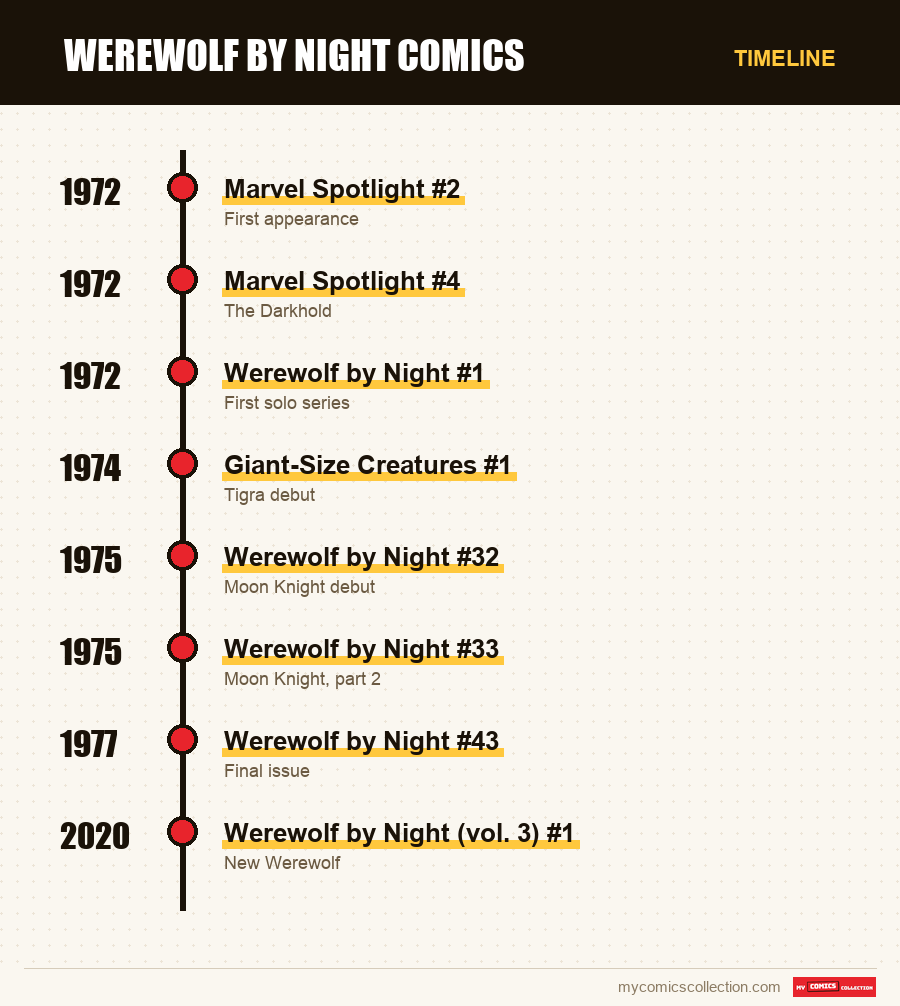
Marvel Spotlight #2
Roy and Jean Thomas, Gerry Conway and Mike Ploog introduce Jack Russell, who inherits his family's werewolf curse at eighteen. Made possible by the loosening of the Comics Code, this story is the character's first appearance.
Werewolf by Night #32
Doug Moench and Don Perlin pit Jack Russell against a mercenary hired by the Committee to capture him: Marc Spector, alias Moon Knight. This issue of a modest series has become the title's most sought-after key.
Werewolf by Night #1
After three tryout issues in Marvel Spotlight, Jack Russell gets his own series, written by Gerry Conway and drawn by Mike Ploog. It will run for forty-three issues.
Werewolf by Night #33
"Wolf-Beast vs. Moon Knight" extends the clash between the werewolf and the mercenary. Moon Knight's second outing completes the two-parter that launched the character.
Giant-Size Creatures #1
Tony Isabella and Don Perlin transform Greer Nelson, formerly the Cat, into Tigra the Were-Woman. Jack Russell shares the bill of this giant-size issue, which marks Tigra's first appearance under that name.
Marvel Spotlight #4
The last of the three tryout issues, by Gerry Conway and Mike Ploog: a writer researching the occult brings Jack Russell information about the Darkhold, the grimoire tied to his family's curse.
Werewolf by Night #43
Doug Moench and Don Perlin deliver the original series' final issue, against the Tri-Animan. The character then keeps appearing as a guest in other Marvel titles.
Werewolf by Night (vol. 3) #1
Written by Taboo and Benjamin Earl and drawn by Scot Eaton, the issue introduces Jake Gomez, a young man living in Arizona who becomes Werewolf by Night in turn. A relaunch handing the title to a new hero.