The most expensive Moon Knight comic is Werewolf by Night #32 (August 1975), the first appearance of the character created by Doug Moench and Don Perlin: a CGC 9.8 copy sold for $31,200 at Heritage Auctions in March 2020, and 2023 CGC 9.8 sales reached $42,000 according to sellmycomicbooks.com. Moon Knight is a Bronze Age character: there are no Silver Age Moon Knight comics in existence. All founding keys are Bronze Age publications: Werewolf by Night #32-33 (1975), Marvel Spotlight #28 (1976), and Moon Knight #1 (1980).
Moon Knight was born in August 1975 in the pages of Werewolf by Night #32, written by Doug Moench and drawn by Don Perlin. The character first appears as a mercenary antagonist hired to capture werewolf Jack Russell, before switching sides in the following issue. Editors Marv Wolfman and Len Wein immediately recognized the character's potential and commissioned Moench and Perlin to write solo stories for Marvel Spotlight #28-29 (1976). The inaugural solo series:Moon Knight #1 (November 1980), scripted by Doug Moench and drawn by Bill Sienkiewicz: established the foundations of Marc Spector: a mercenary resurrected by the Egyptian moon god Khonshu, operating through multiple identities including Steven Grant (businessman), Jake Lockley (cab driver), and Mr. Knight.
This guide sticks to the verifiable: records documented by Heritage Auctions, sellmycomicbooks.com, GoCollect, and CGC Comics. One important methodological note: our eBay estimator does not cover the Werewolf by Night , Moon Knight , or Marvel Spotlight series: it returns "invalid parameters" for these titles. Every figure in this guide comes exclusively from documented web sources. Where no public record exists, we stay qualitative.
Moon Knight key issue ranking (real documented data)
All records below come from public sources (Heritage Auctions, sellmycomicbooks.com, CGC Comics). Our eBay estimator does not cover these series; all figures are sourced from the web.
| Issue | Significance | Documented record |
|---|---|---|
| Werewolf by Night #32 (Aug. 1975) | 1st appearance and origin of Moon Knight | $31,200 (CGC 9.8, Heritage Auctions, Mar. 2020); $42,000 (CGC 9.8, 2023, sellmycomicbooks.com) |
| Werewolf by Night #33 (Sep. 1975) | 2nd appearance of Moon Knight | $13,200 (CGC 9.8, 2021); overall documented record: $6,519 (sellmycomicbooks.com) |
| Marvel Spotlight #28 (Jun. 1976) | 1st solo Moon Knight story | $3,500 (documented record, sellmycomicbooks.com) |
| Moon Knight #1 (Nov. 1980) | First solo series: Moench & Sienkiewicz | $1,350 (CGC 9.8, historical high); $925 (CGC 9.8, 2022, sellmycomicbooks.com) |
Sources: Heritage Auctions, sellmycomicbooks.com, CGC Comics. Our eBay estimator does not cover these series.
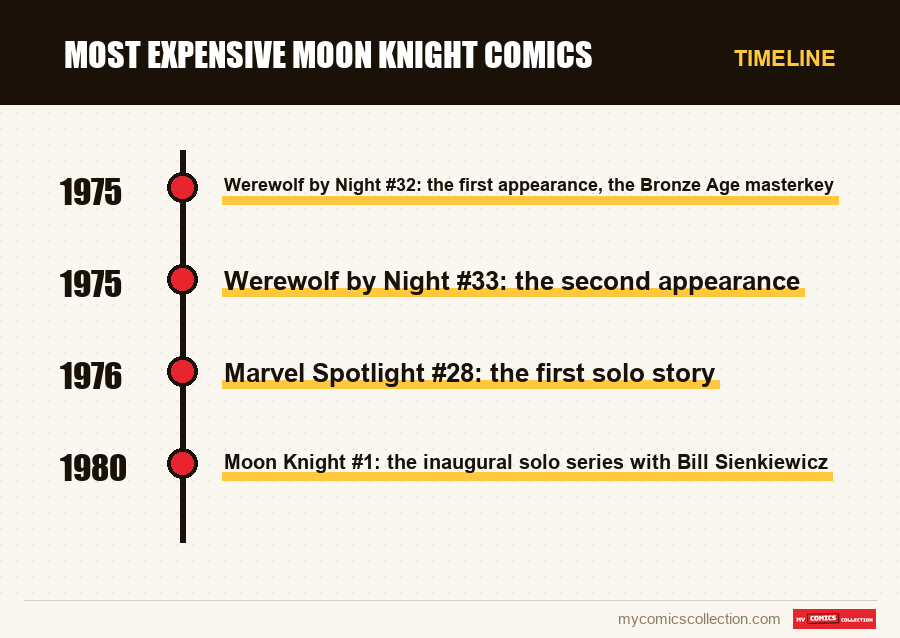
Werewolf by Night #32 (1975): the first appearance, the Bronze Age masterkey
Published with an August 1975 cover date, Werewolf by Night #32 is the definitive Moon Knight key. The story: "Stalker by Night!": is written by Doug Moench and drawn by Don Perlin, with a cover by Gil Kane and Al Milgrom. Moon Knight is introduced as a mercenary hired to capture werewolf Jack Russell; his white costume bearing lunar symbols and his silver weapons (deadly to a lycanthrope) make him a perfectly designed antagonist for the title character. Moon Knight is a Bronze Age character: there are no Silver Age copies, no 1960s keys for this character. Heritage Auctions documents a CGC 9.8 sale at $31,200 in March 2020; sellmycomicbooks.com records a CGC 9.8 sale at $42,000 in 2023. For context, the same source shows a CGC 9.6 at $25,200 in 2022 and $10,100 in 2021. The market peaked around the Disney+ series announcement (2021-2022) before normalizing. CGC has graded 4,930 US copies, with nineteen achieving the maximum grade of 9.8 as of September 20, 2022.
Werewolf by Night #33 (1975): the second appearance
Werewolf by Night #33 (September 1975) is the direct continuation of #32: Moon Knight reverses course and chooses to help Jack Russell rather than hand him over. It is the character's second appearance, and already a key issue for serious Moon Knight collectors. Sellmycomicbooks.com documents an overall record of $6,519, while 2021 data shows a CGC 9.8 copy selling for $13,200. The valuation gap between #32 and #33 is substantial: the first appearance commands a significant premium over the second.
Marvel Spotlight #28 (1976): the first solo story
Following the character's success in Werewolf by Night, editors Marv Wolfman and Len Wein commissioned a run of solo stories. Marvel Spotlight #28 (June 1976) is the first issue dedicated exclusively to Moon Knight, once again written by Doug Moench and drawn by Don Perlin. The issue introduces key characters from Marc Spector's supporting cast including Marlene Fontaine and Samuels. Marvel Spotlight #29 (August 1976) continues the solo run. Sellmycomicbooks.com documents a record of $3,500 for issue #28. These issues represent a more accessible Bronze Age entry point than Werewolf by Night #32, though they trade with less liquidity on the secondary market.
Moon Knight #1 (1980): the inaugural solo series with Bill Sienkiewicz
Moon Knight #1 (November 1980) marks the launch of the first dedicated solo series. Doug Moench returns to script, but it is Bill Sienkiewicz's arrival on art that defines the character's visual identity for generations of collectors: expressive linework, dramatic shadow play, and an atmosphere that anticipates his later experimental style. This issue firmly anchors Marc Spector's four identities (the mercenary, Steven Grant, Jake Lockley, and the avatar of Khonshu) and introduces Bushman, his archetypal nemesis, in that character's first documented appearance. Values are considerably more accessible than the 1975 keys: sellmycomicbooks.com records a historical high of $1,350 for CGC 9.8 and a 2022 sale at $925 in CGC 9.8. It is a coherent collecting choice for anyone wanting the series key without exposure to the price levels of Werewolf by Night #32.
Moon Knight on Disney+: the series effect on key issue values
The Moon Knight series streaming on Disney+ from March 30, 2022 drove a significant surge in demand for the character's Bronze Age keys. Oscar Isaac portrays Marc Spector and his alter egos (Steven Grant, Jake Lockley) across six episodes, facing Ethan Hawke as antagonist Arthur Harrow. The series earned an 86% approval rating on Rotten Tomatoes, with unanimous praise for Isaac's performance. That wave of interest pushed Werewolf by Night #32 to record price levels between 2021 and 2022, before the market gradually normalized. Any future Moon Knight MCU appearances remain a factor that could reignite collector demand for these Bronze Age keys.
Own a Moon Knight comic? Get a free valuation with our tool based on real eBay sales to find its low, median, and high value.
Frequently asked questions
Werewolf by Night #32 (August 1975), the character's first appearance, created by Doug Moench and Don Perlin. The documented record is for a CGC 9.8 copy, with 2023 sales higher than those of 2020. CGC has recorded 4,930 graded US copies, nineteen of them in 9.8 (as of September 20, 2022).
No: Moon Knight is a Bronze Age character and has no key from the 1960s. The founding keys are Werewolf by Night #32 and #33 (1975), Marvel Spotlight #28 (1976) and Moon Knight #1 (1980). Searches for "Moon Knight Silver Age" therefore lead nowhere.
It is the direct follow-up to #32, and Moon Knight's second appearance. Hired to capture Jack Russell, he changes his mind and chooses to help him. The value gap with #32 is significant: the first appearance commands a large premium.
Marvel Spotlight #28 (1976), the first story devoted to Moon Knight, is a more accessible Bronze Age entry, though less liquid. Moon Knight #1 (November 1980), by Doug Moench and Bill Sienkiewicz, anchors the identities of Marc Spector, Steven Grant, Jake Lockley and Mr. Knight. Its values are far more accessible than those of the 1975 keys.
Yes: aired from March 30, 2022, with Oscar Isaac as Marc Spector, it caused a significant rise in demand. Werewolf by Night #32 reached unprecedented price levels between 2021 and 2022, before a gradual normalization. A possible return to the MCU remains a factor that could revive demand.