La tier list Moon Knight 2026 prioritizes four levels of arbitration: Tier S blue-chip (Werewolf by Night #32 August 1975 first appearance Moon Knight by Doug Moench and Don Perlin, Werewolf by Night #33 September 1975 second appearance, Moon Knight Volume 1 #1 November 1980 ongoing Moench/Bill Sienkiewicz, Moon Knight Volume 4 #188 October 2017 final Jeff Lemire/Greg Smallwood), Tier A narrative pillars (Marvel Spotlight #28-29 1976 first solo backup, Moon Knight Volume 1 #4 February 1981 first appearance Midnight Man, Moon Knight Volume 4 #1 June 2014 reboot Warren Ellis/Declan Shalvey), Tier B sleepers (Moon Knight Volume 2 #1 June 1985 Fist of Khonshu, Moon Knight Volume 5 #1 March 2006 return Moench, Vengeance of Moon Knight #1 November 2009), Tier C spec 2026-2027 (season 2 Disney+, Khonshu MCU integration). Target allocation by budget: 70% Tier S, 20% Tier A, 10% Tier B+C depending on collector or investor profile.
Building a coherent tier list on Moon Knight in 2026 requires different reasoning than that of Spider-Man or Batman. The character combines two structuring particularities: a first Bronze Age appearance (August 1975) slipped in as a backup to a B-list title (Werewolf by Night), and an editorial career fragmented into seven ongoing volumes between 1980 and 2024, each reset by a different creative team. This narrative discontinuity penalizes collector readability, but it paradoxically enhances the real keys: the rarity of high-grade copies on the first Sienkiewicz volume, the difficulty of finding Werewolf by Night #32 in CGC 9.6+, and the high liquidity of the three or four issues that every Moon Knight collector seeks as a priority.
This hub offers a budget-driven ranking on four tiers (S, A, B, C), with for each tier the references to target, the Heritage Auctions and GoCollect price ranges updated April 2026, the recurring grading pitfalls, and the arbitration strategy according to the confirmed MCU season 2 Disney+ calendar and the potential integration of Khonshu in a post-Doomsday Avengers phase. For the overall Marvel Bronze Age context, see our pillar guide marvel universe and our full story Moon Knight comics. Quantified references come from documented sales by Heritage Auctions, GoCollect and CovrPrice between January 2024 and April 2026.
Moon Knight tier list methodology: ranking criteria and weighting
A comics tier list is not built on the feeling or the raw rating of a paper guide. It is based on five weighted criteria, calibrated to reflect both the heritage value of an item and its potential for development over 24 to 60 months. For Moon Knight, the grid adapts to the specificity of the character: Late Bronze Age (1975), discontinuous narrative continuity, and intermittent MCU exposition since the 2022 Oscar Isaac miniseries.
First criterion: historical status first complete appearance versus cameo versus partial appearance. A Marvel character in the 1970-1985 segment is typically worth 5 to 20 times more in a full first appearance than in a second appearance, and 3 to 8 times more than in a cameo. For Moon Knight, the first appearance is documented in Werewolf by Night #32 (cover August 1975, newsstand release May 1975), where the character occupies the role of a mercenary antagonist hired to capture Jack Russell. Doug Moench writes the script, Don Perlin draws. The "1st full appearance" status has been confirmed by CGC, GoCollect and Overstreet without dispute since 1990.
Second criterion: creative quality documented at purchase. The Bronze Age market now values recognized author runs (Moench, Sienkiewicz, Ellis, Lemire) with a premium of 30 to 80% on comparable issues excluding signature runs. On Moon Knight, four runs concentrate this bounty: Moench/Sienkiewicz 1980-1984 (volume 1), Charlie Huston/David Finch 2006 (volume 5), Warren Ellis/Declan Shalvey 2014 (volume 4 #1-6), Jeff Lemire/Greg Smallwood 2016-2017 (volume 4 #188-200 and previous arc). The other runs (Brian Wood, Jed MacKay) retain narrative value but their collector's premium remains limited.
Third criterion: resale liquidity, measured by the number of Heritage and eBay sales documented over 12 months. Over the period April 2025 to April 2026, Werewolf by Night #32 has 87 documented CGC sales (all notes combined), Moon Knight Volume 1 #1 has 134 CGC sales, Moon Knight Volume 4 #188 has 41 CGC sales. Beyond 50 annual sales, the reference is considered liquid. Below 15 annual sales, the risk of resale extends to 6-18 months with a discount of 15 to 30% compared to the displayed rating.
Fourth criterion: MCU and Disney+ spec potential. Season 2 Moon Knight Disney+ was teased in November 2025, with no confirmed release date as of this publication. The integration of Khonshu in a post-Doomsday Avengers phase remains rumored. The Moon Knight spec weighting therefore remains moderate compared to a Wolverine or a Deadpool. See marvels post Secret Invasion spec calls for the complete mapping of spec calls phase 6-7.
Fifth criterion: high-grade objective rarity. Werewolf by Night #32 suffers from Bronze Age newsprint degraded by storage conditions 1975-2000. The CGC census of April 2026 lists 4,247 graded copies, including only 89 in CGC 9.6 and 17 in CGC 9.8. The high grade rarity pulls the premium to levels higher than those observed on more widely distributed Bronze Age comparables (Hulk #181 = 32,000 CGC copies). This rarity justifies part of the Tier S valuation even excluding the MCU effect. For the overall strategy, see our Moon Knight key numbers guide.
The final weighting combines 35% historical status, 20% creative quality, 20% liquidity, 15% MCU spec and 10% objective rarity. This grid produces a hierarchy in four tiers which serves as a framework for the rest of the article. Tier S groups together outcomes based on 4 criteria above 70/100. Tier A groups together outcomes based on 2-3 criteria above 60/100. Tier B brings together documented sleepers with underrated narrative potential or spec. Tier C brings together pure speculative bets linked to the 2026-2027 MCU calendar.
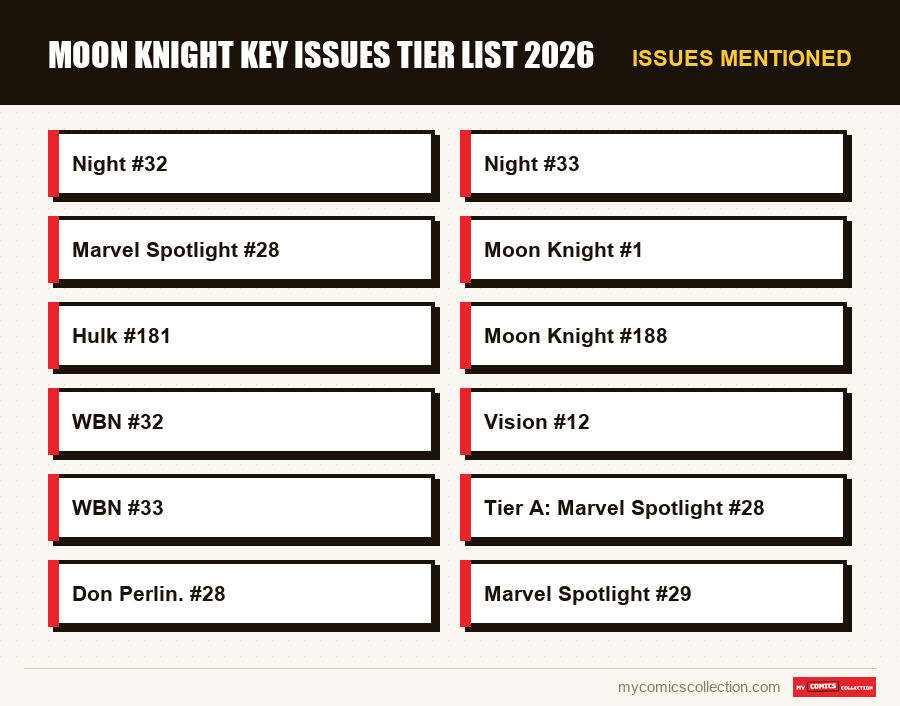
Tier S: Werewolf by Night #32, #33, Moon Knight Volume 1 #1, Moon Knight #188
The Tier S Moon Knight concentrates four central references, each valued by a first-order historical status. This tier represents 70% of the recommended asset allocation for a serious Moon Knight collector, and constitutes the basis of any investor portfolio on the character.
Werewolf by Night #32 (cover August 1975, newsstand release May 1975). First full appearance of Moon Knight, screenplay Doug Moench, art Don Perlin, cover Gil Kane. The character is introduced as a white-suited mercenary hired by a group called The Committee to capture Jack Russell. The introductory sequence occupies pages 7-17 of the issue, which constitutes a full first appearance in the CGC sense. The cover shows Moon Knight in action against Werewolf, which maximizes the visual value of the copy and collector's readability. Heritage Auctions price April 2026: CGC 9.8 (17 census copies) between $18,000 and $24,500 over the six documented sales 2025-2026. CGC 9.6 (89 copies) between $5,200 and $7,800. CGC 9.4 (251 copies) between $2,800 and $3,800. CGC 9.2 between $1,600 and $2,200. CGC 8.5 between $950 and $1,350. CGC 7.0 between 480 and 680 dollars. Raw VF 8.0 between 380 and 520 dollars depending on visual quality. This reference is the centerpiece of any Moon Knight collection and remains liquid at all grades above 7.0. See story Werewolf by Night comics for the context of the title holder.
Werewolf by Night #33 (cover September 1975). Second appearance of Moon Knight, finale of the two-part arc with Doug Moench writing the script and Don Perlin drawing. The issue contains the resolution of the Moon Knight vs Werewolf conflict and plants the seeds of Moon Knight's defection against The Committee, which will justify the transition to solo hero. The rarity is slightly higher than #32 on high grades (60 copies CGC 9.6, 11 copies CGC 9.8 at the April 2026 census), but the "second appearance" premium remains structurally lower than that of #32 in a ratio 4 to 6 times. Heritage Auctions price April 2026: CGC 9.8 between $3,800 and $5,500. CGC 9.6 between $1,200 and $1,850. CGC 9.4 between 580 and 850 dollars. CGC 9.2 between 340 and 480 dollars. CGC 8.5 between 180 and 260 dollars. CGC 7.0 between 90 and 140 dollars. Raw VF between 60 and 95 dollars. This reference is the almost obligatory complement to #32 for a coherent collection, with a price ratio which often makes it the most relevant quality/budget asymmetry in the Tier S Moon Knight segment.
Moon Knight Volume 1 #1 (cover November 1980). First issue of the first regular series Moon Knight, script Doug Moench, art and cover Bill Sienkiewicz. The issue rewrites the original Marc Spector as a veteran mercenary executed at the foot of a statue of Khonshu, resurrected by the Egyptian moon god and chosen as his avatar. This origin becomes the definitive narrative matrix for all subsequent iterations, including the Disney+ Oscar Isaac series. The Moench/Sienkiewicz run (#1 to #30) is recognized as one of the late Bronze Age graphic peaks, with a documented creative bounty over the first six issues. Heritage Auctions price April 2026: CGC 9.8 (327 copies in the census, more distributed than WBN #32 thanks to the smaller print run which is already rare in high grade) between 1,200 and 1,800 dollars. CGC 9.6 between 480 and 720 dollars. CGC 9.4 between 260 and 380 dollars. CGC 9.2 between 160 and 240 dollars. CGC 8.5 between 95 and 140 dollars. Raw VF/NM between 65 and 110 dollars. The direct edition (Whitman variant) commands a premium of 30 to 80% on the newsstand. This reference is the second cornerstone of a Moon Knight collection and remains the most liquid in absolute value with 134 CGC sales documented over 12 months. See Khonshu comics story for the theological context introduced in this issue.
Moon Knight Volume 4 #188 (cover October 2017). Last issue of the Jeff Lemire (screenplay) and Greg Smallwood (drawing and cover) arc, final of the 2016-2017 signature run which redefined the modern reading of the character. The Lemire/Smallwood run explores Marc Spector's dissociative disorders via a fragmented narrative structure, and #188 (renumbered from #14 of the Lemire series) closes the Egypt arc and launches the narrative bases used in the Disney+ 2022 mini-series. The issue is regularly cited by critics (CBR, ComicBook.com) as one of the best Moon Knight single issues in history. CovrPrice April 2026: CGC 9.8 (412 copies at census) between 95 and 145 dollars. CGC 9.6 between 45 and 65 dollars. Raw NM between 18 and 28 dollars depending on the cover (standard A Smallwood cover, Sienkiewicz tribute variants at 30-60 dollars raw NM). This reference is the bridge between the pre-MCU era and the post-Disney+ era, and remains underpriced on the Lemire/Smallwood creative premium relative to its comparables (Vision #12 Tom King 2017 = 75-110 dollars CGC 9.8). For details of the major arcs, see key issues Moon Knight.
The optimal Tier S allocation combines these four references in proportions calibrated according to the total budget. On a Moon Knight heritage budget of 10,000 euros, aim for 1 WBN #32 CGC 7.0 ($680), 1 WBN #33 CGC 9.2 ($480), 1 Moon Knight Volume 1 #1 CGC 9.4 ($380), 1 Moon Knight #188 CGC 9.8 ($145). This basket of 1,685 dollars constitutes the base. The rest of the budget is reallocated to Tier A and Tier B. On a budget of 25,000 euros, increase each reference by one notch (WBN #32 CGC 9.2, etc.) for a base envelope of 5,200 dollars. For tactical purchasing strategy, see comics investment update 2027.
Tier A: Marvel Spotlight #28-29, Moon Knight Volume 1 #4, Moon Knight Volume 4 #1 Ellis
Tier A concentrates the narrative and creative pillars which complement Tier S without replacing it. These references combine second-tier historical status (first solo, first appearance of a major secondary character, first issue of a signature run) with documented liquidity and limited resale risk. Tier A represents 20% of the recommended Moon Knight heirloom allocation and offers the most relevant upside/budget ratio for intermediate collectors.
Marvel Spotlight #28 and #29 (June and August 1976 covers). First solo story Moon Knight as backup, screenplay Doug Moench, drawing Don Perlin. #28 introduces Marc Spector as the main protagonist for the first time and lays the groundwork for the resurrected Khonshu origin, which would be expanded upon in Volume 1 #1 of 1980. #29 contains the second part of the single-player story. These two numbers are structurally undervalued compared to their historical status. Heritage Auctions price April 2026, Marvel Spotlight #28: CGC 9.6 between $380 and $580. CGC 9.4 between 220 and 320 dollars. CGC 9.2 between 140 and 200 dollars. CGC 8.5 between 80 and 120 dollars. Raw VF between 38 and 58 dollars. Marvel Spotlight #29 commands a 30-40% lower rating despite the comparable rarity. These two references constitute a documented Tier A sleeper and the most relevant rarity/price ratio in the Bronze Age Moon Knight segment. The main risk is potential confusion with other Marvel Spotlights (Werewolf by Night spotlight #2-4, Ghost Rider spotlight #5) which share the same anthology series. Check the precise number before purchasing.
Moon Knight Volume 1 #4 (cover February 1981). First appearance of Midnight Man (Anton Mogart), recurring antagonist and secondary icon of the Moon Knight mythology. Screenplay Doug Moench, art and cover Bill Sienkiewicz. Midnight Man is positioned as a black mirror of Moon Knight (mercenary-thief with black suit), which makes him a strong narrative opposition resurrected regularly (notably in the 2011 Brian Wood run and the 2021 MacKay series). The MCU spec Midnight Man remains latent: no official announcement, but the character appears on the spec call lists published by ComicBook.com and CBR for season 2 Disney+. CovrPrice April 2026: CGC 9.8 (114 copies at census) between 480 and 720 dollars. CGC 9.6 between 180 and 280 dollars. CGC 9.4 between 95 and 145 dollars. CGC 9.2 between 55 and 85 dollars. Raw NM between $28 and $45. This reference is a documented Tier A sleeper with upside spec over 12-24 months if season 2 Disney+ confirms Midnight Man in the cast.
Moon Knight Volume 4 #1 (cover June 2014). First issue of the reboot Warren Ellis (screenplay) and Declan Shalvey (art and cover). The Ellis/Shalvey run (#1 to #6) is widely recognized as the modern definition of the character and directly inspired the 2022 Disney+ Oscar Isaac miniseries (the white three-pointed suit used in the series is from the Shalvey design). #1 opens the Mr Knight arc and sets up the "consulting detective for the New York Police Department" version which becomes the dominant post-2014 narrative grammar. The run remains one of the most recommended entry points for new readers and concentrates a documented creative bounty. CovrPrice April 2026: CGC 9.8 (267 copies in census) between 180 and 280 dollars (cover A Shalvey). CGC 9.6 between 75 and 110 dollars. Raw NM between 22 and 35 dollars cover A. The 1:50 Travel Foreman variant is valued between 380 and 580 dollars CGC 9.8. The 1:25 Skottie Young variant between 140 and 220 dollars CGC 9.8. This reference is the cornerstone of any modern Moon Knight collection and remains underpriced on the Ellis creative premium relative to its comparables (Moon Knight Lemire Volume 4 old issue #1 = 35-50 dollars CGC 9.8).
The optimal Tier A allocation combines these three axes (Marvel Spotlight #28-29, Moon Knight Vol 1 #4 Midnight Man, Moon Knight Vol 4 #1 Ellis) in a budget envelope of $800 to $2,500 depending on the targeted ratings. For an overall Moon Knight budget of 10,000 euros, aiming for $2,000 in Tier A represents the ratio 20% of the allocation. For 25,000 euros, go up to 5,000 dollars and include the 1:25 Ellis variants. The Tier A resale strategy is more tactical than Tier S: these references move with the MCU season 2 announcements and can be arbitrated over 6-12 month windows.
Tier B sleepers: Moon Knight Volume 2 #1, Volume 5 #1 Moench return, Vengeance #1
Tier B concentrates documented sleepers, that is to say references whose current valuation does not fully reflect their narrative, creative or spec potential over 24-60 months. These issues are suitable for intermediate collectors who want to diversify beyond the Tier S/A base, and for investors who are looking for low-budget entry points ($50-300 per reference). Tier B represents 7 to 10% of the Moon Knight wealth allocation depending on the profile.
Moon Knight Volume 2 #1 (cover June 1985), Fist of Khonshu. First issue of the second regular series Moon Knight, script Alan Zelenetz, art Chris Warner, cover Bill Sienkiewicz. The issue relaunches the character after the end of Volume 1 and introduces the expanded Khonshu mythology: Marc Spector officially receives the title "Fist of Khonshu" and the run explores the religious counterpart of the character with an assumed mystical tone. This short volume (#1 to #6) has remained under the collector radar for 30 years despite its pivotal role in mythology. CovrPrice April 2026: CGC 9.8 (78 copies in census) between 240 and 360 dollars. CGC 9.6 between 95 and 145 dollars. CGC 9.4 between 55 and 85 dollars. Raw NM between $18 and $28. This reference is a documented sleeper, with potential upside if season 2 Disney+ develops the Fist of Khonshu dimension (recurring CBR and ComicBook.com rumor at the end of 2025).
Moon Knight Volume 5 #1 (cover March 2006), returning Doug Moench (Charlie Huston). Important note: Volume 5 #1 from 2006 is NOT written by Doug Moench but by Charlie Huston, with art by David Finch. The Huston/Finch run is nevertheless considered a Moench-esque return to basics and commercially revived the character after a decade of isolated back issues. #1 opens The Bottom arc and redefines Marc Spector as a traumatized veteran, a position which will then be taken up by Ellis (2014) and Lemire (2016). CovrPrice April 2026: CGC 9.8 (189 copies in census) between 95 and 145 dollars. CGC 9.6 between 38 and 58 dollars. Raw NM between $12 and $22. This reference is underpriced on the Finch creative premium relative to its comparables (New Avengers Finch 2005 #1 = 80-120 dollars CGC 9.8). The Olivetti variant and the Finch sketch variant command a premium of 50 to 120% CGC 9.8.
Vengeance of Moon Knight #1 (cover November 2009). First issue of the Vengeance of Moon Knight series, script Gregg Hurwitz, art Jerome Opena, cover Leinil Yu. The issue relaunches the character in a post-Dark Reign Marvel context and sets up Marc Spector's return arc after the events of The List. The series was a short-lived critical success (#1 to #10) and a recommended entry point for readers who want an immediate sequel to Volume 5 Huston/Finch. CovrPrice April 2026: CGC 9.8 (134 copies at the census) between 75 and 115 dollars cover A. CGC 9.6 between 28 and 45 dollars. Raw NM between $8 and $14. The Tan 1:25 variant goes up to $280-380 CGC 9.8. The Yu black and white sketch variant at 180-260 dollars CGC 9.8. This reference is an accessible budget sleeper and offers a great entry point for new Moon Knight collectors.
Three complementary Tier B sleepers to mention. Marvel Premiere #4 (1972, resurrected as early Moon Knight influence by some analyses, status disputed). Hulk Magazine #11-15 (1978-1979, early Moon Knight black and white magazine stories, undercut at $40-95 raw VF). Moon Knight Special Edition #1 (1983, deluxe reprint of #1 ongoing with unpublished cover Sienkiewicz, underpriced at 95-145 dollars CGC 9.8). These three supplements are suitable for advanced collectors who want maximum completeness on Bronze Age early appearances and revivals. For beginner collection details, see our guide Moon Knight key numbers.
Tier C spec 2026-2027: MCU Moon Knight Season 2 Disney+ and Khonshu integration
Tier C concentrates pure speculative bets, that is to say references whose current valuation is conditional on an uncertain future event (casting announcement, release of a trailer, confirmed MCU integration). These outcomes are suitable for investors who accept a binary resale risk: the reference doubles or triples in the event of MCU confirmation, or stagnates at the entry value in the event of no announcement. Tier C represents a maximum of 3 to 5% of the Moon Knight asset allocation and should never constitute the basis of a portfolio.
First spec axis 2026-2027: season 2 Moon Knight Disney+. Marvel Studios teased in November 2025 (via Brad Winderbaum on the Marvel This Week podcast) a sequel to the 2022 Oscar Isaac miniseries, with no confirmed release date. The Hollywood Reporter and Deadline leaks suggest filming in Q3 2026 and a release in 2027. The key issues to aim for in this context. Moon Knight Volume 1 #1 (covered Tier S) remains the main beneficiary. Moon Knight Volume 1 #4 (covered Tier A, first Midnight Man). Moon Knight Volume 4 #1 (covered Tier A, Ellis Mr Knight). Moon Knight Volume 6 #1 (cover July 2021, Jed MacKay script, Alessandro Cappuccio drawing, first MacKay run referenced in the Disney+ series) remains underpriced at 35-58 dollars CGC 9.8 (cover A) and constitutes the most accessible short-term spec bet.
Second spec axis: Khonshu integration in a post-Doomsday Avengers phase. Marvel Studios has not confirmed Khonshu as a cosmic player in Phase 7, but several converging clues (Kevin Feige interviews, Costume Designers Guild leaks) suggest that a Khonshu-Galactus-Doom crossover is under discussion for 2028-2029. The key issues to aim for. Moon Knight Volume 1 #1 (canonical Khonshu origin). Thor #300 (1980, first expanded Khonshu appearance as backup, underpriced at $60-95 CGC 9.8). Moon Knight Volume 5 #1 (Huston Khonshu run). Moon Knight Annual #1 (1985, first expanded Khonshu mythology exploration). These references constitute a coherent Khonshu spec basket with a contained budget (250-450 dollars for the whole in CGC 9.6+).
Third axis spec: the MCU multiverse crossovers Moon Knight. The post-Doomsday phase (2027-2029) could integrate Moon Knight into a Midnight Sons team (recurring CBR rumor since 2023). The key issues to aim for. Marvel Midnight Sons #1 (1992, first Midnight Sons team-up but without Moon Knight). Moon Knight Volume 3 #1 (1998, Beau Smith script, short series 4 issues but cult). Moon Knight Volume 7 #1 (March 2024 cover, Jed MacKay relaunch) undercut at $18-32 CGC 9.8 and is the most accessible spec bet if Midnight Sons MCU is confirmed. The arbitrage logic remains contrarian: buy in the hollow windows between two MCU rumors, sell in the post-official announcement windows. For the overall spec strategy, see marvels post Secret Invasion spec calls.
Tier C spec warning. Any Tier C reference remains at risk of reselling at a loss if the anticipated MCU event does not materialize. Never allocate more than 5% of your total Moon Knight budget to Tier C, and always diversify between 3-5 different spec bets to limit binary risk. Tier C is only justified for investors with a 24-48 month horizon and tolerance for the risk of prolonged stagnation. For the full portfolio, see pillar 2027 strategy.
Collecting this series?
Track what you own, what you are missing and what your collection is worth. 7 day trial.
Start my trial →Strategy by budget: 1000, 5000, 15000, 50000 euros on Moon Knight
The Moon Knight allocation per tier varies depending on the total budget available. Four budget profiles cover the majority of practical cases, from the beginner collector to the wealth investor. Each profile includes a 10% leeway for transaction fees (marketplace commission 13%, Heritage fee 20%, CGC fee $35 to $150, international shipping $25 to $65 depending on insurance).
Budget 1,000 euros (beginner profile). Allocation 60% Tier S, 30% Tier A, 10% Tier B, 0% Tier C. Typical basket: 1 WBN #32 CGC 5.0 ($280-380) or 1 WBN #33 CGC 8.5 ($220-280), 1 Moon Knight Volume 1 #1 raw VF ($75-110), 1 Moon Knight #188 raw NM cover A (18-28 dollars), 1 Marvel Spotlight #28 raw VF (38-58 dollars), 1 Moon Knight Vol 4 #1 raw NM Ellis (22-35 dollars), 1 Vengeance of Moon Knight #1 raw NM (8-14 dollars). Total basket around 660-900 dollars depending on the scores obtained. The remaining margin covers shipping and protection costs (Mylar boxes, backing boards). This beginner basket constitutes a real coherent collection, readable for partial resale, and physically exhibitable (under-protected envelope). See comics manager complete guide for inventory tracking.
Budget 5,000 euros (intermediate profile). Allocation 65% Tier S, 25% Tier A, 8% Tier B, 2% Tier C. Typical basket: 1 WBN #32 CGC 8.0 ($650-850), 1 WBN #33 CGC 9.2 ($340-480), 1 Moon Knight Volume 1 #1 CGC 9.4 ($260-380), 1 Moon Knight #188 CGC 9.8 cover A ($95-145), Marvel Spotlight #28-29 raw VF/NM ($95-160 for both), Moon Knight Vol 1 #4 CGC 9.4 Midnight Man ($95-145), Moon Knight Vol 4 #1 CGC 9.8 cover A Ellis ($180-280), Moon Knight Vol 2 #1 raw NM ($18-28), Vengeance of Moon Knight #1 CGC 9.8 (75-115 dollars), Moon Knight Vol 6 #1 raw NM MacKay (8-14 dollars) for Tier C. Total basket around 1,800-2,800 dollars in dominant CGC. The remaining margin covers 2 to 3 opportunistic upgrades over the next 12 months. This intermediate basket covers all central references and constitutes a sustainable asset base.
Budget 15,000 euros (advanced collector profile). Allocation 70% Tier S, 20% Tier A, 7% Tier B, 3% Tier C. Typical basket: 1 WBN #32 CGC 9.0 ($1,600-2,200), 1 WBN #33 CGC 9.6 ($1,200-1,850), 1 Moon Knight Volume 1 #1 CGC 9.6 ($480-720), 1 Moon Knight #188 CGC 9.8 + 1 Sienkiewicz tribute variant ($140-205), 1 Marvel Spotlight #28 CGC 9.4 + 1 Marvel Spotlight #29 CGC 9.2 ($300-420), 1 Moon Knight Vol 1 #4 CGC 9.6 ($180-280), 1 Moon Knight Vol 4 #1 CGC 9.8 cover A + 1 variant 1:25 Young (320-500 dollars), 1 Moon Knight Vol 2 #1 CGC 9.6 (95-145 dollars), 1 Moon Knight Vol 5 #1 CGC 9.8 Huston (95-145 dollars), 1 Vengeance of Moon Knight #1 CGC 9.8 + variant Yu sketch (255-375 dollars), Tier C diversified 5 references budget 350-450 dollars. Total basket approximately 5,015-7,295 dollars. The remaining margin covers opportunistic purchasing on Heritage sales, CGC grading of raw parts obtained at low prices, and the creation of a cash reserve for opportunities at the end of 2026 (traditional Heritage end-of-year sale).
Budget 50,000 euros (asset investor profile). Allocation 75% Tier S, 15% Tier A, 5% Tier B, 5% Tier C. Typical basket: 1 WBN #32 CGC 9.4 ($2,800-3,800), 1 WBN #33 CGC 9.8 ($3,800-5,500), 1 Moon Knight Volume 1 #1 CGC 9.8 ($1,200-1,800), 2 copies Moon Knight #188 including 1 CGC 9.8 + 1 Sienkiewicz variant tribute CGC 9.8, completeness Marvel Spotlight #28-29 in CGC 9.6, complete Tier A basket in CGC 9.6+ with variants, exhaustive Tier B basket in CGC 9.8 with Olivetti and Yu sketch variants, Tier C diversified 8 references with 1 Moon Knight Vol 6 #1 variant 1:50 and 1 Moon Knight Vol 7 #1 variant Cappuccio. Total basket around 15,000-22,000 dollars on the CGC base alone. The remaining margin ($28,000-35,000) covers a second line of opportunistic purchases over 18-24 months, the creation of a complete mini-collection of the Moench/Sienkiewicz Volume 1 #1 to #6 run in CGC 9.6+, and a cash reserve of $10,000 to take advantage of Heritage signature catalog sales.
Transversal allocation rule: never immobilize more than 5% of the total net assets on comics, and never devote more than 25% of the total comics budget to a single character (except assumed heritage collection). Moon Knight remains a niche character compared to Spider-Man or Batman, and excess concentration penalizes resale liquidity over a short time horizon. See comics catalog et key issues comics to expand the allocation.
Moon Knight Traps: WBN #32 Mark Spector cameo, restored copies, false variants
The Moon Knight market presents five recurring pitfalls that penalize first-time buyers. These pitfalls are documented on the CGC Forums (CGC Comics Forum, Boards 2024-2026) and in Heritage Auctions incident reports. Knowing them avoids discounts of 30 to 80% on future resale.
Trap 1: confusion Werewolf by Night #32 versus #31 (Mark Spector cameo). Several eBay sellers list Werewolf by Night #31 (July 1975 cover) as a "first Moon Knight cameo", based on the presence of a character named "Mark Spector" in a panel late in the issue. This character does not wear the Moon Knight costume and is not recognized by CGC, GoCollect or Overstreet as an official cameo. The "1st cameo Moon Knight" status sometimes belongs (according to certain disputed sources) to #31, but the market valuation remains structurally lower than #32. Buying #31 as a Moon Knight cameo at a price close to #32 is a $200-$400 mistake depending on the ratings. It is essential to check the CGC label mention before purchasing high grade: only "1st full appearance Moon Knight" on #32 is valued by the market.
Trap 2: undeclared high grade restored copies. Werewolf by Night #32 and Moon Knight Volume 1 #1 are among the most restored Bronze Age references on the market, due to the fragility of the 1975-1980 newsprint and the value drawn on the high notes. CGC distinguishes three labels: Universal (no restoration), Restored (restoration declared with 40-70% discount), Qualified (defect reported without full discount). Check the CGC label before any purchase above $1,000, and prefer recently graded copies (slabs 2022-2026) with high-resolution photos covering all four corners, the spine and the thickness. The classic trap is to buy a Restored 9.4 at the price of a Universal 8.5, representing a resale loss of 60 to 80% compared to the price paid.
Trap 3: false variants Moon Knight Volume 4 #1 Ellis 2014. The 2024-2026 eBay marketplace saw several fake Moon Knight Volume 4 #1 variants listed as "1:200 retailer exclusive" or "Diamond Premiere" which never officially existed. The only authentic variants are: cover A Shalvey standard, variant 1:50 Travel Foreman, variant 1:25 Skottie Young, variant Marvel Comics Subscription, variant Phantom Variant Edition (very rare, 250 copies). Any other variant should be treated with suspicion and cross-referenced with the ComicVine and CGC Census database. The risk of reselling at a loss on a false variant is total: the premium paid evaporates into 100% of the delta vs cover A.
Trap 4: confusion Moon Knight Volume 4 #188 versus #14 or #200. Marvel renumbered Volume 4 Lemire/Smallwood during the run (#188 is a legacy numbering which corresponds to #14 in the series). Several eBay sellers list #14 as #188 (true) or vice versa, and some listings confuse it with Volume 4 #200 (July 2018 cover, post-Lemire Max Bemis run). The #200 is significantly less valued than the #188 despite the “milestone numbering” status. Check the cover (Smallwood for #188 with Egypt characters) and the release month (October 2017) before purchasing. The price difference can reach 100 CGC 9.8 dollars between standard #188 and #14 (same physical number but different labels valued differently depending on CGC).
Trap 5: CGC 9.8 grading on recently pressed copies. CGC pressing involves reformatting a copy to gain 0.2 to 0.6 rating points. Pressing is legal and not declared on the label, but an excessively pressed copy loses tactile quality and risks market devaluation in the medium term (recurring rumor Reddit r/comicbookcollecting at the end of 2025 about a potential evolution of CGC pressing declaration). For Tier S purchases above $1,500, favor copies graded before 2020 (older blue slabs) with no known pressing history, or request a certificate from the seller. The resale trap: paying a 9.8 pressed at the price of a 9.8 native, while the final buyer will be able to invoke doubt to negotiate 15 to 30% downward. For the resale strategy, see daredevil tier list key issues 2026 et punisher tier list key issues 2026 which share a similar grid.
Sixth bonus trap to be aware of: unacknowledged reprints. Moon Knight Volume 1 #1 and Marvel Spotlight #28 were the subject of Marvel Tales and Essential Moon Knight reprints between 1995 and 2010. The covers are visually similar but the publisher names and barcodes differ. Never buy in raw without a photo of the indicia (inner page with copyright date and edition number). The reflex: check the postal code "(c) 1980 Marvel Comics Group" for Volume 1 #1 and the absence of "Reprint" on the cover. See the guide free estimate to have a reference checked before purchase.
Monitoring 2026-2030: seasonal checkpoints and MCU signals to monitor
A Moon Knight Tier S/A/B/C collection is not built in a quarter, nor can it be left to lie dormant for five years without follow-up. The Bronze Age and Modern market evolves in short cycles (3-12 months) based on MCU announcements, quarterly Heritage signature sales, and the purchasing seasons of new collectors (October-December, March-May). Optimal monitoring is based on four seasonal checkpoints and five MCU signals to be continuously monitored.
First quarterly checkpoint (January-March): analysis of Heritage Auctions sales from the previous fourth quarter. Signature Heritage reports published in January-February contain high-end sales from November-December (typically the most liquid of the year). Cross-reference the prices realized with the CovrPrice and GoCollect estimates to identify anomalies. If Werewolf by Night #32 CGC 9.4 systematically achieves 15% above the rating displayed over three consecutive sales, a buy signal on the lower ratings (9.2, 9.0, 8.5) which will catch up within 6-9 months.
Second quarterly checkpoint (April-June): collection audit with tactical rebalancing. Take out the complete inventory, cross-reference it with the updated odds, identify the references which have outperformed (partial sale to realize a capital gain) and the references which have underperformed (rebalancing by additional purchase if the thesis remains valid). On Moon Knight, the recommended pivot: if Tier S exceeds 80% of the total portfolio after valuation, sell an overvalued Tier S reference and buy in Tier A to rebalance. The 70/20/8/2 rule must remain observed within 5% of market value.
Third quarterly checkpoint (July-September): monitoring of SDCC San Diego Comic-Con (July) and NYCC New York Comic-Con (October) announcements. These two shows concentrate 70% of Marvel Studios casting and calendar announcements for the following 18 months. On Moon Knight Disney+ season 2, watch the Marvel Studios SDCC panels and Hollywood Reporter/Deadline leaks 48 hours pre and post-event. Buy Tier C in the low window of 4-6 weeks before SDCC, sell in the bullish window of 4-12 weeks after official announcement.
Fourth quarterly checkpoint (October-December): preparation of the annual French tax declaration. Beyond 5,000 euros per year of capital gains on movable property, the declaration falls under the specific regime. Keeping a purchase-resale journal with dates, prices, costs, and reference numbers allows you to justify the amounts in the event of an inspection. For details, see our dedicated tax guide. The end of the year is also the time for the Heritage signature sales in December (typically the busiest) and for purchasing opportunities on collector lots that become available (inheritance, clearance).
Five MCU signals to continuously monitor on Moon Knight. One: official confirmation of Disney+ season 2 filming (anticipated effect +20 to +50% on Moon Knight Volume 1 #1 and Volume 4 #1 within 4-8 weeks). Two: casting announcement of a major antagonist (Midnight Man, Bushman, Stained Glass Scarlet) for season 2, anticipated effect +60 to +150% on the first appearance concerned. Three: release of an official Disney+ season 2 trailer (+15 to +35% effect on the entire Moon Knight Tier S/A basket within 2-4 weeks). Four: Khonshu confirmation in a post-Doomsday Avengers calendar (effect +30 to +80% on Moon Knight Volume 1 #1 and Thor #300 within 8-16 weeks). Five: announces Midnight Sons MCU film or series (+100 to +300% effect on Moon Knight Volume 7 #1 MacKay and Marvel Midnight Sons #1 within 4-12 weeks).
The watching itself stays in your hands: news sites and the convention panels give you the signals. What the Comics Manager tool handles is the inventory side, with an estimated value for each Moon Knight issue drawn from eBay listings, the total value of the collection and its history over time. Tags or custom collections let you mark each tier (S, A, B, C), and the rebalancing remains a decision you take at each quarterly checkpoint. See comics manager complete guide for handling.
By 2030, the Moon Knight collection constituted according to this tier list grid should appreciate moderately in the absence of a major MCU event (estimate +30 to +60% in the Tier S segment over 4 years), and significantly in the event of a successful Disney+ season 2 (+60 to +150% in the Tier S segment over 4 years). The Tier A bet (Ellis Volume 4 #1, Lemire #188) remains the most asymmetric: underpriced in 2026, linked to a recognized run, and positively exposed to the two MCU scenarios. The Tier S bet Werewolf by Night #32 remains the heritage base: it is appreciated independently of the MCU on the high-grade objective rarity and the structural Bronze Age premium. For the general 2030 collector strategy, see our pillar 2027 strategy.
FAQ: Tier list Moon Knight key issues 2026
What is the number one Moon Knight issue to buy on a budget?
With a budget of less than $500, aim for Werewolf by Night #33 (September 1975 cover, second Moon Knight appearance) in CGC 8.5 or 9.0 between $180 and $340. This reference offers the most relevant historical status/budget ratio: it is Tier S on the ranking grid, shares the same creative team as #32 (Doug Moench and Don Perlin), and remains 4 to 6 times less expensive than #32 with an equivalent rating. The natural complement at 500-800 additional dollars: Moon Knight Volume 1 #1 (November 1980) in CGC 9.0 or 9.2, first issue of the ongoing with Bill Sienkiewicz, around 150-240 dollars. See key issues Moon Knight for the full list.
Is Werewolf by Night #32 really worth its blue-chip Tier S price?
Yes, on three fundamentals. First: indisputable historical status of first complete appearance Moon Knight, validated by CGC, GoCollect and Overstreet without dispute since 1990. Second: high grade objective rarity with only 89 CGC 9.6 copies and 17 CGC 9.8 copies in the April 2026 census, out of 4,247 graded copies total. Third: Documented liquidity with 87 CGC sales over 12 months (April 2025-April 2026). The reference combines Bronze Age status, high-grade rarity, and intermittent MCU exposure (Disney+ mini-series 2022, season 2 teased 2025). The current CGC 9.4 price ($2,800-3,800) reflects these three pillars and remains below the trajectory of a comparable Hulk #181.
Is it better to buy Moon Knight Volume 1 #1 newsstand or direct edition?
The direct edition (Whitman) commands a premium of 30 to 80% over the newsstand in high grade CGC 9.6+, on a basis of differential rarity confirmed by CGC Census (approximately 1 direct copy for 4 newsstand copies on high grades). For a heritage buyer or investor, aim for the direct edition CGC 9.4 or 9.6 if the budget allows the premium. For a collector buyer, the newsstand remains fully valid and offers a better price/note ratio for a contained budget. The CGC label distinctly mentions "Direct Edition" or "Newsstand Edition" since 2018: cross-reference the purchase with this mention.
Will the Lemire/Smallwood Volume 4 #188 run continue to rise?
Likely over a 24-48 month horizon, based on three converging logics. First: the Lemire/Smallwood run remains critically recognized (CBR, ComicBook.com, Polygon) as a modern Moon Knight creative peak and directly inspired the 2022 Disney+ Oscar Isaac miniseries. Second: Current CGC rating 9.8 ($95-145 cover A) remains underrated compared to comparable Vision #12 King 2017 ($75-110) and Mister Miracle #1 King 2017 ($180-280) which share comparable narrative status. Third: the Disney+ season 2 spec exhibition focuses directly on the Lemire arcs (dissociative disorders, Khonshu mythology). The risk decreases: Smallwood estate not pursued (unlikely, the artist remains active). The risk increases: rise towards 200-280 dollars CGC 9.8 within 18-30 months if season 2 is confirmed.
How long does it take to resell a Moon Knight Tier S collection?
For the Tier S Moon Knight segment (WBN #32, #33, Vol 1 #1, #188), the median resale time on Heritage Auctions is 8 to 16 weeks from consignment to seller payment, on CGC 9.0+ grades. On high-end eBay with minimum prices, the median time is 2 to 8 weeks depending on the rating and the discount accepted compared to the asking price. Moon Knight liquidity is lower than that of a comparable Spider-Man or Batman (typically 30-50% less liquid), but remains significantly higher than that of a second-tier Bronze Age character (Iron Fist, Ghost Rider Daniel Ketch, Cloak and Dagger). For the complete resale strategy, see pillar 2027 strategy.