La tier list Punisher 2026 places four pieces in Tier S blue-chip: Amazing Spider-Man #129 (February 1974, Gerry Conway/Ross Andru, first appearance Frank Castle), Punisher Limited Series #1 (January 1986, Steven Grant/Mike Zeck, first five-issue solo miniseries), Punisher Vol 2 #1 (July 1987, Mike Baron/Klaus Janson, first ongoing monthly series) and Punisher MAX #1 (March 2004, Garth Ennis/Lewis Larosa, definitive adult run). Tier A includes Marvel Preview #2 (November 1975, Archie Goodwin/Tony DeZuniga, first solo origin story), Punisher War Journal #1 (November 1988, Carl Potts/Jim Lee) and Punisher Vol 4 #1 (May 2000, Welcome Back Frank by Garth Ennis/Steve Dillon). Tier B aligns the sleepers Bushwacker, War Zone and Frankencastle. Tier C covers the MCU 2026-2027 spec around Daredevil Born Again.
The white skull on a black background remains, more than fifty years after its creation, one of the most recognizable silhouettes in the Marvel ecosystem. Frank Castle has survived every editorial cycle, every numbered relaunch, every political controversy, and he continues to drive a speculative market distinct from that of classic superheroes. This tier list Punisher key issues 2026 aims to prioritize the pieces according to rarity-demand-budget, taking into account the MCU resurgence announced for Daredevil Born Again (season 1 in 2025, season 2 planned for spring 2027) and persistent rumors around an extended Jon Bernthal casting. The Punisher market behaves differently from the Spider-Man or Batman market: fewer variants, fewer marketing relaunchs, but a very loyal collector base which supports the odds even during low periods.
The methodology follows the same grid as the blog's other tier lists: Tier S for the central blue-chip pieces (first canonical appearance, first solo, founding mini-series, definitive run), Tier A for the major key issues often neglected but essential, Tier B for the sleepers which combine rarity and latent narrative catalyst, Tier C for spec bets linked to film and series announcements. Each tier mentions the price ranges observed in May 2026 on the Heritage Auctions, GoCollect and eBay sold listings databases, and specifies the pitfalls specific to the Punisher (newsstand vs direct edition, multiple #1 relaunch, embossed covers from the 90s). This tier list is a spoke of the cluster strategy pillar comics investment 2027.
Punisher 2026 tier list methodology
The Punisher tier list is based on four weighted criteria. The first is the narrative significance: a first canonical appearance weighs more than an anniversary issue, a first solo weighs more than a crossover guest spot. The second is the objective rarity measured by the CGC census: a comic with less than 500 copies in CGC 9.6 or higher falls into the rare category, which justifies a higher third even for less emblematic issues. The third is the market demand evaluated by quarterly eBay transaction volume and bid-ask ratio on ComicConnect. The fourth is the future catalyst, which covers movie announcements, Disney+ series, editorial events and round anniversaries.
The weighting differs depending on the tier targeted. For Tier S, narrative significance accounts for 40% of the decision, rarity for 25%, demand for 25%, catalyst for 10%. A Tier S part must check three of the four criteria at the maximum level. For Tier A, the weighting is balanced around 30% each, with a tolerance on the catalyst. For Tier B, the catalyst rises to 35% because the sleeper logic is based on an expected asymmetry. For Tier C, the catalyst rises to 50%: it is a pure spec bet whose current intrinsic value is low but whose revaluation potential depends on future events.
The Punisher market presents a specificity compared to Spider-Man or X-Men: the multiple numbered relaunchs make it difficult to read #1. Marvel has released at least seven different series titled Punisher #1 between 1986 and 2022, not counting mini-series, annuals and variants. This editorial inflation has created lasting confusion among beginning collectors, who sometimes buy modern #1s without spec value thinking of acquiring a key issue. The discipline consists of distinguishing the founders (1986, 1987, 1988, 2000, 2004)marketing wrap (2009 partially, 2011, 2014, 2016, 2018, 2022).
A second specificity concerns the perceptual variability Punisher according to the times. During the 90s, the character was over-exposed (up to four monthly titles in 1992-1993), which saturated the supply and crushed the ratings of the secondary key issues of this period. During the 2000s, Garth Ennis reinvented him as an ultra-violent adult character, which paved the way for the modern Tier S (Punisher MAX). Since 2018, the public perception of the character has been regularly tainted by his political recovery, which creates cycles of demand sensitive to news. These oscillations make diversification between third parties major.
The grid finally takes into account the MCU Resurgence 2025-2027. Jon Bernthal, already Frank Castle in the 2017-2019 Netflix series, is confirmed in Daredevil Born Again season 1 (March 2025) with an extended role in season 2 (spring 2027). This Disney+ integration activates a measured spec catalyst, more modest than the Avengers MCU boost but lasting. For the complete prioritization method, see Punisher key numbers et key issues Punisher which detail each number individually.
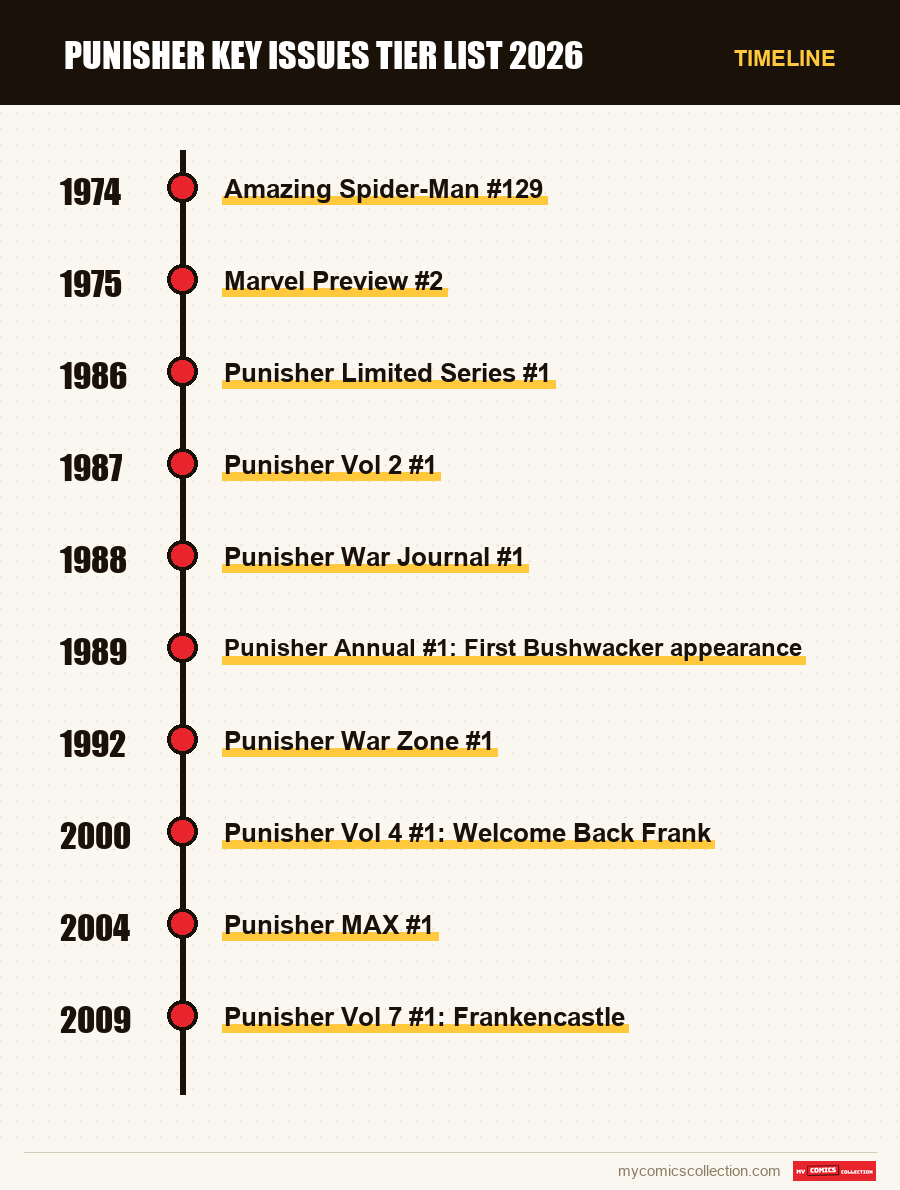
Tier S Punisher: the four central blue-chip pillars
The Tier S Punisher brings together four pieces and only four. This discipline is central: an inflated Tier S loses its prioritization function. These four pieces are the foundations of any serious Punisher collection, in chronological order of narrative and financial importance.
Amazing Spider-Man #129 (February 1974)
Amazing Spider-Man #129 is the absolute top of the Punisher Pyramid. Published in February 1974 under the pen of Gerry Conway and the art of Ross Andru (cover by Gil Kane), this issue contains the first canonical appearance of Frank Castle, aka the Punisher, in any medium. Conway is openly inspired by the pulp series The Executioner by Don Pendleton to create a character that breaks with the superheroic moralism of the 60s. The cover already shows the emblematic skull and the shooter's posture, a sign that the visual identity was locked from the start.
This issue also contains the first appearance of the Jackal, future major antagonist of the Clone Saga. This double narrative significance explains the rating premium: ASM #129 combines two canonical first appearances in the same cover. May 2026 ranges: CGC 9.8 between 95,000 and 145,000 dollars (very few transactions per year), CGC 9.6 between 18,000 and 28,000, CGC 9.4 between 5,500 and 9,500, CGC 9.0 between 2,800 and 4,500, CGC 8.0 between 1 400 and 2,600, CGC 6.0 between 450 and 850, CGC 4.0 between 180 and 320, raw VG between 90 and 160 euros. Heritage 2024-2026 sales confirm an upward trajectory of 12 to 18% per year for grades CGC 9.0 and above.
ASM trap #129 is the distinction newsstand vs direct edition. For 1974, the direct market does not yet exist, but the distribution Mark Jewelers (advertising insert slipped into certain copies intended for American military bases) creates a rare variant very popular with connoisseurs. An ASM #129 Mark Jewelers copy in CGC 9.0 can fetch $6,000-9,500 versus $2,800-4,500 for a standard copy. Always check the Mark Jewelers insertion on the CGC label. For the full narrative profile, see story of Frank Castle in the comics.
Punisher Limited Series #1 (January 1986)
Punisher #1 from January 1986, sometimes called Punisher: Circle of Blood of the name of the arc, throw it first solo miniseries in five issues dedicated to Frank Castle. Steven Grant writes, Mike Zeck draws, Klaus Janson inks certain pages, John Beatty provides colors. This mini-series responds to a latent demand: since 1974, the Punisher has been a profitable recurring character without a proper title. The commercial success was immediate and paved the way for the monthly series in 1987.
Mike Zeck's cover shows Frank Castle in profile, M16 rifle slung over his shoulder, in a photorealistic black and white style that contrasts radically with the superheroic Marvel aesthetic of the time. This cover is today considered one of the most emblematic images of the Late Bronze Age. The ranges for May 2026: CGC 9.8 between 750 and 1,200 dollars, CGC 9.6 between 320 and 520, CGC 9.4 between 150 and 260, raw NM between 35 and 70 euros. The 2024-2026 increase is estimated at 25 to 35% for CGC grades 9.6 and above, driven by the MCU resurgence and the relative scarcity of high copies in CGC.
The trap Limited Series #1 concerns second print and third print. Faced with the success of the first print, Marvel reprinted the mini-series twice in 1987 and 1988. The second print copies have a similar cover but bear the words "second printing" on the inside cover and have a value 8 to 12 times lower than the first print. Always check the notice on the first inside page. This piece is covered in detail in Punisher key numbers.
Punisher Vol 2 #1 (July 1987)
Punisher Vol 2 #1 from July 1987 is the first regular monthly series (ongoing) dedicated to the character. Mike Baron writes, Klaus Janson draws and inks. The series lasted 104 issues until 1995, an exceptional longevity for a character who had no superpowers. The commercial success of #1 exceeded all Marvel predictions and inaugurated what would later be called the "Punisher decade" 1987-1995, during which Frank Castle is one of the publisher's three most profitable characters.
The Klaus Janson cover shows the Punisher in close-up, machine gun in hand, in front of an explosion. Janson's interior style, economical and readable, would become the Punisher's visual signature for eight years. The ranges for May 2026: CGC 9.8 between 280 and 480 dollars, CGC 9.6 between 120 and 200, CGC 9.4 between 65 and 110, raw NM between 18 and 35 euros. The rating remained stable between 2022 and 2024 then accelerated in 2025 with the effect Daredevil Born Again, gaining 30 to 40% on CGC 9.6+ grades.
The trap Vol 2 #1 is confusion with multiple relaunchs Punisher Later #1 (Vol 3 to Vol 13 depending on sources). Marketplace and eBay databases often classify them under the single term "Punisher #1" without specifying the volume, which pollutes the search. Check the publication date (July 1987), the Marvel barcode and the author (Mike Baron) to confirm the identification. The distinction direct edition vs newsstand starts counting for 1987: the newsstand version (with UPC barcode instead of the direct square) represents approximately 50% of the initial circulation and retains a slight rarity premium in high grade.
Punisher MAX #1 (March 2004)
Punisher MAX #1 from March 2004 opens the definitive run of the character. Garth Ennis writes, Lewis Larosa draws, and the MAX line allows violence and nudity prohibited on titles subject to the Comics Code. This 60-issue run (until 2009) is unanimously considered the most relevant Punisher ever written, making it both a central modern issue and a gateway for adult readers discovering the character.
Ennis presents Frank Castle aging, tired, tracking down international criminal organizations (Yakuza, Russian mafia, Italian mafia). The tone is decidedly noir, without any superheroic touch, with autonomous arcs like In the Beginning , The Slavers or The Tyger which each have the status of a modern classic. The Tim Bradstreet cover shows Frank Castle frontally, in close-up, in a dark photorealistic style that would define the MAX aesthetic. The May 2026 ranges: CGC 9.8 between 100 and 180 dollars, CGC 9.6 between 55 and 95, raw NM between 18 and 35 euros.
The trap Punisher MAX #1 is the confusion with Punisher Vol 6 #1 (April 2004), different regular series published the following month. The two series coexisted on newsstands in spring 2004 and their covers are visually similar. The version MAX bears the MAX logo at the top of the cover and the mandatory “Parental Advisory” notice. See Punisher key numbers for the detailed trajectory of the Ennis run.
Tier A Punisher: the three major key issues often underestimated
Tier A Punisher brings together three pieces which would sometimes deserve Tier S but which the more accessible rarity or the slightly secondary narrative significance places at the level just below. These three issues should be in any Punisher collection beyond beginner level. Their ranges remain accessible to intermediate budgets.
Marvel Preview #2 (November 1975)
Marvel Preview #2 from November 1975 contains the Punisher's first solo story and the first expanded version of his origin story. Archie Goodwin writes, Tony DeZuniga draws. The format is that of a black and white magazine, outside Comics Code Authority, which allows for a more adult and violent treatment of Frank Castle. It is in these pages that the foundations of the definitive backstory are laid: Vietnam veteran, family murdered by the mafia during a picnic in Central Park, total vendetta against organized crime.
The issue is often overlooked by beginning collectors because the atypical magazine format and relatively small print run make identification less obvious than for a standard comic. Connoisseurs, however, make it a fundamental key issue: it is technically the first full story of the headlining Punisher, the first time where the character exists for himself and not as Spider-Man's antagonist. The ranges May 2026: CGC 9.6 between 3,500 and 5,800 dollars, CGC 9.4 between 1,600 and 2,800, CGC 9.0 between 700 and 1,300, CGC 8.0 between 380 and 650, CGC 6.0 between 140 and 260, raw VF between 60 and 110 euros.
The rarity in high grade is notable: less than 80 CGC 9.6 copies recorded in the May 2026 census, which explains the significant premium compared to CGC 9.4. The trap Marvel Preview #2 concerns cover tears and the yellowing particularly common on black and white magazines from the 70s, whose paper does not have the resistance of traditional comics. Check paper condition before any transaction above CGC 6.0.
Punisher War Journal #1 (November 1988)
Punisher War Journal #1 from November 1988 launches second Punisher monthly title simultaneously with the regular series. Carl Potts writes, and it is above all Jim Lee who draws, in one of his first notable Marvel contributions before his 1991-1992 X-Men glory. This dual identity (key issue Punisher + early Jim Lee) makes it a piece coveted by two distinct collector bases, which sustainably supports the price.
The Jim Lee cover already shows the exaggerated anatomical style and dynamic composition that would characterize his X-Men work. The issue also contains narrative innovations: the Punisher's logbook, which will become a recurring narrative convention, is introduced in this episode. The ranges for May 2026: CGC 9.8 between 380 and 680 dollars, CGC 9.6 between 180 and 320, CGC 9.4 between 90 and 160, raw NM between 22 and 45 euros. The 2024-2026 increase is driven by the post-pandemic Jim Lee rebound and the MCU Frank Castle effect, estimated at 30 to 45% on CGC 9.6+ grades.
The trap War Journal #1 concerns confusion with Punisher War Journal Vol 2 #1 (December 2006) and Vol 3 #1 (2014), two relaunchs without comparable spec value. Vol 1 from November 1988 can be recognized by its Jim Lee cover, its date and its period Marvel barcode. For Jim Lee fans, see also key issues Punisher which contextualizes Lee's early work at Marvel.
Punisher Vol 4 #1 (May 2000): Welcome Back Frank
Punisher Vol 4 #1 from May 2000, commonly known as Welcome Back Frank of the name of the opening arc, mark it critical and commercial feedback of the Punisher after the 1990s which had diluted the character. Garth Ennis writes, Steve Dillon draws. This issue is crucial on two counts: it restores the Punisher's credibility as a central character, and it lays the narrative foundation that will lead to 2004's Punisher MAX.
Ennis and Dillon repeat the conventions of the character with corrosive black humor, choreographed violence and an assumed disdain for conventional superheroism. The cover by Tim Bradstreet (already the official illustrator who would define the Punisher MAX aesthetic) shows Frank Castle in a rainy alley, rifle pointed at the reader. The ranges for May 2026: CGC 9.8 between 130 and 220 dollars, CGC 9.6 between 70 and 120, raw NM between 18 and 32 euros. The rating has been stable since 2022, supported by continued demand for the Ennis run as a whole.
The trap Welcome Back Frank is the first print vs second print. Faced with success, Marvel reprinted #1 in June 2000 with a clearly identified variant cover. Second print copies have a value 5 to 8 times lower than first print. Check the “second printing” notice on the first inside page. This piece is complementary to Punisher MAX #1 and provides a more accessible entry point into the Ennis-era Punisher collection.
Tier B Punisher: sleepers with high potential
Tier B Punisher brings together three sleepers whose current rating remains accessible but whose latent catalysts (first appearance of antagonist, rare embossed format, cult narrative arc) justify a measured exposure in a diversified collection. These pieces are not major at the beginner level but become strategic beyond that.
Punisher Annual #1 (1989): First Bushwacker appearance
Punisher Annual #1 from 1989 contains the first appearance of Bushwacker, secondary antagonist whose weapon attached to his arm (integrated machine gun) makes him a striking visual character. Bushwacker is then reused in several Daredevil and X-Factor arcs, multiplying his potential entry points into the MCU. With Daredevil Born Again which adapts the Frank Miller arcs of the 80s, some spec analysts consider Bushwacker as a possible candidate for a later season.
The ranges for May 2026: CGC 9.8 between 220 and 380 dollars, CGC 9.6 between 95 and 170, CGC 9.4 between 50 and 90, raw NM between 12 and 22 euros. The rating doubled between 2023 and 2025, driven by Disney+ rumors. The trap Punisher Annual #1 is the relatively high circulation for an annual, which may disappoint if Bushwacker does not materialize on screen. Spec position to be scaled carefully, without exceeding 5% of the total Punisher budget. See spec keys 2027 Marvel DC movies series for the general methodological framework.
Punisher War Zone #1 (March 1992)
Punisher War Zone #1 from March 1992 is third monthly title simultaneous with the Punisher (with the regular series and War Journal). Chuck Dixon writes, John Romita Jr. draws. The cover is in embossed format (relief), a marketing technique typical of the early 90s which amplifies the visual of the skull. This physical characteristic makes it a difficult piece to keep in high grade: the relief is quickly damaged, which makes the CGC 9.8 rarity a real argument.
The ranges for May 2026: CGC 9.8 between 280 and 480 dollars, CGC 9.6 between 120 and 200, raw NM between 18 and 35 euros. The CGC 9.8 rarity is notable: less than 600 copies recorded in the census, while the initial print run exceeded 400,000 copies. The embossed trap is the gradual detachment of the relief on copies stored in non-optimal conditions. Favor CGC slabbed copies for transactions above 200 dollars.
Punisher Vol 7 #1 (July 2009): Frankencastle
Punisher Vol 7 #1 from July 2009 starts the run Frankencastle by Rick Remender, one of the most atypical incarnations of the character. After his death at the end of the arc Dark Reign, Frank Castle is resurrected by a group of Frankenstein-esque Marvel monsters, which opens an unexpected fantasy arc. This narrative reinvention divides fans but remains a unique editorial moment that deserves its place in the historical cartography of the character.
The ranges for May 2026: CGC 9.8 between 65 and 110 dollars, CGC 9.6 between 35 and 60, raw NM between 10 and 18 euros. The rating has remained stable since 2020, without an immediate spec catalyst but with slow cult-following potential. The trap Vol 7 #1 is the identification: the number follows the relaunch Punisher from 2009 which starts as a classic Punisher before switching to Frankencastle at number #11. #1 is therefore less emblematic of the concept than #11, which may qualify its collection interest. For alternative moderns, see spec calls Marvel post-Secret Invasion.
Collecting this series?
Track what you own, what you are missing and what your collection is worth. 7 day trial.
Start my trial →Tier C Punisher: 2026-2027 spec and MCU catalysts
The Tier C Punisher covers spec bets related to the character's MCU resurgence. This tier is explicitly speculative: the current intrinsic value is low, the potential depends on announcements and castings whose materialization remains uncertain. Allocating more than 8-12% of the total Punisher budget to this tier constitutes excessive risk.
The central catalyst 2026-2027 is Daredevil Born Again. Season 1 (released on Disney+ in March 2025) confirmed Jon Bernthal as Frank Castle in several episodes. Season 2, scheduled for spring 2027, would expand his role according to production leaks. This MCU integration is more modest than the Avengers boost: the Punisher remains an adult character difficult to exploit in the Disney+ tone, which probably limits its massive cross-promotion. The classic key issues (Tier S and A) are therefore the first beneficiaries, more than new sleepers.
The secondary catalyst concerns casting rumors around secondary characters. Daniel Cudmore, already known for his role as Colossus in Fox's X-Men, is regularly cited in rumors as a possible candidate for a Punisher antagonist or allied character in a possible post-2028 Punisher solo film. These rumors remain unconfirmed at the time of writing (May 2026). If Cudmore is officially broken, keys from classic Punisher antagonists (Jigsaw, Bushwacker, Barracuda) could see a rapid revaluation. The discipline consists of not anticipating before confirmation.
The tertiary catalyst is 50th anniversary of the Punisher in February 2024 (already passed) then the 40th anniversary of the Mike Zeck mini-series in January 2026 (in progress). These editorial anniversaries traditionally generate relaunchs, variant tributes and anniversary arcs that recall the character to the memory of the market. Marvel has not yet announced a major 2026 anniversary arc, which can be interpreted as an opportunity (backlog to catch up) or as a signal of temporary editorial disinterest.
The Tier C spec key issues to watch for in 2026-2027 include the first appearances of possibly adaptable antagonists: Punisher War Zone #25 (1994, start of modern Jigsaw arc), Punisher MAX #7 (2004, first Barracuda Garth Ennis), and Punisher Vol 6 #4 (2004, first Lady Gorgon). These coins are all trading below $80 CGC 9.8, which offers limited downside risk. For bets outside the Punisher universe but linked to Daredevil Born Again, see Daredevil Born Again Disney comics to buy et Daredevil tier list key issues 2026.
Strategy by Budget: Three Punisher 2026 Portfolios
The budget allocation depends on the available capital and the acceptable level of risk. Three typical wallets cover the majority of collecting situations. Each portfolio integrates the four thirds in different proportions to preserve diversification.
Beginner wallet 1,500 to 3,000 euros. The goal is to build a solid foundation without taking excessive risk. Typical allocation: 0% Tier S (out of reach at these levels), 60% Tier A, 30% Tier B, 10% Tier C. In practice: Marvel Preview #2 raw VF (60-110 euros), Punisher Limited Series #1 CGC 9.6 ($320-520), Punisher Vol 2 #1 raw NM (18-35 euros), Punisher War Journal #1 CGC 9.6 ($180-320), Welcome Back Frank #1 raw NM (18-32 euros), Punisher MAX #1 raw NM (18-35 euros), a Tier B sleepers of your choice (Annual #1 Bushwacker or War Zone #1 embossed). This portfolio covers the four narrative pillars without requiring CGC 9.8 grades.
Intermediate portfolio 5,000 to 10,000 euros. The objective is to move up the ranks on Tier A coins and initiate Tier S exposure. Typical allocation: 35% Tier S (a single coin, generally Punisher Limited Series #1 or Vol 2 #1 in CGC 9.8), 40% Tier A complete in grade CGC 9.6+, 20% Tier B with War Zone #1 and Annual #1 in CGC 9.8, 5% Tier C in accumulation. This portfolio allows for real asset growth without overconcentration. The discipline consists of not giving in to the temptation of ASM #129 raw which would consume the entire budget without sufficient diversification.
Advanced wallet 25,000 euros and more. The objective is to target ASM #129 in intermediate grade (CGC 6.0 to 8.0) as a centerpiece, while complementing the other Tier S in CGC 9.8 and building a diversified Tier B and C exposure. Typical allocation: 55% Tier S (ASM #129 CGC 6.0 or 7.0 + Limited Series #1 CGC 9.8 + Vol 2 #1 CGC 9.8 + MAX #1 CGC 9.8), 25% Tier A in full CGC 9.8, 15% Tier B expanded, 5% Tier C. This portfolio reaches the serious collection level referenced on the CGC Registry databases. For the asset management of such portfolios, see strategy pillar comics investment 2027 et comics manager complete guide for tracking odds.
Whatever the portfolio, two transversal rules apply. First of all, never exceed 60% of the total budget on a single piece, same blue-chip: the liquidity of ASM #129 in CGC 9.0+ is low, and an urgent resale can impose a discount of 15 to 25%. Secondly, maintain a spec cash flow of 10 to 15% to seize opportunities linked to unanticipated studio announcements. The Punisher spec reacts quickly to MCU news and a one-week delay can cost 20-30% upside potential. See free estimate to evaluate your current collection before arbitration.
Specific Punisher pitfalls: newsstand, live, relaunch and variants
The Punisher collection combines several technical traps that distinguish this market from other Marvel universes. Identifying these pitfalls in advance avoids costly mistakes, particularly for intermediate buyers who commit to amounts greater than $500.
The first trap is newsstand vs direct edition distinction on comics 1979-2013. From 1979, Marvel distributed its comics through two channels: specialized comic shops (direct edition, "direct edition" square at the bottom of the cover, no UPC barcode) and general kiosks (newsstand, visible UPC barcode). From 1990, newsstands gradually became a minority, until they disappeared in 2013. For Punisher key issues from the 80s and 90s, newsstands carry a rarity bonus of 1.5 to 3 times at high grade CGC 9.6+. On Punisher War Journal #1 (1988), a CGC 9.8 newsstand can reach 1,200 dollars compared to 380-680 for a direct edition.
The second trap is multiplication of relaunch #1s. Marvel published under the title Punisher #1 at least seven different series: Punisher Limited Series #1 (1986), Punisher Vol 2 #1 (1987), Punisher Vol 3 #1 (1995, short-lived), Punisher Vol 4 #1 (2000, Welcome Back Frank), Punisher Vol 5 #1 (2001, Marvel Knights), Punisher Vol 6 #1 (2004), Punisher Vol 7 #1 (2009, Frankencastle), Punisher Vol 8 #1 (2011), Punisher Vol 9 #1 (2014), etc. Each relaunch has its own editorial logic, but only Vol 1, Vol 2, Vol 4 and MAX have real spec value. Vol 5, Vol 6, Vol 7 are complete collection pieces, not spec.
The third trap is profusion of modern variants. From 2009, Marvel increased the number of variant covers for the Punisher: ratio variants (1:10, 1:25, 1:50, 1:100, 1:500), party variants for conventions, blank covers for sketches, virgin covers without logo, sketch variants in black and white. These variants create an informational jungle where it is easy to buy a relaunch variant thinking you have a key issue. The rule: a variant only has a spec value if it is linked to a narrative key issue. A 1:50 ratio variant on a relaunch without narrative significance remains a rare item but not investable in the long term.
The fourth trap is embossed and chromium format of the 90s. The publishers used these marketing gadgets (relief, hologram, foil) on many Punisher issues 1992-1996: Punisher War Zone #1 embossed, Punisher #75 (1993, hologram), Punisher #100 (1995, foil), and several annuals. These formats are fragile: the relief is damaged, the foil is scratched, the hologram comes off. High grade conservation is demanding and the CGC 9.8 rarity is real, but the market remains segmented: collectors target these variants as a curiosity, not as a primary investment. Favor CGC slabbed copies for these formats.
The fifth trap is distinction Punisher MAX vs Punisher Vol 6 on Spring 2004. Both series released simultaneously with Tim Bradstreet covers similar in style. The MAX is intended for adults (Parental Advisory mandatory), Vol 6 remains mainstream with a more classic Punisher. The spec value is not at all the same: MAX #1 (March 2004) is blue-chip Tier S at 100-180 dollars CGC 9.8, Vol 6 #1 (April 2004) remains on 35-60 dollars CGC 9.8. Check the MAX mention and the exact publication date to avoid confusion. For the Punisher vs Spider-Man comparison grid, see Spider-Man tier list key issues 2026.
Monitoring 2026-2030: MCU calendar and anticipation of spec cycles
Tracking the Punisher 2026-2030 collection is structured around four time windows. The discipline consists of anticipating each window to position purchases and sales at the right time, without giving in to peaks of enthusiasm or troughs of disinterest.
Window 2026: exploitation Daredevil Born Again season 1. Season 1 released in March 2025 has already had a measurable effect on ratings (Punisher Limited Series #1 +25% in 12 months, Vol 2 #1 +30%, War Journal #1 +35%). In 2026, the effect continues with the promotion of season 2 and Jon Bernthal's appearances at conventions. The optimal buying window for new entrants is summer 2026 (traditional seasonal trough) before the fall pre-season 2 rise.
Window 2027: Daredevil Born Again season 2 release. Season 2 scheduled for spring 2027 should focus on the expanded role of Frank Castle. If the leaks confirm arcs adapted from the Punisher MAX, the Tier S rating probably accelerates by 40 to 60% over 6 months. Tier S holders are considering a partial resale at the peak (summer 2027) with rotation to Tier B sleepers. New entrants avoid peaks and wait until the post-release trough (fall 2027 or winter 2028).
Window 2028-2029: post-season 2 digestion and solo film rumors. After each major MCU catalyst, the market digests for 6 to 12 months with the rating plateauing or slightly declining. This phase is the buying opportunity for long-term positions. Persistent rumors of a solo Punisher film (with no official confirmation as of May 2026) could reactivate the market in late 2028 or 2029. Monitor Disney+ and Marvel Studios communications at each Comic-Con and CinemaCon.
Window 2030: 25 years anniversary Welcome Back Frank and 26 years Punisher MAX. Editorial anniversaries traditionally generate commemorative relaunchs, tribute variants and a surge of interest in the original arcs. Welcome Back Frank #1 (May 2000) will reach its 30th anniversary in 2030, the traditional window for hardcover anniversary editions and reprint variants. The rating of CGC 9.8 first prints can accelerate by 30 to 50% over 12 to 18 months before the anniversary.
Beyond the MCU schedule, two macro variables need to be tracked. Firstly, the evolution of public perception of the character: each political controversy (recovery of the skull by certain groups) creates cycles of Marvel editorial disengagement which can temporarily suspend new series and depress ratings. Secondly, the general inflation of the comics market, which affects silver and bronze age key issues (including ASM #129) more than modern ones. The 2022-2024 Currency Squeeze caused the ASM #129 CGC 9.0+ rating to rise 35% in two years, regardless of any MCU catalyst. For methodical tracking of your collection on these windows, see comics catalog et key issues comics.
FAQ Punisher tier list 2026
What is the most important Punisher part to acquire first?
If budget allows, Amazing Spider-Man #129 (February 1974) in CGC 6.0 to 8.0 remains the centerpiece of any serious Punisher collection. This is the canonical first appearance of Frank Castle and the Jackal. If the budget is more modest, Punisher Limited Series #1 (January 1986) in CGC 9.6 or raw NM constitutes the most relevant entry point Tier S: the Steven Grant/Mike Zeck miniseries is the foundation of the Punisher solo with an iconic cover. For tight budgets, Punisher Vol 2 #1 (July 1987) or Punisher MAX #1 (March 2004) in raw NM offer the most accessible Tier S exposure.
How to distinguish real Punisher key issues from worthless relaunch #1s?
Four #1s have real spec value: the Limited Series 1986, Vol 2 1987, Vol 4 2000 (Welcome Back Frank) and the MAX 2004. All other #1s (Vol 3 1995, Vol 5 2001, Vol 6 2004, Vol 7 2009, Vol 8 2011, Vol 9 2014, Vol 12 2018, Vol 13 2022) are marketing relaunchs without any founding narrative meaning. The verification rule: a true key issue #1 must tick at least two criteria: first mini-series, first ongoing, start of run by cult author (Ennis), or major editorial change (change to MAX). Without this double validation, it is a relaunch without spec interest.
Does Jon Bernthal's MCU integration in Daredevil Born Again justify an urgent purchase?
No, but it justifies a progressive repositioning. The MCU Punisher 2025-2027 effect is measured: +25 to +45% on Tier S in 18 months, which is solid without being exceptional. The discipline consists of avoiding panic buying at news peaks (episode release, trailer, leak casting) and favoring seasonal lows (July-August, January-February). Rush buying on a peak can consume 15-25% of the remaining upside potential. See Daredevil Born Again Disney comics to buy for the complete tactical grid.
Should we favor slabbed CGC copies or raws for the Punisher collection?
The rule depends on the amount and the grade targeted. Below 200 dollars in value, the raws in VF or NM offer a better cost-pleasure ratio collection. Between $200 and $800, the CGC 9.6 begins to justify itself for fragile parts (Marvel Preview #2, embossed War Zone #1). Above $800, the slabbed CGC is almost major: the buyer's premium on a CGC 9.8 vs raw NM copy is 80 to 150%, and the resale liquidity is much higher. For ASM #129 or any Tier S above CGC grade 8.0, slabbing is mandatory to authenticate and preserve value. Standard tier CGC service takes 60-120 days in 2026.
What strategy should we adopt if the rumors of a Punisher solo film are not confirmed by 2028?
The non-confirmation scenario remains plausible: Disney+ may consider the character too adult for a mainstream film and confine him to limited Daredevil or Punisher series appearances. In this case, the Tier S rating stabilizes rather than falls, because the intrinsic value of the key issues (narrative significance, CGC rarity) remains intact. Tier C, on the other hand, becomes very exposed: bets on Bushwacker, Barracuda or Jigsaw lose their catalyst and can decline by 30 to 50%. Preventive discipline consists of not exceeding 10 to 12% of the total Punisher budget on Tier C and to favor Tier A and B which resist even without film confirmation.