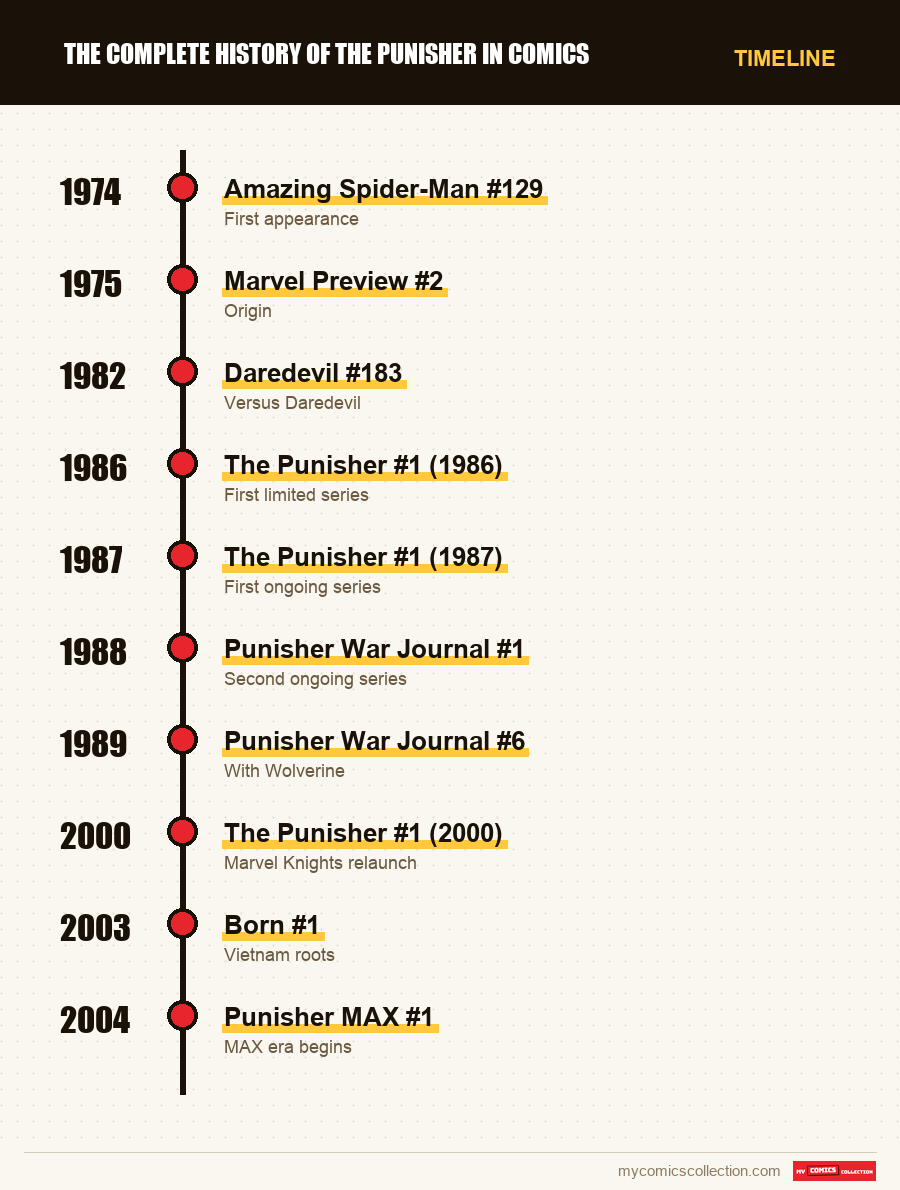
The Punisher (Frank Castle) appears for the first time in Amazing Spider-Man #129 (February 1974), created by Gerry Conway (scenario), Ross Andru (drawing) and John Romita Sr. (costume design). Since then, the character has worn more than 30 series distinct (ongoings, limited series, one-shots), from the first solo Circle of Blood (1986) until the Jason Aaron series (2022). The most highly rated runs on the market: the Steven Grant mini-series (1986), the Punisher MAX by Garth Ennis (2004-2009) and the Greg Rucka run (2011-2012). In CGC 9.8 condition, a Amazing Spider-Man #129 exceeds $40,000.
Frank Castle is a unique case in the Marvel universe. Neither mutant, nor super-soldier, nor Nordic god: he is a Vietnam veteran armed to the teeth who decided to wage a personal war against organized crime after the massacre of his family in Central Park. The Punisher is the Marvel character who asks the most disturbing moral question: Can a hero kill? Since 1974, Marvel has never really responded, and it is precisely this ambiguity that has fueled fifty years of publications.
For the collector, the Punisher represents a vast and sometimes confusing territory. Between the regular series, the limited series, the crossovers with Daredevil or Spider-Man, the ultraviolent one-shots of the MAX line and the successive relaunches, the complete bibliography of Frank Castle exceeds 800 issues. This guide traces the character's entire editorial history, volume by volume, with key issues, creators and current market values.
Whether you're looking to build a complete Punisher collection or simply identify the essential runs and key issues to watch out for, this file gives you a solid foundation. Each section is organized chronologically to follow the evolution of the character, from his creation as a Spider-Man villain to his current status as an essential anti-hero.
Creation and first appearances (1974-1985)
Amazing Spider-Man #129: Birth of the Punisher
In February 1974, Gerry Conway seeks a recurring antagonist for Spider-Man, a character who embodies a radical vision of justice. Inspired by the novel The Executioner by Don Pendleton (Mack Bolan series), Conway imagines an armed vigilante who considers criminals as targets to be eliminated. John Romita Sr. draws the iconic costume, the white skull on a black background, while Ross Andru ensures the interior design of the number. The Punisher breaks into Amazing Spider-Man #129, hired by the Jackal to eliminate Spider-Man. The issue ends with a confrontation without a winner and an anti-hero who will leave a lasting mark on the Marvel universe.
At his creation, the Punisher is only a secondary character, a guest villain. He reappears in ASM #134-135, then in Giant-Size Spider-Man #4 (1975) and sporadically in Captain America , Daredevil and Marvel Preview #2 (1975), the latter offering for the first time a story centered on Frank Castle with a more adult magazine tone, from the pens of Conway and Tony DeZuniga.
Pre-solo appearances (1976-1985)
For a decade, the Punisher remained a regular guest star without a series of his own. It appears in Spectacular Spider-Man #81-83 (1983), in several issues of Daredevil (notably #182-184 by Frank Miller in 1982, a founding crossover for the two characters), and in Captain America #241 (1980). Each of these appearances reinforces the identity of the character: Frank Castle is not a superhero, he is a soldier in the war against crime. This period sets the stage for the explosion of the 1980s.
The solo explosion: Circle of Blood and the three series (1986-1995)
The Punisher (limited series, 1986): Circle of Blood
In January 1986, Marvel finally launched the Punisher's first solo: a mini-series of 5 numbers written by Steven Grant and drawn by Mike Zeck . Circle of Blood is a major editorial turning point. The tone is dark, the violence explicit, and the commercial success is immediate. The Punisher #1 (1986) quickly reached key issue status: in CGC 9.8, it trades today between $800 and $1,200. This miniseries proved to Marvel that there was an audience for violent anti-heroes, paving the way for three concurrent monthly series.
The Punisher Vol.2: ongoing series (1987-1995, 104 issues)
Building on the success of Circle of Blood, Marvel launched a regular series in July 1987. The Punisher Vol.2 #1, written by Mike Baron and drawn by Klaus Janson, begins a run that will last 104 issues plus 7 annuals. Mike Baron's run (#1-60) defines the Punisher of the 1980s: single-player missions against the mafia, drug cartels and terrorist organizations. Key issues include #10 (Daredevil crossover), #50 (milestone with holographic cover), and #86 (debut of the "Suicide Run" crossover in 1993).
Market values: #1 (1987) in CGC 9.8 sells for between $150 and $250. Numbers 2 to 104 remain very accessible, often under $10 in raw condition.
The Punisher War Journal Vol.1 (1988-1995, 80 issues)
Launched in November 1988, War Journal is the second monthly Punisher series. The first arc (numbers #1-3) is written and drawn by Carl Potts and inked by Jim Lee: yes, the Jim Lee of X-Men. THE Punisher War Journal #1 is a significant key issue thanks to Jim Lee's inks: in CGC 9.8, it reaches $200 to $400. Jim Lee stayed on the series until #19 before leaving on Uncanny X-Men. #6 and #7 contain a crossover with Wolverine, making them particularly sought-after issues.
The series is distinguished by a slightly more action tone and frequent crossovers with the expanded Marvel Universe: Acts of Vengeance (#12-13), encounters with Spider-Man, and participation in continuity events that the main series avoided.
The Punisher War Zone Vol.1 (1992-1995, 41 issues)
Third monthly series launched in March 1992, at the peak of the character's popularity. Warzone #1, by Chuck Dixon and John Romita Jr., is notable for its embossed covers typical of the speculative era of the 90s. Chuck Dixon writes the first 25 issues with recognized narrative efficiency. The series ran out of steam with market saturation and ended at #41 in 1995.
This is the period when Marvel publishes three Punisher series simultaneously, plus annuals, specials and one-shots. The total volume for the period 1987-1995 exceeds 300 issues, making it a logistical challenge for the complete collector. The good news: the majority of these numbers are in dollar bins.
Notable crossovers and events (1988-1995)
The Punisher's heyday includes several essential cross-series crossovers for completionists:
- “Suicide Run” (1993): 10-part crossover between the three monthly series. Frank Castle pretends to be dead. Issues affected: Punisher #85-88, War Journal #61-64, War Zone #23-25.
- “Countdown” (1994-95): last major crossover before the cancellation of the three series. Punisher #99-104, War Journal #75-80, War Zone #37-41.
- Punisher/Batman (1994): DC/Marvel crossover by Chuck Dixon and John Romita Jr. One-shot highly sought after by collectors of both publishers.
The crossing of the desert and the experiments (1995-2000)
Punisher Vol.3 (1995-1997, 18 issues): John Ostrander
After the simultaneous cancellation of all three series in 1995, Marvel relaunched the Punisher with a new series by John Ostrander. The tone changes radically: Castle joins an organized crime family and becomes its boss. The series did not find its audience and ended after only 18 issues. These issues are inexpensive and rarely collected, but Ostrander's storyline is worth a look for fans of continuity.
The Punisher Vol.4 (1998-1999, 4 issues): Purgatory
The most controversial point in the character's history. Marvel entrusts the Punisher to Christopher Golden and Bernie Wrightson for a 4-issue series where Frank Castle, after committing suicide, returns as a supernatural avenging angel armed with divine guns. The concept is unanimously rejected by fans. Despite Wrightson's artistic talent, this miniseries is considered the character's absolute nadir. The issues have no significant market value, but have become curiosities for collectors of oddball comics items.
Punisher Vol.5 (2000-2001, 12 issues): Marvel Knights / Garth Ennis
The rebirth. In April 2000, under the label Marvel Knights , Garth Ennis and Steve Dillon relaunch the Punisher with a #1 that redefines the character for the 21st century. Ennis takes Castle back to basics: a broken man who kills criminals, with no supernaturals or superheroes. The tone oscillates between graphic violence and caustic black humor. THE Punisher Vol.5 #1 (2000) in CGC 9.8 trades between $100 and $200. The 12 issues of this series (nicknamed “Welcome Back, Frank”) constitute the best entry point to discover the character.
The MAX era: Garth Ennis' masterpiece (2001-2009)
The Punisher Vol.6 / Marvel Knights (2001-2004, 37 issues)
Building on the success of Welcome Back, Frank, Ennis continues with a second series under the Marvel Knights label (37 issues). The tone remains similar, with arcs like "The Slavers" (foreshadowing of MAX brutality) and crossovers with Wolverine and Daredevil. This series serves as a segue into Ennis's most ambitious work.
Punisher MAX Vol.1 (2004-2009, 75 issues). The definitive series
In March 2004, under the imprint MAX (reserved for adult readers, without Comics Code Authority), Garth Ennis and the cartoonist Lewis LaRosa launch what is universally considered the best Punisher series ever released. THE Punisher MAX #1 (2004) in CGC 9.8 sells for between $200 and $350.
Ennis' 60 issues of this series (he leaves after #60, but the arcs are complete) constitute a unitary story of rare coherence. Major arcs include:
- "In the Beginning" (#1-6): the return of Micro and the CIA. Masterful opening arc.
- “Mother Russia” (#13-18): Castle infiltrates a Russian nuclear silo.
- “The Slavers” (#25-30): considered the best Punisher arc in all formats. Frank Castle takes on an Eastern European human trafficking ring. The brutality is at its peak.
- “Barracuda” (#31-36): introduction of the most memorable villain in the MAX line.
- “Valley Forge, Valley Forge” (#55-60): Ennis' final arc, which connects Castle's Vietnam War to his current crusade. A narrative masterpiece.
- "Long Cold Dark" (#50-54): the return of Barracuda for a final duel.
For a serious collector, Ennis's complete run on MAX (#1-60) is a profitable and literary investment. Individual numbers remain accessible ($5-15 gross), but the odds are climbing regularly. Check out our Punisher key numbers guide for an updated price statement.
PunisherMAX Vol.2 (2010-2012, 22 issues): Jason Aaron
After Ennis left, Jason Aaron resumes the MAX line with Steve Dillon to the drawing. This 22-issue series reintroduces Wilson Fisk (Kingpin), Bullseye and Elektra in the MAX context: without powers, in a realistic and brutal universe. Aaron's run is excellent but often overshadowed by Ennis's. The #1 in CGC 9.8 reaches $50-100. The series is underpriced and represents an opportunity for discerning collectors.
The modern Punisher in the Marvel Universe (2009-2020)
Punisher Vol.7: Rick Remender (2009-2010, 21 issues)
Rick Remender takes control of the Punisher in the classic Marvel universe and pushes the concept to its wildest limits. Killed by Daken in Dark Reign: The List: Punisher, Frank Castle is resurrected by Morbius and the Legion of Monsters as Frankenstein's creature in the "FrankenCastle" arc (#11-21); from #17 the series is retitled Franken-Castle. The concept deeply divides fans but the series has become a cult collector's item. #11 (first appearance of FrankenCastle) is attracting increasing interest.
Punisher Vol.8: Greg Rucka (2011-2012, 16 issues)
The run of Greg Rucka , with Marco Checchetto in drawing, is one of the little-known gems of the Punisher bibliography. Rucka takes a unique approach: Frank Castle barely speaks for all 16 issues. The story is carried by Rachel Cole-Alves, a female character who follows a path parallel to that of Castle. #1 (2011) in CGC 9.8 is worth $50-80. The series ends with the crossover Punisher: War Zone Vol.3 (5 issues), where Castle faces the Avengers. Checchetto's work is sumptuous and this run deserves to be collected in its entirety.
Punisher Vol.9: Nathan Edmondson (2014-2015, 20 issues)
Nathan Edmondson relocates Frank Castle to Los Angeles with Mitch Gerads to the drawing. The approach is more military and tactical, influenced by the aesthetic of modern thrillers. The series is solid without being revolutionary. The numbers remain very affordable ($2-5) and Gerads, today recognized for his work on Mister Miracle and Batman, adds retrospective interest for speculators.
Punisher Vol.10: Becky Cloonan (2016-2018, 228 issues including relaunch)
Becky Cloonan becomes the first woman to write a regular Punisher series, with Steve Dillon in drawing (Dillon's last work before his death in October 2016). The series starts with a first arc of 6 issues before a relaunch under the title The Punisher Vol.11 (2017, #218-228 in legacy numbering). #218, the first issue written by Matthew Rosenberg, marks a turning point with Frank Castle in War Machine armor, a concept that precedes the events of Secret Empire. #218 (first appearance War Machine Punisher) is attracting growing interest among modern key issue collectors.
Punisher Vol.12: Matthew Rosenberg (2018-2019, 16 issues)
Matthew Rosenberg offers a direct and brutal run where Castle confronts Baron Zemo's control over the New York underworld. The run is appreciated for its no-nonsense approach and reads like a tribute to the classic series of the 1980s. The issues remain under $5.
The controversial redesign and comeback (2022-present)
Punisher Vol.13: Jason Aaron (2022-2023, 12 issues)
Jason Aaron returns to the character with Jesus Saiz and Paul Azaceta for a series that radically redefines Frank Castle. Aaron connects the Punisher's origin to the Beast (The Hand) and reveals that the white skull is an ancient symbol linked to a demon. Castle becomes the leader of The Hand, moving away from his identity as a lone vigilante. The series deeply divides fans: some see it as a daring evolution, others as a betrayal of the character.
The editorial context plays an important role: after the Punisher logo was appropriated by extremist groups in the real world, Marvel made the conscious choice to redefine the symbol. #1 (2022) in CGC 9.8 is trading around $40-60. The series ends at #12 and leaves the character in a state of transition.
To follow all the series and make sure you don't miss any issues, consult our complete guide to the Punisher collection.
Essential miniseries and one-shots
Beyond the regular series, the Punisher has carried dozens of side publications. Here are the most significant for a collector:
Unmissable mini-series
- Punisher: Return to Big Nothing (1989): Graphic novel by Steven Grant and Mike Zeck. Prestige format, highly sought after.
- Punisher: Year One (1994, 4 issues): By Dan Abnett and Andy Lanning. The definitive origin story of Frank Castle.
- Punisher Kills the Marvel Universe (1995): One-shot by Garth Ennis. Frank Castle eliminates every hero and villain in the Marvel Universe. Ennis' first work on the character, which became a cult classic. In CGC 9.8, it trades between $300 and $500.
- Punisher: The End (2004): One-shot MAX by Ennis. Frank Castle in a post-apocalyptic world. Thematic conclusion to Ennis's vision.
- Punisher MAX: Born (2003, 4 issues): By Ennis and Darick Robertson. Castle's Vietnam War. Essential prequel to the MAX series.
- Punisher: The Platoon (2017, 6 issues): By Ennis and Goran Parlov. Ennis returns to the character for a Vietnam war story.
Notable crossovers
- Punisher vs. Daredevil: Marvel's richest philosophical rivalry. Key moments in Daredevil #182-184 (Frank Miller, 1982), Daredevil Vol.2 (Bendis/Brubaker) and Daredevil season 2 (Netflix).
- Punisher/Batman: Deadly Knights (1994): DC/Marvel crossover by Chuck Dixon and John Romita Jr.
- Punisher vs. Bullseye (2006, 5 issues): Marvel Knights miniseries.
- Cosmic Ghost Rider (2018, 5 issues): By Donny Cates. Frank Castle in the future, become cosmic Ghost Rider then herald of Galactus. #1 in CGC 9.8 reached prices exceeding $100.
Key issues and market values
The Punisher occupies a special place on the comics market: its major issues are expensive, but most of its bibliography remains very affordable. Here are the essential numbers classified by decreasing value:
| Number | Year | Event | CGC value 9.8 | Gross value VF/NM |
|---|---|---|---|---|
| Amazing Spider-Man #129 | 1974 | 1st appearance of the Punisher | $40,000-$55,000 | $3,000-$6,000 |
| Marvel Preview #2 | 1975 | 1st solo origin story, magazine format | $2,500-$4,000 | $300-$600 |
| Punisher #1 (limited, 1986) | 1986 | 1st solo, Circle of Blood | $800-$1,200 | $40-$80 |
| Punisher Kills the Marvel Universe | 1995 | 1st Ennis/Punisher, cult one-shot | $300-$500 | $80-$150 |
| Punisher War Journal #1 (1988) | 1988 | Jim Lee, 1st War Journal series | $200-$400 | $15-$30 |
| Punisher MAX #1 (2004) | 2004 | Start of the Ennis MAX run | $200-$350 | $15-$30 |
| Punisher Vol.5 #1 (2000) | 2000 | Welcome Back, Frank (Marvel Knights) | $100-$200 | $10-$25 |
| Cosmic Ghost Rider #1 | 2018 | Frank Castle as Cosmic Ghost Rider | $80-$150 | $10-$20 |
| Punisher Vol.2 #1 (1987) | 1987 | 1st ongoing series | $150-$250 | $10-$20 |
| Punisher War Journal #6-7 | 1989 | Crossover Wolverine, Jim Lee | $100-$200 | $15-$30 |
Collector's advice: If you're starting a Punisher collection on a limited budget, focus on Ennis' MAX run (#1-60). The literary quality is exceptional, the issues are still affordable, and the rating has been rising steadily since the Netflix series. For vintage key issues, aim for an ASM #129 in intermediate condition (CGC 4.0-6.0) rather than a high-end example: demand remains strong in all conditions.
Collecting this series?
Track what you own, what you are missing and what your collection is worth. 7 day trial.
Start my trial →Complete timeline list of the Punisher series
Here's the complete rundown of all the Punisher's regular series and significant miniseries, in chronological order:
- The Punisher (limited series, 1986), 5 issues, Steven Grant / Mike Zeck
- The Punisher Vol.2 (1987-1995), 104 issues + 7 annuals, Mike Baron, then various
- Punisher War Journal Vol.1 (1988-1995), 80 issues, Carl Potts, Jim Lee, then various
- Punisher War Zone Vol.1 (1992-1995), 41 issues, Chuck Dixon / John Romita Jr., then various
- Punisher Year One (1994), 4 issues, Dan Abnett & Andy Lanning
- The Punisher Vol.3 (1995-1997), 18 issues, John Ostrander
- The Punisher Vol.4 (1998-1999), 4 issues, Christopher Golden / Bernie Wrightson
- The Punisher Vol.5 (2000-2001), 12 issues, Garth Ennis / Steve Dillon
- The Punisher Vol.6 (2001-2004), 37 issues, Garth Ennis
- Punisher MAX: Born (2003), 4 issues, Garth Ennis / Darick Robertson
- Punisher MAX Vol.1 (2004-2009), 75 issues, Garth Ennis, then various
- Punisher War Journal Vol.2 (2007-2009), 26 issues, Matt Fraction / Ariel Olivetti
- Punisher Vol.7 (2009-2010), 21 issues, Rick Remender
- PunisherMAX Vol.2 (2010-2012), 22 issues, Jason Aaron / Steve Dillon
- Punisher Vol.8 (2011-2012), 16 issues, Greg Rucka / Marco Checchetto
- Punisher: War Zone Vol.3 (2012-2013), 5 issues, Greg Rucka
- Punisher: The Trial of the Punisher (2013), 2 issues, Marc Guggenheim
- Punisher Vol.9 (2014-2015), 20 issues, Nathan Edmondson / Mitch Gerads
- Punisher Vol.10 (2016-2017), 17 issues, Becky Cloonan / Steve Dillon
- Punisher Vol.11 (2017-2018), 228 legacy, Becky Cloonan then Matthew Rosenberg
- Punisher Vol.12 (2018-2019), 16 issues, Matthew Rosenberg
- Punisher: Soviet (2020), 6 issues, Garth Ennis / Jacen Burrows (MAX)
- Punisher Vol.13 (2022-2023), 12 issues, Jason Aaron / Jesús Saiz
Not to mention the dozens of annuals, specials, one-shots (Punisher: The Ghosts of Innocents , Punisher: No Escape , Punisher: G-Force, etc.), Marvel crossovers (Punisher/Captain America: Blood & glory , Punisher Meets Archie), and alternative adaptations (Punisher 2099, 34 issues from 1993 to 1995; Black Punisher, 4 issues in 2009).
Tips for Collecting the Punisher
Where to start?
The Punisher is one of the most accessible Marvel characters for collectors thanks to the moderate price of the vast majority of his issues. The runs from the years 1987-1995, despite their impressive volume, can easily be found in lots for a few dozen euros. The challenge is not the budget, it's completeness: finding every issue of three simultaneous monthly series, plus one-shots and annuals, requires patience and good organization.
The three recommended approaches
- Quality approach: focus on the Ennis (Vol.5, Vol.6, MAX) and Rucka (Vol.8) runs. Around 150 issues in total, consistent quality, and a controlled budget (€200-400 for the whole gross).
- Key issues approach: Aim only for the first numbers of each series and the key numbers listed in the table above. More speculative, more expensive, but more compact.
- Comprehensive approach: the 800+ issues of the complete bibliography. Plan for several years and a suitable storage solution. A tool for collection tracking number by number is essential for this type of project.
Storage and preservation
The majority of Punisher comics are in standard US format (comic book, 6.625" x 10.25"). Magazine format issues (Marvel Preview , Punisher Magazine) require separate magazine pouches. Graphic novels and prestige format (Return to Big Nothing , Punisher: The End) require suitable pouches. For valuable key issues (ASM #129, Punisher #1 1986), CGC or CBCS grading is recommended to protect and authenticate your investment.
Summary: The Punisher is a character whose bibliography offers both premium key issues (ASM #129 at the top) and entire runs available at low prices. The literary quality reaches its peak with Garth Ennis on the MAX line, but the runs of Rucka, Aaron and even the classic series of the 80s-90s deserve the attention of the discerning collector. Use a collection management application to track your progress and identify your missing comics in this dense bibliography.
Biography of Frank Castle (The Punisher)
Frank Castle , aka The Punisher, is a Marvel Comics character created by Gerry Conway (screenwriter), Ross Andru (designer) and John Romita Sr. (costume design). His first appearance is in Amazing Spider-Man #129 , published in February 1974.
Frank Castle's identity card
- Real name: Francis "Frank" Castle (birth name: Castiglione)
- Date of birth: 1950 (fictional, varies depending on runs)
- Place of birth: Queens, New York, USA
- First appearance : Amazing Spider-Man #129 (February 1974)
- Creators: Gerry Conway, Ross Andru, John Romita Sr.
- Occupation: Ex-Marine (Vietnam veteran), Urban vigilante
- Family status: Widower (Maria Castle), father of two murdered children (Frank Jr. and Lisa)
- Memberships: None permanent (casual ally of Daredevil, Spider-Man, S.H.I.E.L.D.)
Character origins
Frank Castle is a former Marine Captain and decorated veteran of the Vietnam War. Back in New York with his wife Maria and their two children, he accidentally witnesses a mafia execution in Central Park. Embarrassing witnesses, his wife and children are shot dead in cold blood before his eyes. Also affected but surviving, Frank Castle abandons his civilian identity and becomes The Punisher: a merciless vigilante who leads a personal war against organized crime, using military techniques learned in combat.
Unlike other Marvel heroes, Frank Castle kill your enemies. This particularity makes him a morally complex and controversial character, who questions the limit between justice and revenge, heroism and vigilantism.
Powers and Abilities
Frank Castle has no superpowers. Its formidable effectiveness is based on:
- Elite military training: Marines, Special Forces, multiple decorations including the Navy Cross and the Medal of Honor.
- Weapon Mastery: expert in firearms (pistols, assault rifles, snipers), bladed weapons, explosives.
- Close combat: mixed martial arts (boxing, judo, krav maga).
- Tactics and strategy: planning of complex operations, infiltration, surveillance.
- Exceptional endurance: pain tolerance and exceptional recovery capacity.
Iconic costume
The Punisher's costume is one of Marvel's most recognizable: black jumpsuit with a stylized white skull on the torso. This design, created by John Romita Sr., symbolizes the death that Castle brings to his enemies. The pattern was taken up by American soldiers as a controversial symbol, leading Marvel to occasionally modify its design in the 2020s.
Key issues to know
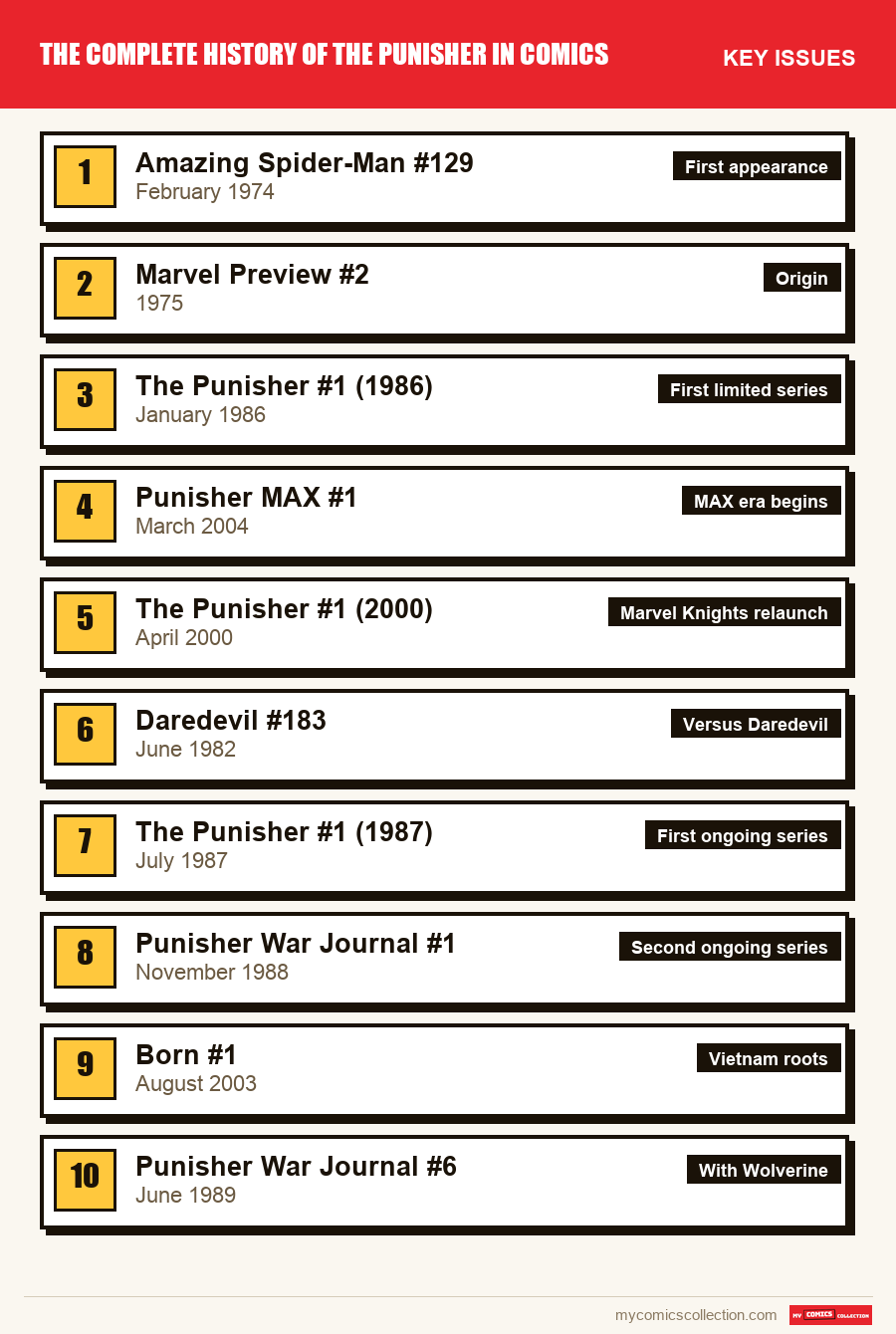
Amazing Spider-Man #129
Gerry Conway and Ross Andru introduce the Punisher as a gunman hired by the Jackal, who also debuts under that name, to take out Spider-Man. The skull-chested vigilante is only a guest antagonist at this point, but this issue launches one of Marvel's most enduring antiheroes.
Marvel Preview #2
In this black-and-white magazine aimed at older readers, Gerry Conway and Tony DeZuniga reveal the name Frank Castle and the murder of his family by Mafia gangsters. The character's fifth appearance, it lays down the tragedy that remains at the heart of the Punisher.
The Punisher #1 (1986)
Steven Grant and Mike Zeck launch Circle of Blood, the first series to carry the Punisher's name. Billed on the cover as the first of four issues, it actually runs five. The story blames his earlier excesses on mind-altering drugs he had been poisoned with and sets up a more controlled Castle.
Punisher MAX #1
Under the adults-only MAX imprint, Garth Ennis and Lewis LaRosa open a 75-issue series, the first 60 of which Ennis writes. The In the Beginning arc sets up a realistic Punisher kept apart from the superheroes.
The Punisher #1 (2000)
Under the Marvel Knights imprint, Garth Ennis and Steve Dillon relaunch the character with Welcome Back, Frank, a 12-issue limited series. After the supernatural detour of Purgatory, this back-to-basics Castle revives the Punisher's popularity.
Daredevil #183
Roger McKenzie and Frank Miller send Daredevil and the Punisher after the dealer responsible for the death of a young girl on drugs. The two vigilantes end up fighting, and Castle, unwilling to kill the hero, takes him down with a tranquilizer shot. Originally planned for issue #167, the story had to be reworked to meet the Comics Code.
The Punisher #1 (1987)
Mike Baron and Klaus Janson launch the character's first ongoing series, which would reach 104 issues by July 1995. From issue #4, Castle gets backup from Microchip, who supplies his weapons and armored vans.
Punisher War Journal #1
The Punisher's second ongoing series, War Journal opens with the tribute Castle pays his family every year in the park where they were killed. Carl Potts writes and pencils, with Jim Lee on inks before Lee takes over full art duties a few issues later.
Born #1
Garth Ennis and Darick Robertson go back to Frank Castle's last tour in Vietnam in this four-issue limited series published under the MAX imprint. The story shows the psychological transformation that, on a besieged base, gives birth to the Punisher.
Punisher War Journal #6
Jim Lee draws, from a Carl Potts script, the Punisher's meeting with Wolverine in Africa. On leave, Castle runs into a poaching ring that Wolverine is tracking on his own. The story continues in issue #7.
Go further
- Punisher Reading Guide: Where to Start and in What Order
- Best Punisher Comic Runs: Top 7 Series Every Collector Should Know
- The Best Punisher Story Arcs: A Collector's Guide
- Top 10 essential Punisher key issues
- Punisher First Appearance: Amazing Spider-Man #129: Collector's Value Guide
- Collection Guide: Punisher : Complete Guide