
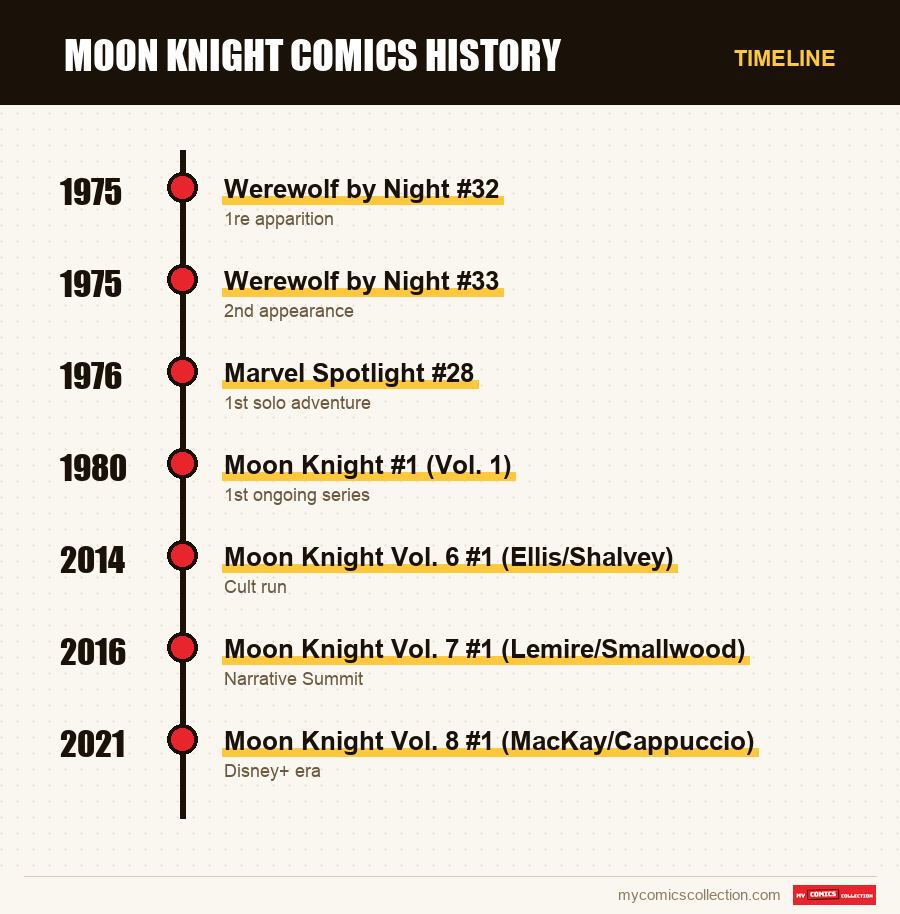
Moon Knight appears for the first time in Werewolf by Night #32 (August 1975), created by Doug Moench (screenplay) and Don Perlin (drawing). First a mercenary hired to capture Jack Russell, Marc Spector becomes the fist of Khonshu, Egyptian lunar god. Eight main ongoing volumes punctuate its history: appearances in Hulk Magazine (1978), the Flight. 1 Moench/Sienkiewicz (1980-1984, 38 issues), Fist of Khonshu (1985, 6 issues), Marc Spector: Moon Knight (1989-1994, 60 issues), the Flight. 4 Huston/Finch (2006-2009), the Flight. 5 Bendis/Maleev (2011-2012), the Flight. 6 Ellis/Shalvey (2014-2015), the Flight. 7 Lemire/Smallwood (2016-2018), and the Flight. 8 MacKay/Cappuccio (2021-2023). The Disney+ series with Oscar Isaac (2022) blew up the ratings: Werewolf by Night #32 in CGC 9.4 today exceeds $20,000.
Created in 1975 as a simple antagonist in a horror comic, Moon Knight has become one of the most fascinating and complex characters in the Marvel Universe. Marc Spector (mercenary, millionaire, taxi driver, masked hero) suffers from dissociative identity disorder that blurs the line between madness and divine power. His relationship with Khonshu, Egyptian lunar god, perpetually oscillates between mystical blessing and psychological manipulation. This ambiguity, explored brilliantly by authors like Doug Moench , Bill Sienkiewicz , Warren Ellis , Jeff Lemire and Jed MacKay, made Moon Knight a cult character whose popularity exploded with the Disney+ series Oscar Isaac in March 2022.
This guide traces the complete story of Moon Knight since its creation in Werewolf by Night #32 in 1975, details the timeline of each volume in order, identify the key issues essential to know to build a structured collection, and analyzes the impact of the MCU on the back issue market. We'll cover five decades of publication, from the first Bronze Age appearances to the current run, distinguishing the main volumes, miniseries, and story arcs that redefined the character.
Often compared to Batman (vigilant, rich, dark, obsessive) Moon Knight differs radically: where Bruce Wayne wears a mask, Marc Spector wears one. four, and where the Black Knight remains grounded in reality, the Moon Knight never knows if Khonshu really exists. It's this fractured identity that makes the character irresistible to writers, and his comics so collectible.
The Birth of Moon Knight: Werewolf by Night #32 (August 1975)
Moon Knight's story begins in an unlikely title: Werewolf by Night, the Marvel horror series starring Jack Russell, a cursed werewolf. In the #32 (August 1975), the Committee, secret criminal organization, hires a mercenary named Marc Spector: dressed in white and silver, calling himself Moon Knight: to capture the werewolf. Spector is then a pure antagonist, a hired hunter without qualms. But from the #33, he turns against the Committee and helps Russell escape, revealing an unexpected moral code. It is this moral shift that convinces Doug Moench and the editor Marv Wolfman that the character deserves his own series.
Doug Moench, a prolific screenwriter (Master of Kung Fu, Batman), created Moon Knight by drawing on Egyptian mythology and the concept of multiple identities. Don Perlin, regular artist for Werewolf by Night, designed the initial design: silver cape, crescent moon on the chest, white hood. The all-white suit was a bold choice at the time: Spector wanna be seen by his enemies. This detail will become a fundamental character trait of the character.
First appearances outside of Werewolf by Night (1975-1978)
After his debut in Werewolf by Night #32-33, Moon Knight reappears sporadically in other Marvel titles: Marvel Spotlight #28-29 (June-August 1976), his first solo adventure outside WBN, and Defenders #47-51 (1977), where he fights alongside Dr. Strange's team. These appearances, always written by Doug Moench, develop Spector's multiple identities: Steven Grant (millionaire), Jake Lockley (taxi driver), and the masked hero Moon Knight. This triangle of identities, initially conceived as a tool of infiltration, will gradually become the symptom of a real dissociative disorder.
Hulk Magazine and solo debut (1978-1980)
The pre-series consecration arrives in Hulk Magazine (parfois nommé Rampaging Hulk), Marvel's black and white magazine in magazine format. Moon Knight gets prose and comic back-up stories in the issues #11 à #15 and #17 à #20 (1978-1980), signées Doug Moench with drawings of Bill Sienkiewicz: their first collaboration. These stories, more mature than the color comics of the time, explore Spector's mercenary past, his trauma in Egypt, and resurrection by Khonshu. It is in these pages that the founding myth is laid: Spector, left for dead by his partner Raoul Bushman at the foot of a statue of Khonshu, is brought back to life by the lunar god in exchange for an oath of eternal servitude.
The magazine format, exempt from the Comics Code Authority, allows Moench and Sienkiewicz to push violence and darkness well beyond what mainstream comics allow. These Hulk Magazine stories are considered the true creative breeding ground for the ongoing series that will follow. They remain difficult to find in high condition today.
Moon Knight Vol. 1: Moench/Sienkiewicz (1980-1984)
In November 1980, Moon Knight finally got its first ongoing series: Moon Knight Vol. 1, published from November 1980 to July 1984, for a total of 38 issues . Le duo Doug Moench / Bill Sienkiewicz signed off on the first 30 issues, creating what many consider to be the character's definitive run. This series is distributed exclusively via the direct market (comic shops), without going through newsstands: a pioneering decision that makes Moon Knight one of the first Marvel titles to adopt this distribution model.
The first 30 issues, signed Moench/Sienkiewicz, form a coherent narrative whole. Moench develops Spector's four identities into truly distinct characters, each with its own network of secondaries: Marlene Alraune (compagne), Frenchie (pilote, Jean-Paul Duchamp), Crawley (Jake Lockley's informant). Recurring villains include Bushman , Morpheus , et le Black Spectre . Sienkiewicz, then a young artist, evolves visually in a spectacular way: the first issues recall Neal Adams, but from the #24, he shifted towards an expressionist style which anticipated his revolutionary work on New Mutants. After his departure at #30, the series continues with Kevin Nowlan and Bo Hampton jusqu'au #38 (July 1984). The full run remains the cornerstone of any Moon Knight collection.
Fist of Khonshu (1985): Vol. 2
One year after the end of Vol. 1, Marvel launches Moon Knight: Fist of Khonshu in June 1985, a mini-series of 6 issues signée Alan Zelenetz (scénario) et Chris Warner (drawing). The tone changes radically: Spector gains supernatural powers directly linked to the phases of the moon (superhuman strength, resistance, night vision) granted by Khonshu himself. This turn towards the supernatural divides fans. Moench, the creator, publicly distanced himself from this direction, judging that the magical powers betrayed the original concept of a human and fragile hero.
Despite its only 6 issues, Fist of Khonshu has a lasting impact: it is this version which integrates Moon Knight into West Coast Avengers in the exits #21-41 of this series (1987-1989), Spector's first participation in an Avengers team. Fist of Khonshu #1 se trouve facilement en condition correcte et reste abordable (10-30 dollars en CGC 9.4).
Marc Spector: Moon Knight (1989-1994): Vol. 3
In June 1989, Moon Knight returned with a new ongoing series: Marc Spector: Moon Knight , publiée pendant 60 issues until March 1994. The title, which highlights the civilian name rather than the hero name, announces a tone more anchored in reality. Several creative teams succeed one another, but the main writer of the first arcs is Chuck Dixon , suivi par Terry Kavanagh.
Le #1 (June 1989) establishes a new status quo: Spector abandons his alternative identities. THE #25 (April 1991), with its silver embossed cover and a Ghost Rider crossover, is typical of 90s speculative fashion. The real key from the run is the #35 (février 1992) : first appearance de Randall Spector en tant que Shadow Knight, Marc's brother who became an adversary. The series ends at #60 in 1994, and Moon Knight disappeared from newsstands for more than a decade.
Crossing the desert (1994-2006)
For twelve years, Moon Knight had no ongoing series. Two mini-series under the label Marvel Knights: Resurrection War (4 issues, 1998, by Doug Moench) and High Strangers (4 issues, 1999): attempt to relaunch the character without commercial success. Moon Knight remains a niche character, adored by a loyal base but invisible to the general public.
Moon Knight Vol. 4: Huston/Finch (2006-2009)
The real comeback arrived in April 2006 with Moon Knight Vol. 4 , signé Charlie Huston (scénariste, romancier de polars) et David Finch (drawing). This series in 30 issues (the Huston run covers #1-13, followed by Mike Benson until #30) is a shock: ultra-violent, psychologically tortured, visually dark. THE #1 opens with a fallen Marc Spector, addicted to painkillers, with broken knees, who hasn't worn the costume in months. Khonshu harasses him in the form of increasingly aggressive hallucinations.
Huston treats Moon Knight like a noir novel character, and the scene where Spector cuts the visage de Bushman in #2 remains one of the most shocking moments in the character's history. David Finch delivers obsessively precise boards that redefine the Moon Knight aesthetic. THE #1 in CGC 9.8 is a key issue Modern Age sought-after ($60-120).
Moon Knight Vol. 5: Bendis/Maleev (2011-2012)
En mai 2011, Brian Michael Bendis and Alex Maleev: the duo behind the legendary run of Daredevil: relaunch Moon Knight with the Vol. 5 , a series of 12 issues. The concept is radical: Spector moves to Los Angeles to produce a television series based on his adventures as Moon Knight, and his dissociative disorder manifests itself in the form of conversations with hallucinations of Spider-Man , Wolverine and Captain America. Each heroic identity represents an aspect of Spector's psyche.
The run divides fans (the talkative, relaxed Bendis approach frustrates those accustomed to the action of the Huston run) but it has the merit of introducing Moon Knight into the mainstream conversation. Maleev delivers atmospheric plates that capture nighttime Los Angeles. The complete run is affordable on the secondary market.
Moon Knight Vol. 6: Ellis/Shalvey (2014-2015)
En mars 2014, Warren Ellis and Declan Shalvey , with the colorist Jordie Bellaire , lancent le Vol. 6 . Their run of 6 issues seulement (#1-6) is unanimously considered one of the best Moon Knights ever written, and one of the best Marvel comics of the decade. Ellis adopts a self-contained story format (one-shot per issue), with each episode exploring a different facet of the character and adopting a distinct visual style.
Le #1 redéfinit le concept : Spector porte from now on un costume entièrement blanc (three-piece, mask, gloves), abandoned the traditional cape. THE #5 , " Scarlet", is legendary: Moon Knight climbs a building alone, floor by floor, in a 20-page action sequence without dialogue. Shalvey and Bellaire use a quasi-monochromatic palette: bright white against dark backgrounds. After Ellis, the series continues with Brian Wood (#7-12) puis Cullen Bunn (#13-17), without finding the same brilliance. THE #1 is the most searched Modern Age key issue after WBN #32 (CGC 9.8 : 80-150 dollars).
Moon Knight Vol. 7: Lemire/Smallwood (2016-2018)
En avril 2016, Jeff Lemire and Greg Smallwood lancent le Vol. 7 , a series of 14 issues which delves deep into the fractured psyche of Marc Spector. THE #1 opens in a psychiatric hospital: Spector is committed, convinced that he is an ordinary patient, and a doctor, who looks suspiciously like Khonshu, tries to convince him that Moon Knight, Steven Grant, Jake Lockley, and the Moon God are delusions. The reader never knows what is real.
Lemire, master of psychological narrative (Sweet Tooth, Black Hammer), constructs a narrative labyrinth where each Spector identity exists in a different genre: Marc Spector lives a war story in Sudan, Steven Grant inhabits a New York film noir, Jake Lockley evolves in a cosmic space opera. Greg Smallwood adapts his graphic style to each reality: clear line for film noir, expressionist hatching for Sudan, saturated palette for space. Guest artists Francesco Francavilla , James Stokoe and Wilfredo Torres intervene for alternative segments.
The Lemire/Smallwood run is considered the peak narrative of Moon Knight, surpassing even Ellis/Shalvey in emotional depth. TEA #1 is a constantly growing key issue (50-100 dollars in CGC 9.8). For a detailed guide to the collection, see our article Moon Knight collection: the complete guide.
Moon Knight Vol. 8: MacKay/Cappuccio (2021-2023)
En juillet 2021, Jed MacKay and Alessandro Cappuccio lancent le Vol. 8, which would become Moon Knight's longest run since Marc Spector in the 90s, with 30 issues more annuals. Strategically launched a few months before the Disney+ series, this run benefits from perfect timing and exceptional sales for a Moon Knight title.
MacKay sets Moon Knight in a converted temple: the Mission Midnight: where Spector welcomes anyone threatened by the nocturnal supernatural. Villains include Zodiac the Comité réinventé, et surtout Hunter's Moon, another avatar of Khonshu who will become an ally. Alessandro Cappuccio stands out as the Moon Knight designer of his generation, with a distinctive color code: pages in black, white and gray, punctuated with bursts of jaune doré for items related to Khonshu. THE Vol. 8 #1 se négocie entre 30 et 60 dollars in CGC 9.8. The run also includes the crossover Devil's Reign.
The impact of Disney+ on the Moon Knight market (2022-present)
On March 30, 2022, Moon Knight arrives on Disney+ with Oscar Isaac in the role of Marc Spector/Steven Grant and Ethan Hawke as antagonist Arthur Harrow. The 6-episode series, directed by Mohamed Diab, chooses to focus on identity Steven Grant (a shy and awkward London museum worker) and dissociative identity disorder, rather than superhero action. May Calamawy embodies Layla El-Faouly, an original character who becomes the Scarlet Scarab.
The explosion of ratings
The impact on the back issue market is massive and immediate:
- Werewolf by Night #32 (CGC 9.4) : passe de ~8 000 dollars (2020) à 20 000-25 000 dollars au pic de 2022, avant de se stabiliser around 15 000-18 000 dollars.
- Werewolf by Night #33 (CGC 9.4) : triple de valeur, passant de ~1 500 à 4 000-5 000 dollars.
- Moon Knight #1 (1980) (CGC 9.8) : passe de ~800 dollars à 2 000-3 000 dollars au pic, stabilisé around 1 500 dollars.
- Marvel Spotlight #28 (CGC 9.4) : bondit de ~500 à 1 200-1 800 dollars.
- Moon Knight Vol. 6 #1 (Ellis, CGC 9.8) : passe de ~40 à 100-150 dollars.
The phenomenon follows the classic pattern of MCU adaptations: speculative peak 3-6 months before release, plateau during broadcast, correction of 20-40% in the following year, then stabilization at a level lastingly higher than the pre-announcement price. Savvy collectors bought in 2020-2021, before the official casting announcement, and those who waited until the March 2022 peak often overpaid.
The question of season 2
To date, no season 2 has been officially announced, but Moon Knight's appearances in other MCU projects (recurring rumors of participation in a film Midnight Sons) maintain speculative interest. Each announcement rumor causes a mini-spike on the key issues. For collectors, the optimal buying window is between two MCU announcements, when the market falls: check out our analysis of issues clés Moon Knight for detailed monitoring.
Collecting this series?
Track what you own, what you are missing and what your collection is worth. 7 day trial.
Start my trial →Key issues Moon Knight: the essential numbers
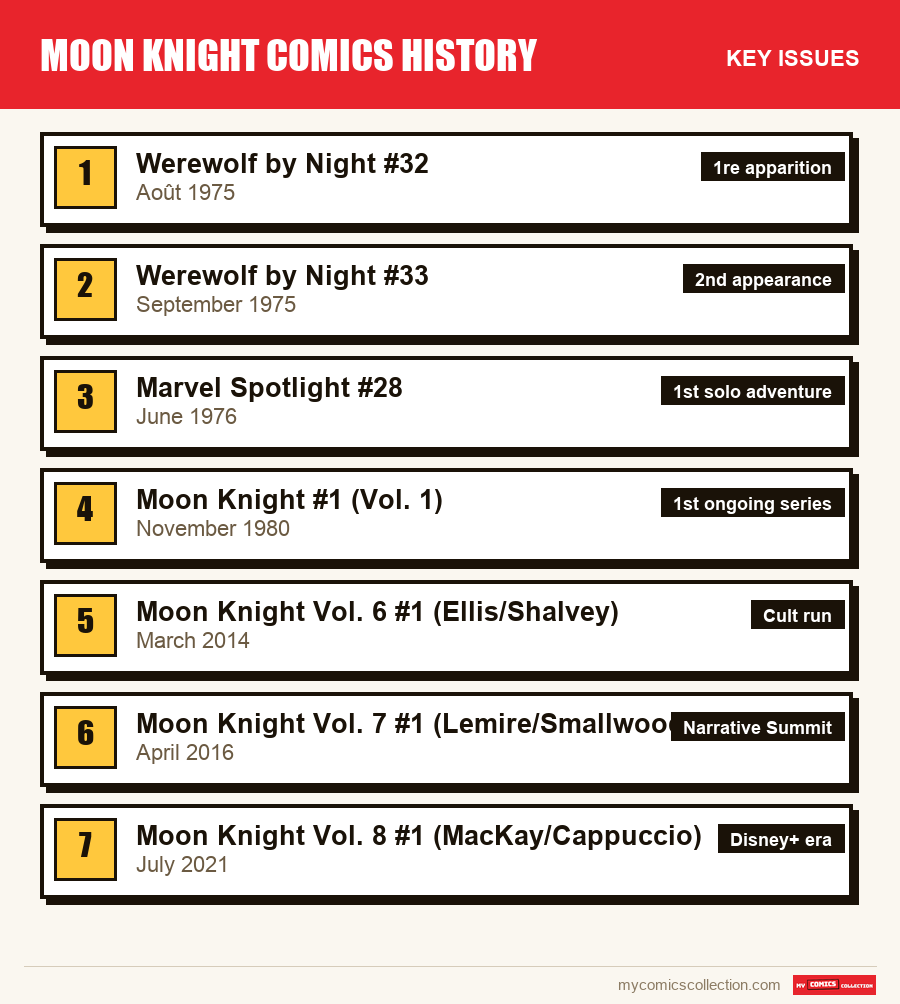
Here is the list of key issues to know to build a solid Moon Knight collection, classified in chronological order of publication:
Werewolf by Night #32
Première apparition de Moon Knight. Marc Spector, hired as a mercenary by the Committee to capture Jack Russell, appears in a white and silver suit. Written by Doug Moench , dessiné par Don Perlin. This is the absolute holy grail of any Moon Knight collection: the issue whose value increased tenfold with the Disney+ announcement.
Werewolf by Night #33
Second appearance. Spector turns against the Committee and helps Jack Russell: the hero's founding moment. Essential for the completeness of the origin story.
Marvel Spotlight #28
First solo adventure excluding Werewolf by Night. Key issue has long been undervalued, its popularity has exploded with the MCU.
Moon Knight #1 (Vol. 1)
First issue of the first ongoing series. Moench/Sienkiewicz, distributed exclusively in direct market. Iconic crescent moon cover.
Moon Knight Vol. 6 #1 (Ellis/Shalvey)
Start of the cult Ellis/Shalvey/Bellaire run. Full white costume, one-shot format by number. Key issue Modern Age in high demand.
Moon Knight Vol. 7 #1 (Lemire/Smallwood)
Narrative peak of the character. The opening in a psychiatric hospital has become a cult scene in modern comics.
Moon Knight Vol. 8 #1 (MacKay/Cappuccio)
Longest run Moon Knight since the 90s. Entry point for the post-Disney+ generation: sustained demand.
Chronological summary of the Moon Knight volumes
| Volume | Period | Nº | Creative team |
|---|---|---|---|
| Werewolf by Night #32-33 | 1975 | 2 | Doug Moench / Don Perlin |
| Marvel Spotlight #28-29 | 1976 | 2 | Doug Moench / Don Perlin |
| Hulk Magazine #11-20 | 1978-1980 | ~8 | Doug Moench / Bill Sienkiewicz |
| Moon Knight Vol. 1 | 1980-1984 | 38 | Doug Moench / Bill Sienkiewicz |
| Fist of Khonshu (Vol. 2) | 1985 | 6 | Alan Zelenetz / Chris Warner |
| Marc Spector: Moon Knight (Vol. 3) | 1989-1994 | 60 | Chuck Dixon, T. Kavanagh / various |
| Resurrection War | 1998 | 4 | Doug Moench / Tommy Edwards |
| High Strangers | 1999 | 4 | Doug Moench / Mark Texeira |
| Moon Knight Vol. 4 | 2006-2009 | 30 | Charlie Huston, Mr. Benson / David Finch |
| Revenge of the Moon Knight | 2009-2010 | 10 | Gregg Hurwitz / Jerome Opeña |
| Moon Knight Vol. 5 | 2011-2012 | 12 | Brian M. Bendis / Alex Maleev |
| Moon Knight Vol. 6 | 2014-2015 | 17 | Warren Ellis, B. Wood, C. Bunn / D. Shalvey |
| Moon Knight Vol. 7 | 2016-2018 | 14 | Jeff Lemire / Greg Smallwood |
| Moon Knight Vol. 8 | 2021-2023 | 30+ | Jed MacKay / Alessandro Cappuccio |
Building your Moon Knight collection: practical advice
Moon Knight is a character whose bibliography is surprisingly manageable for a 50 year old Marvel hero. Unlike Spider-Man (900+ issues of Amazing alone) or Batman (thousands of issues), the entire ongoing Moon Knight volumes total approximately 250 numbers, to which are added around twenty mini-series. A determined collector can realistically aim for the full run.
Tight budget (less than 200 euros): the runs Ellis/Shalvey (#1-6, ~40 euros), Lemire/Smallwood (#1-14, ~60 euros) and MacKay Vol. 8 (2-3 euros per issue in bins) offer the quintessence of Moon Knight for a minimal investment.
Average budget (500-1,500 euros): add it Moon Knight Vol. 1 #1 in raw (VF/NM, 200-500 euros), Vol. 4 complete Huston/Finch (100-200 euros in lots), and Marc Spector: Moon Knight #1 to cover each volume.
High budget (3,000+ euros): the Holy Grail remains Werewolf by Night #32: a raw in Fine (6.0-7.0) costs 2,000-4,000 euros; in CGC 9.0+, plan on 10,000 euros and more. Marvel Spotlight #28 in high condition remains undervalued compared to WBN #32.
To track your acquisitions number by number and automatically identify missing ones, use our collection management application which includes the entire Moon Knight catalog.
→ See all “History” articles on the blog
Biography of Marc Spector (Moon Knight)
Moon Knight is a character of Marvel Comics created by Doug Moench and Don Perlin. His first appearance is in Werewolf by Night #32 , published in August 1975.
Identity sheet of Marc Spector
- Real name: Marc Spector (multiple identities: Steven Grant, Jake Lockley, Mr. Knight)
- Date of birth: August 1975 (creation)
- Place of birth: Chicago, Illinois, USA
- First appearance : Werewolf by Night #32 (August 1975)
- Creators: Doug Moench (writer) and Don Perlin (artist)
- Editor: Marvel Comics
- Memberships: Avengers (West Coast), Heroes for Hire, Defenders, Khonshu (avatar)
Character origins
Marc Spector, a former Marine and mercenary, is left for dead in Egypt by his employer. In front of the statue of the god Khonshu, Egyptian god of vengeance and the moon, he agrees to become his earthly avatar in exchange for his survival. Having become Moon Knight, he fights crime in New York by alternating between multiple identities (Steven Grant: millionaire; Jake Lockley: taxi driver; Mr. Knight: daytime vigilante in a white suit).
Powers and Abilities
- Avatar of Khonshu, Egyptian god of the moon
- Amplified strength, agility and endurance (on full moon nights)
- Close combat: ex-Marine, ex-mercenary, boxing, judo, savate
- Multiple identities: Dissociative Identity Disorder (DID)
- Arsenal: crescent moon (boomerang), bo staff, grappling hook
- Mystical vision: able to see the dead and spirits
- Wealth of Steven Grant (Business Millionaire)
Costume and visual identity
Full white costume with hood, white cape, belt and white boots. Crescent moon as signature weapon. White coloring so his enemies “see him coming”: he wants to be seen.
Go further
- Moon Knight reading guide: where to start and what to collect
- The Best Moon Knight Comic Runs: Essential Reading for Collectors
- The Best Moon Knight Story Arcs
- Top 10 essential Moon Knight key issues
- Moon Knight First Appearance: Werewolf by Night #32: Value, CGC Grades & Collector Guide
- Collection Guide: Moon Knight : Complete Guide