Moon Knight (2022), created by Jeremy Slater with Oscar Isaac, adapts the lunar vigilante born in Werewolf by Night #32 (1975) by Doug Moench and Don Perlin. The series places at the center his dissociative identity disorder (Marc Spector, Steven Grant…) and his link to the Egyptian god Khonshu, in the spirit of the run Jeff Lemire (2016). She retains the essence of the character while reinventing her plot. Here is the detailed comparison, series versus comics.
The strangest and most self-contained series in the Marvel Universe upon its release, Moon Knight delves into the fractured psyche of its hero. She adapts a cult character but little known to the general public, drawing on her most notable runs. Source-by-source decryption.
As in each article in this series, only verified information (creators, distribution, dates, comic numbers) is stated; the comparative analysis is ours, without reproducing dialogue or protected images.
Title : Moon Knight (2022)
Creator: Jeremy Slater
Actors: Oscar Isaac (Marc Spector / Steven Grant / Moon Knight), Ethan Hawke (Arthur Harrow), May Calamawy (Layla)
Broadcast: March-May 2022, Disney+ (6 episodes)
Studio: Marvel Studios
Werewolf by Night #32 (1975): Moon Knight's first appearance (Moench & Perlin)
Run by Jeff Lemire (2016): dissociative disorder comes to the fore
Multiple identities: Marc Spector, Steven Grant, Jake Lockley
Khonshu: the Egyptian god of the moon
- Dissociative identity disorder by Marc Spector, at the heart of the story.
- THE multiple identities: Marc Spector, Steven Grant, and beyond.
- Khonshu, the Egyptian god who makes Marc his avatar.
- Le white suit and crescent moon weapons.
- Imaging Egyptian and mystical of the character.
- Steven Grant becomes a shy London museum employee, far from the comic book millionaire.
- Arthur Harrow, the antagonist, is largely reinvented for the series.
- Layla is a creation specific to the series (close to Marlene from the comics).
- The plot highlights Ammit and the Egyptian pantheon.
- The story is autonomous, largely detached from the rest of the saga.
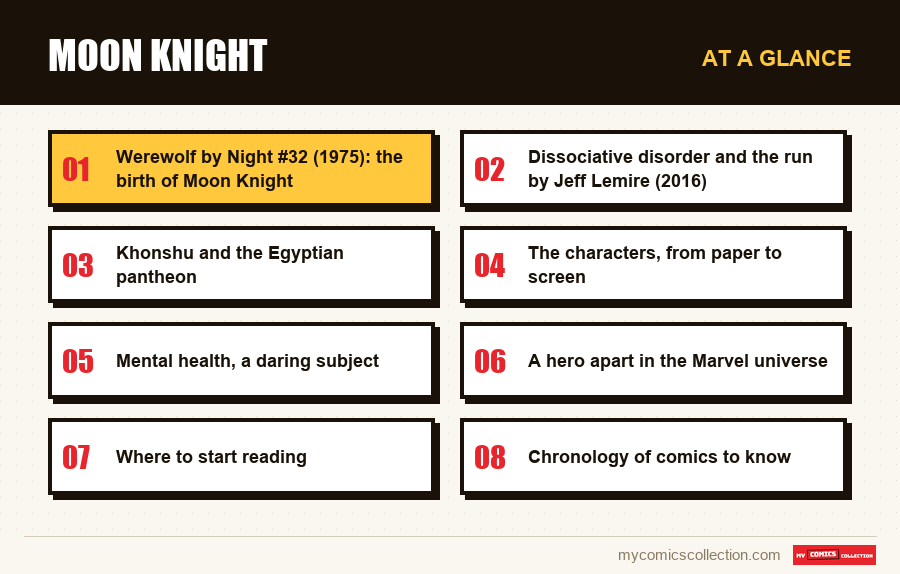
Werewolf by Night #32 (1975): the birth of Moon Knight
Moon Knight first appears in Werewolf by Night #32 (1975), created by Doug Moench and Don Perlin. Originally, he was just a mercenary, Marc Spector, hired to capture the werewolf of the title, but the character, dressed in white and armed with crescent moons, enjoyed immediate success which earned him his own series. His myth is then built: a former mercenary left for dead in Egypt, Marc is resurrected by the lunar god Khonshu, whose avatar he becomes on Earth, the “fist of vengeance”. The series faithfully takes up these foundations (the white costume, the crescent weapons, the link to Khonshu, the Egyptian imagery) as well as the brutal and tormented vigilante nature of the character. Oscar Isaac plays this fractured hero with praised intensity.
This character, long remained in the shadow of more famous heroes, was nevertheless one of the richest in Marvel. The series finally offers him light, relying on what has always made him unique: his fractured psyche.
Dissociative disorder and the run by Jeff Lemire (2016)
The central axis of the series, Marc Spector's dissociative identity disorder, is the character's most fascinating characteristic. For a long time, comics have evoked his multiple identities: Marc Spector the mercenary, Steven Grant the millionaire, Jake Lockley the taxi driver, so many “personalities” between which he oscillates. But it was the run by Jeff Lemire and Greg Smallwood (2016) that most seriously explored this psychiatric dimension, opening with Marc interned in an asylum, uncertain of what is real. The series is directly in line with this: it places dissociative disorder at the heart of the story, plays on the confusion between reality and delirium, and makes mental health its real subject. This fidelity to Lemire's psychological approach distinguishes the series, which treats its hero not as a simple costumed vigilante, but as a being in struggle with his own mind.
Khonshu and the Egyptian pantheon
The series develops the character's Egyptian mythology. Khonshu, the god of the moon who makes Marc his avatar, is a demanding and manipulative figure, whose voice haunts the hero. The series faithfully reproduces this complex relationship between the god and his servant, made of debt and servitude. She enriches the plot with other Egyptian deities, notably Ammit, the devourer of souls, whom the antagonist Arthur Harrow seeks to free. This mystical framework, anchored in the mythology of ancient Egypt, is specific to the character and clearly distinguishes him from the other heroes of the saga. The series fully embraces this strangeness, offering a story halfway between an archaeological adventure film, a psychological thriller and the supernatural.
The characters, from paper to screen
- Marc Spector / Moon Knight: True to Werewolf by Night #32: resurrected mercenary, avatar of Khonshu.
- Steven Grant: Reinvented as a shy museum employee, far from the comic book millionaire.
- Khonshu: The demanding moon god, faithful to his complex relationship with Marc.
- Arthur Harrow: Largely reinvented antagonist, follower of Ammit.
- Layla: Creation specific to the series, close to Marlene from the comics.
Collecting this series?
Track what you own, what you are missing and what your collection is worth. 7 day trial.
Start my trial →Mental health, a daring subject
Like other Marvel series, Moon Knight stands out for its frontal treatment of mental health. By placing dissociative identity disorder at the center, the series tackles a subject rarely treated in the superhero genre with such seriousness. She refuses to make Marc's multiple personalities a simple gimmick: she makes them the heart of a story about trauma, dissociation and the difficulty of rebuilding oneself. This approach, inherited from Lemire's run, gives the series an unusual psychological depth. The hero not only fights external enemies, but his own fractured mind, in a story that knowingly blurs the boundaries between reality and delirium. This narrative audacity, praised by critics, illustrates the capacity of series to explore territories that blockbusters avoid.
By treating its hero as a human being dealing with real suffering, rather than just a costumed icon, Moon Knight continues a trend in modern comics to delve deeper into the psychology of characters. Marc Spector, in the best stories and in the series, is defined not by his powers but by his inner struggle: which makes him one of Marvel's most complex and human heroes.
A hero apart in the Marvel universe
Moon Knight occupies a unique place in the Marvel catalog. Often compared, rightly or wrongly, to certain dark and wealthy vigilantes from a competing publisher (because of his costume, his arsenal and his nocturnal urban anchoring) he is radically distinguished by his mystical dimension and his fractured psyche. Where other nocturnal heroes rely on self-control, Moon Knight is defined by his loss of control, by the coexistence within him of multiple personalities, and by his servitude to a manipulative god. This originality makes him a character apart, difficult to adapt but of rare richness. The series fully embraces this singularity, refusing to smooth out the character to make him more conventional.
This outsider status has long kept Moon Knight in semi-confidentiality, appreciated by connoisseurs but unknown to the general public. However, over the decades, it has attracted some of Marvel's best authors, seduced by the psychological potential of the character. The series is part of this tradition by entrusting the hero to a team keen to preserve his complexity. By finally revealing it to the general public, she does justice to a character who, beneath his costumed vigilante exterior, hides one of the deepest portraits of mental suffering in all of comics. For the reader, it is the opportunity to discover an atypical figure, a thousand miles from the usual heroic archetypes.
Where to start reading
To discover Moon Knight, the run by Jeff Lemire and Greg Smallwood (2016) is the closest read in the series, exploring dissociative disorder head-on. We can also go back to his first appearance in Werewolf by Night #32 (1975), then discover the run by Warren Ellis and Declan Shalvey (2014), which modernized the character. The stories of Doug Moench, its creator, remain the matrix of mythology. From 1975 to 2016, this journey covers the sources of a series faithful to the psychological singularity of its hero.
Chronology of comics to know
- 1975: Werewolf by Night #32: First appearance of Moon Knight.
- 1980s: Doug Moench's series, matrix of the character's mythology.
- 2014: run by Warren Ellis and Declan Shalvey (modernization).
- 2016: run by Jeff Lemire and Greg Smallwood: dissociative disorder in the foreground.
Collection side: what numbers to aim for after the series
Moon Knight highlights an iconic Bronze Age key. Werewolf by Night #32 (first appearance of Moon Knight) is the centerpiece, a highly sought-after number whose popularity has risen sharply with the series and the growing popularity of the character. The collections of runs by Ellis (2014) and Lemire (2016) offer the best entry point into reading, on a controlled budget. Werewolf by Night #32 is among the most prized early releases of the 1970s. As always, condition and grading determine value; relying on real recent sales is strongly recommended. It is a target of choice for a collector attentive to characters on the rise.
Its place in the saga and for the collector
Moon Knight stood out for his autonomy and daring, proving that the Marvel Universe could accommodate dark and introspective stories. For the collector, the series had a spectacular effect on Werewolf by Night #32, whose value jumped with the adaptation: a textbook case of the effect of a series on the market. This film illustrates the power of cinema and series to rediscover characters who have long been confidential. Beyond speculation, the series invites us to explore one of Marvel's most unique heroes, whose psychological complexity makes him a special case. By treating dissociative disorder with seriousness and empathy, Moon Knight does justice to a character that the best authors, from Moench to Lemire, have always thought of as a deeply human figure beneath his lunar vigilante mask.
The verdict: the lunar vigilante, in all its complexity
- Loyalty: dissociative disorder, multiple identities, Khonshu and Egyptian imagery come from comics.
- Freedoms: Steven Grant reinvented, Arthur Harrow revamped, Layla created for the series, a standalone story.
- Collectible numbers: Werewolf by Night #32 (first appearance), runs by Ellis (2014) and Lemire (2016).
Moon Knight adapts one of Marvel's most complex characters by placing his fractured psyche at the heart of the narrative. Faithful to Khonshu, to multiple identities and to Lemire's psychological approach to running, the series dares a dark and introspective tone. For both the reader and the collector, it is an invitation to discover the lunar vigilante and one of the most popular first appearances of the 1970s.
Frequently asked questions
In Werewolf by Night #32 (1975), created by Doug Moench and Don Perlin. Initially a simple mercenary engaged against the werewolf, he enjoyed immediate success which earned him his own series.
Yes: Marc Spector's multiple identities (Steven Grant, Jake Lockley, etc.) are old, but it is Jeff Lemire's run (2016) which most seriously explored dissociative identity disorder, an approach that the series takes up.
The Egyptian god of the moon, who resurrects Marc Spector and makes him his avatar on Earth, the “fist of vengeance”. The series faithfully reproduces this complex relationship, made of debt and servitude.
Little: Moon Knight is one of the most autonomous series in the Marvel universe, largely detached from the rest of the saga, which allows it to assume its dark tone and its anchoring in Egyptian mythology.
Werewolf by Night #32 (first appearance of Moon Knight) is the centerpiece, a Bronze Age key whose popularity has risen sharply with the series.
Does the series make you want to collect? Estimate the value for free of your issues (Werewolf by Night #32…) with our tool based on current eBay listings.