
Khonshu, Egyptian god of the moon borrowed from the real pantheon of ancient Egypt, entered the Marvel catalog with Moon Knight #1 (November 1980, Doug Moench and Bill Sienkiewicz), even if his "champion" Marc Spector had already appeared five years earlier in Werewolf by Night #32 (August 1975). Long a secondary character reserved for readers of Moon Knight, Khonshu gained mainstream notoriety with the 2022 Disney+ series, where F. Murray Abraham lends him his voice, causing a lasting surge in Bronze Age keys linked to the lunar vigilante.
There are few Marvel figures whose editorial history sticks so closely to that of a deity truly worshiped in Antiquity. Khonshu is not an invention from scratch like Galactus or Ego: it is a revival, stylized and hardened, of a lunar god from the Theban pantheon that the Egyptians already honored more than three thousand years before Doug Moench put him down on paper. This double identity, between mythological artifact and comic book creation, explains why Khonshu occupies a special place in the Marvel universe: he is never completely a supervillain, never completely a benevolent god, and this ambiguity has fueled forty-five years of stories where we never really know if he manipulates his avatar Marc Spector or if he protects him.
For the collector, following Khonshu is like following the complete publishing history of Moon Knight, since the god never had a title to his name until recent years. This means that we have to look at several different series and several decades: the Bronze Age origins at Marvel Spotlight, the launch of the solo series in 1980, the modern runs of Jason Aaron and Jed MacKay, up to the arrival of the character on Disney+. Each of these stages has left key issues whose rating and availability vary enormously, from the bronze age book with a small circulation to the modern comic printed in tens of thousands of copies.
This article traces the real history of Khonshu, from its original Egyptian cult to its most recent adaptations, based on verifiable editorial facts: publication dates, creative teams, key issues and documented market elements.
Khonshu at Marvel: from a real Egyptian god to a Bronze Age editorial creation
Before being a comic book character, Khonsu (we also find the spellings Chons or Khons in French-speaking Egyptology) was one of the major gods of the Egyptian pantheon, associated with the moon, the passage of time and healing. Its name is generally translated as “the one who crosses” or “the traveler”, in reference to the nocturnal course of the moon in the sky. He formed, with Amon and Mut, the Theban triad venerated at the great temple of Karnak, where a sanctuary was specifically dedicated to him. Ancient representations most often show him in a human appearance wearing a lunar disk placed on a crescent, sometimes with a falcon's head reminiscent of Horus. According to the stories, he could be a protective deity associated with fertility and growth, or on the contrary a force capable of unleashing harmful influences, a duality that the Marvel writers directly took up to build their version of the character.
1975: Marc Spector appears, but not yet Khonshu
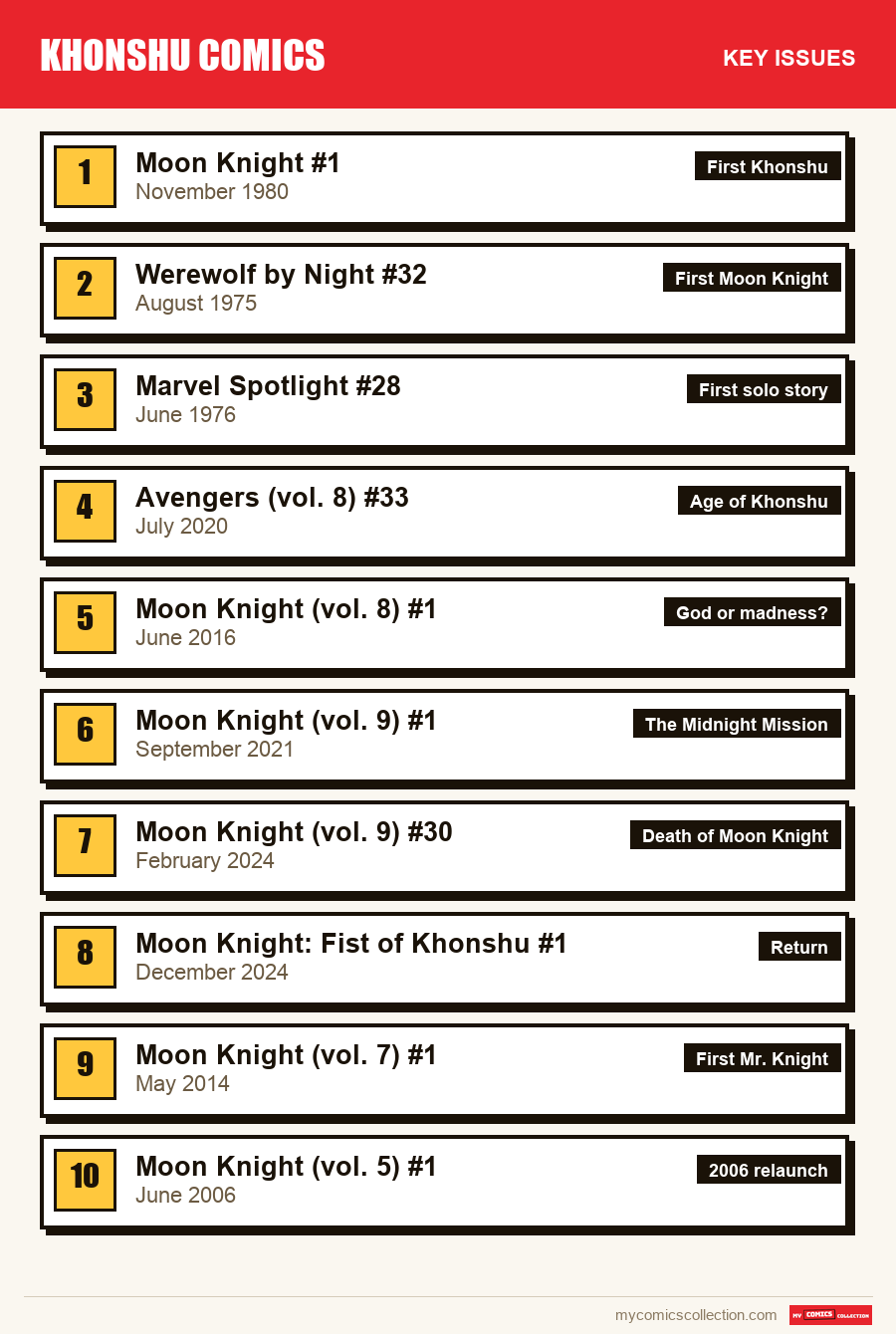
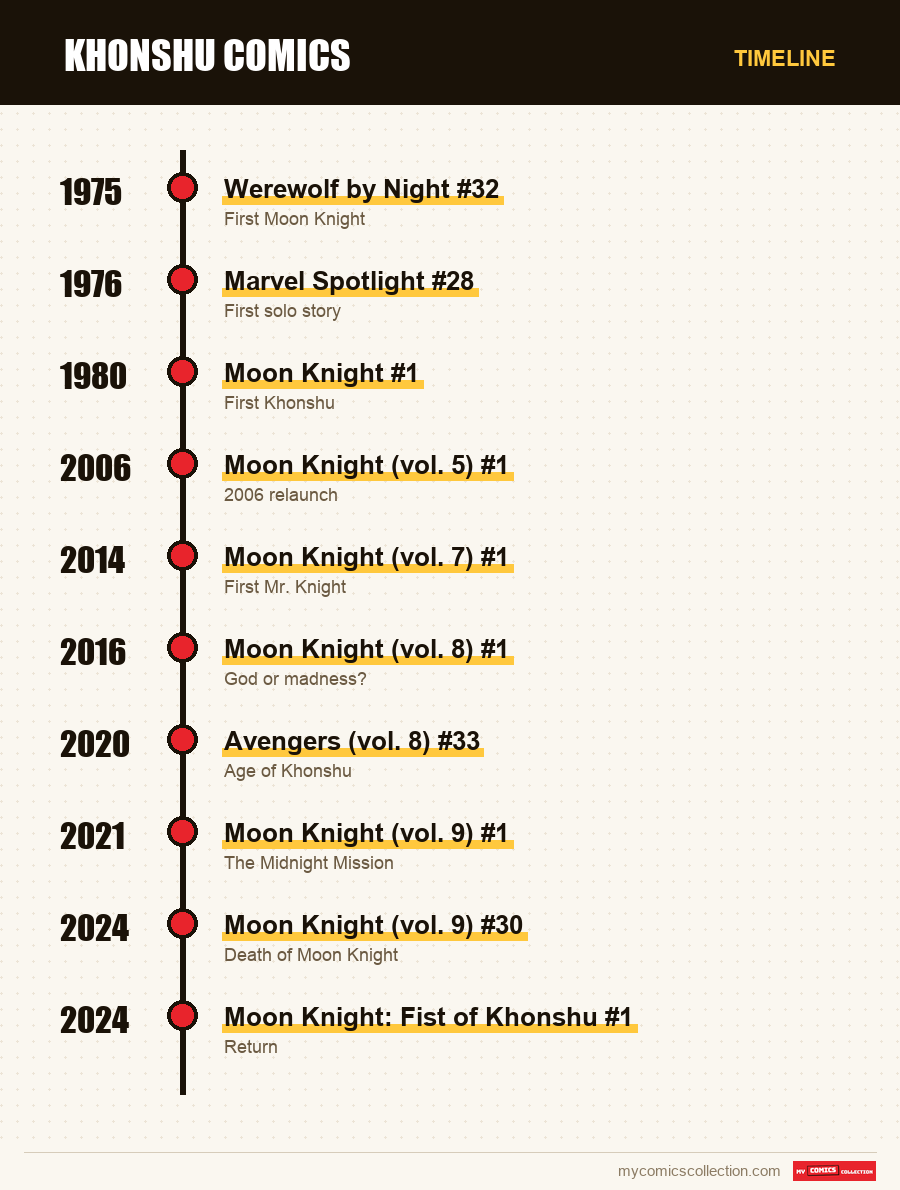
Khonshu's editorial chronology paradoxically begins without him. It is in Werewolf by Night #32, dated August 1975 and signed by screenwriter Doug Moench and artist Don Perlin, that the character of Moon Knight takes his very first steps, in the guise of a mercenary hired to hunt down Jack Russell, the werewolf of the title. Marc Spector is already presented there as the “Fist of Khonshu”, a filiation mentioned in full, but the god himself does not appear physically in these pages: he remains a reference, a name associated with the costume, without graphic incarnation or dialogue scene. This is an important nuance for a collector, since it clearly distinguishes Moon Knight's first appearance from Khonshu's first appearance as a full character, two milestones separated by five years in the title's history.
1976: Marvel Spotlight #28 deepens the character without lifting the veil on the god
Moon Knight got his first solo story in Marvel Spotlight #28, published in June 1976, again written by Doug Moench with art by Don Perlin. This issue, titled “The Crushing Conquer-Lord!” », develops the multiple identities of the character (Jake Lockley, Steven Grant) and introduces two recurring figures from the Moon Knight mythology: Marlene Alraune, his great long-term love, and the informant Bertrand Crawley. Khonshu remains an implicit presence, a name cited to justify the powers and the costume of the hero, but without a scene that directly depicts him. This issue remains sought after by Bronze Age collectors today as the true narrative birth of Moon Knight as a hero in his own right, before his own series.
1980: Moon Knight #1, the real editorial birth of Khonshu
It was not until the launch of the first Moon Knight series, in November 1980, that Khonshu truly took shape on the page. This first issue, still written by Doug Moench but drawn this time by Bill Sienkiewicz, develops an extended origin of the character: Marc Spector, a mercenary left for dead in the Egyptian desert, is brought before a statue of the god in an ancient temple. Spector rises there and puts on the idol's cloak to become the god's earthly avatar, the “Fist of Khonshu”; in this issue, Khonshu is still only a silent statue. This resurrection scene, often described by historians of the medium as definitive for the character, firmly establishes Khonshu as a full-fledged entity in the Marvel pantheon and also introduces Bushman, one of the recurring enemies of the series. It is this issue which constitutes, from a strict editorial point of view, the first appearance of the god Khonshu as readers know him today, distinct from the first appearance of the Moon Knight costume five years earlier. The Moench/Sienkiewicz duo then built the entire mythology that made the series' reputation in the 1980s, mixing urban thriller and Egyptian fantasy, a mixture of tones which remains the character's trademark even today.
From the 1980s to modern revivals: a god by turns ally and threat
After the launch in 1980, Khonshu remained lastingly associated with the sole title Moon Knight for several decades, appearing throughout the series' relaunches in the 1980s, 2000s and then 2010. The character regularly changes register: sometimes demanding mentor, sometimes cold manipulator who pushes Marc Spector to violent acts to establish his power on Earth. This instability of characterization, far from being a defect, has become a central narrative driving force: the successive screenwriters play on the permanent doubt which surrounds the real intentions of the god, between benevolent protector of travelers of the night and cold entity having nothing to do with the well-being of its human avatar.
Between the original launch in 1980 and the Jason Aaron turn of the 2020s, the character has gone through several notable relaunches, each of which reinterprets Khonshu's place in Marc Spector's life. The 2006 series launched by Charlie Huston refocuses the story on a Spector consumed by guilt and addiction, before Mike Benson took over the writing from issue 14, all concluding at issue 30 in 2009. In 2011, it was the turn of Brian Michael Bendis and designer Alex Maleev to relaunch the title with an approach closer to the Californian thriller, Spector having moved to Los Angeles to himself embody three heroic avatars inspired by the Avengers. Warren Ellis then took over the series in 2014 for a tight run in six issues which brought the hero back to New York under the identity of "Mr. Knight", three-piece white suit and strict mask, with a deliberately more urban and less mystical approach to the mythology of the god. Brian Wood then Cullen Bunn each pursue an arc in stride. However, it is the series launched in 2016 by Jeff Lemire and designer Greg Smallwood which pushes the founding ambiguity of the character the furthest, by directly questioning whether Khonshu is a truly divine entity or a mental construction linked to the dissociative identity disorder from which Marc Spector suffers, a questioning which has lastingly marked the critical perception of the character and influenced the reading subsequently offered by the Disney+ series.
“Age of Khonshu”: when the god takes control
The most significant turning point in the Khonshu mythology for the current generation of readers comes with the arc “The Age of Khonshu”, published in Avengers (2018) #33 to #38 by Jason Aaron. The story imagines an alternate future in which Khonshu, freed from all constraints, conquers Earth and establishes a brutal theocratic rule, forcing the Avengers to confront the deity directly rather than just his avatar. This arc had a direct editorial consequence: it served as a springboard for the launch of a brand new Moon Knight series in 2021, written by Jed MacKay with Alessandro Cappuccio on the drawings, which deepens the power relationship between Marc Spector and his god. As this series opens, Khonshu is locked in the dungeons of Asgard, where he was imprisoned after his defeat at the end of “Age of Khonshu”, a reversal which upsets the balance of power established since 1980 between the god and his avatar.
The Death of Moon Knight and the Return of Khonshu
Jed MacKay's run spans thirty issues and ends with the death of Marc Spector, a rare event for a character of this status at Marvel. It is Khonshu himself who brings his avatar back to life during the Blood Hunt event, which relaunches the series under a new title, Moon Knight: Fist of Khonshu, with a resurrected Marc Spector and a relationship with his god once again rehashed. This recent sequence clearly illustrates the constant in Khonshu mythology since 1980: the god is never completely on the side of good nor completely on the side of evil, and each screenwriter reinterprets this cursor in his own way, which makes the character particularly rich to follow in a collection over time.
Collecting this series?
Track what you own, what you are missing and what your collection is worth. 7 day trial.
Start my trial →The impact of adaptations on the rating
As with many second-rate Marvel characters for decades, it was the arrival on screen that shook up the collector's perception of Khonshu and Moon Knight. The Disney+ series Moon Knight, released on March 30, 2022, stars Oscar Isaac in the role of Marc Spector/Steven Grant, Ethan Hawke as antagonist Arthur Harrow, and especially F. Murray Abraham, Oscar-winning actor for Amadeus, who lends his cavernous voice to the god Khonshu. This vocal incarnation greatly contributed to popularizing the character among an audience who until then knew neither Moon Knight nor his tutelary god, making Khonshu one of the most discussed “villains without being a villain” of phase 4 of the MCU.
The effect on the old comic market was immediate and especially lasting on high grade copies. Werewolf by Night #32, which remains the very first physical appearance of Marc Spector in the costume of Moon Knight, illustrates this phenomenon well: a copy rated CGC 9.8 traded around $3,000 in 2013, before climbing to $14,500 in 2015, driven by the progressive recognition of the character. A copy in NM+ 9.6 sold for $12,000 at the end of 2019, still before the television series aired, while copies in average condition (FN 6.0) were circulating for around $1,100. On the highest grades, the highest sale reported for a 9.8 reached $72,000, a price level which places this issue among the most expensive bronze age books in the Marvel catalog, to be put in relation to its real rarity in very high conservation: the number of copies rated 9.8 by CGC remains very limited, of the order of around twenty copies listed at the maximum level.
The dynamic is very different for Moon Knight #1 (1980), which nevertheless contains the true first appearance of the god Khonshu himself. Published at a time when Marvel print runs were significantly higher and the comic shop market was just beginning to structure itself around direct sales, this issue remains much more abundant in circulation, including in very high grades. A CGC 9.8 copy therefore trades in a much more modest range, of the order of a few hundred dollars, with variations depending on the period and current demand. This is a point often misunderstood by beginning collectors: the "true" first appearance of a character is not always the most expensive issue, with the relative rarity of the print run and the number of surviving high-grade copies weighing at least as much as the narrative importance of the issue in the final grade.
Marvel Spotlight #28, which contains Moon Knight's first solo story, has also benefited from a renewed structural interest since 2022, without reaching the heights of Werewolf by Night #32: it remains positioned as an intermediate bronze age book, sought after by collectors who want to cover all of the character's editorial milestones rather than just the first costumed appearance.
Buying guide
Following Khonshu and Moon Knight in a collection requires clearly distinguishing the different editorial layers of the character, each with its own pitfalls and opportunities. Here are the points to be aware of before purchasing:
- Do not confuse the two “first appearances”. Werewolf by Night #32 (1975) is the first appearance of Moon Knight's costume and identity; Moon Knight #1 (1980) is the first appearance of the god Khonshu as a physically depicted character. These are two distinct keys, with completely different rarity and price profiles.
- Systematically check the condition of the paper on bronze age copies. Comics from the mid-1970s are particularly prone to yellowing and weakening of the paper; a copy advertised as high grade but with browned or brittle pages loses a significant part of its value, even without official certification.
- Favor certified copies for high-stakes bronze age books. On an issue like Werewolf by Night #32, the gap in value between grades is considerable; CGC certification or equivalent secures the purchase and avoids unpleasant surprises from undeclared restoration.
- Don’t neglect secondary milestones. Marvel Spotlight #28 (first solo story) and the major modern relaunches (Moon Knight 2021 by Jed MacKay, “Age of Khonshu” arc in Avengers) usefully complete a character-centered collection without requiring the budget of a very high gradation bronze age book.
- Keep in mind that Moon Knight #1 (1980) remains accessible even in very high conservation. The larger print runs of the era make this a great entry point to owning the first physical appearance of Khonshu without a Bronze Age budget.
- Follow the character's editorial news. Recent series (Fist of Khonshu) and possible new television or cinematographic adaptations can reactivate demand for all keys linked to Khonshu, including numbers that are currently underrated.
- Compare several recent sales before setting your budget. The prices of books linked to characters featured in a recent adaptation fluctuate more than average; an updated estimate remains preferable to a fixed list price.
To organize the tracking of these different numbers throughout your acquisitions, the use of a dedicated tool like our collection management application allows you to keep an overview of the condition, gradation and provenance of each copy, a real plus when a collection spans several editorial decades as is the case for Khonshu and Moon Knight.
Key issues to know
Moon Knight #1
Doug Moench and Bill Sienkiewicz tell Marc Spector's expanded origin: betrayed by fellow mercenary Bushman and left for dead in the desert, he is laid before a statue of Khonshu and rises as Moon Knight. The god appears for the first time, as a statue. Bushman also debuts here.
Werewolf by Night #32
Doug Moench and Don Perlin introduce Marc Spector as a mercenary paid by the Committee to capture Jack Russell, the werewolf of the title. It is the first appearance of the Moon Knight costume, five years before Khonshu himself shows up.
Marvel Spotlight #28
Moon Knight gets his first starring adventure, again by Doug Moench and Don Perlin. The issue introduces Marlene, his long-time partner, and the informant Crawley, whom Spector consults as cab driver Jake Lockley.
Avengers (vol. 8) #33
Jason Aaron and Javier Garrón launch The Age of Khonshu: the god wants to rule Earth in order to save it and has Moon Knight take down the Avengers one by one. For the first time, the team faces Khonshu directly rather than just his avatar.
Moon Knight (vol. 8) #1
Jeff Lemire and Greg Smallwood wake Marc Spector up in a psychiatric hospital, powerless and holding a lifetime of medical records. The series asks the question head-on: is Khonshu real or a product of Spector's mind?
Moon Knight (vol. 9) #1
Jed MacKay and Alessandro Cappuccio put Marc Spector at the head of the Midnight Mission, where, as Mr. Knight, he protects people threatened by the supernatural. The high priest states from the outset that Khonshu deserves no one's worship, redefining their relationship.
Moon Knight (vol. 9) #30
The last issue of Jed MacKay and Alessandro Cappuccio's run ends with the death of Marc Spector. The members of the Midnight Mission carry on his work, a rare ending for a Marvel character of his standing.
Moon Knight: Fist of Khonshu #1
Jed MacKay and Alessandro Cappuccio relaunch the character with Marc Spector back from the dead, once again the Fist of Khonshu. The title reuses the god's avatar nickname, already the title of a 1985 mini-series.
Moon Knight (vol. 7) #1
Warren Ellis and Declan Shalvey bring Spector back to New York as a police consultant in a white three-piece suit: it is the first appearance of the Mr. Knight identity. Khonshu shows up as a cobweb-covered vision.
Moon Knight (vol. 5) #1
Charlie Huston and David Finch find a broken Marc Spector, confined to a wheelchair in his empty mansion, looking back at the events that brought him there. This darker series runs to #30.