Venom (2018) Ruben Fleischer , with Tom Hardy in the role of Eddie Brock, adapts the antihero born in Amazing Spider-Man #300 (1988) by David Michelinie and Todd McFarlane, based on the symbiote that appeared in Secret Wars #8 (1984). The film retains the Eddie/symbiote fusion and the “lethal protector”, but cuts all ties with Spider-Man and invents a space origin via the Life Foundation. Here is the detailed comparison, film versus comics.
The first film in the Sony universe dedicated to characters linked to Spider-Man, Venom brings to the screen one of Marvel's most popular antiheroes. It draws on the symbiote saga and the stories of Eddie Brock. Source-by-source decryption.
As in each article in this series, only verified information (creators, distribution, dates, comic numbers) is stated; the comparative analysis is ours, without reproducing dialogue or protected images.
Title : Venom (2018)
Director: Ruben Fleischer
Actors: Tom Hardy (Eddie Brock / Venom), Michelle Williams (Anne Weying), Riz Ahmed (Carlton Drake / Riot)
Exit : October 2018
Studio: Sony Pictures (Columbia)
Secret Wars #8 (1984): 1st appearance of the symbiote
Amazing Spider-Man #300 (1988): 1st appearance of Venom (Eddie Brock)
Venom: Lethal Protector (1993): the antihero and the symbiotes of the Life Foundation (Riot)
Anne Weying: Eddie's ex-wife, future She-Venom
- Eddie Brock, journalist whose career is collapsing.
- La Eddie/symbiote fusion and their inner dialogue.
- Venom in “lethal protector”, antihero neither good nor bad.
- Riot and the Life Foundation symbiotes.
- Anne Weying, Eddie's ex-partner.
- No connection to Spider-Man, absent for rights reasons.
- The symbiote arrives via a space probe of the Life Foundation, not the Spidey costume.
- The tone turns to comedy and buddy movie.
- Venom becomes endearing from the outset, far from its original darkness.
- L'origin of Eddie is uncorrelated with his hatred of Spider-Man.
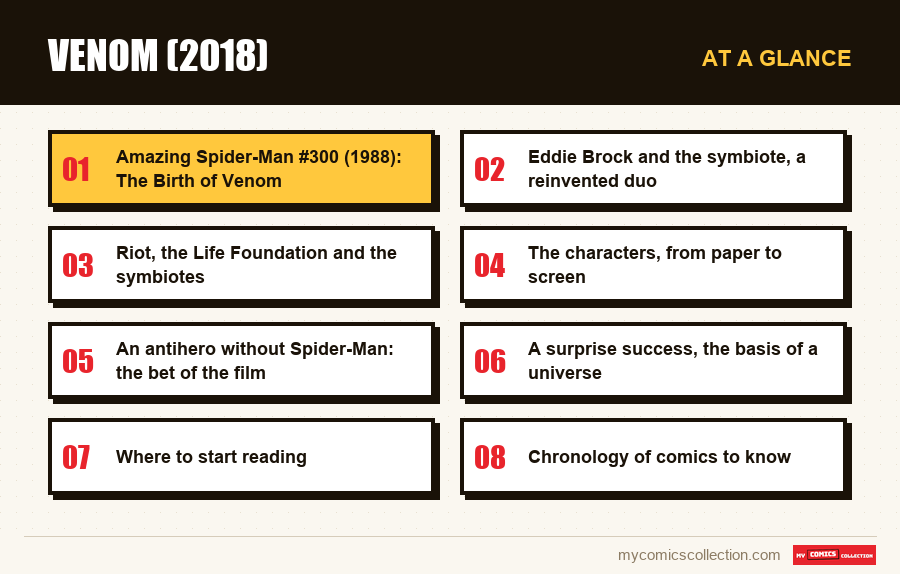
Amazing Spider-Man #300 (1988): The Birth of Venom
Venom is born in the comics from the meeting of two elements. First the symbiote, this living black suit that Spider-Man brings back from Secret Wars #8 (1984) before rejecting it upon discovering its parasitic nature. Then Eddie Brock, journalist whose career is ruined: in the comics, by an erroneous article that Spider-Man helped to deny. Consumed by hatred of the hero, Eddie becomes the ideal host for the rejected symbiote, also thirsty for revenge. From their union was born Venom, in Amazing Spider-Man #300 (1988), under the pen of David Michelinie and the pencil of Todd McFarlane. Knowing Peter Parker's secret identity, Venom immediately establishes himself as one of the hero's most dangerous and personal enemies.
The film takes the heart of the character (Eddie Brock, the fusion with the symbiote, the inner voice of Venom) but cuts the root: the absence of Spider-Man. Due to lack of rights to the character at the time, the film cannot connect Venom to Peter Parker. The entire original mythology, based on the shared hatred of Spider-Man, therefore disappears. The symbiote is no longer Spidey's discarded suit but an alien creature brought back by a space probe. This rewriting, imposed by the context, profoundly transforms the origins of Venom while preserving the essentials of the Eddie/symbiote duo.
Eddie Brock and the symbiote, a reinvented duo
The great success of the film lies in the relationship between Eddie and Venom. In the comics, the symbiote is first and foremost a threat, a manipulative parasite. On the contrary, the film makes him a talkative and cynical partner, with whom Eddie maintains a permanent dialogue, made up of arguments and complicity. This “mismatched couple” dynamic, close to comedy, gives the film its identity and its tone. Tom Hardy plays a clumsy and overwhelmed Eddie, inhabited by an inner voice that pushes him to bite and devour. This comic spring, absent from the original comics, is nevertheless based on a truth of the character: Venom is a dual being, a consciousness shared between two entities.
This humanization of the symbiote reflects the evolution of the character in the comics themselves. Over the years, Venom has gone from being a pure enemy to being an antihero, the famous “lethal protector” who defends the innocent in his brutal way. The film follows in this vein, by immediately presenting a Venom capable of choosing the side of good, in his own way. This choice, more consensual than the original darkness, appealed to a wide audience while dividing purists. It nevertheless remains faithful to a real facet of the character, developed in the comics since the 1990s.
Riot, the Life Foundation and the symbiotes
The film's antagonist, Riot, draws on a specific part of Venom's mythology: the Life Foundation symbiotes. In the comics, notably the series “Venom: Lethal Protector” (1993), the Life Foundation extracts five offspring of the Venom symbiote to make living weapons, of which Riot is one. The film takes up this idea of an organization, here led by Carlton Drake, seeking to exploit symbiotes. Riot becomes the antagonistic symbiote, more powerful and destructive, opposing Venom in a final confrontation. This loyalty to the Life Foundation anchors the film in the mythology of the symbiotes, even without Spider-Man.
The film also develops Anne Weying, Eddie's ex-partner, a character from the comics where she briefly becomes She-Venom by uniting with the symbiote. This reference, slipped into the film, will delight connoisseurs. By drawing on “Lethal Protector” and Eddie’s entourage, the film creates a coherent mythology around Venom, independent of Spider-Man. It proves that the character, long defined by his opposition to the hero, can exist on his own, carried by the richness of his own universe of symbiotes. This risky bet met with great commercial success.
Collecting this series?
Track what you own, what you are missing and what your collection is worth. 7 day trial.
Start my trial →The characters, from paper to screen
- Eddie Brock / Venom: Fallen journalist fused with the symbiote, faithful to the essentials despite an uncorrelated origin from Spider-Man.
- The Venom symbiote: Talkative and cynical partner, humanized compared to the comics.
- Carlton Drake / Riot: Antagonist inspired by the Life Foundation symbiotes.
- Anne Weying: Eddie's ex-partner, a nod to She-Venom.
- The Life Foundation: Organization that exploits symbiotes, faithful to the comics.
An antihero without Spider-Man: the bet of the film
The big challenge of the film was to bring to the screen a character entirely defined, originally, by his relationship to Spider-Man, without being able to mention the latter. The bet was daring: Venom is Spidey's rejected costume, Eddie's hatred for the hero, the knowledge of his secret identity. Depriving the character of these roots amounted to reinventing him. The film takes up the challenge by focusing on the Eddie/symbiote duo as the heart of the story, and by drawing on parts of the mythology that do not depend on Spider-Man: the Life Foundation, the symbiotes, the “lethal protector”.
This choice illustrates the particular constraints of adaptation rights, which have long divided the Spider-Man universe between studios. It also shows the intrinsic richness of Venom, capable of carrying its own film. For the reader, the film is an invitation to rediscover the character's true origins in the comics, where his relationship with Spider-Man is inseparable from his identity. He recalls that Venom, before being an autonomous antihero, was first the dark reflection of Peter Parker, born from his costume and his guilt. This dimension, absent from the film, is at the heart of the original stories.
A surprise success, the basis of a universe
Against all odds, Venom achieved immense commercial success, becoming one of the highest-grossing superhero films of its year. This triumph, despite a mixed critical reception, surprised the industry and validated Sony's strategy: building a universe of films around characters linked to Spider-Man, without the hero himself. The charisma of Tom Hardy, the offbeat tone of the Eddie/Venom duo and the public's appetite for the antihero carried the film well beyond expectations. This success launched a franchise and opened the way for sequels, as well as other films devoted to figures from the spider universe.
This phenomenon says a lot about Venom's popularity with the general public. A character born in comics at the end of the 1980s, he established himself as one of Marvel's most beloved, to the point of carrying a film franchise on his own. For the reader, this success is an opportunity to measure the progress made: from Spider-Man's enemy in Amazing Spider-Man #300 to movie star, Venom embodies the lasting fascination with antiheroes. The film, by propelling it to the forefront, has revived interest in its origin stories and in the entire saga of the symbiote, the richness of which continues to nourish both comics and the screen.
Where to start reading
To extend the film, Secret Wars #8 (1984) shows the arrival of the symbiote, and Amazing Spider-Man #300 (1988), by Michelinie and McFarlane, the birth of Venom. The series “Venom: Lethal Protector” (1993) developed the antihero and introduced the symbiotes of the Life Foundation, including Riot. This journey covers the sources of a film that reinvents the origins of Venom while remaining faithful to the spirit of the Eddie/symbiote duo.
Chronology of comics to know
- 1984: Secret Wars #8: the first appearance of the symbiote.
- 1988: Amazing Spider-Man #300: the first appearance of Venom (Eddie Brock).
- 1993: “Venom: Lethal Protector”: the antihero and the symbiotes of the Life Foundation.
Collection side: what numbers to aim for after the film
Venom points to highly sought-after modern keys. Amazing Spider-Man #300 (1988, first appearance of Venom) is one of the most coveted modern keys, driven by McFarlane and the popularity of the character. Secret Wars #8 (1984, first of the symbiont) is another important and more accessible target. The series “Venom: Lethal Protector” (1993) will interest fans of the antihero and the symbiotes of the Life Foundation. These targets cover various budgets. As always, condition and gradation determine value; relying on real recent sales is strongly recommended.
Its place in the saga and for the collector
Venom launched the Sony universe by bringing one of Marvel's most popular antiheroes to the screen, despite the absence of Spider-Man. For the collector, it permanently revived interest in Amazing Spider-Man #300 and Secret Wars #8. It illustrates the effect of adaptations on the market, especially for modern keys. Beyond speculation, the film invites you to discover the saga of the symbiote and the true origins of Venom, inseparable from Spider-Man in the comics. By reinventing the character for the screen, he proved his ability to exist on his own, while making us want to go back to his paper roots.
The verdict: an antihero reinvented for the screen
- Loyalty: Eddie Brock, the fusion with the symbiote, the “lethal protector”, Riot and the Life Foundation come from the comics.
- Freedoms: the absence of Spider-Man, the spatial origin of the symbiote, the comic tone, an immediately endearing Venom.
- Collectible numbers: Amazing Spider-Man #300 (Venom), Secret Wars #8 (symbiote), “Lethal Protector” (1993).
Venom brings to the screen a cult antihero by cutting him off from his root, Spider-Man, to focus on the Eddie/symbiote duo and the tone of comedy. Faithful to the “lethal protector” and to the Life Foundation, the film reinvents the origins of the character. For both the reader and the collector, it is an invitation to discover Amazing Spider-Man #300 and the symbiote saga.
Frequently asked questions
The symbiote appears in Secret Wars #8 (1984); Venom is born from his fusion with Eddie Brock in Amazing Spider-Man #300 (1988), by David Michelinie and Todd McFarlane. The film resumes the Eddie/symbiote duo but without Spider-Man.
For rights reasons: at the time, the film could not link Venom to Spider-Man. The entire original mythology, based on the shared hatred of the hero, is therefore rewritten, the symbiote arriving via a space probe.
An antagonistic symbiote inspired by the offspring of the Life Foundation, developed in "Venom: Lethal Protector" (1993). The film makes him the enemy of Venom, more powerful and destructive, played by Riz Ahmed (Carlton Drake).
The ongoing dialogue between Eddie and Venom draws on the dual nature of the character, but its comedic treatment and the immediately endearing Venom are unique to the film. The original comics present a much darker character.
Amazing Spider-Man #300 (1988, Venom premiere) is one of the most coveted modern keys. Secret Wars #8 (symbiote) is a more accessible target.
Does the film make you want to collect? Estimate the value for free of your issues (Amazing Spider-Man #300, Secret Wars #8…) with our tool based on current eBay listings.