
Venom: Let There Be Carnage (2021) Andy Serkis pits Venom against Carnage , born in Amazing Spider-Man #361 (1992) by David Michelinie and Mark Bagley, played by the serial killer Cletus Kasady (Amazing Spider-Man #344, 1991). The film keeps Kasady, the red symbiote and his companion Shriek, but cuts all ties with Spider-Man and greatly lightens the tone. Here is the detailed comparison, film versus comics.
Following the first Venom, the film brings to the screen the symbiote's most feared enemy: Carnage, a murderous and unstable offspring. It draws on the horrific stories of the 1990s. Decryption source by source.
As in each article in this series, only verified information (creators, distribution, dates, comic numbers) is stated; the comparative analysis is ours, without reproducing dialogue or protected images.
Title : Venom: Let There Be Carnage (2021)
Director: Andy Serkis
Actors: Tom Hardy (Eddie / Venom), Woody Harrelson (Cletus Kasady / Carnage), Naomie Harris (Shriek)
Exit : October 2021
Studio: Sony Pictures (Columbia)
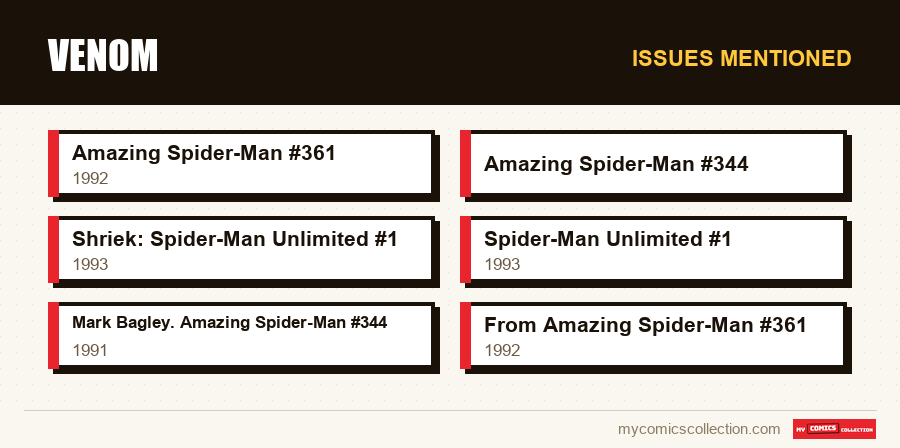
Amazing Spider-Man #344 (1991): Cletus Kasady's first appearance
Amazing Spider-Man #361 (1992): Carnage's first appearance
Shriek: Spider-Man Unlimited #1 (1993)
“Maximum Carnage”(1993): the great saga of Carnage
- Cletus Kasady, psychopathic serial killer.
- Carnage, red symbiote derived from that of Venom.
- Carnage more powerful and unstable than Venom.
- Shriek, Cletus' companion, with sonic powers.
- La rivalry Venom ↔ Carnage, father and offspring.
- No Spider-Man, while “Maximum Carnage” revolves around him.
- Un your lightened, far from the horror of comics.
- Carnage born via Eddie (blood), unrelated to Spidey.
- The saga “Maximum Carnage” is not suitable.
- Shriek's relationships and origin are condensed.
Amazing Spider-Man #361 (1992): The Birth of Carnage
Carnage appears in Amazing Spider-Man #361 (1992), created by David Michelinie and Mark Bagley, a few months after the introduction of his host, serial killer Cletus Kasady, in Amazing Spider-Man #344 (1991). The idea is chilling: the Venom symbiote generates an offspring, redder, more violent and more unstable, which unites with an already murderous psychopath. Where Eddie Brock retained a part of humanity, Cletus Kasady is a pure killer, whose madness increases the savagery of the symbiote tenfold. Carnage instantly becomes one of Spider-Man's most feared foes, a threat so extreme that Venom himself must team up with the hero to stop him.
The film faithfully takes up the heart of the character: Cletus Kasady, the killer, and Carnage, the red symbiote born from that of Venom, more powerful than his “father”. Woody Harrelson plays a disturbing Kasady, faithful to the character's dementia. The main freedom lies, as with the first film, in the absence of Spider-Man. In the comics, Carnage is inseparable from the hero's universe; the film only connects him to Venom, giving rise to the Red symbiote from Eddie's blood. This rewriting preserves the Venom/Carnage connection while cutting it from its original context.
Cletus Kasady and Shriek, a dementia couple
The film develops the relationship between Cletus Kasady and Shriek, a character from the comics where she appears in Spider-Man Unlimited #1 (1993). Endowed with sonic powers and mental instability, Shriek and Kasady form a destructive couple, united by madness. This dynamic, present in the comics, notably during the “Maximum Carnage” saga where they form a family of psychopaths, structures the film’s narrative. Naomie Harris plays a tormented Shriek, whose past and powers fuel chaos. This duo of antagonists offers a counterpoint to the Eddie/Venom couple, two symbiotic relationships that are completely opposed.
This symmetry (a couple who protects, a couple who destroys) is one of the interesting springs of the film. Where Eddie and Venom learn to live together, Kasady and Carnage thrive on their shared violence. The film plays with this mirror, opposing two visions of symbiotic fusion. This reading, faithful to the spirit of the comics where Carnage embodies the dark side of Venom, gives the story thematic coherence. It reminds us that the symbiote is neither good nor bad in itself: everything depends on the host it unites with, and the humanity it retains or loses.
A lighter tone, far from the horror of comics
The most striking difference concerns the tone. In the comics, Carnage is a figure of pure horror, of extreme violence which marked readers of the 1990s. The saga “Maximum Carnage” (1993), which brings together Carnage and a band of killers facing an alliance of heroes, is a peak of brutality. The film retains the light and comic tone of the first Venom, considerably toning down the horror. The violence is stylized, the humor omnipresent, and the format tight. This choice, consistent with the identity of the franchise, disappointed fans of the horrific aspect of the character, while appealing to a family audience.
This gap illustrates a constant arbitration of adaptations: should we serve the darkness of the source or the accessibility of the general public? By opting for lightness, the film assumes its identity, even if it means smoothing out one of Marvel's most terrifying characters. For the reader, it is an invitation to discover the real Carnage in the comics, this incarnation of absolute evil which pushed Spider-Man and Venom to team up. “Maximum Carnage” and the original stories offer a much darker and more intense experience than the film, revealing the full horrific dimension of a character that the screen has chosen to soften.
Collecting this series?
Track what you own, what you are missing and what your collection is worth. 7 day trial.
Start my trial →The characters, from paper to screen
- Cletus Kasady / Carnage: Serial killer united with the red symbiote, faithful to his dementia despite a light tone.
- Eddie Brock / Venom: Forced to confront the offspring of his symbiote, continuing from the first film.
- Shriek: Kasady's companion with sonic powers, from Spider-Man Unlimited #1.
- The Carnage symbiote: Offspring of Venom, more powerful and unstable, faithful to the comics.
- Anne Weying: Ex-partner of Eddie, present in the continuity of the franchise.
Carnage, the monstrous reflection of Venom
Beyond the confrontation, the film explores a strong idea from the comics: Carnage is what Venom could have become without the humanity of Eddie Brock. The red symbiote, united with a pure psychopath, embodies unbridled violence, without the slightest moral restraint. This connection, Venom “father” of Carnage, gives their rivalry an almost familial and tragic dimension. The film depicts this opposition, making Venom an antihero forced to confront his own monstrous descendants. This is one of the aspects most faithful to the spirit of the comics, where Carnage serves as a dark mirror to Venom.
This dynamic enriches the symbiote mythology carried by the franchise. By opposing two hosts who are separated by everything (one consumed by guilt, the other by madness) the film illustrates the idea that the symbiote reveals the deep nature of the person it inhabits. For the reader, it is a gateway to the great stories of Carnage, where this reflection on monstrosity and free will is developed with an intensity that the film only touches on. Carnage appears as one of the most striking enemies in the entire Spider-Man and Venom universe.
A tighter sequel, looking towards the future
Venom: Let There Be Carnage stands out for its brevity and fast pace. Where many sequels seek to go bigger, the film assumes a tighter format, centered on the confrontation between Venom and Carnage and on the relationship, always funny, between Eddie and his symbiote. This effective bias avoids the overload that had undermined other films with multiple villains. Andy Serkis, directing, focuses on humor and action to deliver direct entertainment, faithful to the identity of the franchise established by the first part. The result, without pretension, once again met its audience.
Above all, the film stood out for its post-credits scene, which opened up new perspectives by connecting, for an instant, the universe of Venom to that of Spider-Man in the cinema. This wink electrified fans and illustrated the public's appetite for a rapprochement between characters long separated by rights. For the reader, it reminds how Venom and Carnage are, in the comics, inseparable from Spider-Man: their entire mythology revolves around the hero. By initiating this rapprochement, the franchise recognized this fundamental link, the very one that the films had to circumvent. It is towards comics that we must turn to grasp all their richness.
Where to start reading
To extend the film, Amazing Spider-Man #344 (1991) introduced Cletus Kasady, and #361 (1992) the birth of Carnage. The “Maximum Carnage” saga (1993) is the great reference for the character, bringing together Carnage, Shriek and a band of killers facing an alliance of heroes. This journey covers the sources of a film which faithfully adapts the Kasady/Carnage duo, while lightening the horror.
Chronology of comics to know
- 1991: Amazing Spider-Man #344: Cletus Kasady's first appearance.
- 1992: Amazing Spider-Man #361: Carnage's first appearance.
- 1993: “Maximum Carnage”: the great saga of Carnage and Shriek.
Collection side: what numbers to aim for after the film
Venom: Let There Be Carnage points to sought-after modern keys. Amazing Spider-Man #361 (1992, first appearance of Carnage) is a highly coveted key, driven by the popularity of the character and the pencil of Mark Bagley. Amazing Spider-Man #344 (1991, first by Cletus Kasady) is another important target, often more accessible. The issues of “Maximum Carnage” (1993) will interest fans of the saga. These targets cover various budgets. As always, condition and gradation determine value; relying on real recent sales is strongly recommended.
Its place in the saga and for the collector
Venom: Let There Be Carnage brought the symbiote's most feared enemy to the screen, despite a lighter tone and the absence of Spider-Man. For the collector, it reignited interest in Amazing Spider-Man #361 and #344, sought-after modern keys. It illustrates the effect of adaptations on the market. Beyond speculation, the film invites us to discover the real Carnage in the comics, this figure of pure horror born in the 1990s. By adapting Cletus Kasady and the red symbiote, it makes you want to go back to “Maximum Carnage” and the origin stories, much darker and more intense.
The verdict: Softened but recognizable carnage
- Loyalty: Cletus Kasady, Carnage (red symbiote from Venom), Shriek and the father/offspring rivalry come from the comics.
- Freedoms: the absence of Spider-Man, the lighter tone, the origin of Carnage via Eddie, “Maximum Carnage” not adapted.
- Collectible numbers: Amazing Spider-Man #361 (Carnage), Amazing Spider-Man #344 (Cletus Kasady), “Maximum Carnage” (1993).
Venom: Let There Be Carnage adapts Venom's monstrous spawn by retaining Cletus Kasady, Carnage and Shriek, but toning down the horror and cutting Spider-Man. Faithful to the Venom/Carnage lineage, the film remains lighter than its source. For the reader as well as the collector, it is an invitation to discover Amazing Spider-Man #361 and the “Maximum Carnage” saga, where the character reveals all the horrific excess and extreme violence that the big screen, this time, has deliberately preferred to keep at bay.
Frequently asked questions
From Amazing Spider-Man #361 (1992), created by David Michelinie and Mark Bagley. Its host, the killer Cletus Kasady, appears in #344 (1991). Carnage is an offspring of Venom's symbiote, redder, more violent and unstable.
Yes, in the comics as in the film: Carnage's symbiote, offspring of Venom's, is more powerful and unstable. United with a pure psychopath, Cletus Kasady, he becomes such an extreme threat that Venom must ally himself with others to stop him.
Cletus Kasady's companion, with sonic powers and mental instability. She appears in Spider-Man Unlimited #1 (1993) and forms, with Carnage, a destructive couple, notably during the “Maximum Carnage” saga.
No: the great 1993 saga is not adapted, and the film greatly lightens the horror. It keeps the characters (Kasady, Carnage, Shriek) but in a tighter story and a much lighter tone than the comics.
Amazing Spider-Man #361 (1992, Carnage premiere) is a highly coveted modern key. Amazing Spider-Man #344 (Cletus Kasady) is a more accessible target.
Does the film make you want to collect? Estimate the value for free of your issues (Amazing Spider-Man #361, #344…) with our tool based on current eBay listings.