Blade: Trinity (2004) David S. Goyer , with Wesley Snipes, concludes the trilogy by pitting the hunter against Dracula (Drake) and introducing the Nightstalkers , of which Hannibal King (Tomb of Dracula #25, 1974). The film takes up Blade (Tomb of Dracula #10, 1973) and Marvel's vampire mythology, but reinvents Dracula and adopts a lighter tone. Here is the detailed comparison, film versus comics.
The final part of the trilogy, Blade: Trinity expands the hunter's universe by summoning Dracula and new allies. It draws from Marvel's horror mythology. Source-by-source decryption.
As in each article in this series, only verified information (creators, distribution, dates, comic numbers) is stated; the comparative analysis is ours, without reproducing dialogue or protected images.
Title : Blade: Trinity (2004)
Director: David S. Goyer
Actors: Wesley Snipes (Blade), Ryan Reynolds (Hannibal King), Jessica Biel (Abigail Whistler), Dominic Purcell (Drake)
Exit : December 2004
Studio: New Line Cinema
Tomb of Dracula #10 (1973): Blade's first appearance
Tomb of Dracula #25 (1974): Hannibal King's first appearance
Dracula: the lord of the vampires (Tomb of Dracula, 1972)
The Nightstalkers: the vampire hunting team
- Blade, the vampire-hunting “Daywalker”.
- Hannibal King, hunter from the comics.
- Dracula, the ancestral lord of vampires.
- THE Nightstalkers, team of hunters.
- The universe horrific and the crusade against vampires.
- Dracula is modernized under the name "Drake".
- Abigail Whistler is a creation of the film.
- The tone is more light and humorous.
- THE Nightstalkers are freely adapted.
- The plot is largely original.
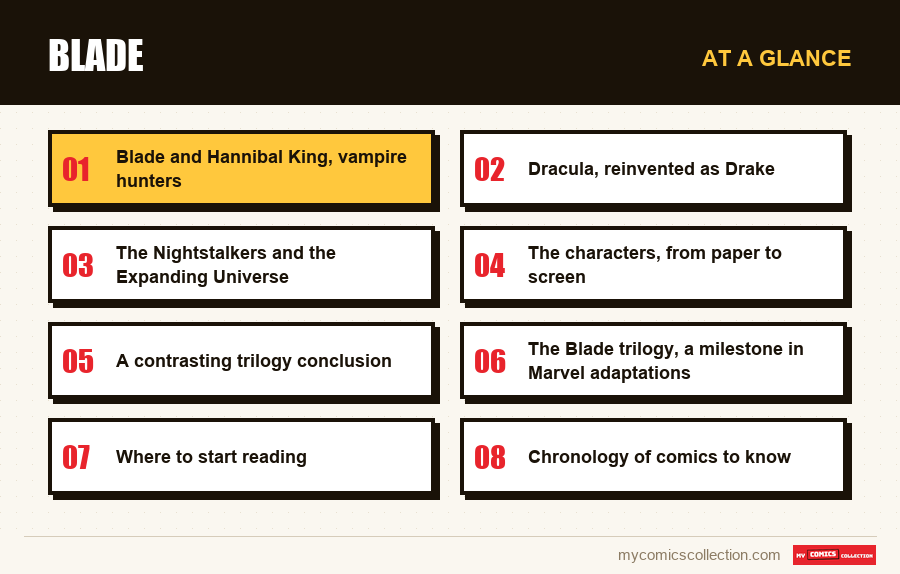
Blade and Hannibal King, vampire hunters
Blade: Trinity continues the story of the hunter who appeared in Tomb of Dracula #10 (1973), created by Marv Wolfman and Gene Colan. The “Daywalker”, half-man, half-vampire, leads his crusade against the bloodsuckers. The film adds Hannibal King, a character from the comics, who appeared in Tomb of Dracula #25 (1974). In the comics, King is a private detective transformed into a vampire but refusing to feed on human blood, who hunts down creatures of the night. The film takes up this character, played by Ryan Reynolds, reinventing him as a charismatic and sarcastic hunter, member of a team allied with Blade. This fidelity to an authentic character from the comics enriches the universe of the film.
The film also introduces Abigail Whistler, introduced as the daughter of Blade's mentor, a creation unique to the film. Alongside Hannibal King, she forms the Nightstalkers, a team of vampire hunters. In the comics, the Nightstalkers are a real team, bringing together Blade, Hannibal King and Frank Drake, which appeared in the early 1990s. The film takes up this concept of a team of hunters, freely adapting it with new members. This gallery of allies expands the hitherto rather solitary Blade universe and sets the stage for possible sequels centered on the Nightstalkers. The tone, lighter and humorous, contrasts with the darkness of the previous parts.
Dracula, reinvented as Drake
The antagonist of the film is Dracula himself, the lord of the vampires. In the comics, Dracula is a major figure in the horror universe of Marvel, star of the series “Tomb of Dracula” (1972) by Wolfman and Colan, where he notably faces Blade. The film summons him as the ultimate enemy, the first and most powerful vampire, whom the vampire clan seeks to awaken to destroy Blade and humanity. The film, however, modernizes him under the name "Drake", giving him a contemporary appearance and shapeshifting powers, far removed from the classic gothic aristocrat. Dominic Purcell plays this reinvented Dracula, an ancient warrior more than a Transylvanian count.
This rereading of Dracula illustrates the film's approach: drawing on Marvel's vampire mythology while modernizing it for contemporary action. By making the lord of the vampires a primordial warrior capable of transforming, the film moves away from the gothic figure of the comics and the Bram Stoker novel that inspired him. This modernization, if it serves the spectacle, deprives Dracula of part of its majesty and its historical anchoring. For the reader, Marvel's real Dracula, as he appears in "Tomb of Dracula", is a rich and menacing figure, whose clashes with Blade constitute the heights of comic book horror. The film gives a more generic version, in the service of its spectacular conclusion.
The Nightstalkers and the Expanding Universe
The film seeks to expand the Blade universe by introducing a team, the Nightstalkers. In the comics, this team, born in the early 1990s, brings together hunters of supernatural creatures (Blade, Hannibal King, Frank Drake) as part of the "Midnight Sons", Marvel's horror section bringing together Ghost Rider, Morbius and other figures of the supernatural. The film takes the concept of a team of hunters, adapting it with Hannibal King and Abigail Whistler. This orientation towards a team, rather than a solitary hero, aimed to open up new perspectives for the franchise, in particular a project centered on the Nightstalkers which will not see the light of day.
This expansion ambition testifies to the richness of Marvel's horrific universe, where Blade evolves alongside numerous figures of the supernatural. The film only exploits a fraction of this potential, however, freely adapting the Nightstalkers without developing its full mythology. For the reader, this team is an invitation to discover the “Midnight Sons” and the horrific universe of Marvel, where hunters and creatures of the night clash in stories of great richness. Blade: Trinity gives an overview, faithful in spirit but simplified, closing a trilogy which will have successfully brought to the screen, for the first time, this little-known part of the Marvel universe.
Collecting this series?
Track what you own, what you are missing and what your collection is worth. 7 day trial.
Start my trial →The characters, from paper to screen
- Blade: The vampire-hunting “Daywalker,” faithful to Tomb of Dracula #10.
- Hannibal King: Hunter from Tomb of Dracula #25, reinvented as a sarcastic ally.
- Dracula (Drake): The Lord of the Vampires, modernized into an ancient warrior.
- Abigail Whistler: Huntress, daughter of Blade's mentor, creation of the film.
- The Nightstalkers: Team of hunters, loosely adapted from the comics.
A contrasting trilogy conclusion
Blade: Trinity concluded the trilogy on a more contrasting note than the previous installments. By adopting a lighter and more humorous tone, carried in particular by the character of Hannibal King, the film moves away from the darkness which was the strength of the first two. This orientation, as well as a production deemed difficult, divided audiences and critics. The film nevertheless remains an ambitious conclusion, seeking to expand the Blade universe and summon Dracula, the ultimate figure of vampire mythology. It closes a trilogy that will have marked the history of Marvel adaptations.
Despite its flaws, this last part illustrates the richness of the horrific universe in which Blade evolves. By introducing Hannibal King, the Nightstalkers and Dracula, it draws from a pool of characters and stories born in the 1970s and 1990s. For the reader, it is an invitation to explore “Tomb of Dracula”, the “Midnight Sons” and the entire supernatural side of Marvel. The Blade trilogy, from its pioneer in 1998 to this conclusion in 2004, will have lastingly made known this little-known part of the universe, proving that a vampire hunter could bring a saga to the cinema and pave the way for other horrific adaptations.
The Blade trilogy, a milestone in Marvel adaptations
With Blade: Trinity, one of the most important trilogies in the history of Marvel adaptations comes to an end. Launched in 1998, before the wave of superhero films, the Blade saga proved that a Marvel character could carry a successful franchise, paving the way for X-Men, Spider-Man and everything that followed. This pioneering role, often forgotten, is crucial: without the success of Blade, the landscape of superhero cinema would undoubtedly have been different. The trilogy, from its innovative first part to this contrasting conclusion, will have had a lasting impact on the industry.
Beyond its historical importance, the Blade trilogy introduced the general public to the horror side of Marvel, which had long remained in the shadow of classic superheroes. By bringing to the screen a vampire hunter and his universe, she revealed the richness of a little-known part of the publisher, populated by creatures of the night and figures of the supernatural. For the reader, this trilogy is an invitation to explore "Tomb of Dracula" and the "Midnight Sons", these horror stories born in the 1970s. Blade, from its pioneer in 1998 to this conclusion, will remain as the ambassador of a fascinating supernatural universe, proving that Marvel is not limited to heroes in tights.
Where to start reading
To extend the film, Tomb of Dracula #10 (1973) features Blade, and #25 (1974) features Hannibal King. The “Tomb of Dracula” series by Wolfman and Colan expands on Dracula and his universe. The stories of “Nightstalkers” and “Midnight Sons” (1990s) bring together vampire hunters. This journey covers the source material for a film that draws on Marvel's horror mythology.
Chronology of comics to know
- 1972: “Tomb of Dracula” #1: the launch of the series dedicated to Dracula.
- 1973: Tomb of Dracula #10: Blade's first appearance.
- 1974: Tomb of Dracula #25: the first appearance of Hannibal King.
Collection side: what numbers to aim for after the film
Blade: Trinity points to keys to the horrific Bronze Age. Tomb of Dracula #10 (1973, first appearance of Blade) is a highly sought-after issue. Tomb of Dracula #25 (1974, Hannibal King premiere) is another popular target. The first issue of “Tomb of Dracula” (1972) will be of interest to Dracula fans. These targets cover various budgets. As always, condition and gradation determine value; relying on real recent sales is strongly recommended.
Its place in the saga and for the collector
Blade: Trinity concluded the trilogy by expanding the Hunter's universe, despite mixed reception. For the collector, he highlighted Tomb of Dracula #10 and #25, keys to the Bronze Age. It illustrates the effect of adaptations on the market. Beyond speculation, the film invites us to discover “Tomb of Dracula” and the “Midnight Sons”, this horrific part of Marvel where Blade, Hannibal King and Dracula clash. By closing the trilogy on an ambitious note, it recalls the richness of a supernatural universe born in the 1970s, of which Blade is the ambassador to cinema.
The verdict: a broad but uneven conclusion
- Loyalty: Blade, Hannibal King, Dracula, the Nightstalkers and the horror universe come from comics.
- Freedoms: Dracula modernized into "Drake", Abigail Whistler invented, the tone lighter, the Nightstalkers freely adapted.
- Collectible numbers: Tomb of Dracula #10 (Blade), Tomb of Dracula #25 (Hannibal King), “Tomb of Dracula” #1.
Blade: Trinity concludes the trilogy by summoning Dracula and introducing the Nightstalkers, including Hannibal King. Faithful to Marvel's horrific mythology but reinventing Dracula and adopting a lighter tone, the film was divisive. For both the reader and the collector, it is an invitation to discover “Tomb of Dracula” and Hannibal King, as well as the entire horror side of Marvel of which Blade remains, even today, the most emblematic ambassador to cinema.
Frequently asked questions
A vampire hunter who appeared in Tomb of Dracula #25 (1974). In the comics, he is a detective transformed into a vampire who refuses to drink human blood. The film reinvents him as a charismatic and sarcastic ally of Blade, played by Ryan Reynolds.
The film modernizes him under the name "Drake", into an ancient warrior with powers of metamorphosis, very far from the gothic aristocrat of "Tomb of Dracula" (1972). The major figure of Marvel horror loses part of his majesty.
A team of hunters of supernatural creatures from the comics (1990s), bringing together Blade, Hannibal King and Frank Drake, as part of the “Midnight Sons”. The film loosely adapts this concept with Hannibal King and Abigail Whistler.
No: presented as the daughter of Blade's mentor, she is a creation of the film. Along with Hannibal King, she forms the core of the Nightstalkers in the adaptation.
Tomb of Dracula #10 (1973, Blade premiere) is the most sought after key. Tomb of Dracula #25 (1974, Hannibal King premiere) is another target for fans.
Does the film make you want to collect? Estimate the value for free of your issues (Tomb of Dracula #10, #25…) with our tool based on current eBay listings.