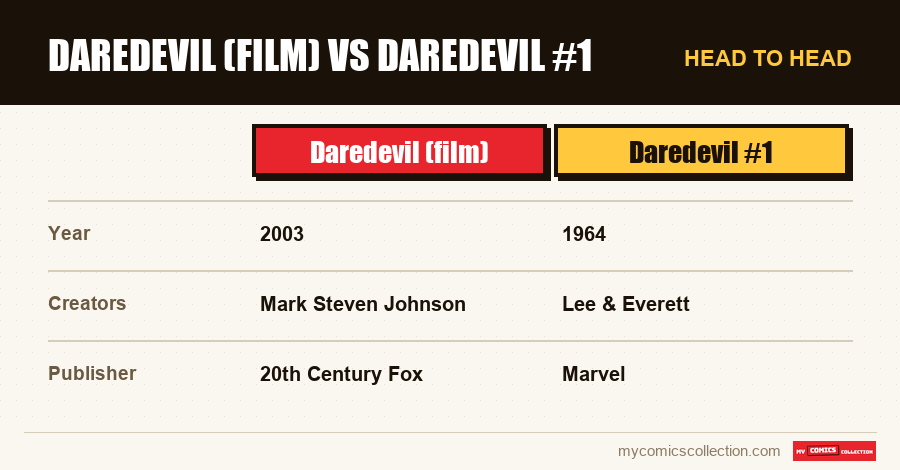
Daredevil (2003) Mark Steven Johnson , with Ben Affleck, adapts the fearless man born in Daredevil #1 (1964) by Stan Lee and Bill Everett. The film draws on the cult run of Frank Miller , featuring Elektra (Daredevil #168, 1981), Bulleye (Daredevil #131, 1975) and the Caid (Amazing Spider-Man #50, 1967). Faithful to the dark universe of the character, it condenses the plot. Here is the detailed comparison, film versus comics.
The first film adaptation of the blind vigilante from Hell's Kitchen, Daredevil brings to the screen one of Marvel's most tortured characters. It draws on the founding stories and the run of Frank Miller. Source-by-source decryption.
As in each article in this series, only verified information (creators, distribution, dates, comic numbers) is stated; the comparative analysis is ours, without reproducing dialogue or protected images.
Title : Daredevil (2003)
Director: Mark Steven Johnson
Actors: Ben Affleck (Matt Murdock), Jennifer Garner (Elektra), Colin Farrell (Bullseye), Michael Clarke Duncan (The Kingpin)
Exit : February 2003
Studio: 20th Century Fox
Daredevil #1 (1964): 1st appearance (Lee & Everett)
Daredevil #168 (1981): Elektra's first appearance (Frank Miller)
Daredevil #131 (1975): Bullseye's first appearance
Frank Miller's run: the dark universe of Daredevil
- Matt Murdock, blind lawyer with overdeveloped senses.
- Le “radar” and the hero's hyper-fine hearing.
- Elektra, love and murders him.
- Bulleye, the killer who turns everything into a weapon.
- Le Caid, crime boss of Hell's Kitchen.
- L'plot condenses several arcs from the comics.
- Bulleye is reinvented as an eccentric Irish killer.
- La death of Elektra is rearranged for the film.
- Le red suit in leather, darker than the comics.
- Some powers are amplified (the visual radar).
Daredevil #1 (1964): The Man Without Fear
Daredevil appears in Daredevil #1 (1964), created by Stan Lee and Bill Everett. Matt Murdock, a young man blinded as a child by a radioactive substance, sees his other senses heightened to a superhuman level: hearing, smell, touch, and a “radar sense” which allows him to perceive his environment despite his blindness. Having become a lawyer by day, he fights crime by night in the costume of Daredevil, the vigilante of Hell's Kitchen. A character marked by Catholicism, guilt and a two-sided justice, legal and vengeful, Daredevil is one of Marvel's most tortured and human heroes, whose urban and dark universe has inspired stories of great depth.
The film faithfully reproduces the origin and essence of the character: blindness, overdeveloped senses, radar sense, the double life of lawyer and vigilante, anchoring in Hell's Kitchen. Ben Affleck plays a tormented Matt Murdock, faithful to the hero's darkness. The film draws mainly on the run of Frank Miller, who redefined the character in the 1980s by deepening his dark and tragic dimension. The main freedom lies in condensation: the film brings together several arcs and characters from different eras in a single story, at the risk of a certain density. On the spirit of the character, on the other hand, he remains faithful to the universe of Daredevil.
Elektra, love and murder
The film features Elektra Natchios, one of the most iconic characters in the Daredevil universe, who appeared in Daredevil #168 (1981), created by Frank Miller. Matt Murdock's childhood sweetheart, Elektra becomes a formidable assassin, a mercenary in the service of the powerful, wielding her knowledge with deadly mastery. His relationship with Daredevil, made of passion and conflict, they find themselves on opposite sides of the law, is one of the most tragic in comics. Jennifer Garner plays a combative and tormented Elektra, faithful to the spirit of the character, whose love story with Matt structures the film.
The film takes up the trajectory of Elektra and her heartbreaking relationship with Matt, but rearranges the elements. In the comics, Elektra's death, caused by Bullseye, is one of the most notable moments of Miller's run, a shock that shocked readers. The film reprises this fatal confrontation, while changing the circumstances and outcome for its own narrative. This adaptation, faithful to the tragic spirit of the character, was enough to popularize Elektra among the general public, to the point of earning her her own film two years later. For the reader, it is an invitation to discover Miller's run, where Elektra reaches her full mythological dimension.
Bullseye and the Kingpin, Daredevil's enemies
The film summons two of Daredevil's greatest enemies. Bulleye, appeared in Daredevil #131 (1975), is a psychopathic killer capable of transforming any object into a deadly weapon, with unerring precision. Obsessive rival of Daredevil, he is responsible, in the comics, for the death of Elektra. The film reinvents him as an eccentric Irish killer, played by Colin Farrell, in a flamboyant interpretation that takes liberties with the character while retaining his murderous gift. The Caid (Wilson Fisk), who appeared in Amazing Spider-Man #50 (1967), is the crime boss who rules Hell's Kitchen, Daredevil's sworn enemy in Miller's run.
The film faithfully reproduces these figures and their role. The Kingpin, played by Michael Clarke Duncan, is presented as the master of the underworld, an adversary as physically imposing as he is strategically formidable. His rivalry with Daredevil, one of the richest clashes in comics, structures the story. Bullseye, more fanciful in the film than in the comics, nevertheless retains the essential: the killer who never misses his target. These antagonists, from different eras of comics, are brought together in the film to compose the hero's gallery of enemies. For the reader, they are invitations to discover Miller's run, where the Kingpin and Bullseye reach their full dimensions.
Collecting this series?
Track what you own, what you are missing and what your collection is worth. 7 day trial.
Start my trial →The characters, from paper to screen
- Matt Murdock / Daredevil: Blind lawyer and tortured vigilante, loyal to Daredevil #1 and Miller's run.
- Elektra: Matt's love turned assassin, loyal to Daredevil #168.
- Bulleye: Infallible killer, reimagined as an eccentric Irishman.
- The Kingpin (Wilson Fisk): Hell's Kitchen crime boss, true to his role.
- Foggy Nelson: Matt's associate and friend, present in the film.
The Dark World of Frank Miller
The film's big influence is Frank Miller's run on Daredevil, at the turn of the 1980s, which transformed the character. Before Miller, Daredevil was a relatively classic hero; Miller made him a dark and tragic figure, rooted in a grimy and violent Hell's Kitchen, populated by gangsters, ninjas and assassins. He introduced Elektra, deepened the Kingpin, and gave the character a noir dimension, between film noir and tragedy. This run is considered one of the peaks of superhero comics, and its influence on all adaptations of Daredevil is decisive.
The 2003 film follows in this vein, seeking to capture Miller's dark, urban atmosphere. It achieves this in part, through its nocturnal atmosphere, its violence and the darkness of its hero. This fidelity to the spirit of the run, if it is laudable, comes up against the constraints of a general public adaptation from the early 2000s, less free than Miller's stories. For the reader, the film is an invitation to discover this founding run, where Daredevil reveals all his tragic depth. The subsequent television series, darker and more faithful, will extend this exploration of Miller's universe with a freedom that the film could not allow itself.
A first adaptation to re-evaluate
Daredevil experienced a mixed reception upon its release, considered too condensed and general public in view of the richness of the character. The film has, however, been partially rehabilitated, notably thanks to a longer version that is darker and more faithful to the spirit of Miller's run. It remains the first attempt to bring this complex hero to the screen, paving the way for later adaptations, particularly the acclaimed television series. Despite its flaws, it introduced Daredevil to the general public and confirmed the cinematic richness of its universe, between film noir and urban tragedy.
This reception illustrates the difficulty of adapting such a dense character in a single film. Daredevil, with its dark universe, its gallery of enemies and its tragic arcs, lends itself better to the long format of the series, which will be able to develop what the film was to condense. For the reader, the 2003 film is a gateway to the world of Daredevil, whose comics, particularly Miller's run, offer a depth that the screen took time to match. He reminds us that the best Marvel characters sometimes deserve several attempts before finding their right adaptation.
Where to start reading
To extend the film, Daredevil #1 (1964) presents the origin of the hero. Frank Miller's run, from the late 1970s, is the gold standard, introducing Elektra (Daredevil #168) and delving deeper into the Kingpin and Bullseye. “Born Again” (1986) is a peak for the character. This journey covers the sources of a film faithful to the dark universe of Daredevil.
Chronology of comics to know
- 1964: Daredevil #1: The first appearance of the Man Without Fear.
- 1975: Daredevil #131: Bullseye's first appearance.
- 1981: Daredevil #168: the first appearance of Elektra (Frank Miller).
Collection side: what numbers to aim for after the film
Daredevil points to major keys. Daredevil #1 (1964, first appearance of the hero) is a pillar of the Silver Age, much sought after. Daredevil #168 (1981, premiere of Elektra) is a coveted key to the Bronze Age, driven by the popularity of the character. Daredevil #131 (1975, premiere of Bullseye) is another target. Miller's run numbers and "Born Again" (1986) are must-sees. These targets cover various budgets. As always, condition and gradation determine value; relying on real recent sales is strongly recommended.
Its place in the saga and for the collector
Daredevil brought the blind vigilante of Hell's Kitchen to the screen for the first time, drawing on Frank Miller's run. For the collector, it revived interest in Daredevil #1 and #168, major keys. It illustrates the effect of adaptations on the market. Beyond speculation, the film invites you to discover the dark universe of Daredevil, in particular Miller's run, the pinnacle of superhero comics. By introducing Elektra, Bullseye and the Kingpin to the cinema, it prepared the ground for subsequent adaptations, which would explore this rich and tragic universe more freely.
The verdict: a faithful but dense first adaptation
- Loyalty: Matt Murdock, his overdeveloped senses, Elektra, Bullseye and the Kingpin come from the comics and Miller's run.
- Freedoms: the condensed plot, Bullseye reinvented, Elektra's death rearranged, the costume darker, the powers amplified.
- Collectible numbers: Daredevil #1 (the hero), Daredevil #168 (Elektra), Daredevil #131 (Bullseye).
Daredevil brings the man without fear to the screen by drawing on Frank Miller's cult run, bringing together Elektra, Bullseye and the Kingpin. Faithful to the dark universe of the character but condensing several arcs, the film divided before being partially rehabilitated. For the reader as well as the collector, it is an invitation to discover Daredevil #1 and Miller's run.
Frequently asked questions
From Daredevil #1 (1964), created by Stan Lee and Bill Everett. Matt Murdock, blinded as a child, sees his other senses heightened and fights crime at night. The film faithfully returns to its origins and draws on Frank Miller's dark run.
Matt's childhood sweetheart turned assassin, appearing in Daredevil #168 (1981), created by Frank Miller. His tragic relationship with Daredevil structures the film. Jennifer Garner plays him, which earned her her own film in 2005.
Partly: appeared in Daredevil #131 (1975), he is an infallible killer capable of transforming any object into a weapon. The film reinvents him as an eccentric Irishman (Colin Farrell), while retaining his murderous gift and his rivalry with the hero.
Defining: His 1980s run transformed Daredevil into a dark and tragic figure, rooted in a violent Hell's Kitchen. It introduced Elektra and delved deeper into the Kingpin. The film is directly inspired by this universe, the pinnacle of comics.
Daredevil #1 (1964, The Hero) and Daredevil #168 (1981, Elektra) are two major keys. Daredevil #131 (Bullseye) and Miller's run, including "Born Again" (1986), are other targets.
Does the film make you want to collect? Estimate the value for free of your numbers (Daredevil #1, #168…) with our tool based on current eBay listings.