
Daredevil: Born Again (2025), with Charlie Cox and Vincent D'Onofrio, revives the blind vigilante born in Daredevil #1 (1964) by Stan Lee and Bill Everett. Its title and its spirit refer to the cult arc “Born Again”(Daredevil #227-233, 1986) by Frank Miller and David Mazzucchelli, where the Kingpin methodically destroys the life of Matt Murdock. The series retains the Murdock/Fisk confrontation and the urban thriller tone, while extending the Netflix continuity. Here is the detailed comparison, series versus comics.
The highly anticipated return of Charlie Cox's Daredevil to the saga, Born Again draws on one of the greatest stories in comics. The series combines the legacy of Frank Miller's comics and that of the Netflix series. Source-by-source decryption.
As in each article in this series, only verified information (creators, distribution, dates, comic numbers) is stated; the comparative analysis is ours, without reproducing dialogue or protected images.
Title : Daredevil: Born Again (2025)
Showrunner: Dario Scardapane
Actors: Charlie Cox (Matt Murdock / Daredevil), Vincent D'Onofrio (Wilson Fisk / Kingpin), Wilson Bethel (Bullseye), Deborah Ann Woll (Karen), Elden Henson (Foggy)
Broadcast: March-April 2025, Disney+
Studio: Marvel Studios
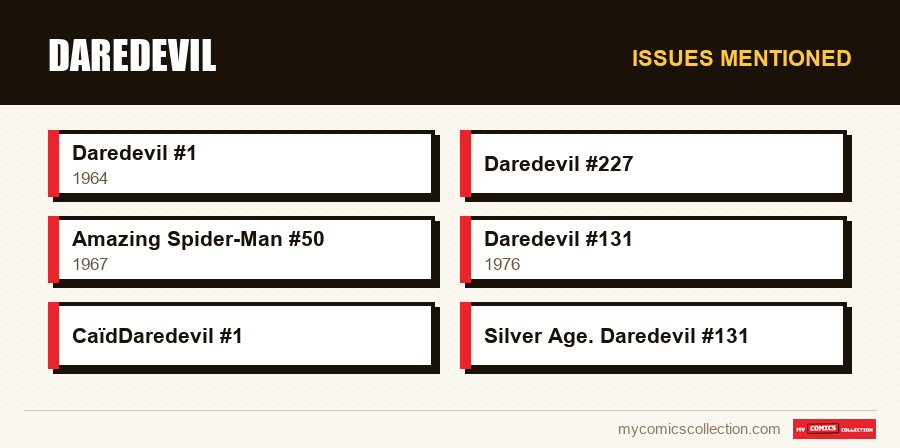
Daredevil #1 (1964): Daredevil's first appearance (Lee & Everett)
“Born Again”: Daredevil #227-233 (1986), Miller & Mazzucchelli
Amazing Spider-Man #50 (1967): the Kingpin
Daredevil #131 (1976): Bullseye
- Matt Murdock, blind lawyer and vigilante with hyper-developed senses.
- Le Murdock/Fisk duel, the heart of the entire Daredevil narrative.
- The theme of the fall and rebirth, essence of “Born Again”.
- Bulleye, the infallible assassin, sworn enemy of the hero.
- Le urban thriller tone and Catholic, inherited from Miller.
- Fisk becomes mayor of New York, a plot taken from more recent comics.
- The series extends Netflix continuity rather than adapting the arc to the letter.
- The betrayal of Karen Page, central to the comic, is not repeated as is.
- Bulleye is a former FBI agent, a reinvention.
- De new characters and legal intrigues flesh out the story.
Daredevil #1 (1964): The Birth of the Man Without Fear
Daredevil appears in Daredevil #1 (1964), created by Stan Lee and Bill Everett. Matt Murdock, blinded as a child by a radioactive substance which however increased his other senses tenfold, leads a double life: lawyer by day, masked vigilante by night. This character, long in the background, has become one of Marvel's richest, notably thanks to Frank Miller's runs. The series faithfully takes up this foundation (blindness, superhuman senses, the double life of lawyer and vigilante, the guilt-ridden Catholicism that haunts Matt) while relying on the immense legacy left by the Netflix series, considered one of the best adaptations of the character. Charlie Cox, back in the role, plays a Matt Murdock faithful to the darkness and moral complexity of the comics.
This return of an already established character and actor gives the series a special status: it does not start from scratch, but capitalizes on years of public attachment, while drawing on the hero's darkest comics.
“Born Again” (1986): Frank Miller’s masterpiece
The title of the series refers to one of the greatest stories in comic book history: “Born Again” (Daredevil #227-233, 1986), written by Frank Miller and drawn by David Mazzucchelli. In this comic, Karen Page, Matt's former partner who fell into drugs, sells her secret identity, which reaches the Kingpin. Fisk then sets out to methodically destroy Murdock's life (his career, his money, his sanity) before Matt, reduced to nothing, is reborn from the ashes. This story of destruction and redemption, of rare intensity, is an absolute reference. The series takes up its spirit (the theme of fall and rebirth, the psychological confrontation between Murdock and Fisk) without adapting the letter, preferring to construct a new plot extending television continuity.
The Kingpin Mayor of New York: borrowing from recent comics
The main direction of the series, Wilson Fisk becoming mayor of New York, does not come from “Born Again” but from more recent comics. In the 2010s, the Kingpin was actually elected mayor, a plot developed notably in Chip Zdarsky's run ("Devil's Reign"), where Fisk uses his political power to track down vigilantes. The series seizes on this fascinating idea: rather than operating in the shadows, the Kingpin conquers power through the ballot box, blurring the line between crime and legality. This rereading gives the Murdock/Fisk duel a new political dimension, pitting a lawyer who believes in the law against a criminal who has twisted it for his own benefit. This is an example of how the series draws on several eras of comics to compose its story.
The characters, from paper to screen
- Matt Murdock / Daredevil: Faithful to Daredevil #1 and Miller's runs: blind lawyer, tormented vigilante.
- Wilson Fisk / the Kingpin: Historical nemesis, here become mayor of New York (recent comics).
- Bulleye: The infallible assassin from Daredevil #131, reimagined as a former FBI agent.
- Karen Page and Foggy Nelson: Matt’s loved ones, pillars of his world.
- The new characters: Legal and political intrigues specific to the series.
Collecting this series?
Track what you own, what you are missing and what your collection is worth. 7 day trial.
Start my trial →The legacy of the Netflix series
Born Again occupies a unique place: it extends the Netflix series (2015-2018), long considered one of the best superhero adaptations. This link of continuity is rare in the saga and explains the considerable wait around the series. By using the same actors (Charlie Cox, Vincent D'Onofrio) and the same adult and violent tone, it honors the legacy of a cult work while integrating it into the main continuity. This fidelity to Netflix's Daredevil, itself deeply inspired by the comics of Miller and his successors, creates a chain of influences: from the 1986 comics to the Netflix series, then to Born Again. The series is thus doubly heir, to paper and to the screen, which makes it a particularly rich case of adaptation.
This status as a sequel to an acclaimed series imposes a particular pressure: that of not disappointing an audience attached to a specific version of the character. By retaining the dark tone, choreographed violence and moral depth of Netflix, while drawing on recent comics, Born Again seeks to reconcile these legacies. For the reader, it is an invitation to go back to the sources, Miller's runs, which shaped all these adaptations.
Bullseye, the most dangerous enemy
The series features Bullseye, one of Daredevil's most formidable adversaries. The character appears in Daredevil #131 (1976): an assassin with superhuman precision, capable of transforming any object into a deadly weapon, and devoid of any scruples. In Miller's comics, Bullseye is responsible for some of the most tragic moments in Matt's life, including the death of Elektra. The series reinvents his origins, an unstable former FBI agent, while retaining his dangerousness and his status as a dark mirror of the hero. Where Daredevil imposes moral boundaries on himself, Bullseye has none, making him his perfect opposite. This opposition, faithful to the comics, nourishes the tension of the story.
Karen Page and the moral heart of the story
An essential element of the Daredevil universe, present in “Born Again” as on screen, is the character of Karen Page. In Miller's comic, it's her fall from grace, she sells Matt's secret identity for a dose of drugs, that triggers all the tragedy, before she seeks redemption. The television series had made her a tenacious journalist and a moral pillar of Matt's entourage, a role that Born Again extends. Karen embodies the part of humanity in Daredevil, the link that connects him to his life as a man beyond the mask. His presence, alongside Foggy Nelson, Matt's associate and best friend, anchors the vigilante in a network of relationships that make him vulnerable, and therefore deeply human.
This relational dimension is fundamental: in Daredevil, tragedy is not born only from fights, but from the price that his double life makes those he loves pay. “Born Again,” in both the comics and its adaptation, explores precisely this idea: how the life of a vigilante destroys everything around him, and how he must be reborn by accepting this burden. By retaining this moral heart, the series remains faithful to what distinguishes Daredevil from more flamboyant heroes: he is not a god nor a billionaire, but an ordinary, Catholic and guilt-ridden man, whose every victory has a human cost. This seriousness, inherited from Miller, gives the story a tragic depth rare for the genre, and explains the public's lasting attachment to this flayed character.
Where to start reading
The priority reading is obviously “Born Again” (Daredevil #227-233, 1986) by Frank Miller and David Mazzucchelli, the absolute peak of the character. It can be preceded by Miller's first run (from 1979), which introduced Elektra and redefined Daredevil. For the Mayoral Kingpin, “Devil's Reign” by Chip Zdarsky sheds light on this recent intrigue. Finally, Daredevil #1 (1964) sets the origins. From 1964 to today, this journey covers the sources of a series deeply rooted in comics.
Chronology of comics to know
- 1964: Daredevil #1: First appearance of Daredevil.
- 1976: Daredevil #131: First appearance of Bullseye.
- 1986: “Born Again” (Daredevil #227-233) by Miller and Mazzucchelli.
- Years 2010-2020: the Kingpin Mayor of New York (“Devil’s Reign”).
Collection side: what numbers to aim for after the series
Born Again points to major keys. Daredevil #1 (1964, first appearance) is a sought-after key to the Silver Age. Daredevil #131 (first appearance of Bullseye) is another important target, as are the issues of “Born Again” (1986), available in highly regarded collections. These issues span a variety of budgets, from the Silver Age to 1980s comics. As always, condition and grading determine value; relying on real recent sales is strongly recommended. The collection of “Born Again” is a must-have for any library, considered one of the best superhero stories ever written.
Its place in the saga and for the collector
Born Again officially integrates Daredevil and his street-level universe into the main continuity, a major event for fans of the Netflix series. For the collector, it revived interest in Daredevil #1, Daredevil #131 and especially the story “Born Again”, one of Frank Miller's most prestigious. It illustrates the effect of series on the market, particularly for such a popular character. Beyond speculation, the series invites you to discover Miller's runs on Daredevil, considered to be peaks in comics, where the blind vigilante reaches a rare tragic depth. Drawing from “Born Again” and “Devil's Reign,” the series pays homage to a half-century of stories that have made Daredevil one of Marvel's most complex characters.
The verdict: the rebirth of a cult vigilante
- Loyalty: Matt Murdock, the duel with Fisk, the theme of the fall and Bullseye come from the comics.
- Freedoms: Fisk Mayor (recent comics), Netflix continuity extended, Bullseye reinvented.
- Collectible numbers: Daredevil #1 (1964), #131 (Bullseye), “Born Again” (1986).
Born Again revives one of Marvel's most beloved vigilantes by drawing on Frank Miller's masterpiece and recent comics. Faithful to the Murdock/Fisk duel and the dark tone of the character, the series extends the legacy of the Netflix series while anchoring it in continuity. For both the reader and the collector, it is an invitation to discover “Born Again”, one of the greatest stories in comics.
Frequently asked questions
From the “Born Again” arc (Daredevil #227-233, 1986) by Frank Miller and David Mazzucchelli, from which it takes the spirit (the fall and rebirth of Matt against the Kingpin), as well as recent comics where Fisk becomes mayor of New York.
It takes up the spirit and the title, but not the letter: the series constructs a new plot extending the Netflix continuity, without repeating as is the betrayal of Karen Page central to the comic.
Yes: in the comics of the 2010s, the Kingpin is elected mayor of New York, a plot developed in “Devil's Reign” by Chip Zdarsky. The series takes hold of this idea.
Yes, for the most part: Born Again extends the Netflix series (2015-2018) with the same actors (Charlie Cox, Vincent D'Onofrio) and the same tone, while integrating it into the main continuity of the saga.
Daredevil #1 (1964, first appearance) and Daredevil #131 (Bullseye) on the Silver/Bronze Age side. The collection of “Born Again” (1986) is a must-have, considered one of the best superhero stories.
Does the series make you want to collect? Estimate the value for free of your numbers (Daredevil #1, #131…) with our tool based on current eBay listings.