
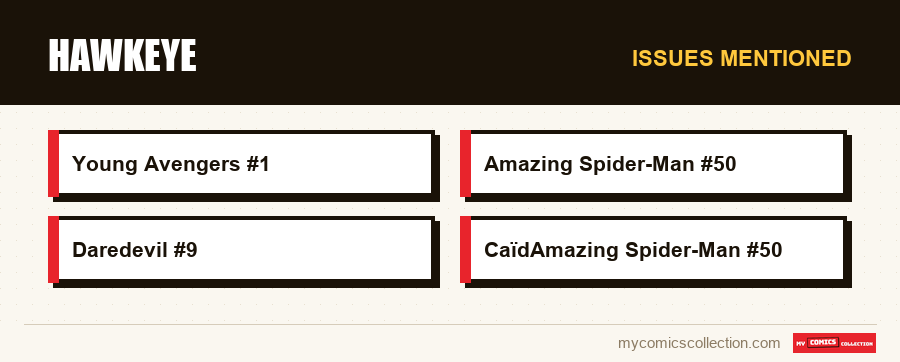
Hawkeye (2021), created by Jonathan Igla with Jeremy Renner and Hailee Steinfeld, directly adapts the cult run of Matt Fraction and David Aja (“Hawkeye”, 2012) about the “street-level” life of Clint Barton. She introduces Kate Bishop ( Young Avengers #1 , 2005), the Caid (Amazing Spider-Man #50, 1967) and Echo (Daredevil #9, 1999). The series maintains the tone and characters of the comic while integrating them into continuity. Here is the detailed comparison, series versus comics.
A Christmas series on a human scale, Hawkeye brings the Marvel universe back to ground level after the cosmic stakes. It adapts one of the most beloved runs of the 2010s and introduces a heroine with a bright future. Source-by-source decryption.
As in each article in this series, only verified information (creators, distribution, dates, comic numbers) is stated; the comparative analysis is ours, without reproducing dialogue or protected images.
Title : Hawkeye (2021)
Creator: Jonathan Igla
Actors: Jeremy Renner (Clint Barton), Hailee Steinfeld (Kate Bishop), Vincent D'Onofrio (The Kingpin), Alaqua Cox (Echo / Maya Lopez), Florence Pugh (Yelena)
Broadcast: November-December 2021, Disney+ (6 episodes)
Studio: Marvel Studios
“Hawkeye”(2012): Matt Fraction & David Aja, the cult run
Young Avengers #1 (2005): 1st appearance of Kate Bishop
Amazing Spider-Man #50 (1967): 1st appearance of the Caïd
Daredevil #9 (1999): 1st appearance of Echo (Maya Lopez)
- The tone “street-level” and Clint's daily life, taken from the Fraction run.
- Kate Bishop, a brilliant young archer and admirer of Clint.
- Le dog Pizza Dog, cult character from the comic.
- Le Caid, New York crime boss.
- Echo, a deaf vigilante with a complex background.
- The Christmas setting and Clint's Ronin past are unique to the series.
- The Mafia Track Suit is adapted from the comic but reinstated into continuity.
- Elena Belova is integrated, extending Black Widow.
- The Echo/Caïd link is developed for the series and its sequel.
- The origin of Kate is adapted to the cinematic context.
“Hawkeye” (2012): the cult run of Fraction and Aja
The series directly adapts one of the most acclaimed runs of the 2010s: “Hawkeye” (2012), by Matt Fraction and David Aja. This comic had revolutionized the character by abandoning the cosmic adventures of the Avengers to tell the daily life of Clint Barton "the days when he is not an Avenger": his apartment troubles, his complicated relationships, his fight against a local mafia, and his mentor-rival Kate Bishop. The tone, mixing humor, melancholy and ground-level action, as well as Aja's refined visual style, made this run a reference. The series faithfully takes up this spirit: it brings Marvel back to a human scale, in a snowy New York, with a tired Clint and an enthusiastic Kate. She even borrows her logo, her dog Pizza Dog and her mafia in tracksuits (the Track Suit Mafia) from the comic. Matt Fraction was also a consultant on the series, guaranteeing this fidelity.
This choice to adapt a specific run, rather than drawing here and there, sets Hawkeye apart: it is one of the most faithful Marvel adaptations of a unique work, of which it captures the bittersweet tone and anchoring in reality.
Young Avengers #1 (2005): Kate Bishop, the next generation
The big revelation of the series is Kate Bishop, destined to become a major heroine. The character appears in Young Avengers #1 (2005), created by Allan Heinberg and Jim Cheung: a wealthy, brilliant and determined young New Yorker, who takes the arc and name of Hawkeye. The run of Fraction (2012) then established her as Clint's partner and heiress. The series faithfully adapts this Kate (her admiration for Clint, her talent as an archer, her nerve and her humor) played by Hailee Steinfeld. By making her the true heart of the series, the story prepares the passing of the torch, a theme dear to recent comics. Kate embodies a new generation of heroes, ready to take up the mantle of veterans.
The Kingpin and Echo: New York crime
The series anchors its plot in the world of New York crime with two major figures. THE Caid (Kingpin), Wilson Fisk, first appears in Amazing Spider-Man #50 (1967), created by Stan Lee and John Romita Sr.: massive and implacable godfather, he is one of the greatest enemies of Spider-Man and Daredevil. The series reintroduces him as a crime boss, true to his stature. Echo (Maya Lopez), for her part, is born in Daredevil #9 (1999), created by David Mack and Joe Quesada: a deaf vigilante of Native American origin, endowed with an ability to reproduce any movement she observes. The series faithfully adapts the character and develops his bond with the Kingpin, laying the foundations for its own spinoff series.
The characters, from paper to screen
- Clint Barton: True to the Fraction run: a tired, fallible Hawkeye, anchored in everyday life.
- Kate Bishop: Faithful to Young Avengers #1 and the 2012 run, the heart of the series.
- The Caid: Crime Godfather from Amazing Spider-Man #50, true to his stature.
- Echo (Maya Lopez): Deaf vigilante from Daredevil #9, her link to the Kingpin developed.
- Elena Belova: Integrated, extending its introduction in Black Widow.
Collecting this series?
Track what you own, what you are missing and what your collection is worth. 7 day trial.
Start my trial →The passing of the torch, central theme
Beyond its plot, Hawkeye tells of a transmission: that of a tired veteran to a young heroine full of energy. This theme of the passing of the torch, dear to recent comics, is at the heart of the series, which depicts the meeting between two generations. Clint, haunted by his past actions (notably his identity as Ronin), seeks to return home for Christmas; Kate, admiring, dreams of becoming a heroine. Their mentor-student relationship, directly resulting from Fraction's run, structures the story and prepares Kate's future within the saga. This dynamic, faithful to the comics, illustrates a constant concern of Marvel: preparing the next generation, passing on the heroic mantles from one generation to the next.
This passing of the torch gives the series a particular warmth. Far from cosmic issues, it tells a human story of transmission, mourning and starting over, through ordinary characters. In this, it remains deeply faithful to the spirit of Fraction's run, which made Clint and Kate endearing heroes precisely because they were fallible and human.
Ronin and the weight of Clint's past
The series exploits a dark element of Clint's past: his identity as Ronin, the masked and brutal vigilante that he became during the five years of mourning that followed the big snap. In the comics, Ronin's identity has a particular history: it was first carried by other characters: including Echo herself, then Clint Barton in the "New Avengers" (2007), when he was looking for a new identity after his own death and resurrection. The series draws on this imagery of the masked warrior without a bow to embody the darkest side of Clint, haunted by violence and guilt. This Ronin past gives the character a melancholic depth, a perfect counterpoint to Kate's enthusiasm.
This play on identities (the same costume worn by several characters, a hero who takes on a dark role to escape his grief) is typical of comics, where coats are passed on and where the past never really fades. The series uses it to tell the story of a fallible Clint, marked by his actions, seeking redemption as much as rest. This humanity, at the heart of Fraction's run, is what distinguishes Hawkeye from the more flamboyant heroes of the saga: Clint is not a god or a genius, but an ordinary man who does his best, and this is precisely what makes him endearing. For the reader, exploring the identity of Ronin in the “New Avengers” sheds light on this dark side of the character.
Where to start reading
The priority reading is obviously the run “Hawkeye” by Matt Fraction and David Aja (2012), direct source of the series and modern peak of the character. Those curious about Kate Bishop will go back to Young Avengers #1 (2005), then follow her own series. For Echo, Daredevil #9 (1999) and David Mack's "Parts of a Hole" arc are the source. Finally, the Kingpin is discovered as early as Amazing Spider-Man #50 (1967) and in the great Daredevil stories. From 1967 to 2012, this journey covers the sources of a series anchored in the New York of crime.
Chronology of comics to know
- 1967: Amazing Spider-Man #50: First appearance of the Kingpin.
- 1999: Daredevil #9: first appearance of Echo (Maya Lopez).
- 2005: Young Avengers #1: First appearance of Kate Bishop.
- 2012: “Hawkeye” by Fraction and Aja: the cult run adapted by the series.
Collection side: what numbers to aim for after the series
Hawkeye highlights various keys. Amazing Spider-Man #50 (first appearance of the Kingpin) is a major key to the Silver Age, highly sought after. Young Avengers #1 (first appearance of Kate Bishop) is a modern number whose popularity has risen with the popularity of the character. Daredevil #9 (first Echo) is an interesting target, carried by the derivative series. The Fraction run is available in collections, ideal for reading. As always, condition and gradation determine value; relying on real recent sales is strongly recommended. Young Avengers #1 is a great target for a collector focusing on the new generation of heroes.
Its place in the saga and for the collector
Hawkeye introduces Kate Bishop and Echo, two heroines with bright futures, while reintroducing the Kingpin into the saga. For the collector, the series has revived interest in Young Avengers #1 and Daredevil #9, two modern first appearances whose prices may rise. It illustrates the effect of series on the market, particularly for emerging characters. Beyond speculation, the series invites you to discover Fraction and Aja's "Hawkeye" run, one of the most beloved of the 2010s, and to explore the "street-level" side of Marvel, often eclipsed by the cosmic but rich in human stories. By adapting a cult work so faithfully, Hawkeye proves that the best adaptations know how to respect the unique tone of their source.
The verdict: Marvel at eye level
- Loyalty: the street-level tone, Kate Bishop, Pizza Dog, the Kingpin and Echo come from the comics.
- Freedoms: the Christmas setting, Clint's Ronin past, Yelena's integration and the Echo/Kid bond developed.
- Collectible numbers: Amazing Spider-Man #50 (the Kingpin), Young Avengers #1 (Kate Bishop), Daredevil #9 (Echo).
Hawkeye faithfully adapts Fraction and Aja's cult run, bringing Marvel back to life in a snowy New York. By introducing Kate Bishop and chronicling a passing of the torch, the series stays true to the bittersweet spirit of its source material. For the reader as well as the collector, it is an invitation to discover one of the best modern runs and the intimate side of the Marvel universe. By focusing on human warmth rather than spectacle, Hawkeye reminds us that Marvel's most endearing stories are sometimes those that take place at sidewalk level, between a tired veteran, a hopeful young recruit and a dog named Pizza Dog.
Frequently asked questions
Directly from the run “Hawkeye” (2012) by Matt Fraction and David Aja, which tells the “street-level” daily life of Clint Barton. The series takes up the tone, the characters (Kate Bishop, Pizza Dog) and even the logo.
A young archer who appeared in Young Avengers #1 (2005), who takes the bow and name of Hawkeye. The run of Fraction (2012) established her as Clint's partner and heiress. She is the heart of the series.
Maya Lopez, a deaf vigilante of Native American origin who appeared in Daredevil #9 (1999), endowed with an ability to reproduce any movement she observes. The series develops its link with the Kingpin and prepares its own spin-off series.
Rather from Spider-Man and Daredevil: the Kingpin (Amazing Spider-Man #50, 1967) is the great godfather of New York crime. The series integrates him into Hawkeye's storyline via his connection to Echo and the Track Suit Mafia.
Amazing Spider-Man #50 (the Kingpin) on the Silver Age side, Young Avengers #1 (Kate Bishop) and Daredevil #9 (Echo) on the modern side, more accessible and carried by emerging characters.
Does the series make you want to collect? Estimate the value for free of your issues (Amazing Spider-Man #50, Young Avengers #1…) with our tool based on current eBay listings.