
Echo (2024), created by Marion Dayre with Alaqua Cox, follows Maya Lopez, a deaf vigilante born in Daredevil #9 (1999) by David Mack and Joe Quesada. The series resumes its link to Caid (manipulator from his childhood) and his ability to imitate any observed movement, in the spirit of the arc “Parts of a Hole”. In the comics, Maya also becomes Ronin. The series highlights his Native American heritage. Here is the detailed comparison, series versus comics.
The first story derived from Hawkeye, Echo offers Maya Lopez her own series, darker and anchored in her roots. She adapts a discreet but rich character from the Daredevil comics. Source-by-source decryption.
As in each article in this series, only verified information (creators, distribution, dates, comic numbers) is stated; the comparative analysis is ours, without reproducing dialogue or protected images.
Title : Echo (2024)
Creator: Marion Dayre
Actors: Alaqua Cox (Maya Lopez / Echo), Vincent D'Onofrio (The Kingpin), Charlie Cox (Daredevil), Chaske Spencer
Broadcast: January 2024, Disney+ (5 episodes)
Studio: Marvel Studios
Daredevil #9 (1999): Echo's first appearance (Mack & Quesada)
“Parts of a Hole”: the character's founding arc
New Avengers #11 (2005): Maya becomes Ronin
The Caid: childhood manipulator
- Maya Lopez, a deaf vigilante with a complex background.
- Its ability to reproduce any movement which she observes.
- Its link to Caid, substitute father figure and manipulator.
- The revelation of the truth about his father's murder.
- Its anchor Native American, central to the character.
- Choctaw heritage and ancestral powers are unique to the series.
- Returning to your community of Oklahoma structures the story.
- Daredevil only appears as an echo, unlike the comics.
- Mystical powers linked to his ancestors are an addition to the series.
- The tone, more mature, is aimed at an informed public.
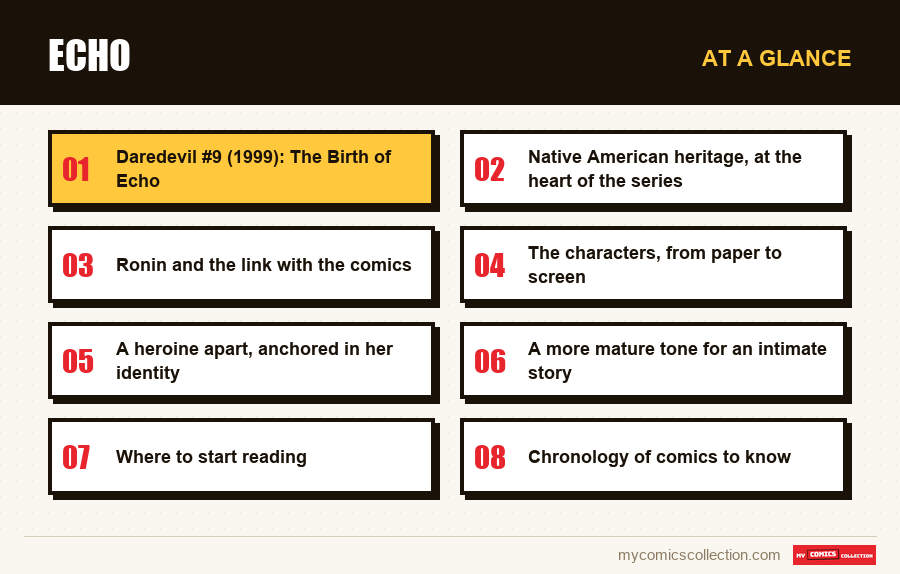
Daredevil #9 (1999): The Birth of Echo
Maya Lopez, aka Echo, was born in Daredevil #9 (1999), created by David Mack and Joe Quesada, within the “Parts of a Hole” arc. A deaf vigilante, she has a remarkable gift: a photographic memory of movement which allows her to instantly reproduce any gesture, any style of combat or even music that she observes. The daughter of a criminal killed when she was a child, she is raised by the Kingpin, who makes her believe that Daredevil is responsible for her father's death: a manipulation that she will eventually unravel. The series faithfully takes up these founding elements: the gift of imitation, deafness, the complex and painful bond with the Kingpin, and the discovery of the truth. Alaqua Cox, a deaf and Native American actress, plays Maya with acclaimed authenticity.
This character, who appeared in the Daredevil comics, was first introduced on screen in Hawkeye, where his link to the Caïd was already established. The spin-off series delves deeper into her story, returning her to her roots and exploring her quest for truth and redemption, faithful to the psychological richness of the character in the comics.
Native American heritage, at the heart of the series
The series places Maya's Native American heritage front and center. In the comics, this background already informs the character, but the series deepens it considerably by making Maya a Choctaw and bringing her back to her community in Oklahoma. This return to the sources structures the entire story: Maya reconnects with her family, her culture and her ancestors. The series adds a mystical dimension by linking his abilities to an ancestral power transmitted through his lineage, an element specific to the adaptation. This exploration of Native American identity, rare in the superhero genre, gives the series a particular cultural depth and a lauded authenticity, carried by a production concerned with faithfully representing Choctaw culture. Echo thus becomes much more than a story of revenge: a story of reconnecting with one's roots.
Ronin and the link with the comics
An important element of Maya in the comics is her time under the identity of Ronin. In New Avengers #11 (2005), on Daredevil's recommendation, she joined the New Avengers under that name, wearing a masked warrior costume-an identity that Clint Barton would later take up. The series does not develop this aspect, but it illuminates the richness of the character and its integration with the rest of the Marvel universe. Maya's link with Daredevil, central in the comics, is only indirectly mentioned here, the series preferring to focus on her relationship with the Kingpin and his heritage. This choice illustrates the desire to make Echo an autonomous story, anchored in its own mythology rather than that of Daredevil.
The characters, from paper to screen
- Maya Lopez / Echo: Faithful to Daredevil #9: deaf vigilante with the gift of imitation, in search of truth.
- The Caid: Substitute and manipulative father figure, faithful to the comics.
- Daredevil: Echoed, unlike its central role in the comics.
- Maya's family: Its Choctaw community, largely developed for the series.
- Maya's ancestors: Source of mystical powers, an addition to the series.
Collecting this series?
Track what you own, what you are missing and what your collection is worth. 7 day trial.
Start my trial →A heroine apart, anchored in her identity
Echo stands out for its anchoring in the identity of its heroine: deaf, Native American, marked by a painful past. The series fully embraces this singularity, making Maya one of the most atypical heroines in the saga. His disability is not erased but integrated, with particular attention paid to sign language and the experience of deafness. Its cultural heritage is not a simple setting but the heart of its story. This authentic representation, rare in the genre, continues a trend in modern comics to diversify their heroes and explore experiences that were previously little shown. Echo is not defined by her powers, but by her journey of reconstruction and reconciliation with her origins.
This dimension makes the series much more than an action story: a story of healing, memory and belonging. By giving its own series to such a unique character, the saga confirms its desire to broaden the palette of its heroes, in the wake of the comics which, since 1999, have made Maya Lopez a figure of rare richness. For the reader, discovering “Parts of a Hole” by David Mack is to measure the depth of a character who has remained in the shadows for too long.
A more mature tone for an intimate story
Echo stands out for its tone, darker and more mature than most series in the saga. Far from cosmic issues and omnipresent humor, it tells an intimate story of revenge, mourning and reconstruction, anchored in reality. This approach, which is aimed at an informed audience, brings the series closer to Marvel's great street-level stories, those of Daredevil in particular, from which Echo comes. Violence is present, but in the service of a statement on the cycle of hatred and the possibility of getting out of it. Maya, manipulated by the Kingpin and haunted by the death of her father, must choose between perpetuating the violence of her mentor or reconnecting with her roots and her community. This moral dilemma, faithful to the richness of the character in the comics, gives the series a rare gravity.
This bias illustrates the diversity of tone that series allow: where films aim for a family spectacle, a series like Echo can allow itself a harsher, more personal story, centered on a single heroine and her inner journey. By assuming this maturity, the series offers a welcome variation and proves that the Marvel universe can accommodate stories that are very different from each other. For the reader, this tone refers directly to the work of David Mack on Daredevil, whose pictorial aesthetic and introspective subject had already made Echo a character apart. The series honors this legacy by refusing to take the easy route, in favor of a challenging and heartfelt story about identity and healing.
Where to start reading
Priority reading is the “Parts of a Hole” arc by David Mack (Daredevil, from #9, 1999), direct source of the character, with remarkable aesthetics. We can then discover “Echo: Vision Quest”, which deepens his quest for identity, then his passage as Ronin in Bendis’ “New Avengers” (2005). Daredevil's great stories, particularly those featuring the Kingpin, illuminate his universe. From 1999 to 2005, this journey covers the sources of a series faithful to the singularity of its heroine.
Chronology of comics to know
- 1999: Daredevil #9: first appearance of Echo (Maya Lopez), in “Parts of a Hole”.
- Early 2000s: “Echo: Vision Quest” by David Mack.
- 2005: New Avengers #11: Maya becomes Ronin.
Collection side: what numbers to aim for after the series
Echo highlights a modern key. Daredevil #9 (1999, first appearance of Echo) is a number whose popularity rose with the introduction of the character on screen, in Hawkeye then in his own series. This is a sought-after first appearance, still accessible for a first thematic purchase. The collections of “Parts of a Hole” by David Mack offer the best entry point into reading, as close as possible to the series. As always, condition and gradation determine value; relying on real recent sales is strongly recommended. Daredevil #9 is an interesting target for a collector banking on the emerging and diverse characters of the saga.
Its place in the saga and for the collector
Echo continues the street-level side of the saga, initiated by Hawkeye, and confirms the desire to broaden the palette of heroes to more diverse figures. For the collector, the series revived interest in Daredevil #9, the first appearance of an emerging character. It illustrates the effect of series on the market, particularly for more confidential creations. Beyond speculation, the series invites you to discover the work of David Mack, whose pictorial and poetic aesthetic has marked the Daredevil comics, and to explore a character of great richness. By putting a deaf and Native American heroine at the forefront, the series remains faithful to the inclusive ambition of modern comics, while offering a personal and intimate story, far from the cosmic issues of the saga.
The Verdict: A Personal and Rooted Account
- Loyalty: Maya Lopez, her gift of imitation, her deafness and her connection to the Kingpin come from the comics.
- Freedoms: the deep Choctaw heritage, the mystical ancestral powers, a self-contained narrative detached from Daredevil.
- Collectible numbers: Daredevil #9 (Echo's first appearance), the "Parts of a Hole" arc.
Echo offers Maya Lopez a personal and rooted story, faithful to her uniqueness as a deaf and Native American vigilante. By delving deeper into his Choctaw heritage and his connection to the Kingpin, the series remains faithful to the spirit of the character from the comics while creating its own mythology. For the reader as for the collector, it is an invitation to discover the work of David Mack and a heroine of rare richness. By putting a deaf and Native American vigilante at the forefront, the series broadens the range of heroes in the saga and proves that the most unique characters are often those who carry the deepest and most sincere stories.
Frequently asked questions
Maya Lopez/Echo appears in Daredevil #9 (1999), created by David Mack and Joe Quesada, in the "Parts of a Hole" arc. She is a deaf vigilante capable of reproducing any movement she observes.
A photographic memory of movement: she can instantly reproduce any gesture, fighting style, or even piece of music she observes. This gift is faithfully taken from Daredevil #9 (1999).
Maya's Native American background is present in the comics, but the series deepens it considerably by making her a Choctaw and bringing her back to her community, with ancestral powers specific to the adaptation.
Yes: in New Avengers #11 (2005), she joined the team under the identity of Ronin, a masked warrior costume that Clint Barton later took over. The series does not develop this aspect.
Daredevil #9 (1999, Echo's first appearance) is the main target, a modern debut whose popularity has soared with the character's on-screen popularity.
Does the series make you want to collect? Estimate the value for free of your issues (Daredevil #9…) with our tool based on current eBay listings.